


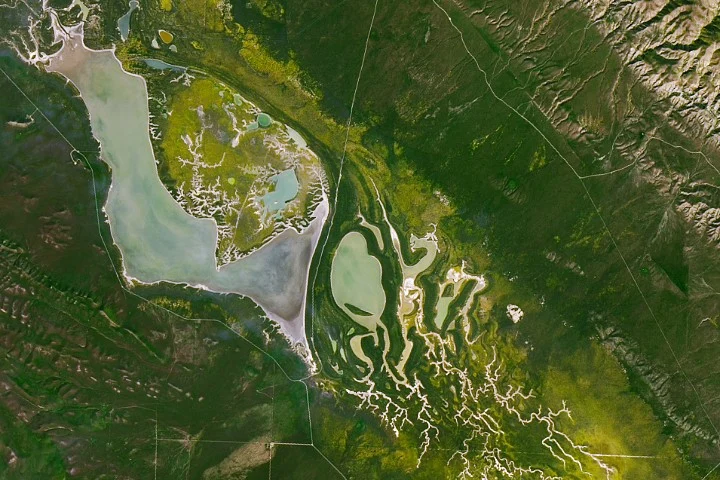
The plains surrounding the iconic San Andreas Fault and stretching across the vast expanse of the Carrizo Plain National Monument have transformed into a vivid tapestry of yellow, signaling a spectacular wildflower bloom in spring 2026. This extraordinary botanical display, while subject to individual interpretation regarding its "superbloom" status, has undeniably painted California’s Carrizo Plain and its adjacent mountain ranges with an unparalleled spectrum of natural hues, captivating observers both on the ground and from orbit.
The Phenomenon of the 2026 Bloom: A Landscape Transformed
The 2026 wildflower season in the Carrizo Plain has been nothing short of remarkable, turning the typically arid landscape into a vibrant mosaic of color. While the term "superbloom" often sparks debate among botanists and enthusiasts, referring to an exceptionally prolific and widespread germination of dormant wildflower seeds, the visual evidence across the Carrizo Plain leaves little doubt about the extraordinary scale of this year’s event. Experts at institutions like the Theodore Payne Foundation define a superbloom as an event where an unusually high percentage of wildflower seeds germinate and bloom simultaneously, blanketing vast areas. The conditions witnessed in early 2026 certainly met, if not exceeded, these criteria.
Early indications of this floral spectacle began to emerge in February 2026, with Landsat satellites providing the first glimpses of nascent color spreading across the landscape. By the onset of March, the areas encircling Soda Lake, a prominent alkaline lake within the monument that frequently dries out during drought periods, had erupted in a brilliant shade of yellow. The bloom’s progression was rapid and extensive; by mid-March, these golden swathes had expanded significantly, visible even amidst the intricate dendritic network of streams that flank the ephemeral lake. The intensity of color was particularly pronounced throughout the Carrizo Plain National Monument, with even the meadows tracing the zipper-shaped San Andreas Fault adorned with splashes of purple, primarily attributed to the abundant blooms of Phacelia ciliata, also known as Great Valley Phacelia. This particular species, with its delicate purple flowers, added a rich counterpoint to the dominant yellow, illustrating the biodiversity spurred by the favorable conditions.
Ecological Foundations: The Science Behind the Spectacle
The genesis of such a magnificent bloom lies in a precise confluence of environmental factors, primarily favorable rainfall patterns and subsequent temperature regimes. The winter of 2025-2026 proved to be exceptionally conducive, characterized by successive bouts of soaking rains interspersed with variable conditions that ideally benefited wildflower germination and growth. Rainfall totals in November and December 2025 were recorded at nearly twice their usual levels, according to a comprehensive report issued by the California Department of Water Resources. This initial saturation of soils was critical. Further data from NASA, cited within the same report, confirmed that soil moisture levels remained consistently well above average throughout February 2026, providing a sustained moisture supply for the developing plants.
The timing of these early rains was paramount in "kick-starting" the wildflowers. As explained by the National Park Service, many wildflower seeds possess a protective coating that requires a minimum of a half-inch of rainfall to be washed away, thereby triggering germination. The substantial precipitation received in late 2025 fulfilled this crucial requirement, allowing a vast reservoir of dormant seeds to awaken. Crucially, the periods of warmth and dryness that followed these initial soaking rains were equally beneficial. Once germinated and established, wildflowers thrive on intermittent rainfall rather than continuous saturation, which can lead to fungal issues or waterlogging. This alternating pattern of wet and dry spells allowed the young plants to develop strong root systems and then flourish without being overwhelmed.
An additional factor contributing to the vibrancy in certain areas, particularly within the Caliente Range, was the reduced presence of grass thatch. This thatch, a layer of dead plant material that can inhibit wildflower growth by blocking sunlight and absorbing moisture, had been significantly diminished by the Madre fire in July 2025. The fire, while a destructive force, inadvertently created cleared ground that allowed native wildflowers to flourish with less competition, showcasing nature’s complex cycles of destruction and renewal.
Satellite Surveillance: NASA’s Role in Monitoring Nature’s Masterpiece
The vast scale of the Carrizo Plain’s bloom makes it an ideal subject for remote sensing, and NASA scientists have been leveraging advanced satellite technology to monitor and study this natural phenomenon. Landsat satellites, specifically Landsat 8 and 9, are instrumental in providing continuous, high-resolution imagery that allows researchers to track the progression of the bloom from its earliest signs to its peak. These satellites capture detailed spectral data, enabling scientists to differentiate between various plant types and assess their health and density across broad geographical areas. The "natural color for visualization" data from Landsat Explorer provided compelling visual evidence of the bloom’s expansion, showing how areas around Soda Lake, initially barren, transformed into a bright yellow expanse.
This monitoring effort is part of a broader initiative by NASA to utilize Earth observation data for understanding complex ecological processes. Teams of NASA scientists are actively employing remote sensing techniques to study wildflower blooms and flowering plants globally. The ultimate goal is to develop sophisticated methods for tracking these blooms over expansive regions and to create practical tools that can assist diverse stakeholders, including farmers, beekeepers, and resource managers. The implications are far-reaching, as flowering plants are critical for the production of numerous vital crops and commodities, such as fruits, nuts, honey, and cotton, making their health and distribution a matter of significant economic and ecological importance.
Insights from the Ground: Botanists and Scientists Weigh In
While satellite imagery provides a macro perspective, the detailed observations of botanists and scientists on the ground offer invaluable insights into the specifics of the bloom. The Wild Flower Hotline, a public resource for tracking California’s floral displays, reported that the west-facing slopes of the Temblor Range were among the first areas to come alive in March. Here, hillside daisies (Monolopia lanceolata) dominated, accompanied by California goldfields (Lasthenia californica) and forked fiddlenecks (Amsinckia furcata), creating a stunning multi-species display.
Further reports from experts indicated that the expansive blankets of yellow near Soda Lake were predominantly formed by common goldfield (Lasthenia gracilis), also known as needle goldfield. These individual plants, though small, possess a remarkable capacity to grow in incredibly dense aggregations, often just centimeters apart in disturbed areas, and bloom synchronously. This synchronized flowering creates the illusion of a continuous, vibrant yellow carpet stretching across the landscape.
Bryce King, the lead field botanist for the California Native Plant Society, shared his profound observations in an article for Flora magazine. During a March visit, King described the Lasthenia blooms as forming "seemingly unending stretches of color" across the valley bottom. He highlighted Lasthenia as a "staple" of vernal pools and seasonally wet areas, yet confessed that the sheer synchronicity and scale of the blooms across both the valley floor and surrounding hills during his visit surpassed all his expectations. His account underscores the exceptional nature of the 2026 event.
NASA scientists conducting fieldwork also provided critical first-hand accounts. Yoseline Angel, a scientist at NASA’s Goddard Space Flight Center, unequivocally stated, "I would certainly consider this a superbloom. It’s hard to describe how stunning these wildflowers were from the ground." Angel, alongside her Goddard colleague Andres Baresch, was on site in the Carrizo Plain National Monument on March 13, taking spectral measurements of the blooming wildflowers. Their field work was precisely timed to coincide with a Landsat satellite pass, allowing for direct correlation between ground-based observations and satellite data. This coordinated effort is fundamental to their project of developing a global flower monitoring system. This ambitious system aims to integrate ground observations with data from space-based sensors, including OLI (Operational Land Imager) on Landsat 8 and 9, and EMIT (Earth Surface Mineral Dust Source Investigation) aboard the International Space Station, to track the dynamic progression of blooms worldwide.
Angel emphasized the strategic importance of this year’s bloom for their research: "This was the perfect opportunity to test how well our models scale between the ground and satellites." She added, "We were fortunate to have a huge number of seeds germinate and bloom simultaneously because last year was so dry and this winter was so wet," highlighting the rare combination of conditions that made the 2026 bloom a scientific boon.
Broader Impact and Implications: Beyond the Beauty
The 2026 superbloom in the Carrizo Plain carries significant implications extending beyond its immediate visual splendor. Ecologically, such massive floral displays provide a critical boost to local ecosystems. They support a wide array of pollinators, including native bees, butterflies, and other insects, which are vital for the health and reproduction of both wild and cultivated plant species. The profusion of flowers ensures a rich food source, bolstering pollinator populations and contributing to the overall biodiversity of the region. Furthermore, the extensive root systems of the wildflowers help stabilize soils, reduce erosion, and enrich the soil with organic matter as the plants eventually decay.
Scientifically, the Carrizo Plain bloom serves as an invaluable natural laboratory for NASA and other research institutions. The opportunity to validate remote sensing models with ground-truth data during such a pronounced event accelerates the development of advanced monitoring systems. These systems will be crucial for understanding the impacts of climate change on plant phenology – the timing of biological events such as flowering – and for predicting future blooms, droughts, or other environmental shifts. The data collected can inform climate models and help scientists better understand the resilience and vulnerability of arid ecosystems.
For land managers, particularly the Bureau of Land Management (BLM) which oversees the Carrizo Plain National Monument, such events present both opportunities and challenges. The bloom attracts considerable public interest, leading to increased visitation. This necessitates careful management of visitor access to protect fragile ecosystems while allowing the public to experience the natural wonder. The scientific data gathered from these blooms can also inform long-term conservation strategies, habitat restoration efforts, and fire management plans, especially considering the role the Madre fire played in this year’s display.
The 2026 Carrizo Plain superbloom stands as a powerful testament to the intricate balance of natural forces and the hidden resilience of ecosystems. It underscores the critical role of specific climatic conditions in shaping landscape ecology and highlights the indispensable contribution of advanced scientific monitoring in deciphering Earth’s complex natural phenomena. As the vibrant yellow and purple hues gradually fade, the scientific data and ecological insights gathered will continue to enrich our understanding of California’s unique botanical heritage and the broader dynamics of our planet.