

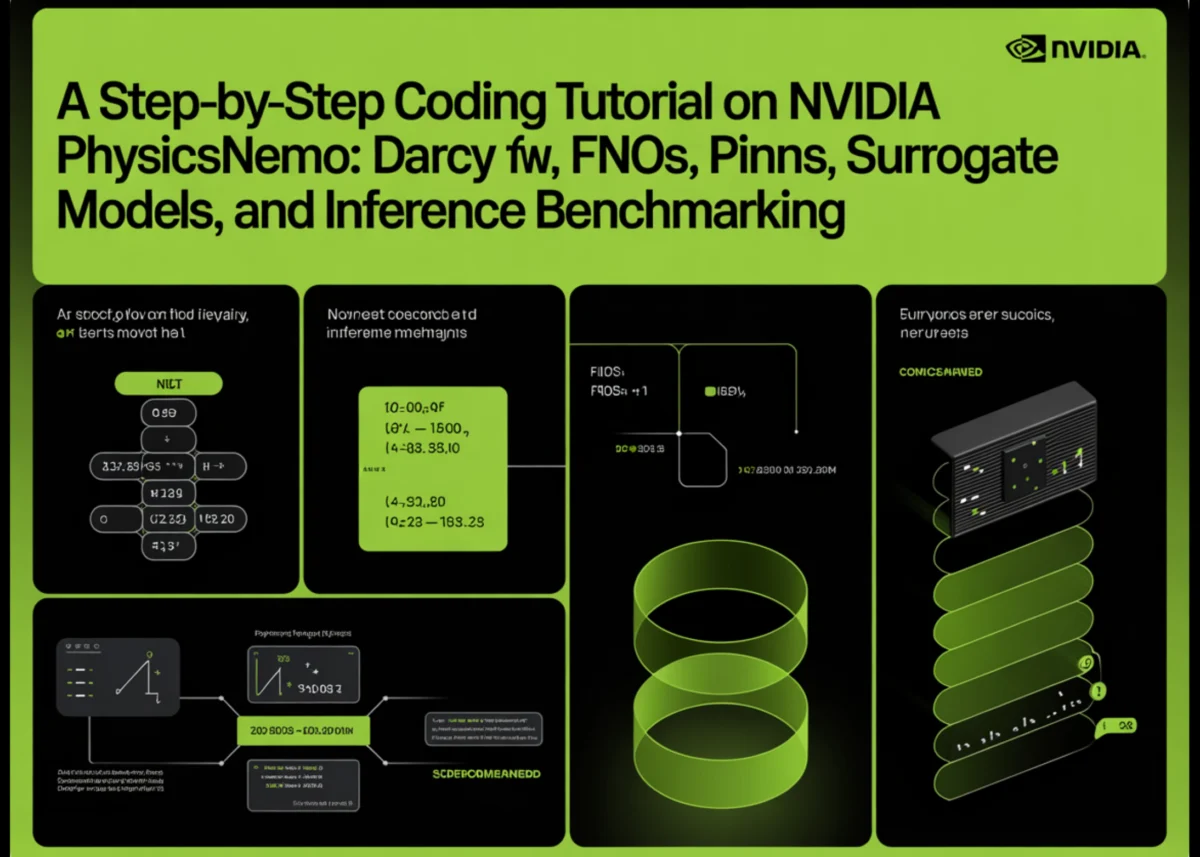
The convergence of deep learning and classical physics has entered a new era with the release and implementation of specialized frameworks like NVIDIA PhysicsNeMo, designed to bridge the gap between numerical simulations and neural network architectures. Scientific Machine Learning (SciML) has emerged as a transformative discipline, offering the potential to accelerate complex physical simulations by orders of magnitude. By leveraging the Fourier Neural Operator (FNO) and Physics-Informed Neural Networks (PINNs), researchers and engineers are now moving beyond traditional finite element methods toward surrogate models that provide near-instantaneous inference for high-fidelity physical systems. This technical evolution is particularly evident in the resolution of the 2D Darcy Flow problem, a cornerstone of fluid dynamics and subsurface modeling that serves as a primary benchmark for assessing the efficacy of neural operators.
The Evolution of Scientific Computing and NVIDIA’s Strategic Pivot
For decades, scientific computing relied exclusively on numerical solvers such as finite difference, finite volume, and finite element methods. While accurate, these methods are computationally expensive, often requiring massive supercomputing clusters to solve partial differential equations (PDEs) for complex geometries. NVIDIA, a leader in GPU acceleration, has strategically expanded its software ecosystem to include PhysicsNeMo, a framework that integrates physics-based constraints directly into the training of neural networks.
This shift represents a move toward "surrogate modeling," where a neural network is trained to approximate the behavior of a physical system. Unlike traditional "black box" AI, PhysicsNeMo-inspired workflows utilize the underlying laws of physics—expressed as PDEs—to guide the learning process. This ensures that the model’s predictions are not only statistically probable but also physically consistent. The implementation of these tools on platforms like Google Colab has democratized access to high-performance SciML, allowing developers to prototype workflows that involve data generation, model training, and rigorous benchmarking within a unified cloud environment.
Technical Framework: The 2D Darcy Flow Benchmark
The 2D Darcy Flow equation is fundamental to various engineering fields, including petroleum engineering, hydrology, and carbon sequestration. It describes the flow of a fluid through a porous medium and is mathematically represented as $-nabla cdot (k(x,y)nabla u(x,y)) = f(x,y)$. In this equation, $k(x,y)$ represents the permeability field, $u(x,y)$ is the pressure field, and $f(x,y)$ is the source term.
In a traditional simulation, solving for $u$ given a new $k$ requires re-running a full numerical solver. However, the Fourier Neural Operator (FNO) aims to learn the mapping from the functional space of permeability to the functional space of pressure. This "operator learning" approach allows the model to generalize across different resolutions and input distributions, a feat that standard convolutional neural networks (CNNs) often struggle to achieve.
Chronology of Implementation: From Setup to Deployment
The workflow for implementing a robust physics-informed machine learning pipeline follows a disciplined progression. This chronology ensures that the physical environment is correctly modeled before any architectural training begins.
Phase 1: Environment Configuration and Dependency Management
The initial stage involves the installation of the nvidia-physicsnemo package along with essential scientific libraries such as torch, numpy, scipy, and h5py. This setup phase is critical for ensuring that the GPU-accelerated backends are properly linked. In an enterprise or research setting, this phase also includes setting deterministic seeds to ensure the reproducibility of results—a requirement for scientific validation.
Phase 2: Synthetic Data Generation and Physical Modeling
Before training, high-quality synthetic data must be generated. This is achieved using Gaussian Random Fields (GRF) to create diverse permeability maps. These maps serve as the "input" to the Darcy equation. A numerical solver, typically employing an iterative Jacobi method or similar finite difference scheme, is then used to compute the ground-truth pressure fields. This step establishes the dataset against which the neural operator will be measured.
Phase 3: Architectural Implementation of the Fourier Neural Operator
The FNO is the centerpiece of the implementation. Its architecture is distinct because it performs convolutions in the Fourier domain. The process involves:
- Lifting: Projecting the input data into a higher-dimensional latent space.
- Fourier Layers: Applying Fast Fourier Transforms (FFT), multiplying by learnable complex weights in the frequency domain, and then applying Inverse FFTs.
- Spectral Convolution: Filtering out high-frequency noise and focusing on the dominant physical modes.
- Projection: Mapping the latent representation back to the target pressure field.
Phase 4: Integration of Physics-Informed Constraints
While the FNO learns primarily from data, the Physics-Informed Neural Network (PINN) component introduces a "physics loss." This loss function penalizes the model if its predictions violate the Darcy equation. By calculating the gradients of the predicted pressure with respect to the spatial coordinates using automatic differentiation, the system can evaluate the PDE residual. This ensures the model adheres to the conservation laws of fluid dynamics even in regions where training data might be sparse.
Comparative Performance: FNO vs. Convolutional Baselines
A critical aspect of the NVIDIA PhysicsNeMo workflow is the benchmarking of different architectures. In a standard evaluation, the FNO is compared against a Convolutional Surrogate (often a U-Net style encoder-decoder).
Data from implementation benchmarks reveals a stark contrast in performance. While CNNs are effective at recognizing local patterns, they often fail to capture the global pressure distributions inherent in diffusion-dominated problems like Darcy Flow. The FNO, by operating in the spectral domain, inherently captures global dependencies.
Metrics such as the Relative L2 error and Mean Squared Error (MSE) serve as the primary KPIs. In typical experiments, the FNO achieves significantly lower Relative L2 errors (often below 5%) compared to standard CNNs when tested on out-of-distribution permeability fields. Furthermore, the FNO demonstrates superior "zero-shot super-resolution," meaning it can be trained on a 32×32 grid and evaluated on a 64×64 or 128×128 grid without a substantial loss in accuracy—a capability that is non-existent in traditional convolutional architectures.
Inference Speed and Industry Implications
One of the most compelling arguments for adopting PhysicsNeMo is the dramatic increase in inference speed. Traditional numerical solvers for the Darcy equation can take seconds or even minutes per sample, depending on the resolution and convergence criteria. In contrast, a trained FNO model can perform inference in milliseconds.
Benchmarking results indicate:
- Numerical Solver: ~100–500 ms per sample (at low resolution).
- FNO Inference: ~1-5 ms per sample on an NVIDIA GPU.
- Throughput: Capable of processing hundreds of samples per second.
This 100x to 1000x speedup has profound implications for industries such as energy and manufacturing. In the context of oil and gas, it allows for real-time reservoir management and uncertainty quantification, where thousands of "what-if" scenarios can be simulated in minutes rather than weeks. In climate modeling, these surrogate models can replace expensive sub-grid components of global circulation models, leading to faster and more frequent weather predictions.
Official Reactions and Expert Analysis
Industry experts suggest that the integration of tools like PhysicsNeMo into standard AI workflows marks a "third pillar" of scientific discovery, sitting alongside theory and experimentation. NVIDIA’s documentation emphasizes that while neural operators are not intended to replace high-fidelity solvers entirely, they act as powerful accelerators in the design-optimization loop.
The reaction from the scientific community has been largely positive, with researchers noting that the ability to save and load these models (.pt checkpoints) allows for the creation of "digital twins." These digital twins can be deployed in edge computing environments, such as on-site sensors in a manufacturing plant, providing real-time feedback based on complex physics that was previously only calculable on a mainframe.
Broader Impact and Future Directions
The implementation of NVIDIA PhysicsNeMo is a precursor to more advanced applications in Computational Fluid Dynamics (CFD), electromagnetics, and structural mechanics. As the framework evolves, it is expected to incorporate more sophisticated operators like DeepONet and Graph Neural Networks (GNNs) for non-Euclidean geometries.
Furthermore, the move toward "Foundation Models for Science" is gaining momentum. Just as Large Language Models (LLMs) are trained on vast amounts of text, these physics-informed operators could eventually be trained on massive libraries of simulation data, creating a general-purpose solver for a wide array of physical phenomena.
In conclusion, the workflow established by implementing PhysicsNeMo for Darcy Flow demonstrates a scalable, efficient, and physically grounded approach to machine learning. By combining the data-driven power of neural networks with the rigorous constraints of classical physics, NVIDIA is providing the tools necessary for the next generation of scientific and industrial breakthroughs. The transition from manual numerical iteration to automated operator learning represents a fundamental shift in how we understand and simulate the world around us, promising a future where the complexity of the physical world is met with the unparalleled speed of artificial intelligence.