

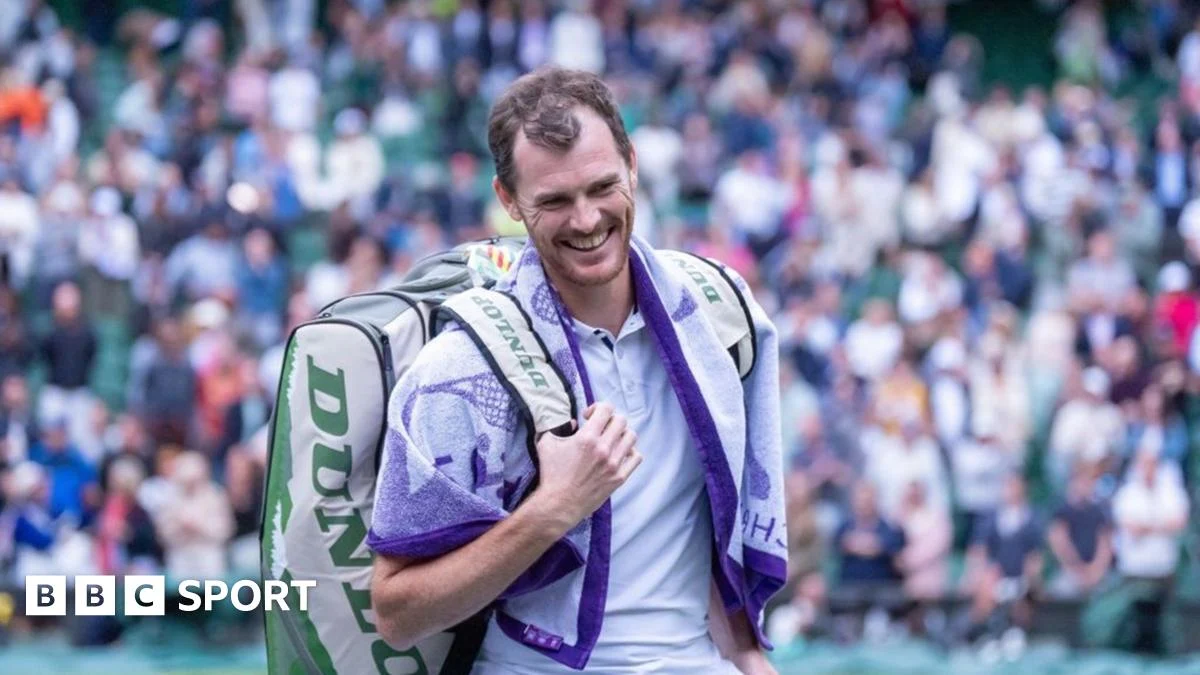
Jamie Murray, a pioneering figure in British tennis who shattered glass ceilings to become the first British doubles player to reach world number one, has officially announced his retirement from the professional circuit. The announcement, made on Instagram, brings a remarkable 36-year journey in tennis to a close for the 40-year-old Scot, who last competed at the US Open in August. Murray’s decision marks the end of an era, not only for his individual achievements but also for his significant contributions to British tennis history, particularly through his partnership with his younger brother, Andy.
A Legacy Forged on the Doubles Court
Murray’s career is a testament to dedication, skill, and a relentless pursuit of excellence in a discipline often overshadowed by singles. Over his extensive career, he amassed an impressive 34 doubles titles and seven Grand Slam titles, cementing his status as one of Britain’s most successful doubles exponents in the Open Era. His journey to the pinnacle of the sport was characterized by tenacious play, strategic acumen, and a distinctive flair at the net, often leaving opponents scrambling with his sharp volleys and audacious angles.
"My tennis journey comes to an end after 36 years," Murray posted on his official Instagram account, reflecting on his time in the sport. "I feel very fortunate and privileged for all the amazing experiences this great sport has given me." He extended heartfelt gratitude to his family, including his mother Judy, father Willie, brother Andy, and other significant figures like Ale, Alan, Louis, and Thomas, acknowledging their "incredible support, efforts and sacrifices" that enabled him to reach his full potential.
A Partnership with Andy: Davis Cup Glory and Shared Triumphs
One of the most significant chapters in Jamie Murray’s career was his dynamic partnership with his younger brother, Andy. The siblings combined for two of Jamie’s 34 doubles titles, but their most iconic achievement together came in 2015 when they were instrumental in Great Britain’s historic Davis Cup victory, their first in 79 years. Their formidable collaboration was on full display during the crucial ties, including a stellar performance against France at Queen’s Club, a grueling five-set semi-final marathon against Australia, and ultimately, their decisive win over the Belgian pair in the final held in Ghent.
Reflecting on his professional life, Murray told BBC Sport, "I played for 20 years at the top level and feel privileged for what I was able to do and experience on the court – I don’t have any regrets. I had a lot of amazing opportunities and now it’s on to something new."
The brothers, while often finding it too stressful to watch each other in major finals, shared moments of profound support. A notable instance occurred at the 2016 Australian Open, where Andy, just hours before his own singles final against Novak Djokovic, appeared in Jamie’s player box to capture a photograph of his brother receiving his first Grand Slam men’s doubles title alongside Brazilian partner Bruno Soares. Jamie, accepting the trophy at 1 am, playfully enquired, "Shouldn’t you be in bed?" This marked the beginning of a dominant period for the pair, who went on to win the US Open title that same summer, concluding the year as the world’s number one doubles team, mirroring Andy’s singles achievement.
A Career Defined by Skill and Advocacy
Beyond his numerous victories, Jamie Murray will be remembered for his exceptional doubles prowess. His left-handed style was a significant asset, characterized by razor-sharp volleys executed with astonishing precision and unexpected angles. His service returns were often unorthodox, frequently employing a lobbed return to disrupt opponents’ rhythm.
Furthermore, Murray was a staunch advocate for doubles players, consistently campaigning for greater recognition and respect for their contributions to the sport. He argued passionately that doubles played a vital role in the entertainment value of tournaments, especially as events expanded in length. "Doubles has its place in the game – it’s not the golden ticket that singles is, but it’s undervalued by the tour," Murray stated in an interview with BBC Sport. "As these events go longer and longer they need content, and doubles supports that."
Roots in Dunblane and a Fostering of Talent
Hailing from Dunblane, Scotland, Murray expressed immense pride in representing his hometown and country on the global stage. He acknowledged the challenging environment for tennis development in Scotland during their formative years, noting, "There is no history of tennis and no environment of tennis [in Scotland]. I’d imagine the odds were against us from the start but we were able to make some good things happen."
His mother, Judy Murray, a prominent figure in British tennis herself, once commented on Jamie’s superior hand-eye coordination as a youngster. The brothers’ competitive spirit was evident from an early age, extending beyond the tennis court to spirited wrestling matches. Judy recalled their childhood bouts, inspired by wrestling stars like The Rock and Stone Cold Steve Austin, where they would create their own rules and championships on their beds.
Jamie, being 15 months older than Andy, initially held a slight edge in their early tennis rivalries. However, Andy’s ascent meant Jamie often bore the brunt of his younger brother’s competitive drive. Andy recounted an incident from their junior years where, after defeating Jamie in an under-12s final, he playfully teased his brother, resulting in Jamie punching his hand, causing a significant injury that left a lasting scar.
While Jamie showed promise for a singles career, a difficult experience at an LTA training school in Cambridge during his early teens proved to be a turning point. The challenges of living away from home and the intensity of the elite training environment reportedly impacted his game, particularly his forehand, and he never quite recaptured the same level of singles potential thereafter. This experience, though not blamed on the LTA, steered him firmly towards the doubles discipline.
Navigating the Shadow of a Superstar Sibling
Throughout his career, Jamie Murray achieved remarkable success while often being in the considerable shadow of his younger brother, Andy, who became a global singles superstar. Despite this dynamic, Jamie never displayed overt jealousy, and their mutual affection remained evident. He candidly acknowledged this dynamic, stating, "I’ve lived in his shadow for the whole career, which didn’t bother me – I had a good career and he was having a great career."
He further elaborated on their differing paths: "He was competing with the other members of the ‘Big Four’ and he brought so much interest to the sport with what he was trying to do. I was there doing my stuff as well, just not with the same amount of eyeballs on it." The brothers’ journeys, though distinct, both culminated in reaching the pinnacle of their respective disciplines, a rare feat in professional sports.
While their on-court tennis rivalry has long since subsided, a new, friendly competition appears to be emerging on the golf course, a testament to their enduring bond and shared pursuit of sporting excellence.
A Wealth of Data and Achievements
Jamie Murray’s professional career spanned 1,019 ATP Tour-level matches, yielding an impressive 589 victories. He retires as the British player with the most Grand Slam and tour doubles titles in the Open Era. His partnership with Bruno Soares, in particular, yielded significant success, including multiple Grand Slam titles and reaching the world number one ranking together.
His mixed doubles record is also noteworthy, with five titles, including two Wimbledon crowns – the first with Jelena Janković in 2007 and the second with Martina Hingis a decade later. These victories highlight his versatility and enduring competitive spirit across different formats of the game.
Reactions and Tributes
The announcement of Murray’s retirement has prompted a wave of tributes from the tennis community. His brother Andy shared a heartfelt video message posted by the Lawn Tennis Association (LTA) on X, acknowledging Jamie’s immense contribution. "Jamie, I’m not sure what I loved more when we were kids, being on court with you or winding you up. But I know the way we pushed each other helped us both go as far as we did," Andy stated. He reminisced about their shared journey, from their first Olympics in Beijing to the Davis Cup triumph, emphasizing the profound significance of their shared experiences. "It meant everything to share that with you and now it’s your turn to call it a day. I know you’re ready. I just hope you know how proud we all are of you. Enjoy retirement. From your number one fan, Andy."
Leon Smith, Britain’s Davis Cup captain, lauded Murray’s impact. "Jamie’s been an unbelievable player representing Great Britain on the world stage over his career. He’s positively impacted the game of doubles in this country and globally – with his achievements and commitment to the game – and it was a great privilege to be a part of his career over the years."
Broader Implications for British Tennis
Jamie Murray’s retirement signifies the end of a golden era for British doubles tennis. His success and advocacy have undoubtedly inspired a new generation of players to consider doubles as a viable and rewarding career path. His achievements, particularly reaching world number one and securing multiple Grand Slam titles, have provided tangible proof that British players can excel at the highest level in doubles.
The LTA will undoubtedly look to leverage his legacy in their ongoing efforts to promote doubles and support aspiring players. The conversation around the valuation and support for doubles within the professional tennis ecosystem, which Murray actively championed, is likely to gain further traction following his departure. His outspokenness on these matters has helped to elevate the profile of doubles, and his retirement may serve as a catalyst for further discussions and potential improvements in how the discipline is supported and perceived.
As Jamie Murray transitions to his next chapter, he leaves behind a legacy of excellence, resilience, and a profound impact on the sport he dedicated his life to. His journey from Dunblane to the summit of the doubles world is an inspiring narrative that will continue to resonate within British tennis for years to come. The "real world" he now enters will undoubtedly be different from the courts he dominated, but the lessons learned and the triumphs achieved will undoubtedly serve him well.