


Elon Musk’s artificial intelligence venture, xAI, has officially expanded its product suite into the specialized domain of audio processing with the release of two standalone application programming interfaces: a Speech-to-Text (STT) API and a Text-to-Speech (TTS) API. This strategic move marks a significant shift for the company, transitioning from providing integrated features within the X (formerly Twitter) platform and Tesla ecosystem to offering infrastructure-level tools for third-party developers and enterprise clients. The new services are built upon the same proprietary architecture that powers Grok Voice across Musk’s various enterprises, including Tesla’s in-car voice assistants and Starlink’s automated customer support systems. By unbundling these capabilities, xAI is positioning itself as a direct competitor to established industry leaders such as ElevenLabs, Deepgram, and AssemblyAI, signaling a new phase in the battle for dominance in the global voice AI market.
The launch follows months of internal testing and iterative improvements within the Musk ecosystem. Previously, these audio models were primarily utilized to enhance the user experience for Grok subscribers on mobile devices and to streamline operational efficiency within Tesla’s software stack. By opening these tools to the public, xAI aims to capture a portion of the rapidly growing generative AI market, which is increasingly pivoting toward multimodal capabilities—systems that can process and generate not just text, but audio, images, and video with human-like nuance.
The Evolution of xAI: A Chronological Overview
The development of the Grok audio APIs is the culmination of a rapid scaling effort that began in July 2023, when Elon Musk officially announced the formation of xAI. The company was founded with the stated goal of "understanding the true nature of the universe," but its immediate commercial objective was to provide a "pro-human" alternative to existing AI models from OpenAI and Google.
In late 2023, xAI released Grok-1, a large language model (LLM) that distinguished itself through its real-time access to data from the X platform. By early 2024, the company had integrated Grok into the premium tiers of X and began testing voice-based interactions. Throughout the middle of 2024, reports surfaced that Tesla was leveraging xAI’s technology to replace legacy voice recognition systems in its vehicles, seeking to provide drivers with a more conversational and context-aware interface.
The transition to a standalone API provider was accelerated by the completion of "Colossus," xAI’s massive AI training cluster located in Memphis, Tennessee. Comprising 100,000 Nvidia H100 GPUs, Colossus provided the computational horsepower necessary to refine the STT and TTS models to a level of accuracy and latency that meets enterprise standards. The public release of these APIs in April 2026 represents the company’s first major foray into the "AI-as-a-Service" (AIaaS) model, moving beyond consumer-facing chatbots to foundational developer tools.
Technical Specifications: Speech-to-Text (STT)
The Grok Speech-to-Text API is designed to solve the complex challenge of converting spoken language into highly accurate, structured text. For developers, this technology is the backbone of modern productivity tools, ranging from automated meeting transcription and call center analytics to real-time accessibility features for the hearing impaired.
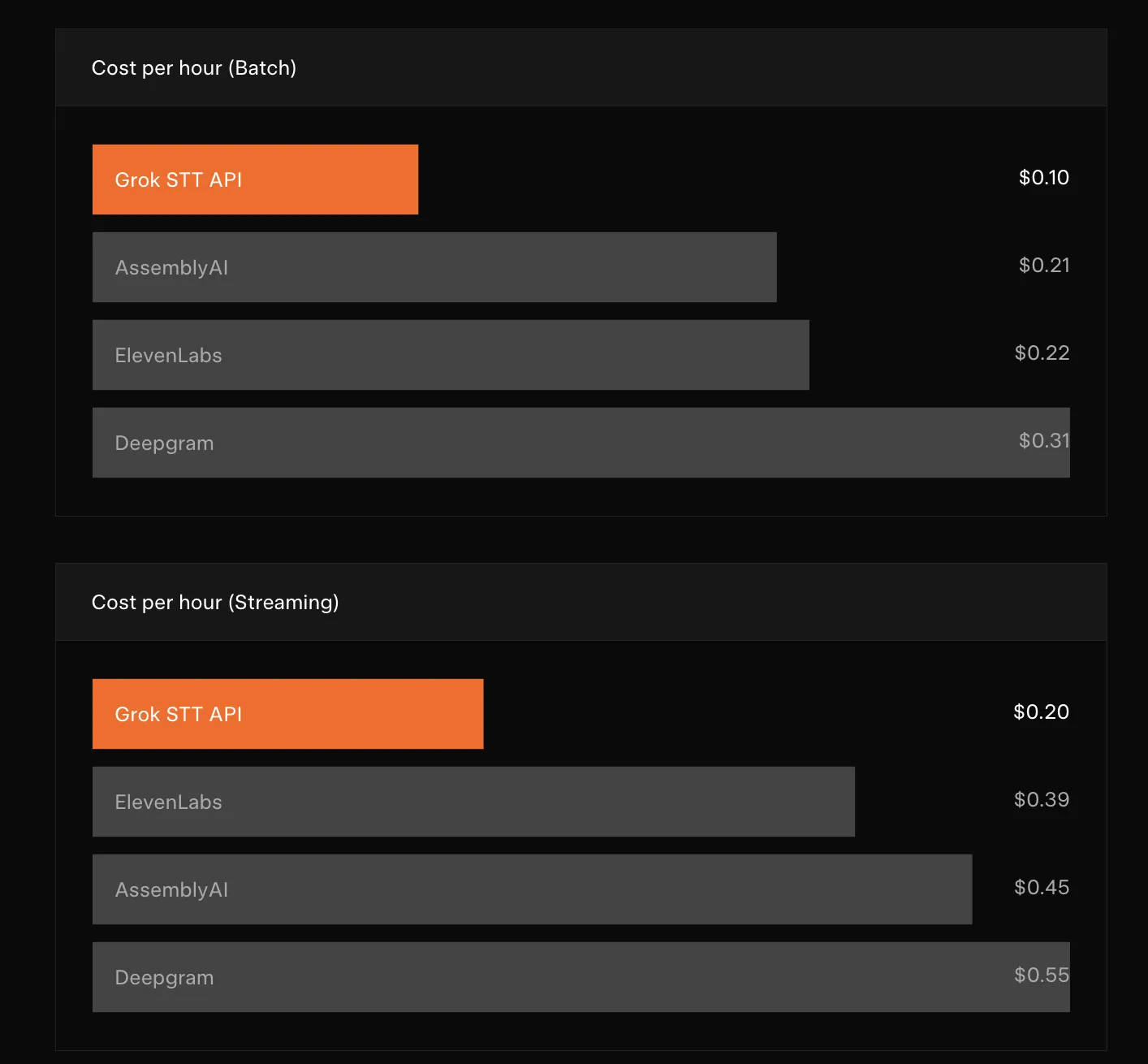
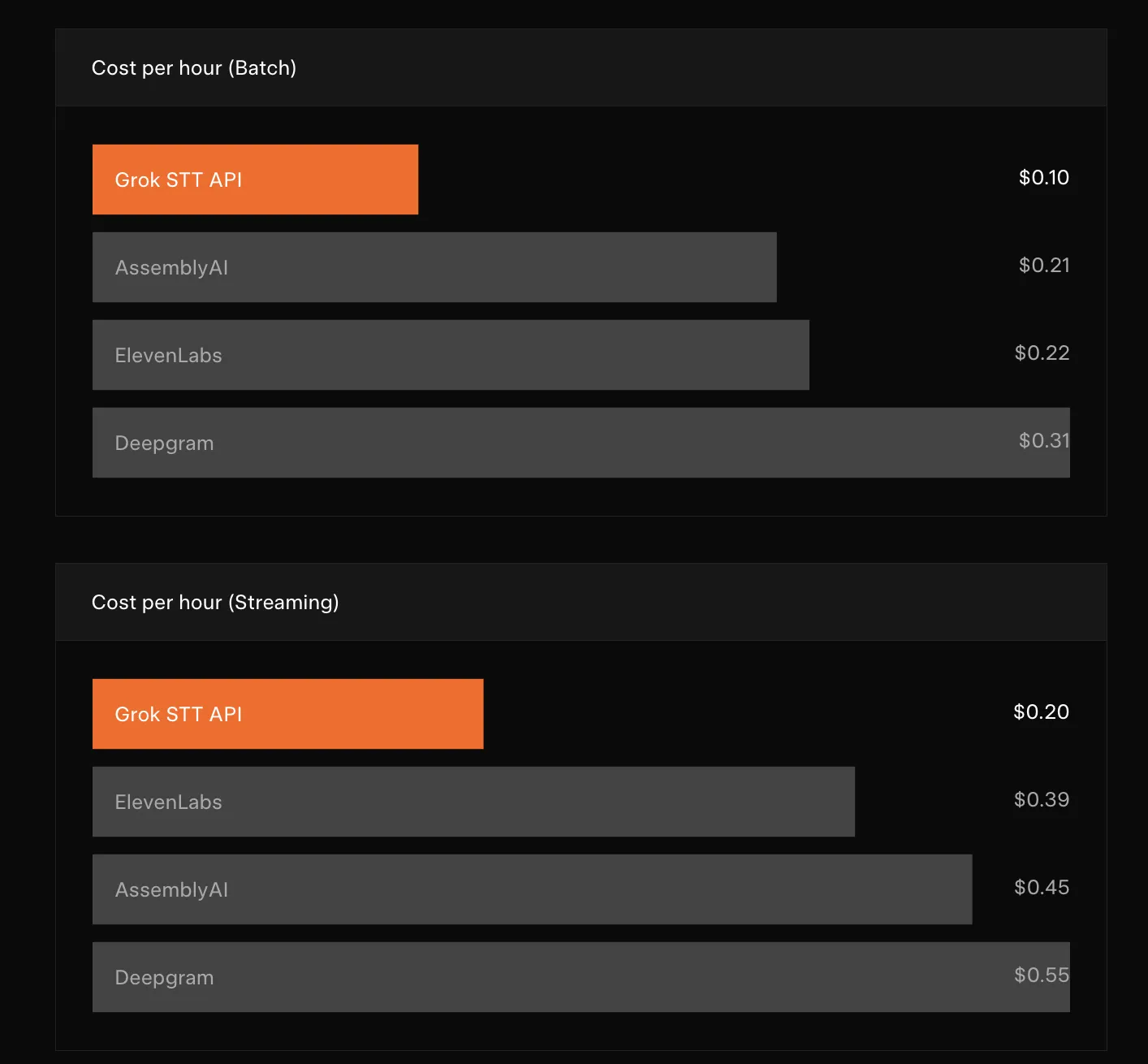
The STT API is now generally available, supporting transcription across 25 languages. xAI has introduced a two-tiered pricing model designed to undercut several competitors. Batch processing, which is intended for pre-recorded files such as podcasts or legal depositions, is priced at $0.10 per hour of audio. Streaming mode, which facilitates real-time transcription for live broadcasts or voice agents, is priced at $0.20 per hour.
Key features of the STT API include:
- Speaker Diarization: This feature identifies and separates different speakers within a single audio stream. In a corporate meeting or a multi-guest podcast, the API can distinguish between "Speaker A" and "Speaker B," a critical requirement for generating readable transcripts.
- Word-Level Timestamps: The API assigns precise start and end times to every word. This is essential for synchronization in video subtitling and for creating searchable audio databases where users can jump to a specific moment in a recording.
- Inverse Text Normalization (ITN): One of the most sophisticated aspects of the Grok STT is its ability to handle "unstructured" speech. If a speaker says "one hundred sixty-seven thousand dollars," the ITN engine automatically converts it to "$167,000" in the final transcript. This extends to dates, phone numbers, and complex currencies.
- Format Versatility: The system supports 12 audio formats, including nine container formats (WAV, MP3, OGG, Opus, FLAC, AAC, MP4, M4A, MKV) and three raw formats (PCM, µ-law, A-law). It can process files up to 500 MB per request.
Technical Specifications: Text-to-Speech (TTS)
On the output side, the Grok Text-to-Speech API focuses on generating natural, emotive human speech from written text. Traditional TTS systems often suffer from "robotic" delivery, characterized by flat prosody and unnatural pauses. xAI’s solution attempts to bypass these limitations through the use of advanced neural synthesis and a set of developer-controlled "speech tags."
The TTS API is priced at $4.20 per 1 million characters. While REST requests are capped at 15,000 characters to ensure low latency, a WebSocket streaming endpoint is available for long-form content. This allows for "bufferless" playback, where the audio begins playing for the end-user while the rest of the text is still being processed by the server.
The API currently offers 20 languages and five distinct voice profiles: Ara, Eve, Leo, Rex, and Sal. "Eve" has been designated as the default voice, characterized by a balanced, professional tone suitable for most enterprise applications.
What sets the Grok TTS apart is its support for inline and wrapping tags. Developers can programmatically insert cues such as [laugh], [sigh], or [breath] into the text string. Furthermore, they can use wrapping tags like <whisper>text</whisper> or <emphasis>text</emphasis> to modify the delivery style. This level of granular control is intended for creators of AI NPCs (non-player characters) in gaming, interactive storytelling, and sophisticated customer service bots that require emotional intelligence.
Comparative Performance and Benchmarking Data
In a market where accuracy is the primary currency, xAI has released internal benchmarking data that claims a significant lead over existing providers. The most striking claim involves "phone call entity recognition"—the ability of the AI to correctly identify and transcribe names, account numbers, and dates in often low-quality telephonic audio.
According to xAI’s research team, the Grok STT API achieved a 5.0% error rate in entity recognition. In comparison, ElevenLabs recorded a 12.0% error rate, Deepgram 13.5%, and AssemblyAI 21.3%. If these figures are replicated in independent third-party testing, xAI would possess a substantial advantage in the high-stakes sectors of financial services and healthcare, where a single mis-transcribed digit can have severe consequences.
In the category of video and podcast transcription, which typically involves higher-fidelity audio, the competition is tighter. Both Grok and ElevenLabs reported a 2.4% error rate, while Deepgram (3.0%) and AssemblyAI (3.2%) followed closely behind. Across general audio benchmarks, xAI reports a consistent word error rate (WER) of 6.9%, placing it in the top tier of currently available commercial models.
Strategic Implications for the AI Industry
The launch of these APIs is not merely a product release; it is a declaration of intent regarding the future of the Musk-led "everything app" and the broader AI ecosystem. By offering standalone audio tools, xAI is attempting to build a developer community that is dependent on its infrastructure, mirroring the strategies used by Amazon Web Services (AWS) and Google Cloud.
Industry analysts suggest that xAI’s entry into the market will likely trigger a pricing war. By setting the STT batch price at $0.10 per hour, xAI is positioning itself as a high-performance, low-cost alternative. This could force incumbents like Deepgram and AssemblyAI to reconsider their pricing structures or accelerate the release of their own next-generation models.

Furthermore, the integration of these tools into Tesla and Starlink provides xAI with a unique "feedback loop." Unlike many competitors who rely on synthetic data or public datasets, xAI can refine its models using anonymized, real-world audio data from millions of Tesla drivers and Starlink users. This real-world edge-case data is invaluable for improving noise cancellation and understanding diverse accents and dialects.
Official Responses and Market Reaction
While xAI has not released a traditional press statement, Elon Musk has signaled the launch through a series of posts on X, emphasizing the speed and "unfiltered" nature of the Grok ecosystem. Developers who participated in the early beta program have noted the "impressive latency" of the WebSocket streaming, which is critical for conversational AI where any delay over 500 milliseconds can break the illusion of human interaction.
Competitors have remained largely silent in the immediate wake of the announcement, though industry insiders expect a flurry of "counter-benchmarks" to be released in the coming weeks. Organizations like the Electronic Frontier Foundation (EFF) and various privacy advocacy groups have raised questions regarding data retention policies for the new APIs, particularly given xAI’s close relationship with the X social media platform. In response, xAI’s technical documentation asserts that enterprise data sent via API is not used for training the foundational models unless explicit consent is provided, a standard but necessary assurance for corporate adoption.
Broader Impact and Future Outlook
The release of the Grok audio APIs arrives at a time when "Voice AI" is moving from a novelty to a necessity. As businesses look to automate more of their operations through AI agents, the ability to "hear" and "speak" with high fidelity becomes paramount.
In the healthcare sector, the Grok STT API could be used to power ambient clinical documentation, allowing doctors to focus on patients while the AI generates structured medical notes. In the legal field, the high accuracy of entity recognition could revolutionize the processing of depositions. In the realm of entertainment, the expressive TTS tags could allow for the rapid localization of content into 20 different languages without losing the emotional weight of the original performance.
Looking ahead, the logical next step for xAI is the full integration of these audio capabilities with its vision models. A truly multimodal Grok would be able to watch a video feed, understand the visual context, listen to the audio, and provide a synthesized voice response in real-time. With the computational backing of the Colossus cluster and a growing suite of developer tools, xAI is no longer just a participant in the AI race—it is increasingly setting the pace for the rest of the industry. The success of the STT and TTS APIs will be a key indicator of whether xAI can successfully pivot from a niche provider for Musk enthusiasts to a foundational pillar of the global enterprise technology stack.