
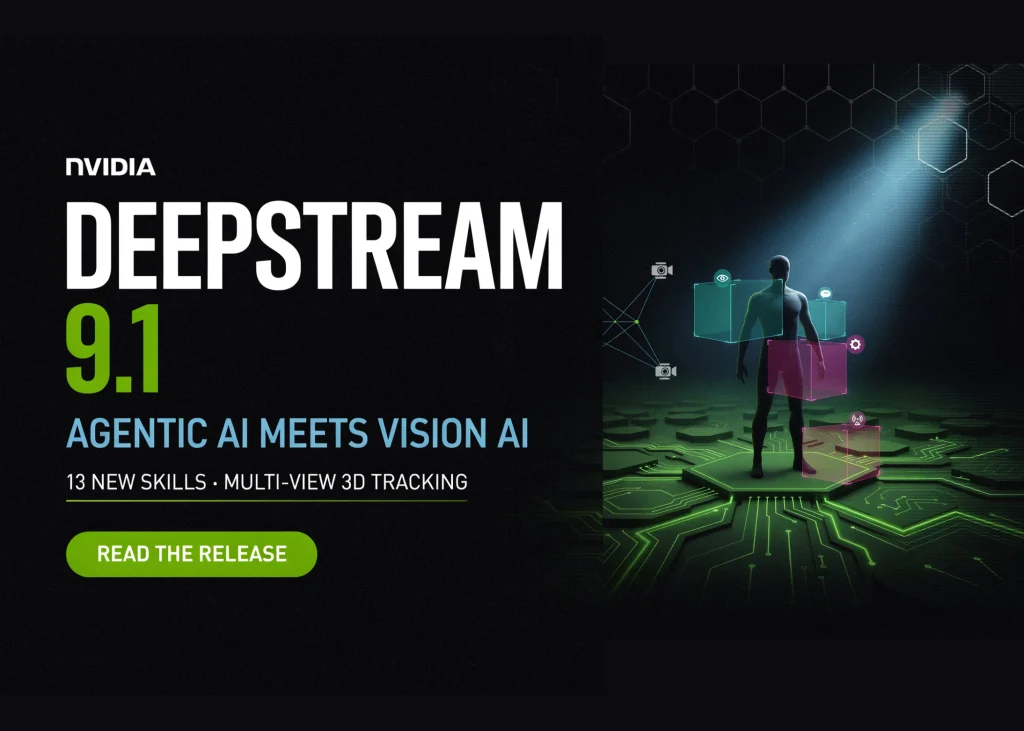
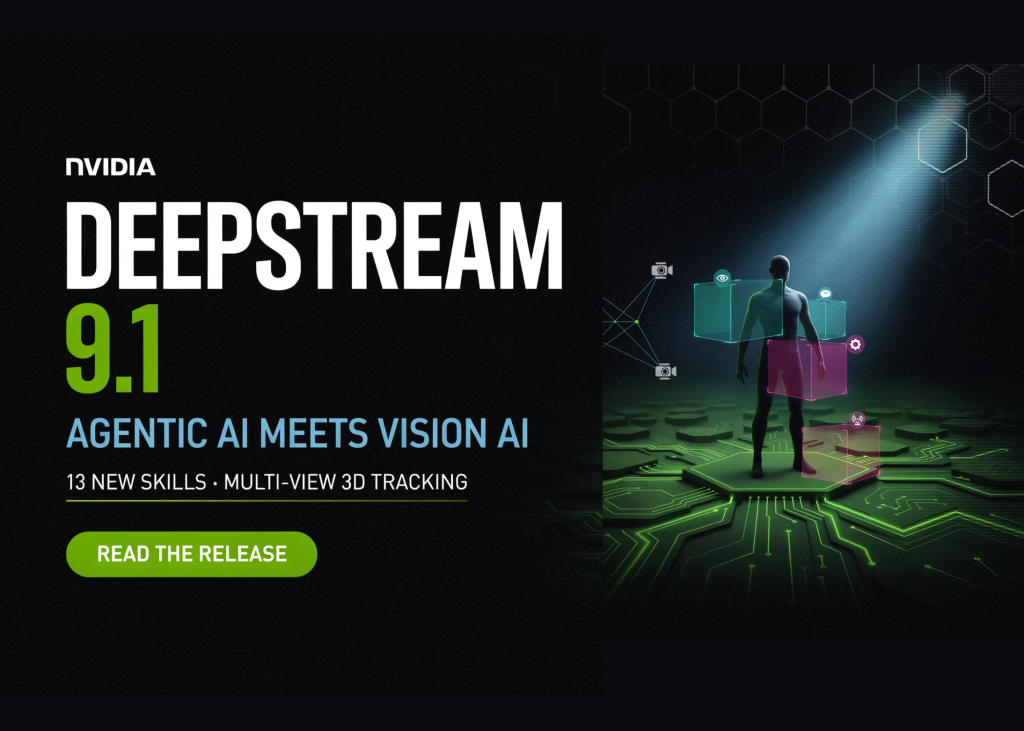
The release of NVIDIA DeepStream 9.1 marks a pivotal advancement in the field of intelligent video analytics (IVA), introducing a suite of tools designed to resolve one of the most enduring challenges in computer vision: consistent object tracking across multiple non-overlapping camera views. As industries ranging from retail to urban planning increasingly rely on distributed camera networks, the ability to maintain a single identity for a person or vehicle as they move through different fields of view has remained technically elusive and computationally expensive. DeepStream 9.1 addresses these hurdles directly through two primary innovations: Multi-View 3D Tracking (MV3DT) and AutoMagicCalib (AMC). By delivering these features as "agentic skills" optimized for AI-driven coding assistants, NVIDIA is effectively lowering the barrier to entry for complex spatial intelligence applications, enabling developers to transition from conceptual frameworks to functional, large-scale pipelines with unprecedented speed.
The Evolution of the DeepStream Ecosystem
To appreciate the significance of the 9.1 update, one must first understand the foundational role of the DeepStream SDK within the NVIDIA AI stack. DeepStream is a comprehensive streaming analytics toolkit designed for AI-based video, audio, and image understanding. Built upon the GStreamer framework, it provides a highly optimized pipeline that leverages NVIDIA GPUs for multi-stream, multi-model inference. The platform’s architecture is designed to maximize throughput and minimize latency by performing hardware-accelerated decoding, pre-processing, inference via TensorRT, and post-processing within a unified data flow.
Historically, DeepStream served as a low-level development environment that required deep expertise in C++ or Python, as well as a sophisticated understanding of GStreamer plugins. While powerful, the complexity of configuring multi-camera environments—specifically the calibration of extrinsic and intrinsic camera parameters—often resulted in long development cycles. Version 9.1 represents a strategic shift toward "agentic" development, where the SDK provides pre-packaged skills that can be interpreted and deployed by AI agents like Claude Code, GitHub Copilot, or Cursor. This shift reflects a broader industry trend toward reducing the "heavy lifting" of infrastructure setup, allowing engineers to focus on higher-level logic and application-specific outcomes.
Multi-View 3D Tracking: A New Paradigm in Spatial Intelligence
The centerpiece of DeepStream 9.1 is the Multi-View 3D Tracking (MV3DT) capability. Traditional multi-camera tracking often relies on "re-identification" (Re-ID) algorithms, which attempt to match the visual appearance of an object (such as the color of a person’s shirt) across different views. However, Re-ID is notoriously prone to errors caused by varying lighting conditions, shadows, and similar-looking subjects.
MV3DT bypasses the limitations of appearance-based tracking by utilizing a geometric approach. The system projects 2D detections from individual cameras into a shared 3D coordinate system. By understanding where an object is located in physical space rather than just where it appears on a 2D screen, the tracker can associate observations based on proximity and trajectory. This methodology ensures that if two cameras observe the same individual, the system assigns a single, globally consistent object ID that persists across the entire network.
The MV3DT data flow is structured into four distinct stages:
- Object Detection: Each camera stream in the pipeline runs a high-performance object detector. DeepStream 9.1 provides out-of-the-box support for industry-standard models, including YOLOv8, YOLOv10, and YOLOv11, ensuring that developers can leverage the latest advancements in real-time detection.
- Monocular 3D Perception: Utilizing a 3×4 projection matrix derived from calibration data, the system back-projects 2D bounding boxes into 3D world-space coordinates. This process relies on a ground-plane assumption, which calculates the intersection of the camera’s line of sight with the floor or ground.
- Multi-View Association: This stage is the "brain" of the cross-camera system. Tracklets—sequences of detections belonging to the same object—are shared between camera nodes using Message Queuing Telemetry Transport (MQTT). MQTT’s lightweight, publish-subscribe architecture allows for efficient communication even in distributed edge computing environments. The tracker then matches these tracklets by analyzing their proximity in the shared 3D world space.
- Result Streaming and Visualization: The final output is delivered in multiple formats to suit different operational needs. An On-Screen Display (OSD) provides a tiled view of 2D and 3D bounding boxes for human monitors. Simultaneously, a Bird’s-Eye View (BEV) renders a top-down map of object trajectories, which is essential for heat-mapping and flow analysis. For downstream applications, the system generates Kafka messages containing per-frame protobuf metadata, including sensor IDs, global object IDs, and 3D spatial coordinates.
AutoMagicCalib: Eliminating the Calibration Bottleneck
The effectiveness of MV3DT is entirely dependent on accurate camera calibration. In traditional computer vision setups, this requires technicians to physically visit each camera location and hold up checkerboard patterns or specialized markers to determine the camera’s position, orientation, and lens characteristics. This process is time-consuming, expensive, and must be repeated if a camera is bumped or moved.
AutoMagicCalib (AMC), introduced in DeepStream 9.1, automates this entire process. AMC is a microservice that analyzes existing video streams to estimate each camera’s intrinsic parameters (focal length, principal point, and lens distortion) and extrinsic parameters (rotation, translation, and world position). By observing the natural movement of objects—such as people walking or cars driving—AMC can mathematically deduce the geometric relationship between the cameras and the physical world.
The AMC pipeline operates through five sophisticated stages: trajectory extraction for each camera, single-view rectification, multi-view tracklet matching, bundle adjustment, and an optional refinement stage using a Visual Geometry Grounded Transformer (VGGT). The VGGT component is particularly innovative, as it provides high-precision refinement even in scenarios where object movement is limited or sporadic. Because AMC runs as a microservice with a REST API and a web interface, users can calibrate a complex 12-camera network by simply providing a floor plan image and a few alignment points, effectively turning a task that once took days into one that takes minutes.
The Shift to Agentic Workflows
Perhaps the most significant strategic change in DeepStream 9.1 is the delivery of these capabilities as "agentic skills." NVIDIA has recognized that the future of software development involves a partnership between human programmers and AI agents. By providing a library of 13 agentic skills—up from just two in version 9.0—NVIDIA allows developers to interact with the SDK using natural language.
In a typical 9.1 workflow, a developer might prompt an AI agent with a command such as "deploy MV3DT on the 12-camera sample dataset." The agent then takes over the operational heavy lifting: it validates system prerequisites, pulls the necessary Docker containers, installs required services like Kafka and the Mosquitto MQTT broker, and downloads pre-trained model weights. If the agent detects that calibration files are missing, it is programmed to automatically trigger the AMC skill to resolve the dependency. This level of automation significantly reduces the "time to first frame" for developers and minimizes the risk of configuration errors that often plague complex AI pipelines.
Comparative Analysis: DeepStream 9.0 vs. 9.1
The transition from version 9.0 to 9.1 represents a substantial leap in both capability and accessibility. The following data highlights the key differences:
- Agentic Skills: Version 9.0 featured only two skills (
deepstream-devandimport-vision-model). Version 9.1 expands this to 13 skills, covering the entire lifecycle from calibration to deployment. - Tracking Sophistication: While 9.0 supported robust single-camera tracking, 9.1 introduces the MV3DT skill as a core component, moving the industry toward holistic spatial awareness.
- Calibration Methodology: 9.0 relied on manual calibration, whereas 9.1 introduces the AutoMagicCalib microservice, enabling zero-touch or low-touch setup.
- Hardware Support: 9.1 adds support for JetPack 7.2, extending the SDK’s reach to the latest NVIDIA Orin and Blackwell (Thor) based Jetson modules, which are essential for edge-based robotics and autonomous systems.
- Distribution Model: NVIDIA has moved to a unified GitHub monorepo, simplifying the process of cloning, updating, and contributing to the DeepStream ecosystem compared to the previous mix of NGC packages and fragmented source code.
Industry Implications and Use Cases
The implications of DeepStream 9.1 extend across multiple sectors where spatial intelligence is a critical requirement. In the realm of Smart Cities and Traffic Management, the ability to track a vehicle across a city-wide network of cameras without losing its identity is vital for incident response and traffic flow optimization. MV3DT allows city planners to visualize traffic patterns in a 3D bird’s-eye view, providing clearer insights than fragmented 2D feeds.
In Retail Analytics, the technology enables "path-to-purchase" tracking. Retailers can now observe a customer’s entire journey through a store—from the entrance to various aisles and finally to the checkout—even if the customer passes through zones covered by different cameras. This data is invaluable for optimizing store layouts and understanding consumer behavior without compromising privacy through facial recognition, as the system relies on spatial geometry rather than personal biometrics.
Logistics and Warehousing also stand to benefit significantly. Automated warehouses can use MV3DT to track autonomous mobile robots (AMRs) and human workers in a shared space, ensuring safety and efficiency. The AMC feature is particularly useful here, as warehouse environments often undergo layout changes that would otherwise require frequent, manual recalibration of the camera system.
Conclusion and Future Outlook
NVIDIA DeepStream 9.1 is more than a incremental software update; it is a fundamental reimagining of the video analytics workflow. By combining the geometric precision of Multi-View 3D Tracking with the automated convenience of AutoMagicCalib and the accessibility of Agentic Skills, NVIDIA has addressed the primary friction points that have historically hindered the deployment of large-scale vision AI.
As the industry moves toward "Vision Language Models" (VLMs) and more autonomous AI agents, the structured, spatially aware data produced by DeepStream 9.1 will serve as a critical input for higher-level reasoning. By providing a consistent, 3D understanding of the world, NVIDIA is ensuring that the next generation of AI applications will not just "see" video, but will truly comprehend the physical context of the environments they monitor. For developers, the message is clear: the era of manual camera calibration and fragmented tracking is coming to an end, replaced by a streamlined, agent-assisted path to spatial intelligence.