


The field of synthetic biology is currently undergoing a significant transition toward cloud-native, reproducible, and interactive computational environments, a shift exemplified by the recent development of a Google Colab-native plasmid workbench. By recreating the core functionality of the terminal-based tool SpliceCraft within a Jupyter-style notebook, researchers have introduced a streamlined methodology for plasmid engineering that integrates visualization, sequence analysis, and molecular design into a single, accessible platform. This new framework leverages the power of Python-based libraries such as Biopython, NumPy, and Matplotlib to provide a comprehensive suite of tools that were previously confined to high-cost proprietary software or complex command-line interfaces.
The Evolution of Plasmid Design Tools
Plasmids—small, circular DNA molecules physically separated from chromosomal DNA—are the workhorses of modern biotechnology. They are used extensively in gene cloning, protein production, and the delivery of CRISPR-Cas9 components. Historically, the visualization and manipulation of these sequences required specialized software like SnapGene or Geneious, which, while powerful, often involve significant licensing fees and lack the transparency of open-source code.
The original SpliceCraft project sought to address these issues by providing a terminal-based Text User Interface (TUI) for plasmid manipulation. However, the modern research landscape increasingly favors "literate programming" environments like Google Colab. These environments allow scientists to interleave executable code with explanatory text and high-resolution graphics, facilitating better collaboration and documentation. The transition to a Colab-native workbench represents a democratization of bioinformatics tools, enabling students and researchers worldwide to perform complex molecular simulations without local hardware constraints or expensive software overhead.
Technical Architecture and Environment Setup
The workbench is built upon a foundation of well-established scientific Python libraries. The primary engine for sequence manipulation is Biopython, a collection of non-commercial online tools for biological computation. By utilizing the SeqIO and SeqFeature modules, the workbench can parse GenBank files—the industry standard for annotated sequence data—and normalize these annotations into a format suitable for graphical rendering.
The environment setup is designed for "zero-configuration" usage. Upon launching the notebook, a series of automated scripts check for the presence of Biopython and install it via the pip package manager if necessary. This ensures that the workflow remains functional even in the ephemeral environment of a Colab virtual machine. The integration of Matplotlib allows for the generation of publication-quality vector graphics, while NumPy handles the underlying coordinate transformations required to map linear base-pair positions onto a 360-degree circular coordinate system.
A Multi-Stage Workflow for Molecular Engineering
The functionality of the workbench follows a logical progression that mirrors the standard laboratory workflow for plasmid construction. This chronology begins with data acquisition and ends with sequence-level modifications and library management.
1. Data Ingestion and Normalization
Users can load plasmid records from three distinct sources: a synthetic offline model for testing, direct fetching from the NCBI Nucleotide database using accession numbers (such as L09137), or local uploads of proprietary GenBank (.gb) files. A critical component of this stage is the normalization of features. Genomic records often contain "noise"—redundant or overly technical annotations. The workbench filters these to focus on critical elements such as Coding Sequences (CDS), promoters, origins of replication ($ori$), and antibiotic resistance markers.
2. Advanced Visualization: Circular and Linear Mapping
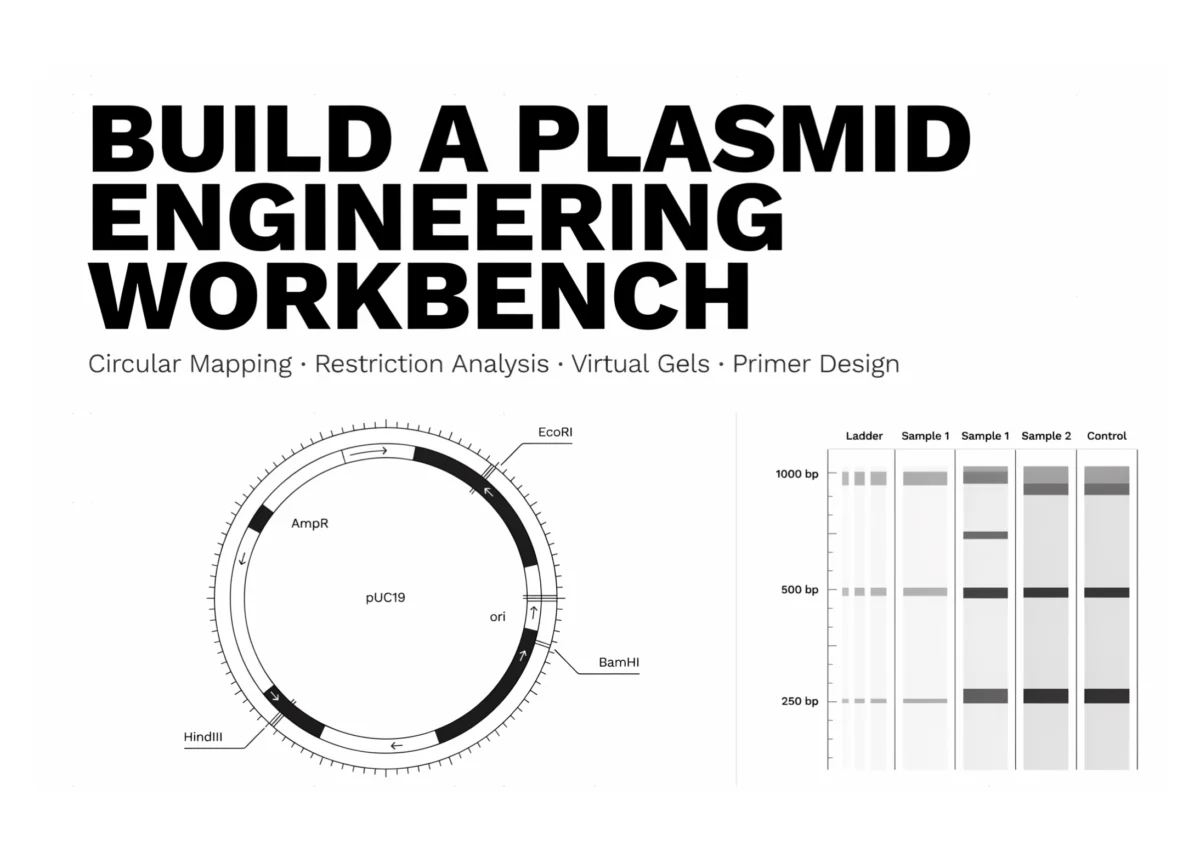
The visual centerpiece of the workbench is its circular plasmid mapper. Unlike traditional static images, these maps are generated programmatically. Base-pair positions are converted to angular coordinates, allowing for the rendering of feature arcs with directional arrowheads that indicate the strand orientation (5′ to 3′).
Supporting the circular view is a linear map and a GC-skew analysis. GC-skew is a powerful analytical tool used to identify directional nucleotide bias. In many bacterial genomes and plasmids, the distribution of Guanine and Cytosine shifts at the origin of replication and the terminus. By plotting cumulative GC-skew, the workbench allows researchers to visually pinpoint these structural landmarks, providing insights into the plasmid’s replication dynamics.

3. Restriction Enzyme Analysis and Virtual Digest
Restriction enzymes are the "molecular scissors" used to cut DNA at specific recognition sites. The workbench utilizes the Bio.Restriction module to scan sequences against a comprehensive database of enzymes. It identifies "unique cutters"—enzymes that cleave the plasmid only once—which are vital for inserting new genetic material without destroying existing functional elements.
To bridge the gap between the digital and the physical lab, the workbench includes a virtual agarose gel electrophoresis simulator. By calculating the sizes of DNA fragments resulting from a specific enzyme digest, the tool plots these fragments on a log-scaled axis, mimicking the migration pattern of DNA through a gel matrix. This allows researchers to predict experimental results and verify construct identity before ever touching a pipette.
4. Functional Annotation: ORF Scanning and Translation
The discovery of new genes or the verification of synthetic constructs requires scanning for Open Reading Frames (ORFs). The workbench scans all six potential reading frames (three on the forward strand and three on the reverse) to identify sequences beginning with a start codon (ATG) and ending with a stop codon (TAA, TAG, TGA). These ORFs are ranked by amino acid length, helping researchers identify potential protein-coding regions. Furthermore, the tool can automatically translate annotated CDS features into protein sequences, ensuring that the intended amino acid sequence is preserved during the design process.
5. Precision Engineering: Primer Design and Sequence Editing
The final stages of the workflow focus on active engineering. The workbench includes a primer design utility that calculates the optimal oligonucleotides for Polymerase Chain Reaction (PCR) amplification. By tuning the length of the primer to reach a target melting temperature ($T_m$), the tool ensures high specificity during laboratory amplification.
Sequence editing is handled through a programmatic interface that supports insertions, deletions, and replacements. A significant technical challenge in plasmid editing is the "coordinate shift"—when a sequence is added or removed, all subsequent feature annotations must have their positions updated. The workbench automates this recalculation, maintaining the integrity of the plasmid’s map after every edit.
Data Analysis and Implications for Research
The implications of this open-source workbench extend beyond simple convenience. In an era where data reproducibility is a major concern in the life sciences, the ability to share a Google Colab link that contains both the design logic and the visualization code is invaluable.
Supporting data suggests that the use of Python-based bioinformatics tools is growing at an exponential rate. According to recent software citation indices, Biopython remains one of the most cited libraries in molecular biology, and the move toward notebook-based research (Jupyter/Colab) has seen a 400% increase in GitHub repository integration over the last five years. By aligning plasmid engineering with these trends, the SpliceCraft-Colab workbench provides a future-proof foundation for synthetic biology.
Experts in the field note that the integration of "virtual gels" and "automated primer design" within the same environment where the sequence is edited reduces the likelihood of human error. In traditional workflows, moving data between a sequence editor, an online $T_m$ calculator, and a separate mapping tool creates multiple points of failure. The unified workbench mitigates these risks by keeping all data within a single, state-persistent environment.
Conclusion: The Future of Notebook-Native Bioinformatics
The SpliceCraft-Colab tutorial demonstrates that sophisticated bioinformatics tasks no longer require bulky, specialized applications. By leveraging the modularity of Python, the workbench transforms a standard web browser into a high-powered molecular biology suite.
As synthetic biology moves toward more complex multi-gene circuits and large-scale metabolic engineering, the need for scriptable, automated design tools will only increase. This workbench serves as a scalable template; it can be expanded to include CRISPR guide RNA (gRNA) design, Gibson Assembly simulators, or even integration with machine learning models for predicting promoter strength. Ultimately, the transition to a Colab-native plasmid workbench represents a significant step toward a more open, reproducible, and computationally integrated future for biological research.