


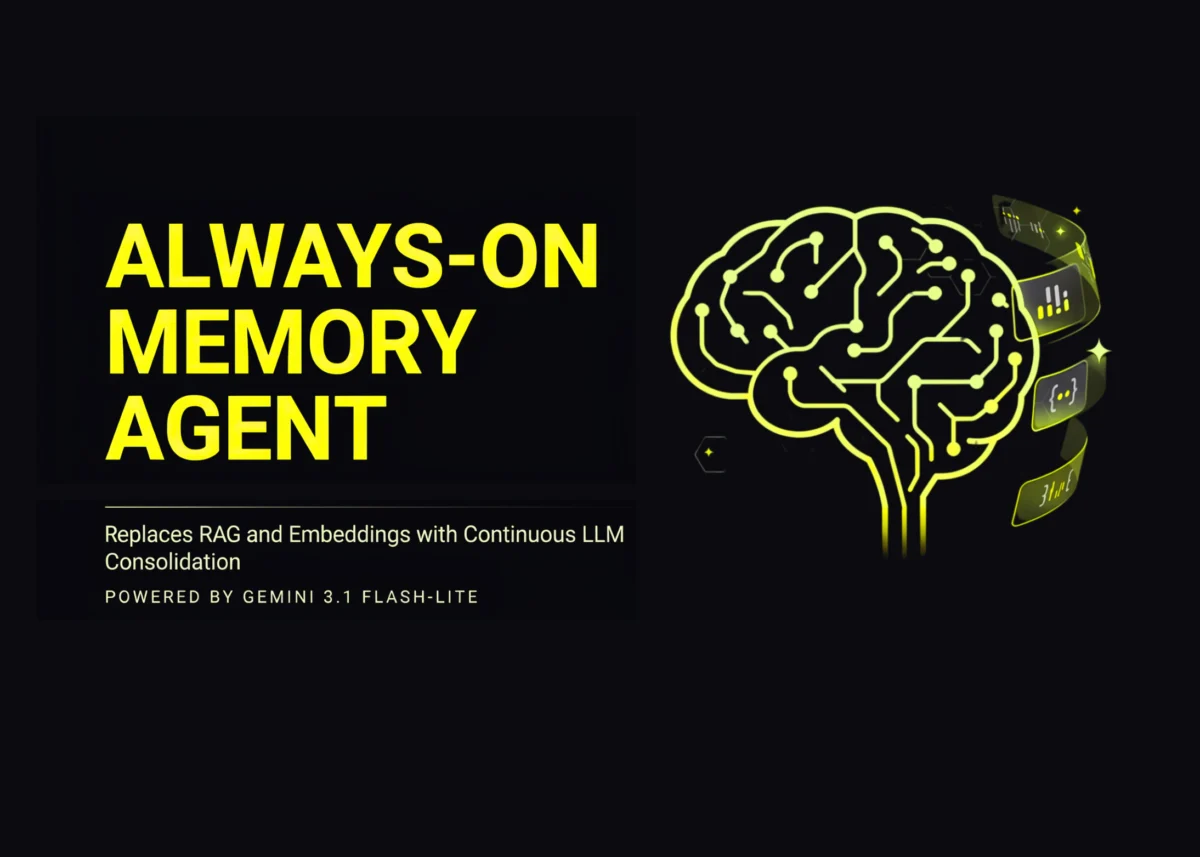
The inherent limitation of most modern Large Language Model (LLM) applications is a phenomenon often described as "session amnesia," where an AI agent processes a specific request, provides an answer, and immediately discards the underlying context. While Retrieval-Augmented Generation (RAG) and expanded context windows have mitigated some of these issues, Google Cloud has introduced a more permanent solution via its generative-ai repository. The newly released Always-On Memory Agent is a reference implementation designed to treat AI memory not as a static database to be queried, but as a continuous, running background process that evolves in real-time.
Built using the Google Agent Development Kit (ADK) and leveraging the Gemini 3.1 Flash-Lite model, this project represents a significant architectural shift in how autonomous agents handle long-term data retention. By operating 24/7 as a background service rather than a series of disconnected API calls, the Always-On Memory Agent maintains a persistent state that allows it to "think" and "consolidate" information even when it is not actively interacting with a human user.
The Architectural Shift: Moving Beyond Vector Databases
For the past two years, the industry standard for AI memory has been the vector database. In a traditional RAG setup, documents are converted into numerical embeddings and stored. When a user asks a question, the system searches for mathematically similar snippets and feeds them into the prompt. While effective for massive datasets, this approach is often criticized for being "passive"—the data sits idle until it is called upon, often losing the nuanced connections between disparate pieces of information.
The Always-On Memory Agent departs from this tradition by eschewing vector databases and embeddings entirely. Instead, it utilizes a structured SQLite database. The intelligence of the system lies in how it uses the Gemini 3.1 Flash-Lite model to read, interpret, and write structured records into this database. This choice is strategic; by using a lightweight, high-speed model like Flash-Lite, Google Cloud minimizes the latency and operational costs associated with continuous background processing. The model acts as its own librarian, deciding what information is important, how it should be categorized, and how it relates to existing knowledge.
The Three-Agent Specialist Framework
The internal logic of the Always-On Memory Agent is governed by an orchestrator that manages three specialized sub-agents. Each agent is designed with a specific role in the cognitive lifecycle of information: ingestion, consolidation, and retrieval.
The IngestAgent: Multimodal Information Capture
The IngestAgent serves as the primary entry point for all data. Leveraging the multimodal capabilities of the Gemini 1.5 architecture (specifically the 3.1 Flash-Lite iteration), this agent does not merely transcribe text. It analyzes incoming content to extract entities, identify core topics, and assign an importance score to the data.
Because the system supports 27 different file types—including audio, video, images, and complex document formats like PDFs and JSON logs—the IngestAgent acts as a universal translator. When a video file is dropped into the system, the agent "watches" the content, summarizes the visual and auditory cues, and stores a structured summary in the SQLite memories table. This ensures that the agent’s memory is not limited to text but encompasses a holistic view of the user’s digital environment.
The ConsolidateAgent: The "Sleep Cycle" for AI
Perhaps the most innovative component of the system is the ConsolidateAgent. In human biology, sleep is the period during which the brain processes the day’s events, strengthens important memories, and discards irrelevant noise. The ConsolidateAgent mimics this process. By default, it runs every 30 minutes, reviewing all "unconsolidated" memories that have entered the system since the last cycle.
During this phase, the agent looks for connections between separate entries. For instance, if the IngestAgent recorded a meeting transcript at 10:00 AM and a project spreadsheet at 2:00 PM, the ConsolidateAgent will synthesize these two data points into a single key insight. It then writes these synthesized connections back into the database. This active processing allows the agent to build a deeper understanding of a project or topic over time, entirely independent of user prompts.
The QueryAgent: Synthesis and Citation
When a user eventually queries the system, the QueryAgent takes over. Unlike a standard search engine that might return a list of links, the QueryAgent reads through the relevant memories and the consolidated insights to draft a comprehensive response. A critical feature of this agent is its commitment to transparency; it provides specific memory IDs as citations for its answers. This reduces the risk of hallucination and allows developers to trace the logic of the AI back to the original source material.

Technical Specifications and Multimodal Support
The Always-On Memory Agent is designed for high-velocity environments where data comes in various formats. The system’s ability to handle 27 file types across five distinct categories makes it a versatile tool for enterprise knowledge management.
- Text and Data: Support for
.txt,.md,.json,.csv,.log,.xml, and.yamlensures that the agent can monitor system logs, codebases, and structured reports. - Visual Media: The inclusion of
.png,.jpg,.gif, and.webpallows the agent to "remember" charts, whiteboard sessions, and visual presentations. - Audio and Video: With support for
.mp3,.mp4,.wav, and.mov, the agent can act as a persistent observer of meetings, webinars, and voice memos. - Documents: Full support for
.pdffiles allows for the ingestion of long-form whitepapers and legal documents.
The deployment of the agent is streamlined for engineering teams. By running a simple Python process, the agent begins watching a designated ./inbox folder. Any file placed in this folder is automatically picked up, processed by the IngestAgent, and integrated into the long-term memory store.
Comparative Analysis: Agentic Memory vs. Traditional RAG
To understand the impact of the Always-On Memory Agent, it is necessary to compare it against existing memory paradigms.
| Feature | Vector DB + RAG | Conversation Summary | Knowledge Graphs | Always-On Memory Agent |
|---|---|---|---|---|
| Storage Method | Embeddings | Compressed Text | Nodes and Edges | Structured SQLite Rows |
| Active Processing | None (Passive) | None (Static) | Manual/High Upkeep | Continuous Consolidation |
| Primary Strength | Massively Scalable | Low Computational Cost | High Context Accuracy | Evolving Contextual Insight |
| Main Limitation | Lacks nuance/logic | Loses granular detail | Expensive to build | Limited to recent memory depth |
The primary differentiator is the "active" nature of the Always-On Memory Agent. While RAG systems are excellent for retrieving a specific fact from a million documents, they struggle to "understand" how a project’s goals might have shifted over a month of daily updates. The Always-On Memory Agent, through its consolidation cycles, tracks that evolution.
Business Implications and Use Cases
The move toward persistent AI memory has profound implications for several industries. In the legal and compliance sector, an Always-On Memory Agent could monitor incoming communications and documents to maintain a running "case file" that identifies contradictions or new evidence without human intervention.
In the realm of software development, such an agent could live within a repository, monitoring commits, pull requests, and Slack discussions. Over time, it would develop a "memory" of why certain architectural decisions were made, serving as an automated onboarding tool for new developers who can query the agent about the history of the codebase.
Furthermore, the low-cost profile of the Gemini 3.1 Flash-Lite model makes this a viable solution for Small and Medium Enterprises (SMEs). Historically, maintaining a sophisticated knowledge graph or a high-performance vector database required significant cloud spend and specialized data engineering. By utilizing SQLite and a lightweight model, Google Cloud has democratized access to persistent AI context.
Chronology of Development and Future Outlook
The release of the Always-On Memory Agent follows a series of advancements in the Google Cloud AI ecosystem. In early 2024, Google introduced the Gemini 1.5 Pro with a million-token context window, which many thought would render specialized memory agents obsolete. However, the industry quickly realized that while a large context window is useful for single-session analysis, it does not solve the problem of multi-month data persistence or the need for autonomous "background thinking."
The introduction of the Agent Development Kit (ADK) later in the year provided the necessary scaffolding for developers to build multi-agent systems. The Always-On Memory Agent is the culmination of these technologies, moving the focus from "prompt engineering" to "agentic workflow engineering."
Looking ahead, the next iteration of this technology will likely involve deeper integration with enterprise APIs (such as Google Workspace or Salesforce), allowing the agent to not only watch a folder but to actively "listen" to an entire corporate ecosystem. As these agents become more autonomous, the distinction between a database and an AI will continue to blur, leading to a future where data is not just stored, but lived with.
For now, the Always-On Memory Agent stands as a robust reference for developers looking to move beyond the limitations of one-shot AI interactions. By treating memory as a living process, Google Cloud has provided a blueprint for the next generation of truly intelligent, persistent digital assistants.