


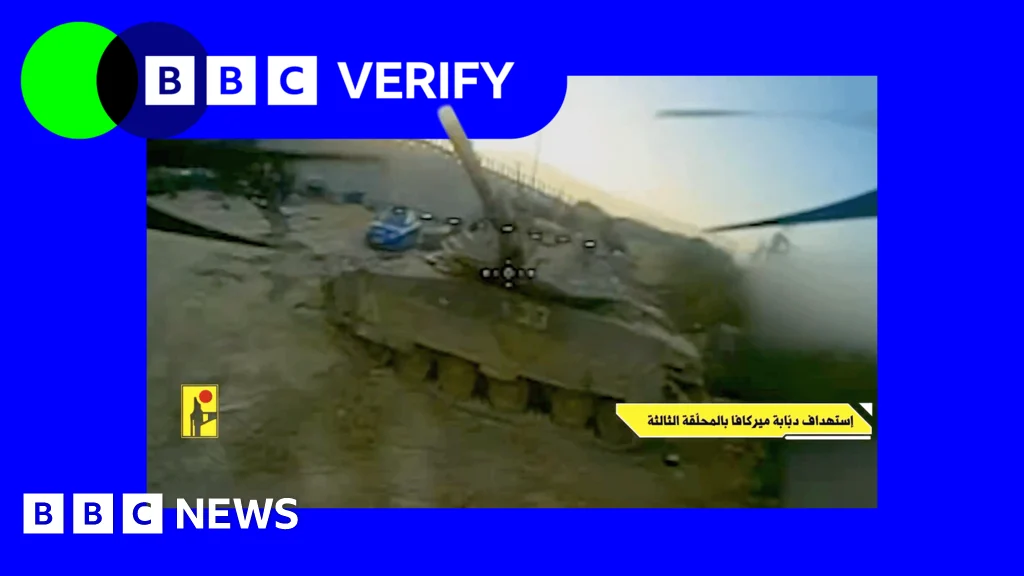
Hezbollah has dramatically escalated its use of small, first-person view (FPV) drones to target Israeli military assets, deploying advanced systems, including those controlled by fibre-optic cables, to bypass sophisticated defenses. This tactical shift, extensively documented and analyzed by BBC Verify, underscores a significant evolution in modern irregular warfare, presenting a formidable challenge to Israel Defense Forces (IDF) operations in southern Lebanon and northern Israel.
The Proliferation of FPV Drones: A New Frontier in Warfare
Since March 26, BBC Verify has meticulously geolocated 35 videos released by the Lebanese armed group, showcasing precision strikes against Israeli soldiers, armored vehicles, and critical air defense systems. These videos, forming part of nearly 100 alleged FPV attacks shared on Hezbollah’s Telegram channel since the specified date, reveal a sustained and deliberate campaign. Prior to March 26, Hezbollah had not disseminated similar FPV strike footage from the conflict that commenced on March 2.
Experts consulted by BBC Verify emphasize that the IDF has, "so far, been unable to develop any effective countermeasures" against these agile, diminutive drones. Their compact size and low radar cross-section enable them to easily circumvent traditional detection systems designed for larger, conventional aerial threats. Moreover, a key factor contributing to their proliferation and effectiveness is their low cost and ease of production. These drones can be assembled from readily available commercial components, often supplemented with parts produced via 3D printing. With an estimated cost ranging from $300 to $500 (£225-£375) per unit, they offer a stark economic asymmetry when pitted against the high-value military targets they are designed to destroy, such as advanced tanks, armored personnel carriers, and complex air defense installations.
The widespread adoption of cheap FPV drones first gained prominence during the ongoing Russia-Ukraine war, where they proved instrumental in reconnaissance, target acquisition, and direct kamikaze attacks, fundamentally altering battlefield dynamics. This precedent highlights a global trend towards the democratization of precision strike capabilities, making advanced targeting accessible to non-state actors with limited budgets.
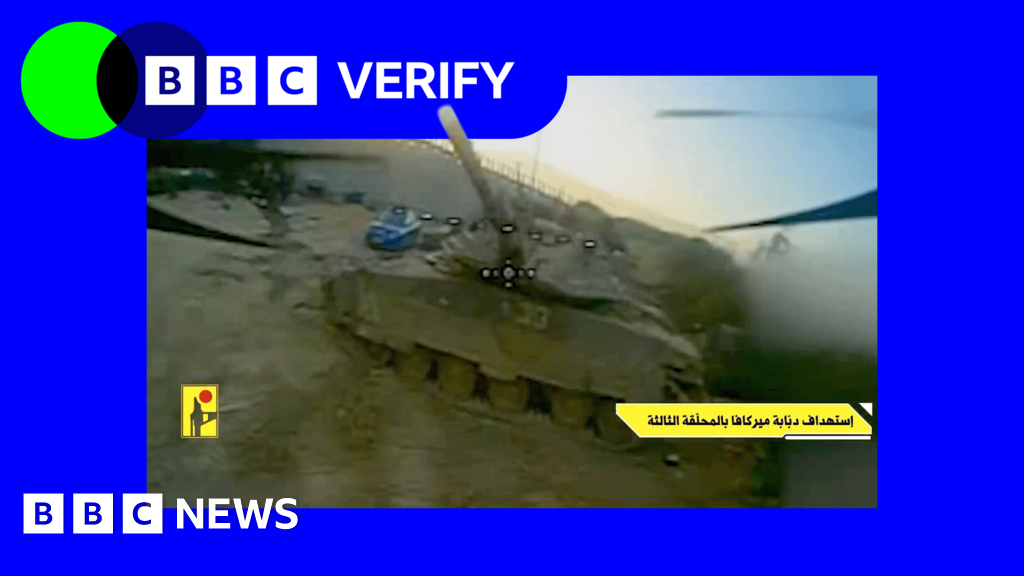
Fibre-Optic Technology: Bypassing Electronic Warfare
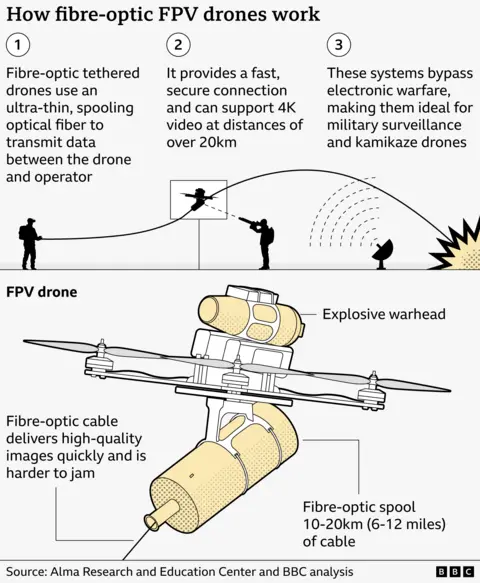
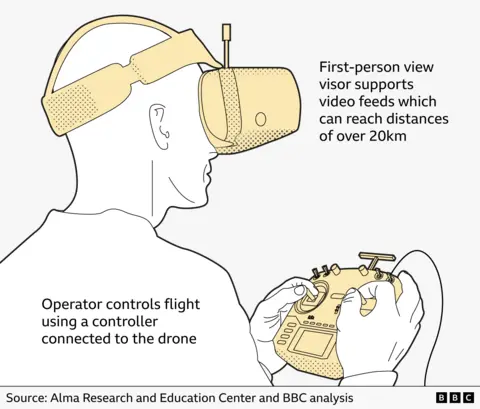
A critical innovation observed in Hezbollah’s evolving drone tactics is the use of fibre-optic cable connections for controlling many of these FPV units. Unlike conventional drones that rely on radio frequencies or other wireless signals, these tethered systems transmit data between the drone and its operator via an ultra-thin, spooling optical fiber. This method provides a highly secure, high-bandwidth connection, capable of supporting 4K video feeds over distances exceeding 20 kilometers (12 miles).
Dr. Andreas Krieg, a security expert at King’s College London, explained to BBC Verify that this fibre-optic tethering effectively bypasses Israel’s sophisticated electronic counter-measures. "The fibre-optics render Israel’s capacity to detect, jam and intercept drones largely irrelevant," Krieg stated, underscoring the severe limitations this imposes on the IDF’s ability to neutralize the threat. Furthermore, the physical tether makes it significantly more challenging to pinpoint the operator’s location, as there are no electromagnetic emissions to trace back to a control station.
The tactical implications for Israeli ground forces are substantial. Krieg noted that Israeli troops are now "having to move more cautiously, harden positions, use physical protective measures such as nets and cages, and devote more attention to immediate local defense." This necessitates a shift in operational protocols, increasing the burden on frontline units and potentially slowing down maneuvers in contested areas. The psychological impact of an "invisible" and highly precise threat, capable of striking heavily armored vehicles, also weighs heavily on soldiers, as highlighted by Leone Hadavi, a senior investigator and weapons expert for the Centre for Information Resilience. Hadavi indicated that the "psychological implication" of increasing FPV strikes appears to be significant, given their capacity to threaten highly protected assets.
Verifiable Incidents and Escalating Casualties
The BBC Verify investigation provides concrete examples of the FPV drones’ operational effectiveness. A verified video shared on Thursday depicted at least four FPV drones orchestrating a coordinated attack on an Israeli border outpost near Kiryat Shmona. The footage showed the drones systematically targeting a series of military vehicles, with at least two appearing heavily damaged or destroyed in the clips. This multi-drone assault signifies a growing level of sophistication in Hezbollah’s drone operations, moving beyond single-drone strikes to coordinated tactical maneuvers.
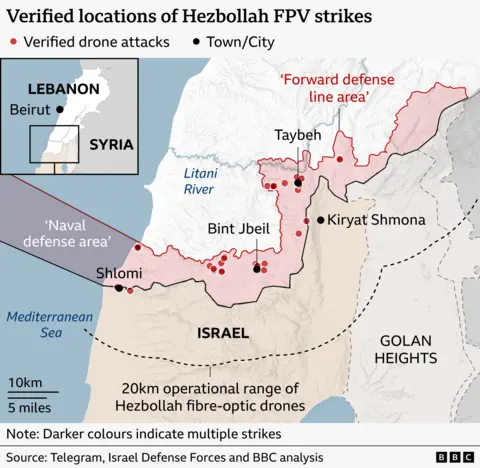
Another documented incident occurred on April 26 in the southern Lebanese town of Taybeh. Videos from this event showed FPV drones initially targeting soldiers, followed by a subsequent strike in close proximity to an IDF helicopter engaged in rescuing injured troops. Israeli media reports confirmed that one soldier was killed and six others were injured in this particular engagement, illustrating the drones’ capacity to inflict casualties and disrupt critical military operations.
While the Israeli military does not publicly release all casualty details, Israeli media reports indicate that FPV strikes have been directly responsible for the deaths of four IDF soldiers and one civilian, with dozens more injured since the significant increase in their use. These figures represent a tangible impact on Israeli personnel, adding to the broader casualty count of the conflict.
The Broader Conflict: A Timeline of Escalation
The current escalation between Israel and Hezbollah is part of a wider regional conflagration, tracing its roots to a pivotal event on March 2. This date marked two days after the United States and Israel reportedly launched a wave of targeted air strikes in Iran, which resulted in the death of Supreme Leader Ayatollah Ali Khamenei. This dramatic event sent shockwaves across the Middle East, igniting a rapid and severe response from Iran’s regional proxies.
Following Khamenei’s death, Hezbollah, a powerful Iranian-backed Shi’ite militant group and political party in Lebanon, immediately retaliated by firing a barrage of rockets into northern Israel. Israel responded with widespread air strikes across Lebanon, quickly escalating into a ground invasion of the southern part of the country. This marked a significant intensification of hostilities that had previously simmered along the border.
In April, US President Donald Trump announced a ceasefire, signaling an attempt to de-escalate the burgeoning conflict. However, despite this diplomatic intervention, fighting continued, albeit with varying intensity. Lebanon’s health ministry has reported a devastating toll, with at least 2,896 people killed since the conflict began on March 2. Alarmingly, over 400 of these fatalities have occurred since the April ceasefire announcement, indicating the fragility and limited effectiveness of the truce. The Lebanese health ministry’s figures do not differentiate between combatant and civilian deaths, making a precise breakdown difficult. The conflict has also triggered a humanitarian crisis, displacing more than one million people within Lebanon, exacerbating an already strained economic and social situation.
On the Israeli side, official figures indicate four soldiers and 18 civilians have been killed in the overall conflict, encompassing all forms of attacks, not exclusively FPV drone strikes. These figures highlight the dual impact of the conflict on both military personnel and civilian populations across the border.
Official Responses and Counter-Tactics
The Israel Defense Forces has publicly acknowledged the escalating threat posed by these evolving drone tactics. In a statement to BBC Verify, the IDF affirmed its commitment to investing "significant resources" in improving its defenses. This includes the development of "more effective alert models" and comprehensive training programs for soldiers, aimed at "improving readiness and increasing awareness of the threat." The IDF’s strategy appears to involve a multi-pronged approach, combining technological upgrades with enhanced troop preparedness.
However, the challenge remains substantial. The ability of fibre-optic drones to negate electronic warfare capabilities means that traditional counter-drone measures, such as jamming signals, are largely ineffective. This forces the IDF to explore alternative solutions, potentially including kinetic interceptors, laser defense systems, or advanced visual detection and targeting systems capable of engaging small, fast-moving aerial threats at close range.
It is also noteworthy that the IDF itself has been employing FPV drones for several years, operating them in southern Lebanon and against Hamas in Gaza. This indicates a symmetrical understanding of the technology’s potential, even as Israel grapples with Hezbollah’s innovations. The fact that both sides are utilizing similar tools underscores a broader shift in military doctrine where low-cost, disposable drones are becoming indispensable assets.
Psychological Impact and Future Implications
The "psychological implication" of Hezbollah’s FPV drone attacks on Israeli troops cannot be overstated. The constant threat of an unseen, silent, and highly precise weapon targeting individuals or armored vehicles can significantly impact morale, operational confidence, and overall combat effectiveness. This form of psychological warfare aims to instill fear and caution, compelling forces to adopt more defensive postures and potentially slowing down offensive maneuvers.
Looking ahead, the tactics employed by Hezbollah have profound implications for the future of warfare. The ability to assemble sophisticated, hard-to-detect weapons from commercial, dual-use components presents a significant challenge to traditional intelligence gathering and arms control efforts. Leone Hadavi noted the difficulty in tracing these components due to their accessibility and non-military nature, and the abundance of RPG warheads in southern Lebanon ensures a ready supply of explosive payloads.
This trend suggests a future where military superiority may not solely hinge on advanced, expensive platforms, but also on the ingenuity and adaptability in deploying low-cost, disruptive technologies. Militaries worldwide will need to rapidly adapt their doctrines, invest in new forms of electronic warfare that can counteract fibre-optic links (perhaps through physical interception or localized jamming of command centers), and develop more robust, multi-layered defensive systems against drone swarms. The proliferation of such technology to other non-state actors globally remains a significant concern, potentially destabilizing other conflict zones. The ongoing conflict between Israel and Hezbollah serves as a critical case study in this evolving landscape, demonstrating how technological innovation, even at a relatively low cost, can dramatically alter the balance of power on the battlefield.
Additional reporting by Lamees Altalebi, Thomas Spencer, Deena Easa, Sherie Ryder and Paul Brown, graphics by Tom Shiel.