
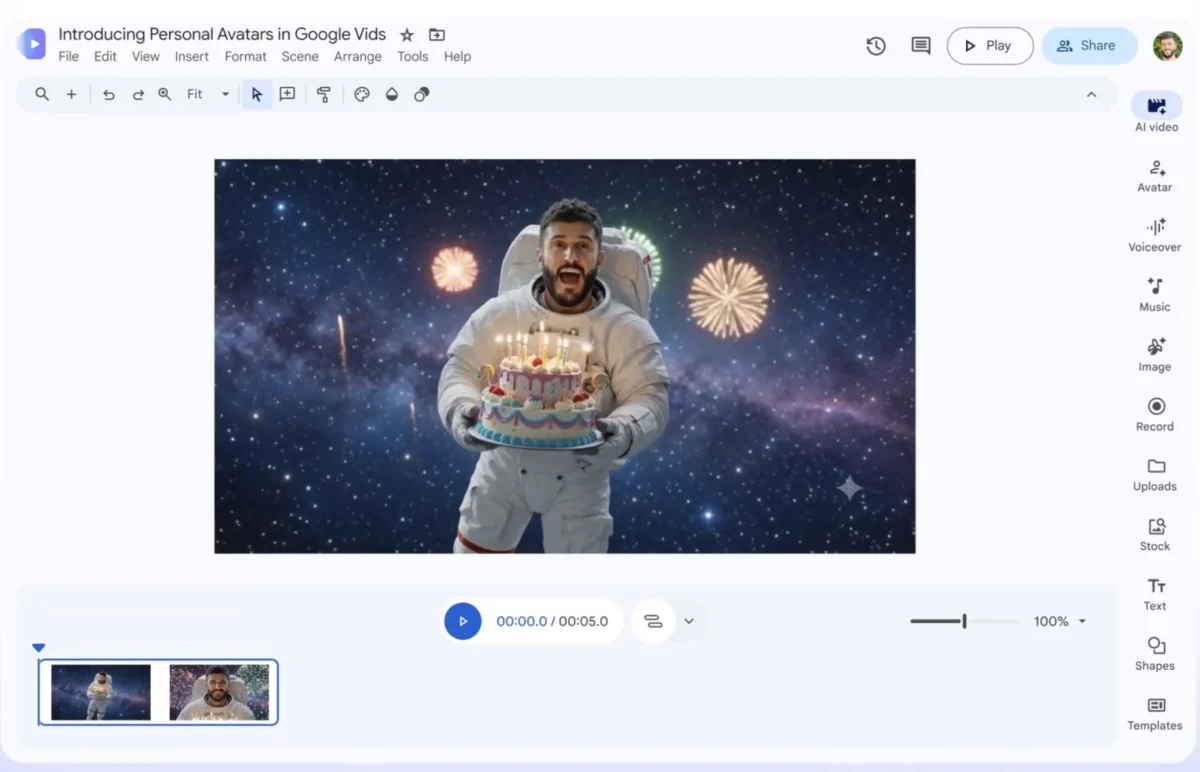
In a significant strategic move announced on Thursday, July 16, 2026, Google unveiled a transformative update to its Google Vids platform, integrating personalized digital avatars and the advanced multimodal capabilities of Gemini Omni. This enhancement propels Google Vids beyond its initial scope as an AI-assisted workplace presentation tool, redefining it as a comprehensive, all-in-one video creation platform poised to democratize sophisticated video production for businesses and professionals worldwide. The update, detailed in an official company announcement, directly addresses the burgeoning demand for efficient, scalable video content creation, leveraging artificial intelligence to streamline complex processes and empower users to star in their own AI-generated videos.
The Genesis of Personal AI Avatars in Google Vids
Central to this monumental update is the introduction of custom digital avatars, allowing users to create a lifelike representation of themselves within Google Vids. This innovative feature leverages a user’s uploaded selfie and a brief voice recording to construct a unique AI avatar that not only mirrors their appearance but also replicates their vocal characteristics. The process is designed for simplicity and accessibility, removing traditional barriers to high-quality, personalized video content. Users can now generate professional-grade videos featuring their digital likeness, complete with synchronized lip movements and natural-sounding speech, all without the need for extensive filming or post-production expertise. This capability is expected to be a game-changer for corporate communications, training modules, marketing campaigns, and internal updates, enabling individuals to become the face and voice of their content effortlessly.
The timing of Google’s announcement is particularly noteworthy, arriving months after OpenAI’s much-hyped Sora video generation model was unexpectedly shut down on March 24, 2026, following concerns regarding its potential misuse and the challenges of content moderation. While Sora captivated the industry with its ability to generate realistic videos from text prompts, its abrupt discontinuation left a void in the high-end AI video creation space. Google’s aggressive push with Vids, particularly its focus on personalized, ethically constrained avatars, signals a deliberate strategy to capture market share and establish a more responsible, enterprise-friendly ecosystem for AI video production. Industry analysts, such as those at Gartner and Forrester, have consistently highlighted the growing enterprise interest in AI-powered content tools, projecting the AI content generation market to exceed $25 billion by 2030, driven largely by video.
Unleashing Multimodal Power with Gemini Omni
Further augmenting Google Vids’ capabilities is the deep integration of Gemini Omni, Google’s cutting-edge multimodal AI model. Gemini Omni, which first demonstrated its prowess in turning images, audio, and text into video in May 2026, now serves as the intelligent backbone for Vids’ advanced creation features. This integration allows users to generate videos using a rich combination of inputs: written prompts describing desired scenes or narratives, coupled with reference images that provide visual context and stylistic guidance. Omni then intelligently synthesizes these diverse inputs, translating abstract ideas and visual cues into coherent, compelling AI-generated video sequences.
The capabilities of Gemini Omni extend far beyond initial video generation. The model introduces sophisticated editing functionalities, enabling users to perform complex manipulations with unprecedented ease. For instance, Omni can seamlessly swap out backgrounds in videos recorded on a phone, adjusting lighting and perspective to maintain realism. It can also rectify lighting issues, enhancing the visual quality of user-generated footage, or add a wide array of dynamic effects to elevate production value. Crucially, Gemini Omni supports step-by-step edits, a revolutionary feature that empowers users to make iterative changes throughout the video creation process. This means revisions can be implemented incrementally, allowing for precise adjustments and refinements without the need to restart from scratch, significantly reducing production time and effort. This iterative editing paradigm is a direct response to feedback from early adopters of AI video tools, who often cited the inflexibility of single-shot generation as a major drawback.
Google’s Strategic Play in the Enterprise Landscape
The transformation of Google Vids is not merely a feature update; it represents a significant strategic pivot for Google within the fiercely competitive enterprise software market. By embedding Vids deeply within Google Workspace—a suite already utilized by billions for productivity and collaboration—Google is emphatically telegraphing its intention for Vids to be a cornerstone business tool. This integration provides a seamless workflow for existing Workspace users, allowing them to leverage AI video creation for a myriad of professional applications, from internal company updates and onboarding videos to comprehensive training modules, marketing content, and client presentations.
This move places Google Vids in direct competition with a rapidly expanding ecosystem of specialized AI video startups that have gained traction in recent years. Companies like HeyGen, Synthesia, Captions, and D-ID have carved out niches by offering advanced AI avatar generation, text-to-video capabilities, and robust editing suites. Synthesia, for instance, boasts an impressive array of AI presenters and multilingual support, while HeyGen has seen rapid adoption for its ability to generate engaging short-form video content quickly. Google’s entry into this arena with a comprehensive, integrated solution backed by its vast AI research and infrastructure poses a formidable challenge to these incumbents. The advantage of Google Vids lies in its ecosystem integration, potentially offering a more unified experience for businesses already reliant on Gmail, Google Docs, and Google Meet.
A Google spokesperson, speaking on background, emphasized the company’s long-term vision: "Our goal with Google Vids is to democratize high-quality video production, making it accessible and efficient for every business, regardless of size or technical expertise. By bringing Gemini Omni and personalized avatars into Workspace, we are providing tools that not only save time and resources but also foster new levels of creativity and communication." This statement underscores Google’s commitment to empowering its vast user base with cutting-edge AI capabilities, transforming how professional content is created and disseminated.
Ethical Safeguards and Responsible AI Deployment
Recognizing the profound ethical implications associated with generative AI, particularly in the creation of lifelike digital representations, Google has implemented stringent safeguards for its personal AI avatars. The company explicitly states that the new AI avatars will be inextricably tied to the account holder’s likeness and Google account. This measure is designed to prevent unauthorized use and ensure accountability. Furthermore, all AI-generated content featuring these avatars will be invisibly watermarked with SynthID, Google’s proprietary technology for identifying AI-generated media. SynthID serves as a crucial tool for provenance tracking, helping to distinguish authentic content from AI-fabricated material and combat the spread of misinformation or deepfakes.
Google’s proactive stance on ethical AI deployment contrasts sharply with some of the challenges faced by earlier AI models, including Sora. The company’s policy implicitly addresses concerns about malicious actors generating misleading or harmful content using celebrity likenesses or creating synthetic media without consent. By tying avatars to individual accounts and employing robust watermarking, Google aims to foster a responsible environment for AI video creation. Additionally, access to personal avatars is restricted to users aged 18 or older and is limited to specific geographic regions, further underscoring Google’s commitment to controlled and ethical rollout. These limitations reflect a cautious approach, allowing Google to monitor usage, gather feedback, and refine its ethical frameworks before a broader global release.
Market Impact and Future Implications
The enhanced Google Vids platform is poised to have a significant impact on the video content market. For businesses, the ability to rapidly generate high-quality, personalized video content with minimal resources represents a substantial competitive advantage. Small and medium-sized enterprises (SMEs) that previously lacked the budget or expertise for professional video production can now create compelling visual narratives, leveling the playing field with larger corporations. This could lead to a surge in diverse video content across various industries, from e-learning and corporate training to internal communications and customer support.
Moreover, the iterative editing capabilities powered by Gemini Omni promise to revolutionize the video production workflow. Traditional video editing is often a laborious and time-consuming process, with revisions requiring significant effort. The ability to make step-by-step changes using AI prompts and visual references will dramatically reduce iteration cycles, accelerating content delivery and fostering greater agility in content strategy. This could free up creative teams to focus on conceptualization and strategy rather than tedious execution.
Experts believe that Google’s move will intensify the "AI arms race" among tech giants and specialized startups. "Google’s entry with a fully integrated, ethically-minded AI video platform is a clear signal that the company sees this as a critical frontier for enterprise productivity," stated Dr. Lena Khan, a lead AI researcher at the Institute for Digital Transformation. "Their focus on security and accountability with SynthID and account tying is crucial for building trust in an area ripe for misuse. This will force competitors to not only innovate on features but also to robustly address ethical concerns."
Looking ahead, Google Vids’ evolution signifies a broader trend towards democratizing advanced creative tools through AI. As multimodal AI models become more sophisticated, the line between human-created and AI-assisted content will continue to blur. Google’s commitment to integrating these capabilities into its widely adopted Workspace suite ensures that millions of users will have direct access to these transformative technologies, potentially reshaping the landscape of professional communication and content creation for years to come. The future of video, it seems, will be increasingly intelligent, personalized, and seamlessly integrated into our digital workflows, with Google Vids leading the charge from within the enterprise ecosystem.