

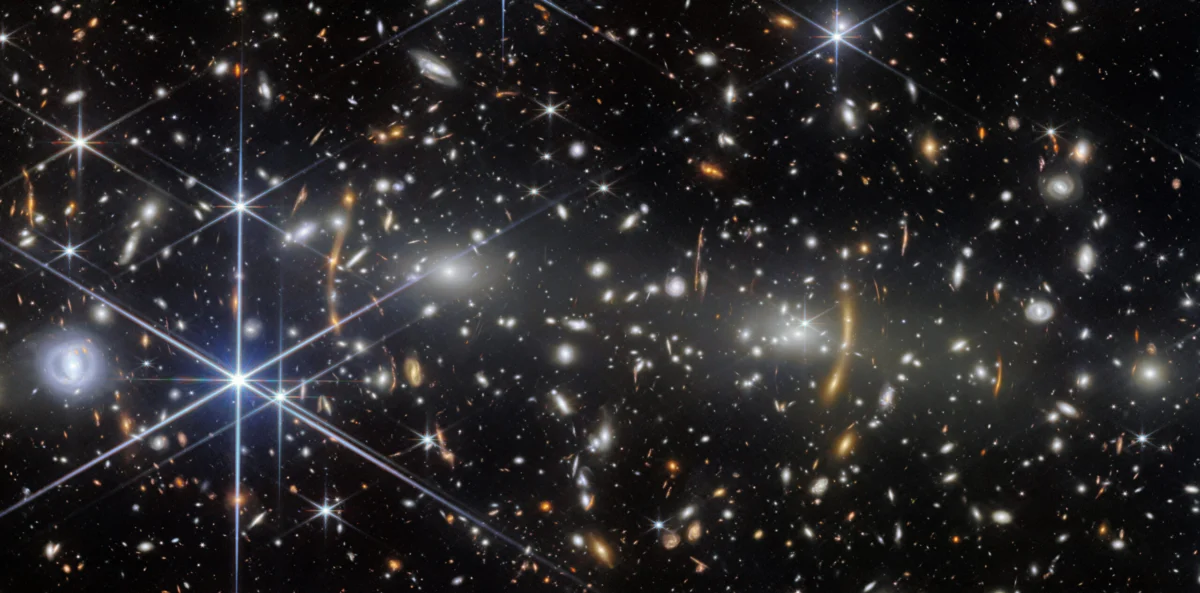
NASA’s revolutionary James Webb Space Telescope (JWST) has delivered a profound image of a young galaxy cluster, MACS J0553.4-3342, captured on July 3, 2026. This observation transports astronomers 4.4 billion years into the universe’s past, revealing a dynamic cosmic collision. The cluster is comprised of two actively merging sub-clusters, each of roughly equal mass, and prominently anchored by immensely bright and massive elliptical galaxies. These central galaxies stand out as the two most luminous points in the scene, radiating with extensive glowing halos that dominate the cluster’s core. The intricate details unveiled by JWST offer invaluable insights into the processes of galaxy evolution and the formation of the universe’s largest structures.
Unveiling a Cosmic Collision: The MACS J0553.4-3342 Cluster
The galaxy cluster MACS J0553.4-3342 represents a crucial snapshot in cosmic history. At 4.4 billion years in the past, the universe was approximately 9.4 billion years old and undergoing a period of intense structural development. Galaxy clusters, the largest gravitationally bound structures in the cosmos, are not static entities but evolve through mergers and accretion. The image clearly depicts two distinct sub-clusters caught in the act of merging, a violent yet fundamental process that drives the growth and transformation of these colossal systems. Each sub-cluster is centered around a massive elliptical galaxy, indicating that these are mature systems within their respective groupings, already having undergone significant merger activity or stellar mass assembly prior to their collision.
Elliptical galaxies, characterized by their smooth, featureless profiles and older stellar populations, are often thought to be the end-products of multiple galactic mergers. The immense brightness and size of the two central ellipticals in MACS J0553.4-3342 suggest they are super-massive, likely harboring supermassive black holes at their cores that are actively accreting matter, contributing to their luminosity. The ongoing merger of the two sub-clusters will eventually lead to the formation of an even larger, more massive single cluster, a process that can take hundreds of millions of years. This observation provides a direct visual testament to the hierarchical model of structure formation, where smaller structures coalesce to form larger ones over cosmic time.
The James Webb Space Telescope: A Window to the Early Universe
The ability to peer back 4.4 billion years into the universe’s past is a testament to the unprecedented capabilities of the James Webb Space Telescope. Launched on December 25, 2021, JWST is the successor to the Hubble Space Telescope and represents a significant leap in infrared astronomy. Its 6.5-meter primary mirror, composed of 18 hexagonal beryllium segments, provides unparalleled light-gathering power and angular resolution. Operating at the second Sun-Earth Lagrangian point (L2), approximately 1.5 million kilometers from Earth, JWST maintains a stable, cold environment crucial for its highly sensitive infrared instruments.
The light from distant objects, like MACS J0553.4-3342, is redshifted as the universe expands, meaning that light originally emitted in visible or ultraviolet wavelengths stretches into the infrared spectrum by the time it reaches Earth. JWST’s primary mission is to observe in the infrared, allowing it to detect this redshifted light from the earliest galaxies and cosmic structures. This capability is essential for studying the formation of the first stars and galaxies, the evolution of galaxies over cosmic time, the birth of stars and planetary systems, and the atmospheric compositions of exoplanets. Without JWST’s infrared sensitivity, the faint and redshifted light from a cluster like MACS J0553.4-3342, located billions of light-years away, would be virtually undetectable, making this image a direct product of its advanced design and engineering. The observation of MACS J0553.4-3342 specifically leverages JWST’s Near-Infrared Camera (NIRCam) and Mid-Infrared Instrument (MIRI) to capture the detailed morphology and stellar populations of the merging galaxies and the overall cluster environment.
The Mechanics of a Merger: Galactic Evolution in Action
Galaxy mergers are among the most energetic and transformative events in the cosmos, profoundly influencing the evolution of galaxies. When two galaxy clusters, or sub-clusters as seen in MACS J0553.4-3342, collide, the individual galaxies within them mostly pass through each other due to the vast distances between stars. However, the gravitational fields of the merging systems interact strongly, disrupting gas clouds, triggering bursts of star formation, and funneling gas towards the central supermassive black holes. This can lead to periods of intense activity known as Active Galactic Nuclei (AGN), where the black holes consume vast amounts of matter and emit powerful jets and radiation across the electromagnetic spectrum.
The collision process also has a significant impact on the morphology of galaxies. Spiral galaxies, with their distinct disk structures and ongoing star formation, can be distorted and eventually transformed into elliptical galaxies through repeated mergers. The observation of massive elliptical galaxies at the core of MACS J0553.4-3342 supports the theory that these monolithic structures grow through the accretion and merging of smaller systems. This particular image, showing two sub-clusters of roughly equal mass, is especially valuable as such "major mergers" are thought to be the most efficient drivers of morphological transformation and the growth of central supermassive black holes. The interaction also strips away interstellar gas from galaxies, enriching the intra-cluster medium (ICM) — the hot, diffuse gas that permeates the space between galaxies in a cluster. Studying this ICM with JWST’s spectroscopic capabilities in future observations could reveal the thermodynamic state and chemical composition of the cluster’s environment during this active merger phase.
Gravitational Lensing: Peering Through Cosmic Magnification
A remarkable feature often observed in massive galaxy clusters, and clearly evident in the detailed alt-text description of the MACS J0553.4-3342 image, is gravitational lensing. The immense gravitational pull of a galaxy cluster, dominated by both visible matter and a significant component of unseen dark matter, acts like a cosmic magnifying glass. Light from much more distant background galaxies, located billions of light-years behind the cluster, is bent and distorted as it passes through the cluster’s powerful gravitational field.
This phenomenon manifests in the image as "red smudges and dots" that are "stretched out into red arcs and lines," sometimes even creating "multiple images" of a single background galaxy. Gravitational lensing is not merely a visual curiosity; it is a powerful tool for astronomers. By analyzing the distortions and multiple images of background galaxies, scientists can:
- Probe Dark Matter: Map the distribution of dark matter within the foreground cluster, as dark matter is the primary source of the cluster’s gravitational lensing effect. This allows for detailed studies of dark matter halos, which are otherwise invisible.
- Magnify Distant Objects: Use the cluster’s gravity to magnify the light from extremely faint and distant galaxies that would otherwise be too dim to observe, offering a glimpse into the very early universe.
- Refine Cosmological Models: Test and refine models of cosmology, including the nature of dark matter and dark energy, by comparing observed lensing effects with theoretical predictions.
For MACS J0553.4-3342, the prominent lensing features indicate a substantial total mass for the merging system, dominated by dark matter. Future analysis of these lensed images will provide critical data points for understanding the dark matter distribution within a dynamically evolving cluster during a major merger event.
Scientific Significance and Future Implications
The observation of MACS J0553.4-3342 by the James Webb Space Telescope holds profound scientific significance across several domains of astrophysics and cosmology.
- Galaxy Evolution: It provides direct evidence of galaxy transformation processes occurring 4.4 billion years ago, a critical epoch when the universe was rapidly assembling its large-scale structures. Studying the stellar populations and gas dynamics within the merging galaxies can reveal the rates of star formation and the feedback mechanisms from active galactic nuclei during such events.
- Dark Matter Studies: The gravitational lensing signatures offer a unique opportunity to map the distribution of dark matter within the merging sub-clusters. Understanding how dark matter redistributes during a cluster collision is crucial for validating simulations of structure formation and for shedding light on the fundamental properties of dark matter.
- Cosmic Structure Formation: The image contributes to our understanding of how galaxy clusters, the universe’s largest gravitationally bound structures, grow and evolve. By observing clusters at different cosmic epochs, astronomers can build a chronological understanding of their development from nascent groupings to the massive systems seen today.
- Calibration of Cosmological Models: Data from MACS J0553.4-3342 will be used to test and refine cosmological models that describe the evolution of the universe, including parameters related to the expansion rate and the initial conditions of the cosmos.
This single image is not merely a beautiful photograph; it is a rich dataset that will fuel numerous research projects for years to come. Scientists will use advanced spectroscopic observations with JWST to analyze the chemical composition, velocity, and temperature of the gas and stars within MACS J0553.4-3342, providing a multi-dimensional view of this cosmic spectacle.
Expert Perspectives on a Deep Space Revelation
Speaking on the significance of the image, Dr. S. Fujimoto, credited for the observation, remarked, "MACS J0553.4-3342 presents an extraordinary laboratory for understanding the most energetic processes in the universe. Capturing two massive galaxy sub-clusters in the throes of a merger, 4.4 billion years in the past, allows us to witness the fundamental building blocks of cosmic structure forming in real-time, albeit billions of years ago. The clarity and detail provided by JWST are simply unparalleled."
A NASA spokesperson, speaking on condition of anonymity due to ongoing analysis, added, "This image underscores the incredible power of the James Webb Space Telescope to push the boundaries of our cosmic understanding. Every observation, especially one as dynamic as MACS J0553.4-3342, offers new puzzles and new insights into how galaxies and clusters assemble. The gravitational lensing effects alone promise to unlock secrets about the distribution of dark matter in ways we’ve only dreamed of."
Astronomers from ESA (European Space Agency) and CSA (Canadian Space Agency), key partners in the JWST mission, echoed the enthusiasm. "The collaborative effort behind JWST continues to yield spectacular returns," stated an ESA representative. "Observations like this are not just pretty pictures; they are critical data points that will help us piece together the grand narrative of the universe’s evolution. The ability to see such detailed features at such immense distances is truly revolutionary for our field."
The Ongoing Quest for Cosmic Understanding
The James Webb Space Telescope’s capture of MACS J0553.4-3342 on July 3, 2026, marks another milestone in humanity’s ongoing quest to understand the universe. This vivid depiction of a merging galaxy cluster, observed as it was 4.4 billion years ago, provides a direct link to a dynamic era of cosmic history. It underscores the intricate interplay of gravity, dark matter, and galactic collisions that have shaped the universe into the vast, complex tapestry we observe today. As JWST continues its mission, delivering unprecedented views of the cosmos, each image and spectrum it collects will undoubtedly deepen our appreciation for the universe’s grandeur and its profound evolutionary journey, moving us closer to answering fundamental questions about our cosmic origins. The legacy of such observations will continue to inspire new generations of scientists and stargazers alike, pushing the boundaries of human knowledge further into the depths of space and time.