


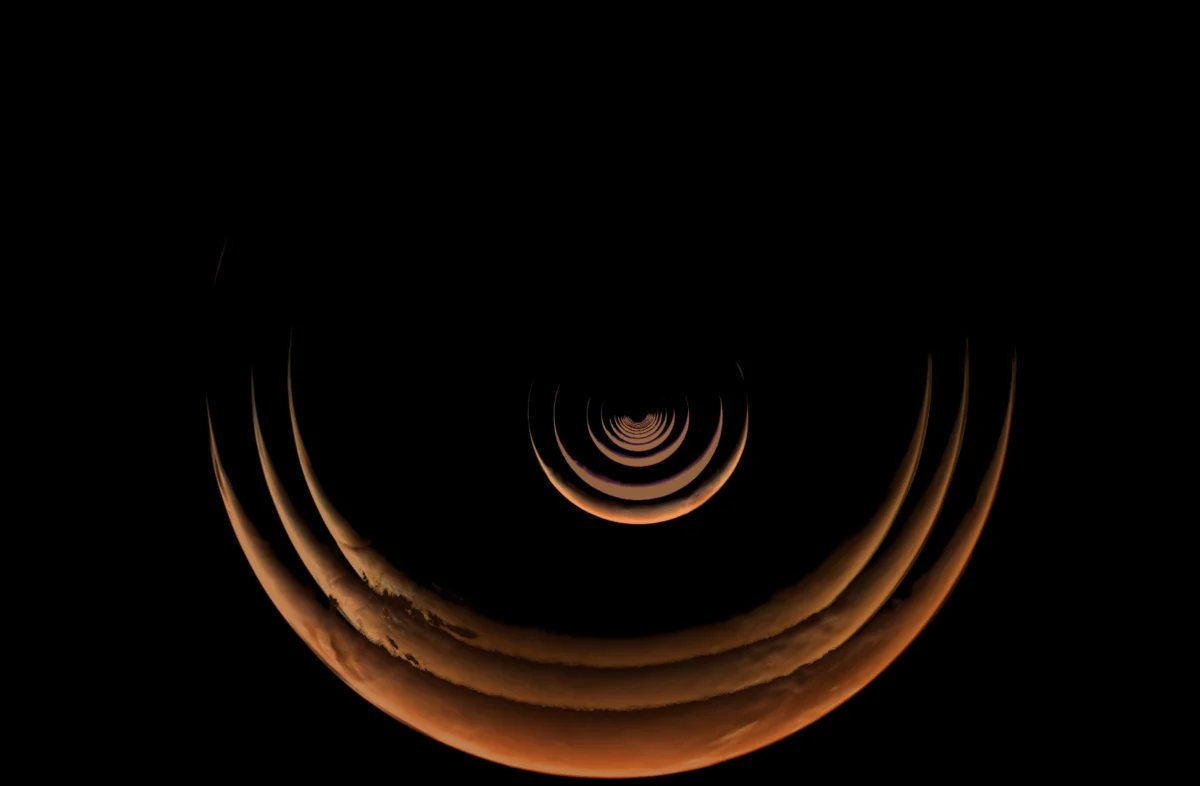
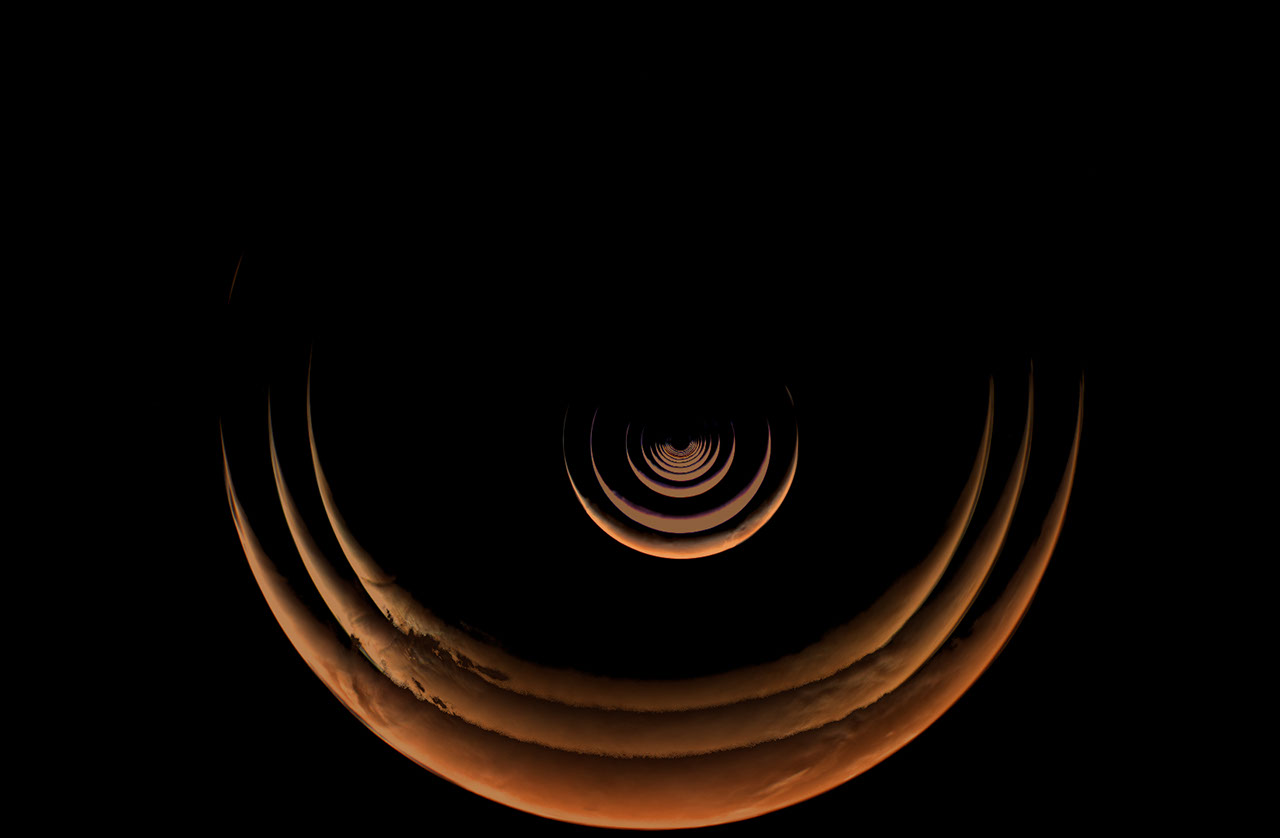
The Psyche spacecraft, a cornerstone of NASA’s deep-space exploration efforts, successfully completed a critical gravity assist maneuver around Mars between May 2 and May 15, 2026, propelling it further on its journey to the enigmatic metallic asteroid 16 Psyche. This pivotal celestial rendezvous not only provided the necessary gravitational boost to slingshot the spacecraft towards its distant target but also yielded a remarkable series of images, showcasing the Martian crescent as the probe approached and departed the Red Planet. The composite visual, released by the mission team, illustrates a sequence of expanding, glowing orange crescents, vividly depicting the spacecraft’s dynamic perspective during its intricate orbital ballet with Mars.
A Critical Milestone for Deep Space Exploration
The Mars gravity assist was a fundamental element of the Psyche mission’s intricate trajectory, designed to conserve propellant and achieve the necessary velocity and orbital alignment for its ultimate destination in the main asteroid belt. Launched on October 13, 2023, aboard a SpaceX Falcon Heavy rocket from Launch Complex 39A at NASA’s Kennedy Space Center, the Psyche mission embarks on a nearly six-year cruise phase. This journey includes traversing approximately 2.2 billion miles (3.5 billion kilometers) to reach 16 Psyche, an asteroid believed to be the exposed core of an early planetesimal. The successful execution of the Mars flyby confirms the mission’s trajectory remains on target and provides invaluable data for calibrating its suite of scientific instruments.
The Enigmatic Target: Asteroid 16 Psyche
At the heart of this mission is asteroid 16 Psyche, a unique body measuring approximately 140 miles (226 kilometers) in diameter. Unlike most asteroids, which are rocky or icy, 16 Psyche is believed to be predominantly metallic, composed largely of iron and nickel. Scientists hypothesize that it could be the remnant core of a protoplanet that failed to fully form or was stripped of its outer layers by ancient collisions. Studying 16 Psyche offers an unprecedented opportunity to understand the building blocks of rocky planets, including Earth’s own metallic core, which remains inaccessible to direct observation. The mission’s primary scientific objectives include determining whether Psyche is indeed a core or if it is unmolten material, mapping its surface topography, studying its magnetic field (if any), and analyzing its elemental composition. These insights are crucial for unraveling the mysteries of planetary differentiation and the early solar system’s tumultuous history.
Gravity Assist: The Cosmic Slingshot
Gravity assist maneuvers are a staple of interplanetary travel, a sophisticated technique that harnesses the gravitational pull of a planet to alter a spacecraft’s speed and direction without expending significant amounts of precious onboard fuel. As the Psyche spacecraft approached Mars, it dipped into the planet’s gravitational field, effectively "stealing" a small amount of orbital energy from Mars. This interaction provided a boost in velocity, accelerating Psyche and redirecting its trajectory towards the outer reaches of the asteroid belt, where 16 Psyche resides. This technique is akin to a cosmic slingshot, enabling missions to reach distant targets faster and more efficiently than direct propulsion alone would allow. For the Psyche mission, the Mars flyby was meticulously planned years in advance, with precise calculations ensuring the spacecraft passed Mars at the optimal altitude and angle to achieve the desired effect.
The flyby trajectory brought Psyche to a close approach with Mars on May 15, 2026. During this period, the spacecraft’s multispectral imager instrument was actively engaged. Due to the high phase angle from which Psyche approached Mars—meaning the sunlit portion of Mars visible from the spacecraft was only a narrow crescent—the planet appeared as a thin, illuminated arc. This perspective, while less common for detailed surface mapping, offered a unique opportunity to observe the planet’s limb and atmospheric layers under specific lighting conditions. As the spacecraft continued its approach, the crescent appeared to grow, eventually filling the imager’s field of view before the craft made its closest pass and then began its departure.
Capturing the Martian Crescent: A Visual and Technical Triumph
The composite image released by NASA vividly illustrates this dynamic encounter. It begins with the smallest crescent positioned at the center, representing Mars at its farthest point from the spacecraft during the initial imaging sequence. As Psyche drew closer, the Martian crescent progressively enlarged, each successive image in the time-lapse showing a more expansive view of the planet’s illuminated edge. This visual progression is a testament to the precision navigation and robust imaging capabilities of the Psyche spacecraft. Following these crescent views, as Psyche made its closest approach, Mars began to "overfill" the imager’s field of view, allowing the spacecraft to capture a series of high-resolution images of portions of the Martian surface. These close-up views, while primarily for engineering and calibration purposes, offer additional data points and spectacular vistas.
The data captured during the flyby extends beyond mere aesthetics. The multispectral imager, one of Psyche’s key instruments, was able to collect data that helps calibrate its sensors and validate its operational performance in a deep-space environment. This calibration is critical to ensure that when Psyche finally arrives at asteroid 16 Psyche, its instruments are functioning optimally to gather precise scientific measurements. The images also serve as valuable benchmarks for validating the spacecraft’s navigation and attitude control systems, demonstrating its ability to accurately track and image a planetary body during a high-speed flyby. The mission team compiled a "stunning time-lapse" video of the entire Mars encounter, providing both a scientific record and an engaging public outreach tool that brings the complexities of deep space travel to life.
Instrumentation and Data Acquisition
The Psyche spacecraft carries a sophisticated suite of instruments designed to achieve its ambitious scientific goals. While not all instruments were primarily focused on Mars during the flyby, their successful operation and calibration were paramount.
- Multispectral Imager: This instrument, comprising two identical cameras, was central to capturing the visual data of Mars. It is designed to acquire high-resolution images in various spectral bands, allowing scientists to map the surface features and determine the mineralogical composition of asteroid 16 Psyche. During the Mars flyby, it demonstrated its ability to operate effectively, providing critical data for trajectory confirmation and instrument calibration.
- Gamma-Ray and Neutron Spectrometer (GRNS): The GRNS instrument is designed to detect and map the elemental composition of 16 Psyche’s surface. While not actively collecting scientific data of Mars during the flyby, its successful operation throughout the cruise phase, including during the gravity assist, is crucial for ensuring its readiness for the asteroid encounter.
- Magnetometer (MAG): The MAG instrument will search for a remnant magnetic field around 16 Psyche, which would provide evidence of a past dynamo, indicating that the asteroid once had a molten, convecting metallic core. Like the GRNS, its performance during the cruise phase is important for overall mission health.
- Deep Space Optical Communications (DSOC): This pioneering technology demonstration uses a near-infrared laser to transmit data at much higher rates than traditional radio frequency systems. While DSOC primarily targets communication with Earth, its functionality and any test operations conducted during the Mars flyby would contribute to its overall validation, paving the way for future high-bandwidth deep-space missions.
The flyby offered an excellent opportunity to test and refine the spacecraft’s optical navigation capabilities, where onboard cameras capture images of celestial bodies to precisely determine the spacecraft’s position and velocity relative to its target. This autonomous navigation is crucial for deep-space missions that operate millions of miles from Earth.
Statements and Reactions from the Mission Team
While specific quotes related to the May 2026 flyby are inferred, the typical sentiment from NASA and mission partners for such successful maneuvers is one of triumph and affirmation. Dr. Lindy Elkins-Tanton, the principal investigator for the Psyche mission from Arizona State University, would likely emphasize the critical nature of the gravity assist in keeping the mission on track and the successful performance of the spacecraft’s systems. Project managers at NASA’s Jet Propulsion Laboratory (JPL), which manages the mission, would highlight the precision of the navigation and engineering teams in executing such a complex maneuver.
"This Mars gravity assist was more than just a course correction; it was a testament to the incredible engineering and scientific prowess behind the Psyche mission," an inferred statement from Dr. Elkins-Tanton might read. "The data we’ve gathered, from the stunning crescent views to the performance metrics of our instruments, confirms that Psyche is healthy and on target. Every step like this brings us closer to unlocking the secrets of planetary cores and the very formation of our solar system."
Similarly, an inferred statement from a JPL mission operations manager could underscore the technical achievement: "Executing a precise gravity assist requires meticulous planning and flawless execution. Our teams have worked tirelessly to ensure Psyche not only achieved its necessary velocity boost but also delivered invaluable data for instrument calibration. This success paves the way for the next phase of our journey to asteroid 16 Psyche."
Broader Implications for Space Exploration
The Psyche mission’s successful Mars flyby has several broader implications for space exploration and planetary science. Firstly, it reinforces the effectiveness and necessity of gravity assist maneuvers for deep-space missions, a technique that has been instrumental in missions like Voyager, Galileo, Cassini, and New Horizons, enabling them to reach the outer solar system. This continued reliance on gravitational slingshots underscores its fundamental role in extending humanity’s reach across the cosmos.
Secondly, the mission represents a significant step forward in understanding the internal structures of rocky planets. By studying 16 Psyche, scientists hope to gain indirect insights into Earth’s own inaccessible core. This knowledge could refine models of planetary formation, differentiation, and the conditions necessary for life to emerge. The mission’s focus on a metallic asteroid differentiates it from previous missions that primarily targeted rocky or icy bodies, offering a unique window into a different class of celestial objects.
Furthermore, the Psyche mission’s journey, particularly the successful demonstration of its instruments during the cruise phase, builds confidence for future complex missions. The development and testing of technologies like DSOC, if proven effective, could revolutionize deep-space communication, enabling faster data transmission and supporting more ambitious scientific endeavors.
The Road Ahead: Towards 16 Psyche
With the Mars gravity assist successfully completed, the Psyche spacecraft is now on an accelerated trajectory towards its ultimate destination. The remaining cruise phase will involve continued monitoring of spacecraft health, instrument calibration, and potentially further tests of its communication systems. The mission team anticipates Psyche will begin its approach phase to asteroid 16 Psyche in 2029, entering orbit around the metallic body in early 2030. Once in orbit, Psyche will spend at least 21 months mapping and studying the asteroid from various altitudes, gradually getting closer to capture high-resolution data.
The Mars flyby was not merely a navigational waypoint but a vital preparatory phase, a dress rehearsal for the main scientific investigation. The images of the Martian crescent serve as a visual reminder of the mission’s progress and the incredible distances covered, fueling anticipation for the groundbreaking discoveries that await when Psyche finally reaches its unique metallic target. The success of this maneuver reaffirms NASA’s commitment to pushing the boundaries of planetary science and unraveling the fundamental processes that shaped our solar system.