


Moonshot AI has officially announced the release of Kimi K3, a monumental advancement in the landscape of open-access artificial intelligence. As a sparse Mixture-of-Experts (MoE) model, Kimi K3 boasts a staggering 2.8 trillion parameters, positioning it as the largest open model of its class currently available to the global developer community. This release marks a significant milestone for Moonshot AI, a company that has consistently pushed the boundaries of large language model (LLM) scaling and long-context processing. Kimi K3 integrates native multimodal vision capabilities and a massive 1-million-token context window, designed specifically to address the complexities of long-horizon coding, intensive knowledge work, and advanced reasoning tasks.
The arrival of Kimi K3 represents the culmination of a year-long strategy to dominate the open-model size category. According to internal data provided by the Moonshot team, Kimi models have defined the upper bound for open-model parameters for nine of the past twelve months. By providing a 3T-class model to the public, Moonshot AI aims to narrow the gap between proprietary frontier models and open-source alternatives, offering researchers and enterprises a high-capacity tool for building sophisticated AI-driven applications.
A Chronological Evolution of the Kimi Series
The development of Kimi K3 is not an isolated event but the latest step in a rapid iterative cycle. Moonshot AI first gained international attention with the release of Kimi K1, which focused on establishing a foothold in the long-context market. This was followed by Kimi K2, which refined the training recipes and introduced more efficient scaling laws.
In early 2025, Moonshot AI began signaling a shift toward massive-scale MoE architectures, recognizing that dense models were becoming increasingly difficult to train and deploy at the trillion-parameter scale. Throughout the first half of 2026, the engineering team focused on solving the "routing" problem—ensuring that the model could accurately select the most relevant "experts" within the architecture without incurring massive computational overhead. The release of Kimi K3 in July 2026 serves as the realization of this architectural pivot, delivering 2.5 times better overall scaling efficiency than its predecessor, Kimi K2.
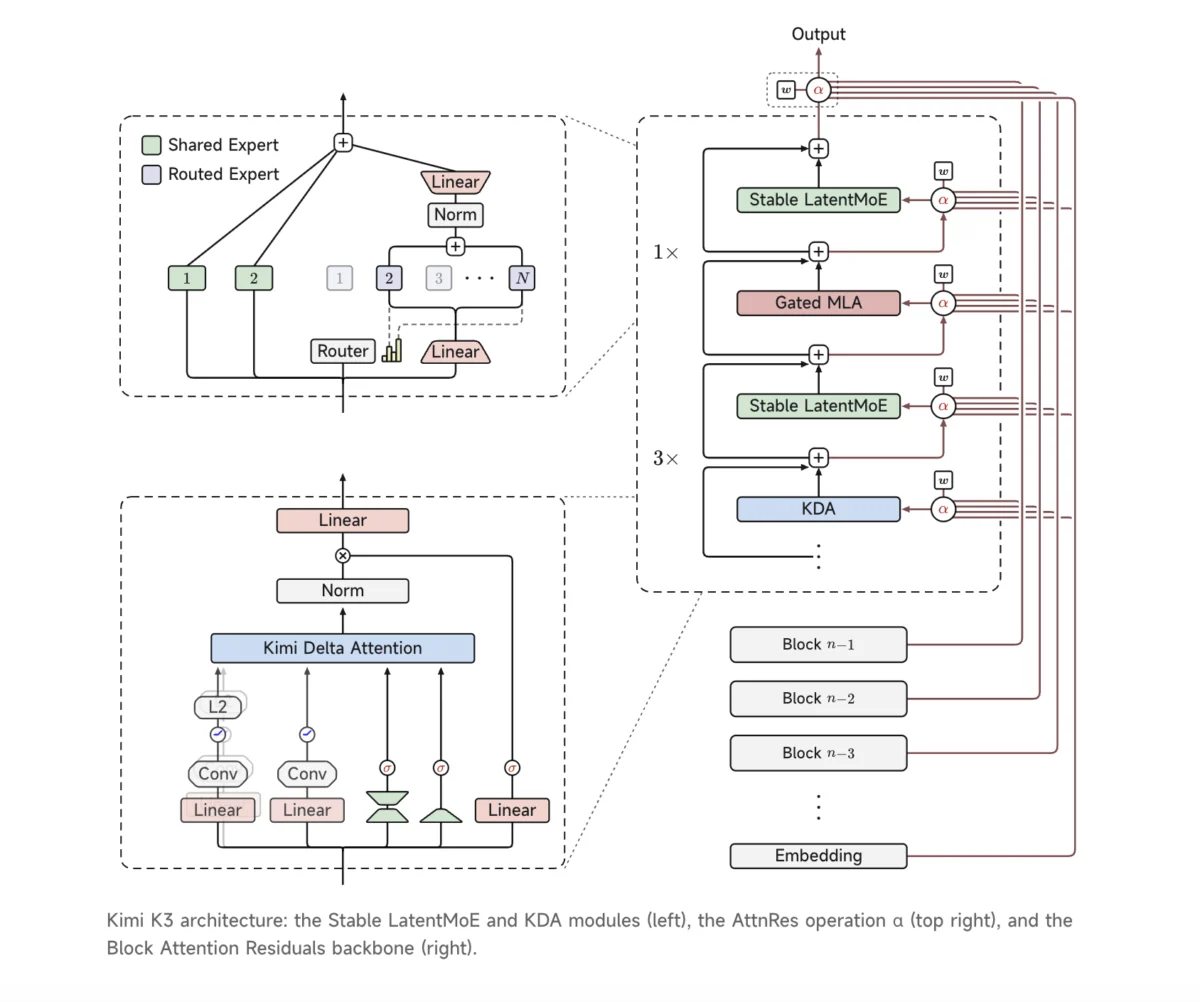
Technical Architecture: KDA, AttnRes, and Stable LatentMoE
The performance of Kimi K3 is rooted in several foundational architectural innovations designed to optimize how information flows across both sequence length and model depth. Two of the most prominent updates are Kimi Delta Attention (KDA) and Attention Residuals (AttnRes).
Kimi Delta Attention (KDA)
KDA is a hybrid linear attention mechanism that addresses the traditional "attention bottleneck" found in long-context models. In standard transformer architectures, the computational cost of attention grows quadratically with the length of the input. KDA mitigates this by allowing for more efficient information retrieval, enabling Kimi K3 to achieve up to 6.3x faster decoding speeds in million-token contexts compared to standard attention mechanisms. This is particularly critical for real-time applications where users need to query massive documents or code repositories.

Attention Residuals (AttnRes)
While KDA focuses on horizontal sequence length, AttnRes optimizes the vertical axis of model depth. Traditional models often accumulate representations uniformly across layers, which can lead to information dilution in very deep networks. AttnRes allows the model to selectively retrieve representations across different depths. Moonshot AI reports that this innovation delivers approximately 25% higher training efficiency with a negligible increase in computational cost (less than 2%).
Sparsity and Expert Routing
Kimi K3 utilizes a "Stable LatentMoE" structure. Out of a total of 896 specialized experts, the model dynamically activates only 16 for any given token. Managing this level of sparsity required the development of Quantile Balancing, a method that derives expert allocation directly from router-score quantiles. This approach eliminates the need for heuristic updates and sensitive balancing hyperparameters that often plague large-scale MoE training.
Furthermore, the model incorporates Per-Head Muon, an optimization technique that allows attention heads to be optimized independently, and the Sigmoid Tanh Unit (SiTU), which improves activation control. These components, alongside Gated Multi-Head Latent Attention (MLA), ensure that Kimi K3 maintains high precision even as it scales to trillions of parameters.
Benchmark Performance and Comparative Analysis
Moonshot AI has been transparent regarding Kimi K3’s standing relative to the most powerful proprietary models on the market. While K3 sets a new standard for open models, it still trails the leading edge of closed-source systems such as Claude Fable 5 and GPT 5.6 Sol in certain high-reasoning benchmarks. However, across Moonshot’s internal evaluation suite, K3 consistently outperformed other open-access models and even surpassed frontier models in specific domains.
Comparative Results Table
| Benchmark | Kimi K3 | Fable 5 (w/ fallback) | GPT 5.6 Sol | Opus 4.8 | GLM-5.2 |
|---|---|---|---|---|---|
| DeepSWE | 67.5 | 70.0 | 73.0 | 59.0 | 46.2 |
| Program Bench | 77.8 | 76.8 | 77.6 | 71.9 | 63.7 |
| Terminal Bench 2.1 | 88.3 | 84.6 | 88.8 | 84.6 | 82.7 |
| FrontierSWE | 81.2 | 86.6 | 71.3 | 66.7 | 67.3 |
| SWE Marathon | 42.0 | 35.0 | 39.0 | 40.0 | 13.0 |
| BrowseComp | 91.2 | 88.0 | 90.4 | 84.3 | — |
| Automation Bench | 30.8 | 29.1 | 29.7 | 27.2 | 12.9 |
| GPQA-Diamond | 93.5 | 92.6 | 94.1 | 91.0 | 91.2 |
| OmniDocBench | 91.1 | 89.8 | 85.8 | 87.9 | — |
The data indicates that Kimi K3 is particularly dominant in software engineering and document analysis, leading in Program Bench, SWE Marathon, and OmniDocBench. Notably, its performance in SWE Marathon (42.0) suggests a superior ability to handle long-running, complex engineering tasks that require maintaining a coherent state over many steps.
Multimodal Capabilities and Real-World Use Cases
Kimi K3 is not merely a text-based model; it is a native multimodal architecture. This means that text, images, and video are processed within a single unified framework, rather than through separate adapter modules. This integration allows for "vision-in-the-loop" workflows where the model can iterate between generating code and analyzing live screenshots of the resulting interface.
Key Use Cases
- Repo-Scale Engineering: Developers can utilize Kimi K3 for long sessions with minimal human oversight. Its ability to ingest entire repositories through the 1M context window allows it to perform system-wide refactoring and bug hunting.
- Deep Research Reproduction: The model has demonstrated the ability to process over 20 academic papers and 3,000 lines of Python code simultaneously to reproduce complex research results, such as the "I-Love-Q" relations in physics.
- Automated Document Parsing: With a score of 91.1 on OmniDocBench, K3 is highly effective at converting complex, visually-rich documents into structured data formats.
- Long-Horizon Research Reports: Moonshot highlighted an example of a 42-year ASIC (Application-Specific Integrated Circuit) study where the model fetched over 2,800 data points from 11,000 pages of documentation to produce a comprehensive synthesis.
Deployment, Pricing, and Infrastructure Requirements
Deploying a 2.8T parameter model presents significant hardware challenges. Moonshot AI recommends "supernode" configurations consisting of at least 64 high-end accelerators to run Kimi K3 effectively. To assist with the computational burden, the model uses quantization-aware training (QAT) starting from the Supervised Fine-Tuning (SFT) stage. It utilizes MXFP4 weights with MXFP8 activations, a configuration chosen for its broad compatibility with modern hardware.

Moonshot AI has also contributed an implementation of KDA to the vLLM library to help the community manage prefix caching, which is particularly complex in hybrid attention architectures.
API Pricing Structure
Moonshot AI has implemented a flat pricing model that does not penalize users for context length, focusing instead on cache efficiency.
- Cache-Hit Input: $0.30 per million tokens (MTok)
- Cache-Miss Input: $3.00 per MTok
- Output: $15.00 per MTok
The company reports that in typical coding workloads, users can expect a cache-hit rate of over 90%, significantly reducing the effective cost of operating at scale.
Industry Implications and Future Outlook
The release of Kimi K3 is likely to trigger a new wave of competition in the open-source AI sector. By proving that a 3T-class model can be effectively trained and shared, Moonshot AI is challenging the narrative that only the largest "Big Tech" firms can develop trillion-parameter systems.
Industry analysts suggest that the success of Kimi K3 will put pressure on other open-source contributors, such as Meta and Mistral, to accelerate their own high-parameter roadmaps. Furthermore, the emphasis on "long-horizon" tasks suggests that the AI industry is moving away from simple chat interactions toward "agentic" workflows where models act as autonomous collaborators on complex projects.
As enterprises begin to integrate Kimi K3 into their stacks, the focus will likely shift from raw parameter counts to the efficiency of the "expert" routing and the practical utility of the 1M context window. Moonshot AI’s commitment to contributing to open libraries like vLLM indicates a desire to not only provide the model but also the infrastructure necessary to make trillion-parameter AI a viable reality for the broader market.