


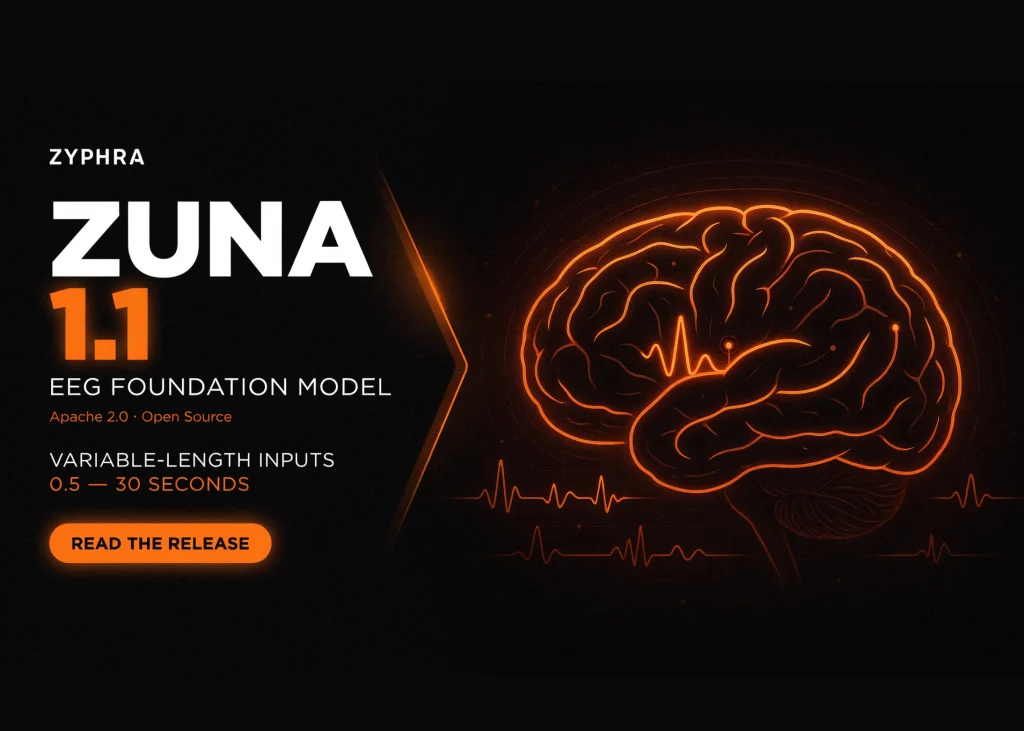
In a significant advancement for the field of computational neuroscience and generative artificial intelligence, Zyphra has officially released ZUNA1.1, an upgraded version of its open-source electroencephalogram (EEG) foundation model. Distributed under the permissive Apache 2.0 license, ZUNA1.1 represents a leap forward in the ability to reconstruct, denoise, and upsample neural data across arbitrary channel layouts. By building upon the architecture of the original ZUNA1, this new iteration addresses the inherent "messiness" of real-world neurological recordings, offering researchers and developers a robust toolset for handling variable-length data and inconsistent electrode configurations.
The release of ZUNA1.1 comes at a time when the integration of deep learning and neurotechnology is accelerating. While traditional EEG analysis often relies on rigid preprocessing pipelines and fixed sensor arrays, ZUNA1.1 introduces a level of flexibility designed to accommodate everything from consumer-grade four-electrode headbands to high-density 256-channel research caps. This adaptability is crucial for clinical and field applications where signal dropouts, sensor noise, and varying session lengths are common obstacles to high-quality data interpretation.
The Evolution of ZUNA: Addressing the Real-World Challenges of EEG
The transition from ZUNA1 to ZUNA1.1 is defined less by an increase in raw parameter count and more by a fundamental shift toward operational versatility. Electroencephalography, the measurement of electrical activity in the brain via electrodes placed on the scalp, is notoriously sensitive to external interference. In a laboratory setting, a technician might ensure perfect contact for every electrode, but in longitudinal studies or clinical environments, channels frequently go "noisy" or fail entirely mid-session.
ZUNA1, while groundbreaking as an open foundation model, was constrained by a requirement for fixed five-second data segments. This limitation necessitated significant manual trimming and alignment of data before the model could process it. ZUNA1.1 removes this bottleneck by accepting variable-length inputs ranging from 0.5 to 30 seconds. This capability allows the model to be integrated into real-time monitoring systems and diverse research workflows without the need for extensive reconfiguration.
Furthermore, ZUNA1.1 maintains a 380-million parameter architecture, a size that balances high-performance inference with accessibility. The model is designed to run efficiently on consumer-grade GPUs and remains functional on CPUs for lighter workloads, ensuring that institutions with limited computational resources can still leverage state-of-the-art neural signal processing.
Technical Architecture: Tokenization and 4D Positional Encoding
At its core, ZUNA1.1 is a transformer encoder-decoder diffusion autoencoder. The model operates by "masking" portions of the EEG signal—either specific channels or time segments—and then using a diffusion process to reconstruct the missing information. The effectiveness of this approach relies on a sophisticated tokenization strategy.
The model slices each EEG channel into 0.125-second segments, which corresponds to 32 samples at a 256 Hz sampling rate. Each of these segments is converted into a continuous-valued token. These tokens are then serialized in a channel-by-time order. However, the true innovation lies in the positional encoding.
ZUNA1.1 utilizes a 4D rotary positional encoding (RoPE) that covers three-dimensional scalp coordinates (x, y, z) and a coarse-time index (t). This spatial awareness is what makes the model "channel-agnostic." Instead of identifying a signal by its index in an array (e.g., "Channel 1"), the model understands the signal based on where the electrode is physically located on the human head. Consequently, ZUNA1.1 can process any electrode layout and even generate synthetic signals for scalp positions where no physical electrode was present. This allows for arbitrary channel upsampling, effectively "filling in the gaps" of sparse sensor arrays to mimic the resolution of high-density montages.
The encoder compresses the input signals into a latent representation, which then conditions the decoder via adaptive-RMS normalization. The training objective utilizes rectified flow, a method in generative modeling that facilitates a straighter, more efficient path for the diffusion process to transform noise into coherent signal data.
Enhanced Training Methodology and Data Corpus Expansion
The improvements in ZUNA1.1 are largely a product of a more sophisticated training regimen and a significantly expanded dataset. Zyphra’s engineering team focused on four key areas to enhance the model’s robustness:
-
Variable-Length Input Handling: To enable the 0.5–30 second input range, ZUNA1.1 was trained using a sampled segment length per example, snapped to a 0.125-second token grid. The training process utilized four distinct bins of lengths, with a heavy emphasis on the 1.5 to 10-second range, which represents the most common operating window for EEG analysis. To maintain computational efficiency, the team implemented "Flex Attention," a mechanism that allows multiple segments to be packed into a single batch while preventing tokens from one sample from attending to tokens in another.
-
Diversified Reconstruction Tasks: While the original ZUNA1 was trained primarily on uniform random whole-channel dropout, ZUNA1.1 incorporates four distinct dropout patterns. These include whole-channel dropout (to simulate dead electrodes), short time-stretch removal across all channels (to simulate brief signal interruptions), clustered gaps in space and time, and scattered missing values. This variety ensures the model can handle a wide spectrum of data corruption scenarios.

-
Quality-Aware Preprocessing: One of the most significant hurdles in EEG foundation models is the quality of the training data. ZUNA1 previously made quality assessments at the whole-recording level, which often led to the disposal of usable segments from otherwise noisy files. ZUNA1.1 adopts a more granular approach, computing a per-channel, per-second quality score. This refined filtering allowed Zyphra to expand its training corpus from approximately 2 million channel-hours to 3.5 million channel-hours of public EEG data.
-
Preprocessing Generalization: The model was trained on two primary filter variants: a 0.1–45 Hz bandpass and a 0.01 Hz highpass combined with a notch filter. This dual-track training helps the model generalize across different preprocessing strategies commonly used in various laboratories.
Benchmarking Results: Accuracy and Reliability
A primary concern during the development of ZUNA1.1 was whether the increased flexibility would result in a loss of reconstruction accuracy. Internal testing conducted by Zyphra indicates that ZUNA1.1 meets or exceeds the performance of its predecessor.
On held-out tasks, ZUNA1.1 achieved a Normalized Mean Squared Error (NMSE) that was either equal to or better than ZUNA1. When compared to classical interpolation methods, such as the spherical-spline interpolation found in the popular MNE-Python library, ZUNA1.1 demonstrated a clear superiority in reconstructing missing signals.
In a more challenging "region-based" evaluation—where all electrodes from a specific brain region are removed and then reconstructed based on the remaining sensors—ZUNA1.1 significantly outperformed both ZUNA1 and traditional spline methods. This suggests that the model has developed a deep internal representation of how neural signals propagate across the scalp, allowing it to infer complex regional activity from distant sensors.
Practical Implementation and Accessibility
Zyphra has prioritized ease of use for the research community. The model weights are hosted on Hugging Face, while the inference and preprocessing code are available on GitHub. Installation is streamlined through the Python package manager with the command pip install zuna.
For those who prefer a low-code environment, Zyphra provides a free browser-based "EEG Playground," allowing users to visualize the model’s denoising and reconstruction capabilities without local installation. The Python API has also been simplified; the reconstruct_fif function allows users to process standard .fif files (the format used by the MNE library) directly.
The software architecture allows for two types of output:
- Full Reconstruction: A complete model-generated output for all requested channels and time segments.
- Hybrid Output: A version that preserves the original recorded data while infilling only the segments and channels that were marked as "bad" or missing.
Broader Implications for Neurotechnology and AI
The release of ZUNA1.1 carries significant implications for several sectors. In the clinical realm, the ability to "repair" corrupted EEG segments could reduce the need for re-testing patients, saving time and resources. For researchers, the channel-agnostic nature of the model means that data from different studies, recorded with different equipment, can be more easily pooled and standardized for meta-analyses.
In the burgeoning field of Brain-Computer Interfaces (BCI), ZUNA1.1 provides a powerful backend for cleaning the noisy signals often produced by non-invasive consumer hardware. By upsampling low-channel-count devices, the model could potentially enable high-fidelity neural control and monitoring using simpler, more comfortable headsets.
Moreover, by releasing the model under an Apache 2.0 license, Zyphra is fostering an "open science" ecosystem. This contrasts with the proprietary, "black box" models often developed by private neurotech firms, allowing the global scientific community to audit the model’s performance, improve its architecture, and adapt it for specialized medical or psychological research.
As foundation models for biological signals continue to evolve, ZUNA1.1 serves as a benchmark for how AI can handle the inherent variability of human physiology. The move toward flexible, spatial-aware architectures marks a departure from rigid signal processing and points toward a future where AI can seamlessly interpret the complexities of the human brain, regardless of the hardware used to capture it.