


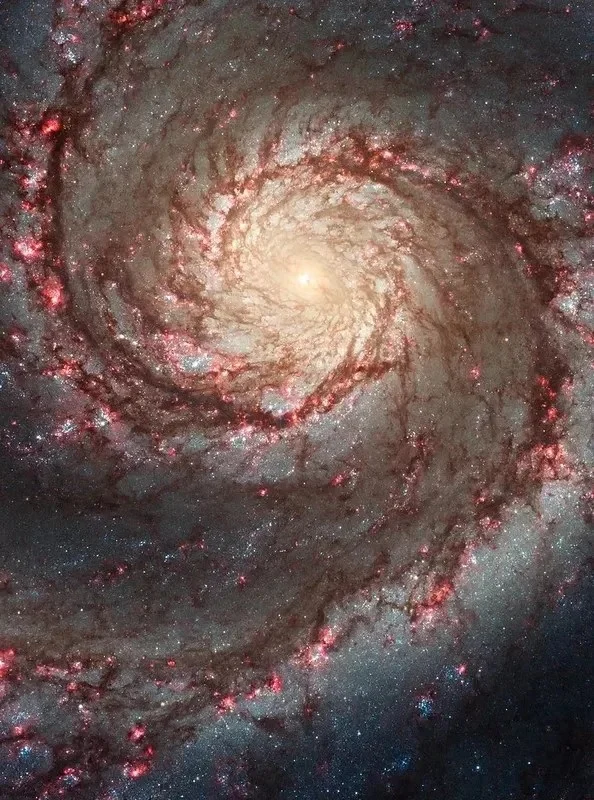
The NASA/ESA Hubble Space Telescope has delivered a striking new image of NGC 4654, an intermediate spiral galaxy situated approximately 72 million light-years from Earth within the gargantuan Virgo Cluster. This celestial portrait, released on July 24, 2026, reveals a galaxy profoundly shaped by the immense gravitational and hydrodynamic forces prevalent in dense galactic environments, offering astronomers crucial insights into the complex processes of galaxy evolution. NGC 4654 presents a distinctly asymmetric form, a testament to a cosmic tug-of-war that has sculpted its very structure and influenced its star-forming activity.
The Hubble Perspective: A Glimpse into Galactic Dynamics
The image, captured by the venerable Hubble Space Telescope, showcases NGC 4654 in exquisite detail, highlighting its unique characteristics. Classified as an intermediate spiral galaxy, its morphology lies between those with prominent central bars and those without. NGC 4654 exhibits a weak bar structure at its core, a feature that often plays a role in channeling gas towards the galactic nucleus, potentially fueling star formation or active galactic nuclei. However, it is the galaxy’s pronounced asymmetry that immediately draws the eye, revealing a cosmic narrative of disruption and resilience.
Hubble, orbiting Earth since its launch in 1990, continues to be an indispensable tool for astronomers, providing unparalleled high-resolution images in visible, ultraviolet, and near-infrared light. Its stable orbital platform above Earth’s distorting atmosphere allows for observations of distant galaxies and nebulae with a clarity unmatched by ground-based telescopes for many wavelengths. For NGC 4654, Hubble’s data, derived from two specific observing programs (15654 and 17502), has been instrumental in dissecting the galaxy’s gas distribution and star formation patterns, crucial elements in understanding its dynamic state.
Unveiling Galactic Dynamics: The Role of Ram Pressure Stripping
One of the primary forces shaping NGC 4654 is ram pressure stripping, a phenomenon frequently observed in galaxies residing within crowded galaxy clusters. As NGC 4654 hurtles through the Virgo Cluster at high velocity, it encounters the intracluster medium (ICM) – a vast reservoir of hot, rarefied gas that fills the space between the cluster’s myriad galaxies. This encounter is akin to a cosmic headwind; the galaxy’s rapid motion generates a "ram pressure" that effectively sweeps away its own interstellar gas.
The effects of ram pressure stripping are starkly visible in NGC 4654. The galaxy’s leading edge, facing the direction of its motion through the ICM, appears compressed and sharply defined. Conversely, a long, diffuse tail of gas stretches out from the opposite side, extending beyond the field of view captured by Hubble. This gaseous wake is direct evidence of the intracluster medium exerting its force, dragging material from the galaxy’s disk. This process is critical because interstellar gas is the raw material for star formation. When this gas is stripped away, it can significantly reduce a galaxy’s ability to create new stars, potentially leading to its eventual quiescence.
The Virgo Cluster, to which NGC 4654 belongs, is the closest large galaxy cluster to our own Local Group, located approximately 50 to 70 million light-years away. It contains over 1,300, and possibly up to 2,000, galaxies, making it a bustling environment where such intergalactic interactions are common. Understanding the dynamics within clusters like Virgo is fundamental to comprehending the evolutionary pathways of galaxies across the universe.
The Tidal Dance: A Gravitational Interaction with NGC 4639
While ram pressure stripping accounts for the overall gas removal and compression on NGC 4654’s leading edge, it does not fully explain the galaxy’s peculiar stellar asymmetry. The Hubble image reveals that while the spiral arm on its leading side is rich in both gas and stars, the opposing arm conspicuously lacks stars, contributing significantly to the galaxy’s lopsided spiral shape. This more unusual stellar distribution points to another powerful force at play: a past gravitational interaction.
Astronomers postulate that approximately 500 million years ago, NGC 4654 experienced a close fly-by encounter with another prominent Virgo Cluster member, NGC 4639. NGC 4639 is a barred spiral galaxy, also residing within the Virgo Cluster, and is known for its own interesting features, including a moderately active galactic nucleus. Although the two galaxies are now far apart, their ancient close approach would have exerted immense tidal forces on NGC 4654. Tidal forces, generated by the differential gravitational pull across an extended object, can rip apart a galaxy’s outer regions, distort its spiral arms, and even strip away gas and stars.
This ancient "tidal dance" with NGC 4639 is believed to have played a crucial role in shaping NGC 4654’s stellar distribution, specifically by stripping away gas from one side of the galaxy. The loss of this cold, star-forming gas would have subsequently limited the birth of new stars in that region, leading to the observed asymmetry in its stellar population. This dual impact of ram pressure stripping and tidal interaction provides a comprehensive explanation for NGC 4654’s complex and unique morphology. Such multi-faceted interactions highlight the intricate and often violent evolutionary paths galaxies undertake within dense environments.
A Galaxy Defying Expectations: Sustained Star Formation
Despite undergoing significant gas loss due to both ram pressure stripping and a past tidal encounter, NGC 4654 exhibits a surprising resilience: it continues to form stars at a robust rate. The galaxy is estimated to produce nearly two Suns’ worth of new stars every year, a rate comparable to other galaxies of similar size that are not experiencing such intense environmental pressures. This sustained star formation challenges the notion that gas-stripping mechanisms invariably lead to a rapid decline in stellar birth.
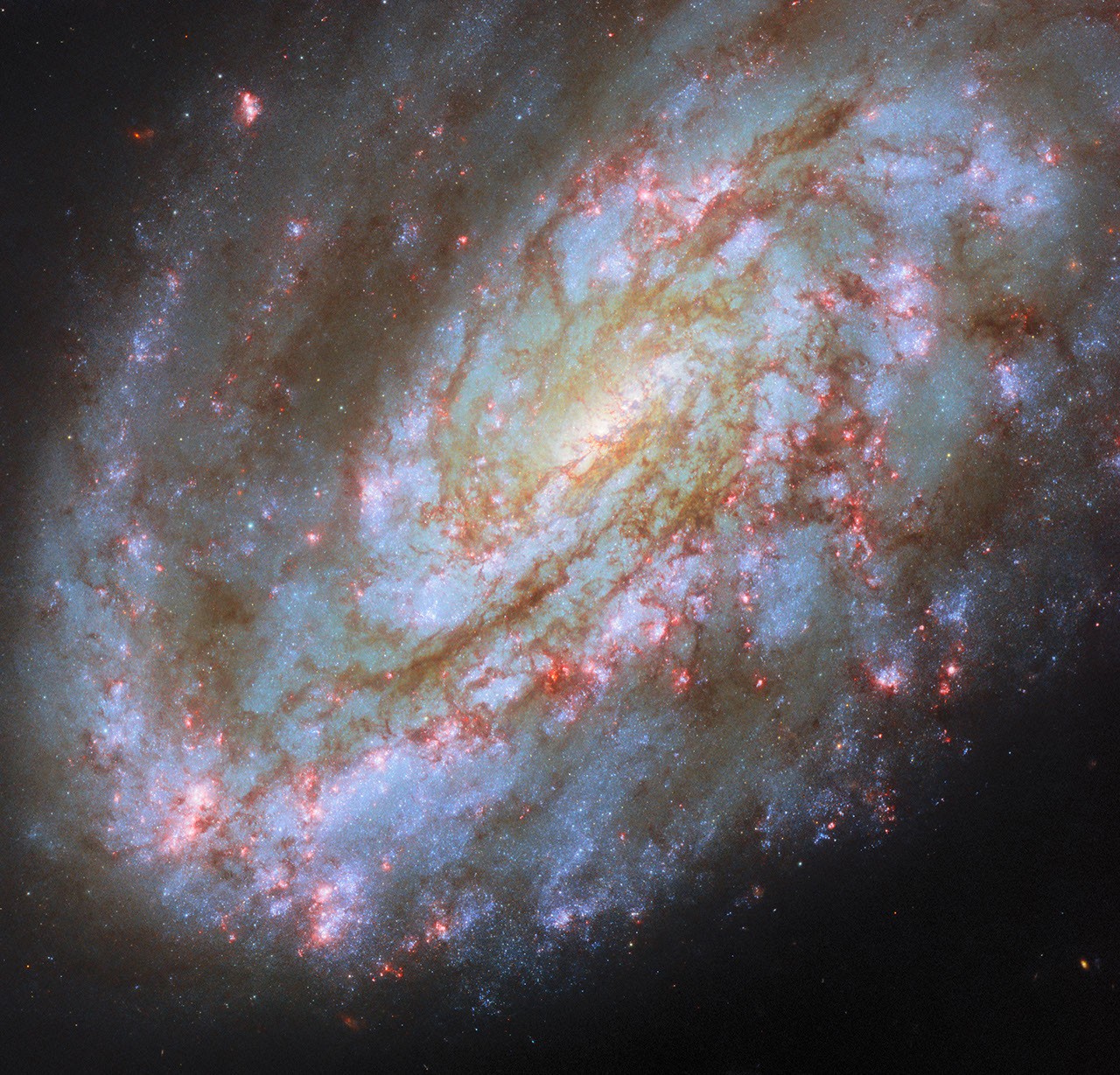
The Hubble data provides direct evidence of this ongoing star formation. The image highlights numerous bright pink bubbles scattered across NGC 4654’s disk, from its forward spiral arm to areas around its weak central bar and extending to its outer edges. These vibrant regions are colossal clouds of energized hydrogen gas, known as H-II regions, which glow brightly in specific wavelengths of red light when ionized by the intense ultraviolet radiation from newly born, massive stars. These H-II regions serve as stellar nurseries, marking areas where the interstellar gas has condensed and collapsed under gravity to ignite new generations of stars.
The detection of these H-II regions in the latest Hubble data underscores that despite the loss of gas from its outer reaches, NGC 4654 still retains sufficient cold, dense gas in its inner regions to sustain active star formation. This suggests that while environmental forces can remove gas from a galaxy, the internal dynamics, perhaps driven by the weak central bar or localized gas concentrations, can still facilitate the conditions necessary for star birth. This observation provides valuable empirical data for theoretical models attempting to predict star formation rates in galaxies subjected to external stripping mechanisms.
The Scientific Quest: Linking Gas to Star Formation
The data used for this captivating image of NGC 4654 originates from two dedicated Hubble observing programs, 15654 and 17502. These programs are part of a broader scientific endeavor aimed at establishing a clearer link between the distribution and kinematics of gas within galaxies and their rates of star formation. By meticulously observing a diverse sample of prominent galaxies in our cosmic neighborhood, researchers seek to unravel fundamental questions in astrophysics: How does gas move within galaxies? Where and when does it reach the critical densities required to collapse and form stars and star clusters? And what impact do these nascent stars have on their surrounding gaseous environments?
Understanding these processes is crucial for building comprehensive models of galaxy evolution. The interstellar medium (ISM), composed of gas and dust, is the lifeblood of galaxies. Its properties – temperature, density, composition, and kinematics – dictate the pace and patterns of star formation. Environmental factors like ram pressure stripping and tidal interactions significantly perturb the ISM, making galaxies like NGC 4654 natural laboratories for studying these complex interplays.
The detailed H-alpha emission data captured by Hubble, which traces ionized hydrogen, is a direct indicator of massive star formation. By combining this with observations of other gas components (e.g., molecular hydrogen, atomic hydrogen, and hotter X-ray emitting gas), astronomers can paint a more complete picture of how gas is distributed, removed, and recycled within galaxies. The long-term goal is to refine our understanding of how galaxies acquire, retain, and lose their gas, ultimately influencing their star-forming histories and their evolution over cosmic timescales.
The Enduring Legacy of Hubble and Future Implications
The continued observations from the Hubble Space Telescope, even decades after its launch, underscore its unparalleled scientific value. While newer observatories like the James Webb Space Telescope (JWST) offer unprecedented views into the infrared universe, Hubble’s capabilities in the visible and ultraviolet spectrum remain critical for studying phenomena like star formation and galactic interactions in the nearby universe. The sharpness of Hubble’s images allows for the resolution of individual star-forming regions within galaxies like NGC 4654, providing granular detail that is essential for robust scientific analysis.
The insights gained from studying NGC 4654 contribute significantly to our broader understanding of how galaxies evolve in the dynamic environments of galaxy clusters. It reinforces the idea that galaxy evolution is not a solitary process but one deeply influenced by cosmic neighbors and the intergalactic medium. The delicate balance between internal galactic processes, such as the flow of gas and the formation of spiral arms, and external environmental forces, like ram pressure and tidal interactions, dictates the ultimate fate of a galaxy.
Further studies, perhaps incorporating multi-wavelength data from other observatories, will likely delve deeper into the specific properties of the gas in NGC 4654, including its temperature and chemical composition, to fully characterize its ongoing star formation and the long-term implications of its environmental struggles. These investigations will help astronomers piece together the intricate puzzle of galaxy transformation, revealing how the grand cosmic ballet of gravitational pulls and gaseous pressures shapes the universe we observe today. The image of NGC 4654 is not just a beautiful picture; it is a profound data point in humanity’s quest to understand the life and death of galaxies.
Media Contact:
Claire Andreoli
NASA’s Goddard Space Flight Center, Greenbelt, MD
[email protected]