


Larry David, the comedic force behind the acclaimed series Curb Your Enthusiasm, has made a highly anticipated return to HBO Max with his new sketch comedy show, Life, Larry and the Pursuit of Unhappiness. The series, which delves into American history with David at the helm, premieres on the heels of the conclusion of his long-running observational comedy. Executive produced by former President Barack Obama and Michelle Obama through their Higher Ground Productions, the show features an ambitious ensemble cast of dozens of celebrity guests portraying pivotal historical figures. This venture marks a significant departure from David’s signature improvisational style, leaning into scripted sketches that reimagine historical events with his unique comedic lens.
The production boasts an extensive roster of talent, drawing from both David’s Curb Your Enthusiasm collaborators and a wide array of Hollywood A-listers. Notably, the series includes the final screen performance of the late Rob Reiner, who also had a recurring role on Curb Your Enthusiasm. Major stars such as Samuel L. Jackson, Lin-Manuel Miranda, Jerry Seinfeld, and Jon Hamm are among the many who don period costumes and wigs to inhabit historical personas. The Hollywood Reporter is providing comprehensive coverage, detailing the appearances and contributions of each notable guest star, acknowledging their integral role in bringing David’s comedic interpretations of history to life.
Life, Larry and the Pursuit of Unhappiness airs new episodes on Friday nights at 9 p.m. ET on HBO and is available for streaming on HBO Max.
Episode Breakdown and Notable Appearances
Episode 1: "Livingston"
The premiere episode sets a high bar, featuring a special introduction by executive producer Barack Obama, appearing as himself. Obama, whose Higher Ground Productions is a driving force behind the series, offers a blend of patriotic sentiment and lighthearted jabs at David, embracing his role as a respected elder statesman commenting on the nation’s approaching semiquincentennial. The narration is provided by Samuel L. Jackson, whose distinctive voice has become a staple in contemporary film and television.
The episode kicks off with a sketch depicting the drafting of the Declaration of Independence. Henry Winkler portrays John Hancock, Chris Parnell takes on the role of Benjamin Franklin, and Alan Tudyk embodies Thomas Jefferson. They are seen rejecting additions proposed by David’s character, Robert Livingston, to the document’s grievances. Following this, David appears as Alexander Graham Bell, struggling to engage in polite conversation with Richard Kind, who plays Thomas Watson, during the public debut of the telephone. The scene is populated by anachronistically demanding spectators, portrayed by sitcom veterans Alison Becker, Mary Sohn, and Rodney J. Hobbs, who express desires for features like text messaging and color options for the revolutionary device.
A subsequent sketch transports viewers to the trenches of World War I, where David plays a timid soldier under the command of Michael Chiklis as a gruff sergeant. Mike Castle and Jake Reiner, son of the late Rob Reiner, join as fellow soldiers. The episode concludes with David as an intrusive bus passenger who encounters Jurnee Smollett in a poignant portrayal of civil rights icon Rosa Parks. This juxtaposition of historical reverence with David’s signature awkward social interactions underscores the show’s unique comedic premise.
Episode 2: "Farewell"
This episode opens with a highly anticipated reunion between Larry David and Jerry Seinfeld, creators of the iconic 1990s sitcom Seinfeld. The duo portrays explorers Lewis and Clark, embarking on their historic expedition. Rita Wilson appears as Mavis Lewis, the long-suffering wife of Meriwether Lewis, who wryly observes the seemingly convenient nature of their prolonged journey.
David then tackles the contentious 1876 presidential election, playing Samuel Tilden, who narrowly lost the Electoral College despite winning the popular vote. Matthew Jones and Rich Fulcher portray Tilden’s aides as he grapples with the outcome. The setting shifts to the Great Depression, where David is joined by Larry Wilmore and Colton Dunn. A particularly memorable segment features Kaley Cuoco as a widow whose place in a breadline David attempts to usurp.
The episode culminates in the final on-screen appearance of Rob Reiner, who portrays George Washington. In a sketch that subtly critiques presidential term limits and alludes to contemporary political figures without direct naming, Reiner’s Washington engages in a discussion that sets the stage for veiled commentary on Donald Trump. Jimmy Kimmel also makes a meta-appearance, referencing his ongoing public feud with Trump.
Episode 3: "McCarthy"
Episode three sees David inserting himself into the Boston Tea Party, playing a character who is left out of the revolutionary act. Lin-Manuel Miranda, drawing on his Hamilton legacy, delivers a spirited performance as one of the event’s organizers. Comedian Lou DiMaggio also features in this segment.
J.B. Smoove’s character, Jonesey, makes an appearance on the Underground Railroad, presenting a series of demanding requests that flabbergast his host. In a comedic twist on the Wright brothers’ story, David plays a less-than-accomplished Wright sibling, engaged in a domestic dispute over butter-churning with his wife, portrayed by Isla Fisher. Jon Hamm and Sean Hayes step into the roles of Orville and Wilbur Wright, respectively, preparing for their historic flight.
The episode’s most discussed segment features David as Senator Joseph McCarthy. Michael McKean, known for Saturday Night Live and Better Call Saul, delivers a powerful performance as attorney Joseph Welch, recreating the iconic "Have you no decency, sir?" moment. Rob Huebel appears as a senator moderating one of McCarthy’s infamous hearings, adding to the intense atmosphere.
Episode 4: "Deepthroat"
The fourth episode tackles the Watergate scandal through David’s unique comedic filter. He plays "Deep Throat," the anonymous informant, but his character provides trivial, nonsensical information to Beck Bennett’s Bob Woodward during their clandestine meeting in a parking lot.
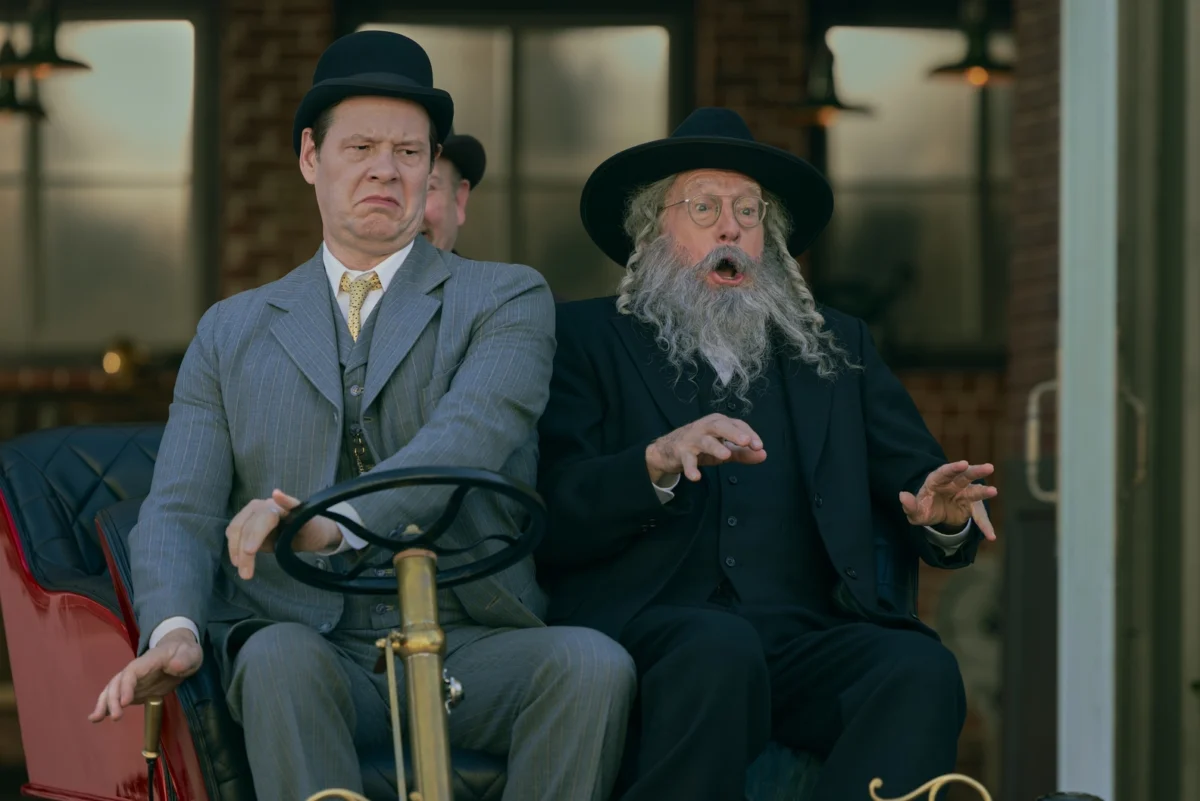
In another sketch, Ike Barinholtz portrays Henry Ford, who expresses displeasure at showing his new vehicle to David’s rabbi character, highlighting Ford’s documented antisemitism. David then plays President James Buchanan, depicted as a lecherous figure at a party, making unwanted advances toward women. Jordana Brewster and Katie Aselton are among the women who encounter Buchanan, while Diallo Riddle appears as his assistant, John Appleton.
The episode’s standout moment is a parody of a Jonas Salk anecdote. David plays Dora Salk, the overly proud mother of the polio vaccine discoverer, boasting about her son’s achievements to her neighbor, Evelyn (Judy Gold). The sketch takes a sharp turn, with David mocking HHS Secretary Robert F. Kennedy Jr., the husband of his former Curb Your Enthusiasm co-star Cheryl Hines. The segment escalates into a parody of contemporary vaccine hesitancy, with a character named Bobby voicing unfounded fears about the polio vaccine’s safety, mirroring the politicized discourse surrounding modern immunizations.
Episode 5: "Lincoln"
The penultimate episode of the initial run focuses on two significant historical events. The first sketch revisits the O.K. Corral shootout, with Timothy Olyphant as Wyatt Earp and Don Johnson as Doc Holliday. David’s character injects his characteristic neuroses into discussions about the logistics and timing of the infamous confrontation. Marc Menchaca, known for his role as the Klansman Joe on Curb Your Enthusiasm, plays a cowboy who criticizes David’s character’s parking. Johnno Wilson and Maximo Salas round out the cast as Virgil Earp and Young Clanton, respectively.
The second major segment explores the strained relationship between Abraham Lincoln and his wife, Mary Todd Lincoln. Bill Hader portrays a beleaguered Lincoln, who, along with his chief of staff, Lawrence Butterfield, schemes to have Mary removed from Ford’s Theatre. The sketch humorously depicts a game of telephone as they watch Our American Cousin from the presidential box. The latter half of the sketch devolves into a domestic squabble between Butterfield and Mary over a stolen sweater, a scenario that feels ripped directly from a Curb Your Enthusiasm episode. Kathryn Hahn plays Mary Todd Lincoln, and Lennon Parham plays Laura Keene, the actress in the play. Jay Renshaw and Seth Morris appear as John Wilkes Booth and Andrew Johnson, respectively.
Production Background and Broader Impact
Life, Larry and the Pursuit of Unhappiness represents a significant investment by HBO Max and Higher Ground Productions in premium comedic content. The Obama’s production company has been instrumental in bringing diverse and socially relevant narratives to the screen, and this collaboration with Larry David marks a notable expansion into historical satire. The show’s ambitious scope, with its extensive guest cast and exploration of various American historical eras, positions it as a unique offering in the current television landscape.
The series arrives at a time when historical narratives are being re-examined and reinterpreted across various media platforms. By using Larry David’s established comedic persona, the show aims to make complex historical events more accessible and engaging for a broad audience, while simultaneously offering sharp social commentary. The blend of celebrated historical figures with David’s signature brand of social awkwardness and observational humor provides a fresh perspective on well-known moments in American history.
The show’s critical reception and viewership numbers will likely be closely watched, given David’s significant fanbase and the high-profile involvement of the Obamas. The success of Life, Larry and the Pursuit of Unhappiness could pave the way for further explorations of historical satire by established comedians and producers, potentially influencing the direction of sketch comedy and historical programming on streaming services. The series’ ability to balance humor with historical context, while delivering on the star power of its guest cast, will be key to its long-term impact.
This story was originally published on July 17, and has been updated as new episodes release.