
Washington D.C. – In an unprecedented turn of events reflecting the volatile relationship between the executive branch and the press, US President Donald Trump addressed a significantly scaled-down White House Correspondents’ Association (WHCA) dinner, a night intended to celebrate press freedom, held under the heavy pall of a recent assassination attempt. The event, meticulously rescheduled and fortified, marked a poignant moment in American political discourse, blending presidential barbs at the "fake news" with calls for unity and respect for free speech, all while honoring acts of heroism and journalistic excellence.
A Rescheduled Gathering Under Threat
The extraordinary circumstances surrounding the dinner on Saturday night were a direct consequence of a violent incident three months prior. The initial WHCA dinner, scheduled for April at the venerable Washington Hilton, was abruptly cancelled following a harrowing shooting attempt on the President. The suspect, identified as 31-year-old Cole Tomas Allen, was apprehended by Secret Service agents just moments before he could access a ballroom where the event was commencing. Officer Victor Gonzalez of the US Secret Service was shot during the incident, a stark reminder of the physical threats that can accompany public life and high-profile events. Allen was subsequently charged with attempting to assassinate the President of the United States, underscoring the gravity of the foiled attack.
In the immediate aftermath of the April incident, the WHCA, an organization dedicated to promoting and protecting the interests of the journalists who cover the White House, faced a critical decision. To cancel the dinner indefinitely would be to concede to an act of violence, a sentiment strongly resisted by the association’s leadership. Instead, the WHCA resolved to reschedule, albeit with significant modifications, demonstrating a powerful commitment to the principles of press freedom and the tradition of the annual gathering. As outgoing WHCA President Weijia Jiang of CBS News articulated, the association would "refuse to let an act of violence have the final word," signaling a defiant stance against intimidation.
Historical Context: The WHCA Dinner’s Evolving Role
The White House Correspondents’ Dinner has a rich history, dating back to 1921, initially conceived as a relatively informal gathering to foster camaraderie between the president and the journalists covering him. Over decades, it evolved into a highly anticipated annual event, often dubbed "nerd prom," serving multiple purposes: raising funds for scholarships for aspiring journalists, presenting awards for excellence in journalism, and providing a unique forum for the president to engage with the press corps, typically through a blend of humor, self-deprecation, and good-natured jabs.
Traditionally, the president’s address has been a highlight, often featuring witty monologues that poked fun at themselves, their administration, and the media. This tradition, however, began to shift significantly with the presidency of Donald Trump. Known for his often adversarial relationship with the press, whom he frequently labeled "enemies of the people" and purveyors of "fake news," Trump notably broke with precedent by largely avoiding the dinner during his term, instead opting for rallies that allowed him to bypass the mainstream media. His attendance at this particular rescheduled event, therefore, carried an added layer of scrutiny and expectation, given the history of tension and the recent security breach.
A Night of Contradictions: Trump’s Address
The atmosphere on Saturday night was palpably different from previous dinners. While past events were characterized by lavish celebrity attendance and a bustling energy among thousands of guests, this rescheduled gathering was considerably scaled down. Approximately 700 people were in attendance, a stark contrast to the more than 2,000 typically present in April. The venue, while not the original ballroom, was still within the Washington Hilton complex, a deliberate choice by the WHCA to reclaim the space.
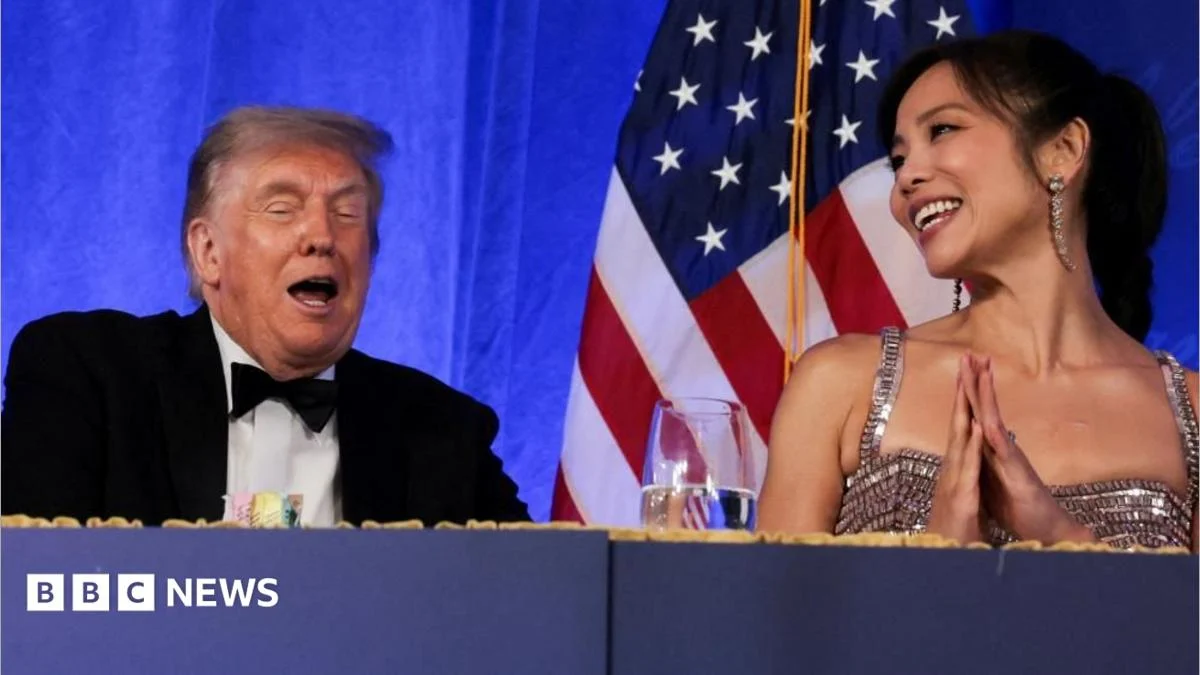
President Trump’s address was a complex tapestry of conciliation and criticism, reflecting the often-contradictory nature of his public persona. He opened with remarks that struck a surprisingly cordial and conciliatory tone, acknowledging the unusual circumstances. "The second time is always better," Trump quipped, adding, "As I said three months ago, the show must go on." He emphasized the importance of fundamental American values, stating, "We settle our differences not with bullets, but with open and vigorous debate. And no deranged loser with a gun will ever change that. We can’t let that ever happen." This call for respect for freedom of speech and a rejection of violence was a unifying message, resonating deeply with an audience still processing the trauma of the April shooting.
However, the President, true to form, could not resist pivoting to his familiar criticisms of the media. He playfully, yet pointedly, told the assembled journalists, "Sometimes I really do think that some of you don’t like me." He then escalated, accusing many in the room of suffering from "Trump Derangement Syndrome," a term he popularized to describe what he perceives as an irrational and obsessive opposition to his presidency by political opponents and the media. "This place [the dinner] is really the largest group of ‘Trump Derangement Syndrome’ people ever put together at one time," he remarked, adding a jesting warning, "I suspect some of you are lucky that our last dinner was cut short… I was going to go after you." These barbs, while delivered with a degree of humor, underscored the persistent friction between the administration and the press.
Honoring Journalism and Heroism
Despite the political sparring, the core purpose of the WHCA dinner—to celebrate journalistic excellence—remained central. President Trump stood and shook hands with award winners, a seemingly incongruous gesture given his frequent attacks on their respective outlets. Reporters from organizations he has often singled out for criticism, including The New York Times, CNN, and The Wall Street Journal, came forward to be honored. Notably, a team from The Wall Street Journal received an award for their coverage of Trump’s links to disgraced financier Jeffrey Epstein, a topic that had been a source of considerable controversy for the administration. The President’s direct engagement with these awardees, even after his remarks, highlighted the complex and often performative dance between power and the press.
A particularly poignant moment of the evening was the recognition of Officer Victor Gonzalez. President Trump personally presented an award to the Secret Service officer for his bravery and quick actions during the April shooting. This act served as a powerful reminder of the sacrifices made by law enforcement in protecting public officials and events, and it provided a brief, apolitical moment of shared appreciation for heroism.
Unprecedented Security Measures
The memory of the April incident cast a long shadow over the entire evening, manifesting in an unprecedented level of security. The typical, relatively relaxed entry protocols of previous dinners were replaced with a fortress-like perimeter. Several blocks around the Washington Hilton were cordoned off, creating a sterile zone enforced by a heavy presence of uniformed police and National Guard personnel.
Guests, including high-ranking government officials and seasoned journalists, underwent multiple layers of screening. Entry required not only government-issued identification but also pre-issued QR codes, which were meticulously scanned. Upon successful verification, attendees were issued color-coded wristbands, indicating their clearance. At one point, visitors were prompted to walk in a single file line, passing between two Secret Service officers who stood vigilantly, rifles at the ready. These stringent measures, while necessary for security, also served as a stark visual cue of the extraordinary circumstances and the prevailing threat landscape, fundamentally altering the traditionally celebratory and somewhat informal atmosphere of the dinner.
Attendance by Key Officials
Despite the tightened security and the underlying tension, the event saw a notable attendance from senior administration officials, signaling a degree of support for the WHCA and the continuity of the institution. Among those present were Defence Secretary Pete Hegseth, acting Attorney General Todd Blanche, FBI Director Kash Patel, Treasury Secretary Scott Bessent, and Commerce Secretary Howard Lutnick. Their presence underscored the administration’s acknowledgment of the event’s significance, even as the President himself delivered a speech characterized by both praise and criticism of the media. This attendance by key cabinet members also served to demonstrate the executive branch’s commitment to engaging, in some capacity, with the White House press corps.
The Future of the WHCA Dinner and Media Relations
The rescheduled White House Correspondents’ Dinner of 2024 will likely be remembered as one of the most unique and symbolically charged in its long history. It served as a testament to the resilience of journalistic institutions in the face of threats, but also as a vivid illustration of the deep schisms characterizing the relationship between the presidency and the press in contemporary America.
WHCA President Weijia Jiang reaffirmed the association’s commitment to returning to the Washington Hilton for next year’s event, a deliberate decision to reclaim the space and signal a refusal to be intimidated. However, the experience of this scaled-down, high-security dinner raises pertinent questions about the future format and purpose of the annual gathering. Will it revert to its previous, grander iterations, or has the current political climate and the security challenges permanently reshaped its character?
The event underscored a broader societal debate about press freedom, the proliferation of "fake news" rhetoric, and the role of the media in a democratic society. President Trump’s dual tone — simultaneously acknowledging the importance of free speech while lambasting specific outlets — encapsulates the complex and often contradictory nature of modern political communication. The dinner, therefore, was not merely a social event but a microcosm of the ongoing struggle to balance accountability, criticism, and mutual respect in the public sphere, especially in an era where words, and even perceived slights, can carry the weight of real-world consequences. The WHCA dinner continues to evolve, reflecting the ever-changing landscape of American politics and the enduring, yet frequently challenged, role of a free press.