

A landmark discovery by scientists from NASA’s Mars Atmosphere and Volatile Evolution (MAVEN) mission has illuminated a fundamental process behind the formation of certain Martian auroras, revealing a striking similarity to the celestial light shows observed on Earth. Published on Thursday, July 21, 2026, in the esteemed journal Nature Communications, these findings detail how a "miniature Dungey cycle" operates within Mars’ localized crustal magnetic fields, a mechanism previously thought to be exclusive to planets with global magnetic protection like Earth. This breakthrough, derived from invaluable data collected by the recently concluded MAVEN spacecraft, significantly advances our understanding of planetary magnetospheres, atmospheric evolution, and the Red Planet’s interaction with the solar environment.
The Martian Aurora Mystery Solved
For decades, the vibrant, transient glows of auroras on Mars have captivated scientists, presenting a persistent enigma due to the planet’s distinct lack of a global magnetic field. Unlike Earth, which possesses a robust, planet-encompassing magnetosphere generated by its molten core, Mars is largely unprotected from the relentless onslaught of the solar wind. However, observations have consistently revealed localized auroral displays, particularly over regions of intense crustal magnetism in Mars’ southern hemisphere. The precise physical processes energizing the electrons to create these auroras remained a critical missing piece in the Martian atmospheric puzzle until now.
The MAVEN team’s meticulous analysis has unveiled that these localized Martian auroras are generated by a scaled-down version of the Dungey cycle, a well-established process responsible for driving Earth’s majestic auroras. This intricate mechanism involves the reconnection of solar magnetic field lines with a planet’s intrinsic magnetic fields, leading to the injection of energy and charged particles into the magnetosphere and subsequent precipitation into the atmosphere, where they collide with atmospheric gases to produce light. The realization that this fundamental plasma physics phenomenon can occur on such vastly different scales—from Earth’s planetary shield to Mars’ fragmented crustal fields—marks a profound advancement in comparative planetology.
Shaosui Xu, the lead author of the study and an associate research physicist at the Space Sciences Laboratory at the University of California, Berkeley, expressed the team’s initial surprise: "We knew that magnetic reconnection was happening at Mars but did not expect it to be like the Dungey cycle." This sentiment underscores the unexpected nature of the discovery, highlighting how MAVEN’s comprehensive dataset allowed scientists to piece together a previously unseen picture of Martian atmospheric dynamics.
Earth’s Dungey Cycle: A Blueprint for Aurora Formation
To fully appreciate the significance of this Martian discovery, it is essential to understand the Dungey cycle as it operates on Earth. Named after British physicist James Dungey, who proposed the concept in 1961, the Dungey cycle describes the large-scale circulation of plasma and magnetic flux within Earth’s magnetosphere, driven by magnetic reconnection at the dayside magnetopause (where the solar wind meets Earth’s magnetic field) and in the magnetotail (the elongated portion of the magnetosphere extending away from the Sun).
When the Sun’s outward-flowing magnetic field lines, embedded within the solar wind, encounter Earth’s protective magnetosphere, they can merge and "reconnect" with Earth’s own magnetic field lines. This process fundamentally alters the magnetic topology, transferring energy from the solar wind into Earth’s magnetosphere. This energy then drives electrical currents, accelerates charged particles (primarily electrons), and circulates plasma. These energized electrons are ultimately catapulted along magnetic field lines into Earth’s upper atmosphere, predominantly near the polar regions. Upon colliding with atmospheric oxygen and nitrogen atoms, these electrons excite the atoms, causing them to emit photons of light, resulting in the spectacular displays of the aurora borealis (Northern Lights) and aurora australis (Southern Lights). The Dungey cycle is a continuous, dynamic process that effectively couples the solar wind to Earth’s magnetosphere and ionosphere, influencing space weather and contributing to various geophysical phenomena.
Mars’ Unique Magnetic Landscape
Mars presents a stark contrast to Earth in terms of its magnetic environment, a difference that has profoundly shaped its evolution. Approximately 4 billion years ago, early Mars is believed to have possessed a global magnetic field, similar to Earth’s, generated by a molten, churning core. This ancient dynamo protected its early atmosphere, likely allowing for the presence of liquid water on its surface and potentially supporting conditions conducive to life. However, for reasons still under investigation but likely related to its smaller size and faster cooling, Mars’ core dynamo ceased functioning around 3.7 to 4 billion years ago.
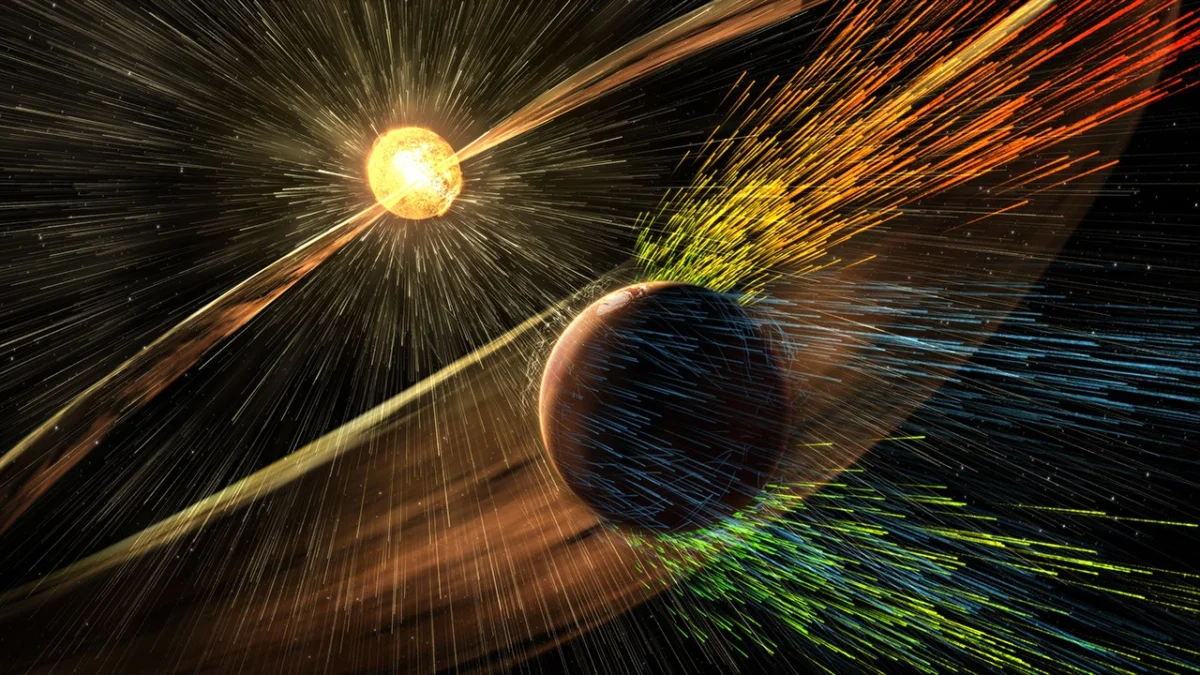
With the collapse of its global magnetic field, Mars became vulnerable to the erosive power of the solar wind – a stream of charged particles continuously emanating from the Sun. Over billions of years, this intense solar wind stripping gradually eroded Mars’ once-thicker atmosphere, leading to the cold, dry, and thin atmospheric conditions observed today. What remains of Mars’ ancient magnetic heritage are "crustal magnetic fields" – intensely magnetized regions embedded within its planetary crust, primarily concentrated in the southern hemisphere. These fossilized magnetic fields were imprinted into the lava that cooled in the presence of the planet’s former global field. These crustal fields, though localized and fragmented, act as miniature magnetospheres, creating pockets of magnetic protection that interact directly with the solar wind. It is over these regions that MAVEN has observed highly localized auroras, akin to Earth’s polar auroras but on a much smaller scale and distributed across the planet’s surface rather than concentrated at geographic poles.
MAVEN’s Illustrious Journey and Its Final Data Harvest
The Mars Atmosphere and Volatile Evolution (MAVEN) mission has been a cornerstone of NASA’s Mars Exploration Program since its launch on November 18, 2013, and its arrival in Mars orbit on September 21, 2014. Its primary objective was to investigate how Mars lost its atmosphere and volatile compounds over time, providing crucial insights into the planet’s climatic history and potential for past life. Equipped with a suite of sophisticated instruments designed to measure the composition, structure, and escape rates of Mars’ upper atmosphere and its interaction with the solar wind, MAVEN meticulously gathered data that revolutionized our understanding of Martian atmospheric dynamics.
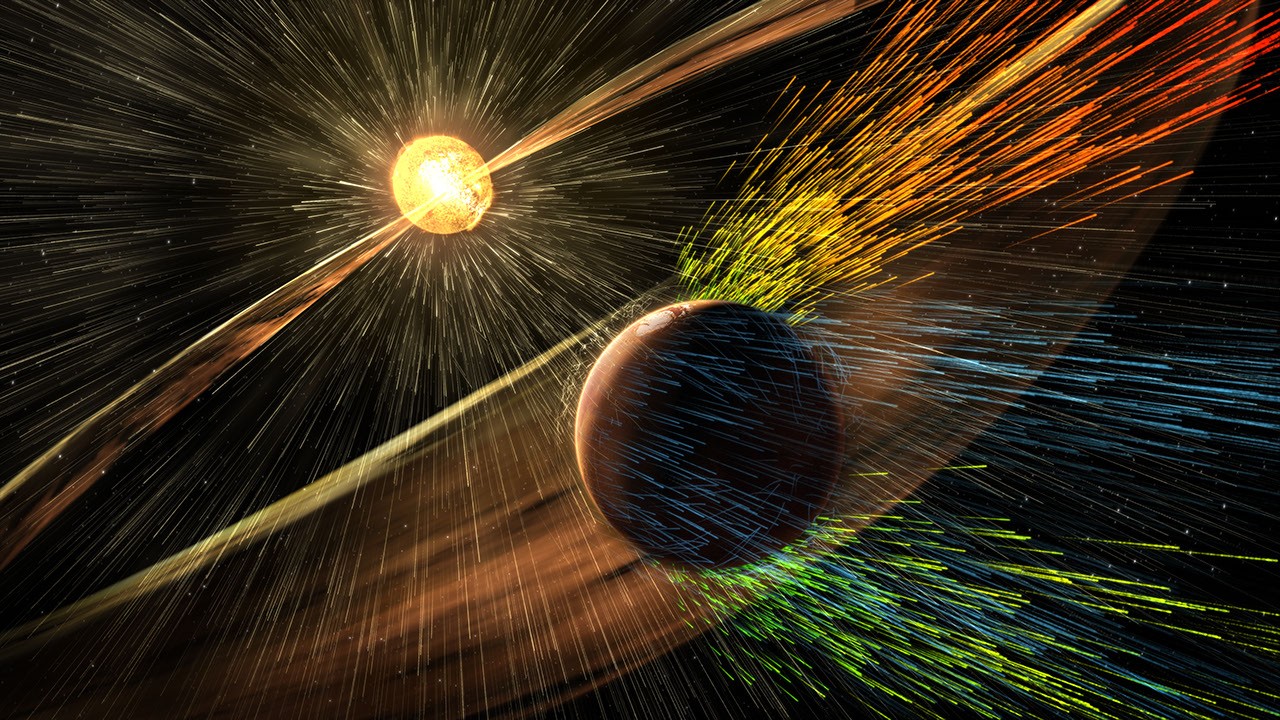
The mission was incredibly successful, repeatedly extended beyond its primary mission duration due to its exceptional scientific output. MAVEN provided unprecedented data on atmospheric escape processes, the role of solar storms in accelerating atmospheric loss, and the complex interplay between the solar wind and Mars’ unique magnetic environment.
However, after nearly a decade of groundbreaking service, the MAVEN spacecraft experienced a critical loss of signal with ground stations on Earth on December 6, 2025. Despite extensive efforts by mission controllers to re-establish contact and recover the spacecraft, these attempts proved unsuccessful. On June 3, 2026, NASA officially declared the MAVEN mission concluded, marking the end of its operational life. While the loss of the spacecraft was bittersweet, the immense trove of data it transmitted back to Earth continues to inform NASA science and future missions to Mars. The current discovery, published nearly two months after the mission’s official conclusion, stands as a testament to the enduring value and analytical potential of MAVEN’s legacy.
Unraveling the "Miniature Dungey Cycle"
The detailed investigation into Martian auroras relied on a synergistic use of several key instruments aboard the MAVEN spacecraft. The Magnetometer (MAG) and the Solar Wind Electron Analyzer (SWEA) instruments were critical for mapping the magnetic field configurations and deriving the electrical currents flowing within the Martian environment. These measurements allowed scientists to discern the complex interplay between the solar wind and Mars’ localized crustal magnetic fields, identifying regions where magnetic reconnection was occurring.
Crucially, the Suprathermal and Thermal Ion Composition (STATIC) instrument provided vital measurements of plasma flows within the Martian ionosphere. By analyzing the motion and composition of charged particles, STATIC allowed the team to track the circulation of plasma, directly linking it to the magnetic reconnection events observed by MAG and SWEA. This comprehensive approach enabled researchers to build a cohesive picture of the Dungey-like mechanism unfolding over Mars’ crustal fields.
"We really pushed the limit of STATIC to get the data we needed," Xu noted, emphasizing the extraordinary efforts involved in extracting such nuanced information from the instrument. "It was the final piece to the puzzle in understanding these localized auroras." This collaborative instrumental approach, combining magnetic field measurements, electron data, and plasma flow analysis, provided the irrefutable evidence needed to confirm the existence and operation of a miniature Dungey cycle on Mars. This finding not only explained how electrons were being energized to create the auroras but also demonstrated that the Dungey-like mechanism is a more universal process than previously assumed, capable of operating effectively across a vast range of spatial scales.
Broader Implications for Planetary Science and Future Exploration
The identification of a miniature Dungey cycle on Mars carries profound implications, extending far beyond the Red Planet itself. For comparative planetology, this discovery suggests that fundamental plasma physics processes, such as magnetic reconnection, are active across diverse planetary environments, regardless of the presence of a global magnetic field. It encourages scientists to re-examine other celestial bodies, such as Venus (which also lacks a global magnetic field but interacts directly with the solar wind), and even gas giants, to investigate the potential presence of similar scaled-down mechanisms. This expands our understanding of how planets interact with their host stars and the broader heliosphere.
Shannon Curry, MAVEN’s principal investigator and a research scientist at the Laboratory for Atmospheric and Space Physics at the University of Colorado Boulder, underscored the broader significance: "This is a remarkable result that changes how we think of Martian auroras and is another important step toward understanding why Mars and Earth have evolved so differently despite being governed by the same underlying physics." Her statement highlights the core mission of MAVEN – to shed light on the divergent evolutionary paths of two terrestrial planets that began with similar conditions. By understanding the intricate details of Mars’ atmospheric and magnetic interactions, scientists gain crucial context for Earth’s own long-term habitability and the protective role of its global magnetic field.
Furthermore, this enhanced understanding of the solar environment’s interaction with Mars is essential for future robotic and crewed missions. Localized auroras are indicative of localized energy deposition and particle precipitation, which can correlate with enhanced radiation levels. For human explorers venturing to Mars, understanding these dynamic processes and identifying regions of increased particle flux is critical for ensuring crew safety and designing appropriate radiation shielding. The data from MAVEN, even post-mission, provides invaluable insights for mission planners and engineers developing the next generation of Mars probes and human exploration architectures.
The journey to this discovery also highlights the long-term nature of scientific inquiry. Xu recalled his graduate school days: "I remember in graduate school discussing with my advisor how the cycling of crustal magnetic fields could work at Mars. It’s incredible to be part of the team that found the answer to that question." This personal reflection underscores the culmination of years of theoretical inquiry and observational effort, demonstrating how scientific curiosity, coupled with advanced technological capabilities, can unravel the universe’s deepest mysteries.
A Legacy of Discovery
The MAVEN mission, though now concluded, leaves behind an extraordinary legacy. Its data continues to serve as a vital resource for the scientific community, enabling breakthroughs like this one that will shape our understanding of Mars and planetary evolution for years to come. The mission was managed by NASA’s Goddard Space Flight Center in Greenbelt, Maryland, with its principal investigator based at the Laboratory for Atmospheric and Space Physics at the University of Colorado Boulder, which also managed science operations and public outreach. Lockheed Martin Space constructed the spacecraft and was responsible for mission operations, while NASA’s Jet Propulsion Laboratory in Southern California provided navigation and Deep Space Network support. This collaborative effort, spanning multiple institutions and countless dedicated individuals, has profoundly enriched our knowledge of the Red Planet and its place within the solar system, ensuring that MAVEN’s spirit of exploration and discovery endures.