A groundbreaking advancement in space weather prediction has been unveiled, as scientists, leveraging continuous imagery from NASA’s PUNCH (Polarimeter to Unify the Corona and Heliosphere) mission, successfully predicted the near-Earth arrival of a solar eruption to within a remarkable 30 minutes in an initial proof-of-concept test. These pivotal results, formally presented on Tuesday at the prestigious Committee on Space Research (COSPAR) Scientific Meeting and currently undergoing peer review at the distinguished journal Space Weather, promise to fundamentally transform the methodology by which Earth-impacting solar storms are forecasted, ushering in an era of enhanced preparedness and protection for critical infrastructure and personnel.
The implications of this breakthrough are profound, signaling a monumental leap in humanity’s ability to anticipate and mitigate the potentially devastating effects of solar phenomena. Craig DeForest, the principal investigator for PUNCH at Southwest Research Institute’s Solar System Science and Exploration Division in Boulder, Colorado, captured the magnitude of the achievement, stating, "We thought PUNCH would be good at this, but it’s a stunning result. To put it in perspective, this could be the space weather equivalent of going from a steam engine to a modern internal combustion engine." This analogy underscores the revolutionary shift in capability, moving from rudimentary, often imprecise predictions to a level of accuracy previously unattainable.
The Menace of Solar Storms: A Critical Forecasting Challenge
Solar storms, formally known as coronal mass ejections (CMEs), are colossal eruptions of plasma and magnetic field that burst forth from the Sun’s outermost atmosphere, the corona. These immense explosions hurl billions of tons of solar material into space at speeds ranging from hundreds to thousands of kilometers per second. When directed towards Earth, CMEs can interact with our planet’s magnetosphere, inducing geomagnetic storms that pose significant threats to modern technological systems.
The critical importance of accurately forecasting the arrival time of CMEs cannot be overstated. Geomagnetic storms can wreak havoc on terrestrial power grids, potentially causing widespread blackouts. A notable historical example is the 1989 Quebec blackout, which plunged millions into darkness for hours following a powerful CME. Satellites, indispensable for global communication, navigation (GPS), weather forecasting, and national security, are highly vulnerable to the surge of energetic particles. These particles can damage electronic components, degrade performance, or even cause complete satellite failure. Astronauts aboard the International Space Station or those embarking on future deep-space missions face elevated radiation exposure risks, necessitating timely warnings for them to take protective measures. Beyond these direct impacts, CMEs can disrupt high-frequency radio communications, affect aviation routes by interfering with navigational systems, and even contribute to pipeline corrosion.
Historically, the challenge in forecasting CME arrivals stemmed from a crucial observational gap. Prior to the PUNCH mission, scientists could only reliably track CMEs for approximately one-fifth of their vast journey from the Sun to Earth. This initial observation window, typically spanning the first few million kilometers, left the vast majority of the interplanetary transit shrouded in uncertainty. Scientists were left to rely on models that extrapolated from these early observations, often making educated guesses about the CME’s speed, direction, and evolution over the remaining 130 million kilometers. This inherent uncertainty led to broad arrival windows, sometimes spanning several hours, which severely limited the effectiveness of mitigation strategies. Power grid operators, for instance, need precise timing to implement load shedding or reconfigure networks, while satellite operators require specific windows to put spacecraft into safe modes.
PUNCH: A New Eye on the Heliosphere
The paradigm shifted dramatically with the launch of the PUNCH mission in 2025. PUNCH, an acronym for Polarimeter to Unify the Corona and Heliosphere, was specifically designed to bridge this critical observational gap. Unlike previous missions that offered limited perspectives, PUNCH comprises a constellation of four small spacecraft strategically positioned in low Earth orbit. These four satellites work in concert to provide continuous, stereoscopic 3D observations of the inner solar system, effectively creating an unprecedented panoramic view of the space between the Sun and Earth.
The technological innovation of PUNCH lies in its ability to continuously track solar explosions, capturing a new image every four minutes. This rapid cadence of high-resolution imagery allows scientists to monitor the CMEs’ propagation, deceleration, acceleration, and morphological evolution as they traverse the vast expanse of interplanetary space. This continuous tracking capability is what fundamentally differentiates PUNCH from its predecessors. Where previous instruments lost sight of CMEs early in their journey, PUNCH keeps them in view nearly all the way to Earth, offering a real-time, dynamic dataset for analysis. This continuous data stream is the bedrock upon which the enhanced forecasting accuracy is built.
The Proof-of-Concept Test: Methodology and Remarkable Results
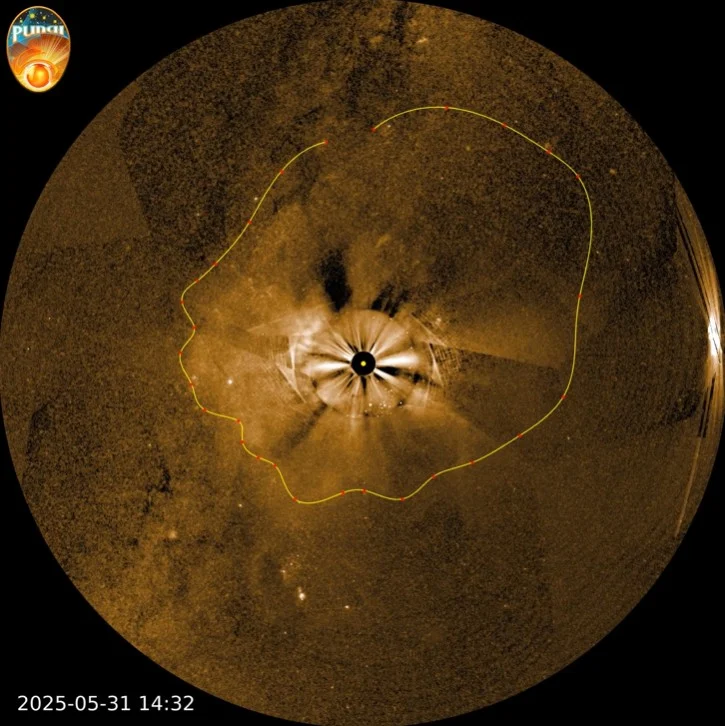
To demonstrate the mission’s transformative potential, scientists undertook a rigorous retroactive test using data from a specific coronal mass ejection that erupted from the Sun on May 31, 2025. This approach allowed researchers to apply the new PUNCH observational capabilities to a known event, enabling a direct comparison with previous forecasting methods.
The methodology involved feeding the continuous PUNCH images into a sophisticated computer model. This model was programmed to meticulously analyze the leading edge of the CME over time, tracking its precise movement, evolution, and changes in geometry as it propagated across the inner solar system. By continuously updating its understanding of the CME’s trajectory, speed, and any potential interactions with the ambient solar wind, the model was able to progressively refine its calculation of when the solar storm would ultimately reach Earth.
The results were nothing short of spectacular. Twelve hours after the coronal mass ejection initially erupted from the Sun, the model converged on a final, stable prediction. This prediction indicated that the storm would arrive approximately eight hours later. Critically, this forecast proved to be accurate to within a mere half-hour of the actual arrival time. This level of precision represents a tenfold improvement over the currently employed state-of-the-art methods, which typically provide a broad arrival window of around five hours.
Adding another layer of confidence, the model itself provided an internal metric indicating when its estimate had stabilized. This feature is invaluable for space weather forecasters, as it allows them to issue predictions with a high degree of certainty, knowing that the model has processed sufficient data to lock in its forecast. As DeForest emphasized, "We accomplished an order of magnitude better result than the state-of-the-art method with a really basic process, just informed by the fact that the coronal mass ejection could be tracked continuously across the solar system." This statement highlights that the primary driver of this unprecedented accuracy is not necessarily a radically new modeling paradigm, but rather the availability of continuous, high-fidelity observational data provided by PUNCH.
Broader Implications and Future Horizons
The success of this initial proof-of-concept test holds far-reaching implications, extending well beyond mere numerical improvements in arrival time predictions.
Enhanced Mitigation and Preparedness: With a 30-minute arrival window, critical infrastructure operators, such as those managing power grids or satellite fleets, gain invaluable time to implement proactive mitigation strategies. This could include reducing voltage levels, rerouting power, taking sensitive satellites offline, or advising astronauts to seek shielded areas. This shift from reactive damage control to proactive prevention could save billions of dollars in potential damages and prevent widespread societal disruption. The ability to distinguish between a minor and a severe impact with greater lead time allows for more tailored and efficient responses.
Evolution of Space Weather Forecasting: This breakthrough signals a transformative era for space weather forecasting, mirroring the evolution of terrestrial weather prediction from basic observations to sophisticated numerical models. Just as advanced meteorological satellites and radar networks have revolutionized our ability to forecast hurricanes and blizzards, PUNCH is poised to do the same for solar storms. Future refinements to PUNCH data processing and the development of even more sophisticated models are expected to further extend the lead time for accurate predictions, potentially allowing for forecasts days in advance rather than hours. This would enable even more comprehensive and coordinated global responses.
Scientific Discovery Beyond Forecasting: The PUNCH mission is not solely a forecasting tool; it is also a powerful scientific observatory. The high-resolution, continuous imagery is already yielding unprecedented insights into the fundamental physics of CMEs. Scientists have observed new structures within these clouds of material, revealing that CMEs are significantly "clumpier" than previously theorized. Furthermore, the data indicates that these solar eruptions are not static entities but continue to evolve dynamically as they traverse the solar system, shedding light on the complex interplay of magnetic fields and plasma within them. This enhanced understanding of CME evolution will inevitably feed back into more accurate and physically robust forecasting models.
Astrophysical Connections: Beyond the immediate solar system, PUNCH data is contributing to a deeper understanding of plasma behavior in space. Plasma, the superheated, ionized gas that constitutes the vast majority of visible matter in the universe, is a fundamental component of CMEs. By studying how this solar material moves and interacts across interplanetary distances, scientists can glean insights into similar processes occurring in vastly different astrophysical environments. For instance, the dynamics observed in CMEs can inform our understanding of plasma behavior in star-forming regions or within active galactic nuclei, where direct observation at small scales is often impossible. PUNCH effectively provides a nearby, natural laboratory for studying universal plasma physics.
A Collaborative Endeavor
The success of the PUNCH mission is a testament to extensive scientific and engineering collaboration. The Southwest Research Institute (SwRI), headquartered in San Antonio, Texas, plays a leading role in the mission, including the critical operation of PUNCH’s four spacecraft from its facilities in Boulder, Colorado. The mission’s overall management falls under the purview of Space Science Mission Operations at NASA’s Goddard Space Flight Center in Greenbelt, Maryland, which oversees PUNCH on behalf of the Science Mission Directorate at NASA’s headquarters in Washington, D.C. This collaborative framework, combining institutional expertise with cutting-edge technology, has been instrumental in bringing this revolutionary capability to fruition.
The journey from initial concept to a validated proof of concept has been marked by rigorous scientific inquiry and technological innovation. The PUNCH mission stands as a beacon of progress in space weather research, promising a future where humanity is better prepared to navigate the powerful and sometimes unpredictable forces emanating from our Sun. The "steam engine to internal combustion engine" leap is not just a metaphor; it represents a tangible improvement that will safeguard our increasingly space-dependent civilization for generations to come.
By Mara Johnson-Groh
NASA’s Goddard Space Flight Center, Greenbelt, Md.