The Ferrari Amalfi Spider has officially debuted as the successor to the Roma Spider, positioning itself as a sophisticated evolution of the Italian marque’s front-mid-engined V8 lineage. Priced at £227,260, the new convertible arrives with a significant increase in power, a overhauled chassis control system, and a design philosophy that shifts away from the darting elegance of its predecessor toward a more monolithic and grounded aesthetic. Designed to serve as an accessible entry point into the Ferrari brand, the Amalfi Spider aims to balance daily usability with the visceral performance expected of a Maranello-bred supercar.
Strategic Positioning and Market Context
The Amalfi Spider represents a pivotal component of Ferrari’s current product strategy, targeting a demographic that the company describes as "new Ferraristi." During the technical presentation at the media launch in Greece, Ferrari engineers emphasized that the vehicle was developed to be "as easy to drive as possible." This focus is a calculated move to capture market share from high-end grand tourers such as the Porsche 911 Turbo S Cabriolet, the Aston Martin Vantage Roadster, and the Mercedes-AMG SL63.

By positioning the Amalfi Spider as a less "intimidating" step into the Ferrari ecosystem compared to the mid-engined 296 GTS or the flagship 12Cilindri, the company is securing a pipeline of customers who may eventually transition to its more extreme hybrid and V12 offerings. However, despite this "approachable" branding, the Amalfi Spider’s technical specifications suggest a vehicle that remains firmly rooted in high-performance engineering.
Technical Specifications and Powertrain Evolution
At the heart of the Amalfi Spider is a refined version of Ferrari’s award-winning 3.9-liter (3855cc) twin-turbocharged V8 engine. Through a series of internal optimizations, including the installation of lighter camshafts and the recalibration of the turbochargers to spin at higher velocities, peak power has been raised to 631bhp at 7500rpm. This represents a noteworthy increase over the 611hp produced by the outgoing Roma.
The engine’s redline has also been increased by 100rpm to 7600rpm, providing a slightly broader power band. Torque remains a formidable 561lb-ft, available from 3000rpm. Power is delivered to the rear wheels via an eight-speed dual-clutch transaxle, a unit derived from Ferrari’s expertise in Formula 1 and GT racing. This combination allows the Amalfi Spider to achieve a 0-62mph (100km/h) acceleration time of just 3.3 seconds, with a top speed rated at 200mph.

To ensure compliance with increasingly stringent global emissions standards, Ferrari has adopted the use of thinner engine oils and advanced catalytic converter systems. While these measures ensure the V8 meets environmental benchmarks, they present a challenge in maintaining the signature acoustic profile of a Ferrari engine. Engineers have compensated by reworking the exhaust plumbing to preserve a mechanical, high-frequency note, though some early assessments suggest the sonic output is more subdued than in previous generations.
Chassis and Dynamics: The 6D Controller Integration
Perhaps the most significant technical upgrade found in the Amalfi Spider is the integration of the "6D" chassis controller. This system, originally developed for Ferrari’s more track-oriented supercars, manages the vehicle’s lateral, longitudinal, and vertical movements in real-time. By coordinating the Magneride dampers, the electronic differential (E-Diff), and the F1-Trac traction control, the 6D controller provides a more cohesive handling profile.
The vehicle also features an "ABS Evo" by-wire braking system. This technology, first seen on the 296 GTB, allows for more precise brake modulation and shorter stopping distances by decoupling the physical pedal from the hydraulic circuit. This allows the electronic stability control (ESC) to intervene with greater subtlety.

Ferrari has also introduced a new "Race" mode on the Amalfi Spider’s manettino dial. While the Roma Spider’s settings were focused on safety and stability, the Amalfi’s Race mode allows for a higher degree of slip before the electronics intervene. This shift suggests that while the car is marketed as "easy to drive," it possesses an underlying agility that rewards skilled drivers.
Design Philosophy and Aerodynamics
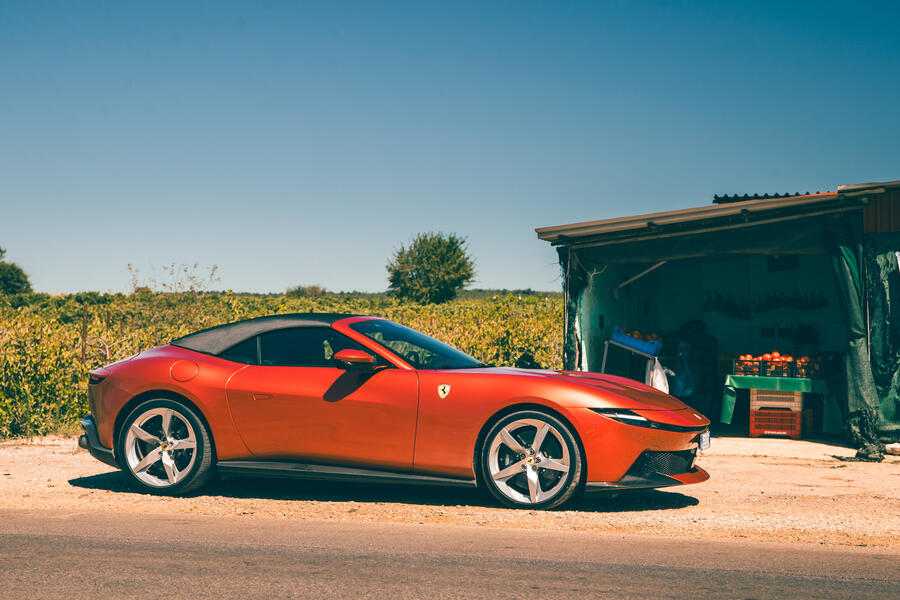
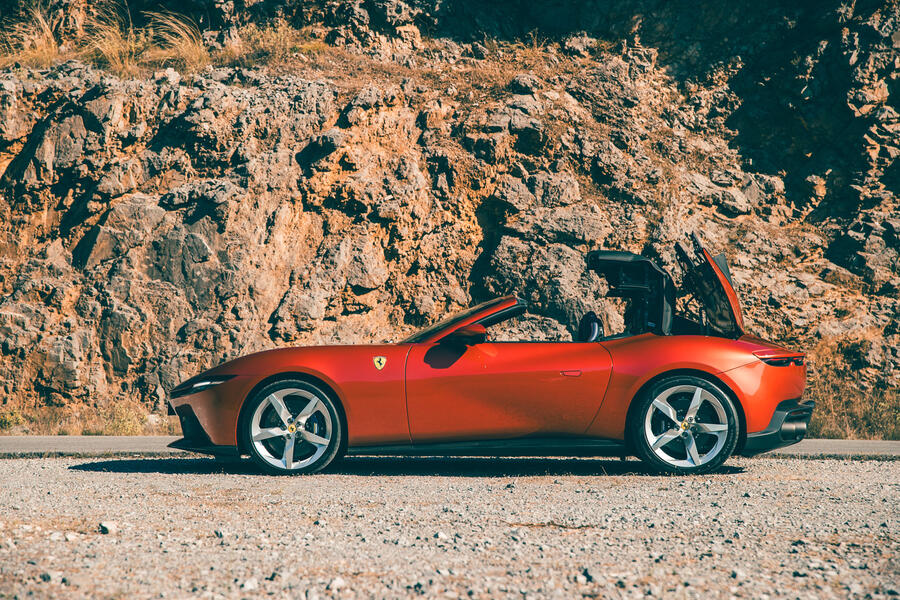
Under the direction of Chief Design Officer Flavio Manzoni, the Amalfi Spider introduces a "monolithic" design language. The tapered, shark-nose front end and the distinctive "pseudo-grille" of the Roma have been replaced with a more integrated, solid front fascia. The rear of the car features a subtle "boat-tail" taper, which enhances the grand touring silhouette while optimizing airflow.
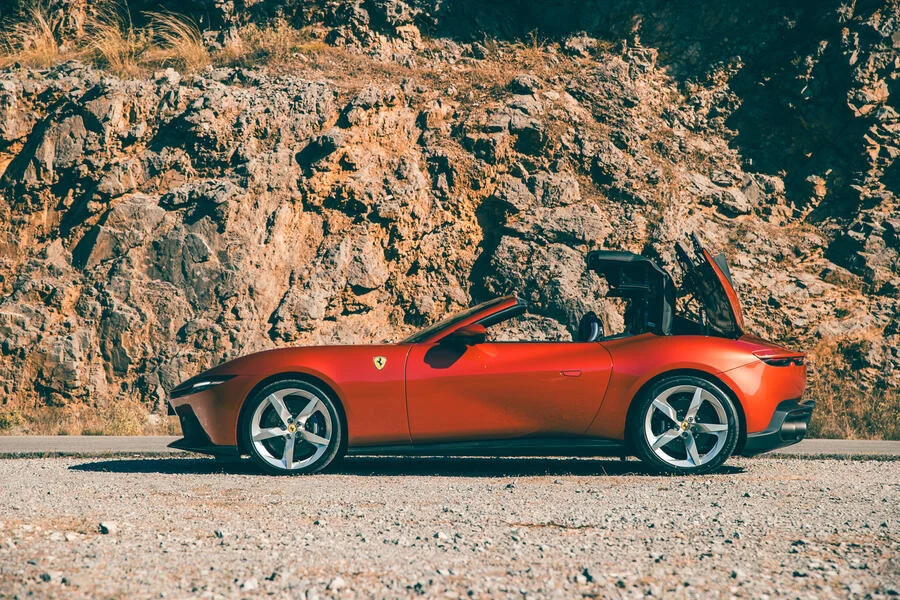
A critical component of the Spider’s design is its folding fabric roof. The top consists of five layers of fabric and three layers of rubber, engineered to provide acoustic insulation comparable to a folding hard-top. The mechanism can deploy or retract in 13.5 seconds at speeds of up to 40mph. When stowed, the roof stack height is a compact 22cm, though it does impact the vehicle’s luggage capacity, reducing the boot space to 172 liters.
To mitigate cabin turbulence during open-top driving, Ferrari has integrated a rear seat-back panel that can be deployed horizontally. This acts as a wind deflector, allowing for comfortable conversation at motorway speeds.
Interior Refinement and Ergonomics
The interior of the Amalfi Spider addresses several criticisms directed at recent Ferrari models. Most notably, the company has reintroduced physical controls on the steering wheel, replacing the haptic touchpads that were often cited as distracting or unresponsive in the Roma. The stop-start button is now a physical switch, providing a more tactile interaction for the driver.
The cabin features a "dual-cockpit" layout, with a dedicated display for the passenger that provides real-time data on speed, gear selection, and navigation. The seats have been redesigned with a focus on long-distance comfort, utilizing a more "cupped" profile to provide support during spirited cornering without sacrificing the "waft" quality required of a grand tourer.
Performance Evaluation on the Peloponnese Route
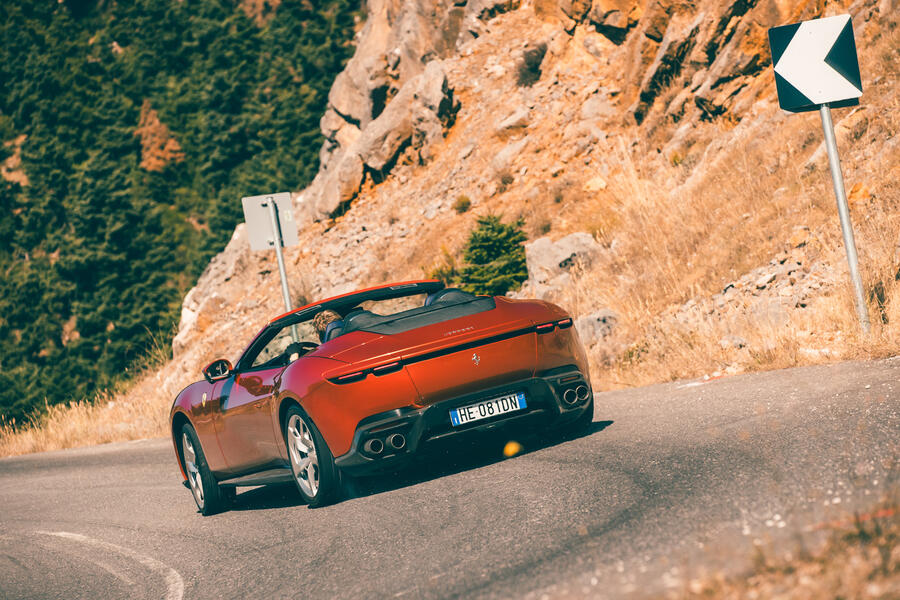
The media launch took place across the Peloponnese region of Greece, utilizing a variety of road surfaces from the glass-smooth motorways of Attica to the rugged, winding passes of the Oligyrtos mountains.
Observations from the launch event indicate that the Amalfi Spider maintains a "split personality." In Comfort mode, the Magneride dampers provide a supple ride quality that rivals dedicated luxury grand tourers like the Bentley Continental GTC. However, the steering remains exceptionally fast—a characteristic shared with the Ferrari 812 Superfast and 296 GTB—requiring the driver to remain attentive to the car’s immediate responses.
On more technical stretches, such as the EO66 pass, the Amalfi Spider demonstrated a "sled-like" aptitude for oversteer when pushed in Race or ESC Off modes. The 285-section rear tires, while narrower than those found on some rivals, allow for a more communicative transition from grip to slip, making the car feel more playful and less clinical than a Porsche 911 Turbo.

Chronology of the V8 Front-Engine Lineage
The Amalfi Spider is the latest chapter in a lineage that began in 2008:
- 2008: Ferrari California – The first front-engined V8 with a folding hard-top.
- 2014: California T – Introduction of turbocharging to the line.
- 2017: Portofino – Improved chassis and increased power (592bhp).
- 2020: Roma – A shift toward "La Nuova Dolce Vita" styling and improved interior tech.
- 2023: Roma Spider – The return of the soft-top to the front-engine V8 line.
- 2025/2026: Amalfi Spider – The current evolution, focusing on 6D chassis control and refined V8 power.
Economic and Competitive Landscape
The Amalfi Spider enters a market that has seen significant price inflation. At £227,260, it is approximately £49,000 more expensive than the Roma Spider was at its launch in 2023. This price hike reflects Ferrari’s increased focus on exclusivity and higher margins per unit.
Competitively, the Amalfi Spider sits in a unique niche. While the Porsche 911 GTS Cabriolet offers a more "natural" steering feel and daily ergonomics, it lacks the theatricality and brand prestige of the Ferrari. The Aston Martin Vantage Roadster provides a more muscular, front-engine experience but lacks the technical sophistication of Ferrari’s 6D chassis controller.
Conclusion: Implications for the Ferrari Brand
The Ferrari Amalfi Spider is more than a simple facelift; it is a refinement of the "entry-level" supercar concept. By making the car more approachable through advanced electronics while simultaneously increasing its raw performance figures, Ferrari has created a vehicle that caters to both the novice enthusiast and the seasoned driver.
The move toward more physical controls and enhanced refinement suggests that Ferrari is listening to its customer base regarding usability. While the styling may be more "ordinary" than the avant-garde Roma, the mechanical and electronic improvements under the skin ensure that the Amalfi Spider remains a benchmark for the open-top grand touring segment. As the industry moves toward electrification, the Amalfi Spider stands as a highly polished, albeit expensive, celebration of the pure internal combustion V8.