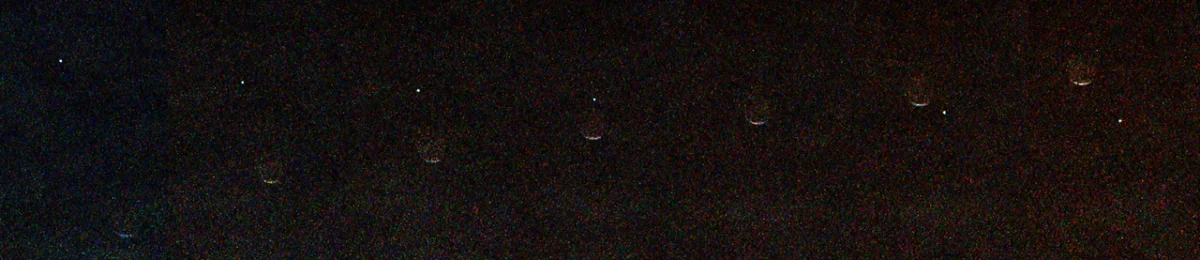
On July 2, 2026, the 1,907th Martian day, or sol, of its mission, NASA’s Perseverance Mars rover accomplished a unique celestial observation, capturing a series of images depicting Earth as a distant, bright dot momentarily disappearing behind Phobos, one of Mars’ two enigmatic moons. This extraordinary event, an occultation of Earth by Phobos, was meticulously recorded by the rover’s Mastcam-Z instrument, offering humanity an unprecedented perspective of its home planet from the surface of another world. The composite imagery, painstakingly processed and assembled by mission scientists, not only provides a poignant reminder of Earth’s presence in the vast cosmic ocean but also serves as a testament to the advanced capabilities of the Perseverance mission and its scientific instruments.
The Martian Spectacle Unveiled: A Dance of Worlds
The captivating sequence of images reveals Earth, our "pale blue dot," appearing as a small, luminous speck tracing a path from the upper left to the lower right of the frame, before being briefly obscured by the irregular silhouette of Phobos. This rare alignment was captured during the Martian twilight, approximately 40 minutes after sunset, providing a unique atmospheric backdrop to the celestial event. The original raw images were processed to remove extraneous light, resulting in a stark black background that enhances the detail of both Earth and Phobos, allowing for clearer observation of their interaction.
The primary composite, consisting of seven distinct images, illustrates the overall trajectory of Earth relative to Phobos. Further detailed analysis, presented in an annotated composite of nine images (Figure A), highlights the precise patch of Martian sky that was targeted for this observation. An inset within Figure A, comprising five key images, specifically focuses on the moments of occultation, displaying Earth’s movement behind Phobos in chronological order from left to right. Phobos itself appears to move upward in the frame, while Earth descends, creating a dynamic visual narrative of the celestial ballet. The local solar times on Mars when these five individual images were taken are meticulously documented (Figure B), underscoring the precision required for such an observation.
The Martian sky during this twilight period presented a distinctive hue. As described by the mission team, the sky exhibited an approximate true color of gray, transitioning from a brighter blue-gray closer to the horizon to a reddish-gray higher up. This atmospheric context adds another layer of scientific detail to the observation, providing data on light scattering and atmospheric composition during specific Martian conditions, even as the rover’s primary focus was on the distant celestial objects.
The Science Behind the Gaze: Unraveling Orbital Mechanics
While visually stunning, the capture of Earth transiting behind Phobos carries significant scientific weight. Such observations are invaluable for several reasons:
- Validating Orbital Models: Precisely documenting the apparent motion of Earth relative to Phobos from Mars provides critical data for refining and validating orbital models of the inner solar system. By comparing predicted positions with actual observations, scientists can enhance their understanding of gravitational interactions and planetary mechanics. This precision is crucial for future interplanetary missions, ensuring accurate navigation and trajectory planning.
- Understanding Phobos’s Dynamics: Although the primary target was Earth, the event inherently involves Phobos. Phobos is a fascinating and enigmatic moon, characterized by its irregular, potato-like shape, its unusually close orbit to Mars (averaging just 6,000 kilometers or 3,700 miles above the Martian surface), and its rapid orbital period (completing an orbit in just over 7.5 hours, meaning it rises and sets multiple times a sol). Observations like this, even indirect ones, contribute to the broader study of Phobos’s characteristics, including its ephemeris (the calculated positions of a celestial body at regular intervals). Scientists are particularly interested in Phobos due to its unique orbital decay, which predicts its eventual collision with Mars or its breakup into a ring system within tens of millions of years.
- Demonstrating Rover Capabilities: The successful execution of this observation underscores the sophisticated capabilities of the Mastcam-Z instrument and the Perseverance rover as a whole. Mastcam-Z, a pair of zoomable, high-resolution cameras, is primarily designed for geological and atmospheric analysis. Its ability to precisely track and image distant, fast-moving celestial bodies demonstrates its versatility and the ingenuity of the mission’s operations team. The demanding requirements for pointing, focusing, and timing in a dynamic Martian environment highlight the engineering prowess behind the mission.
- Comparative Planetology: Observing our home planet from another world offers a unique perspective in comparative planetology. It allows scientists to consider how Earth might appear from other celestial bodies and to reflect on the distinct atmospheric and orbital conditions that shape such views. This remote sensing of Earth from Mars contributes to a broader understanding of planetary systems.
Perseverance and Mastcam-Z: A Mission of Discovery
The Perseverance rover, a cornerstone of NASA’s Mars Exploration Program, landed in Jezero Crater on February 18, 2021. Its primary mission objectives are ambitious and multi-faceted: searching for signs of ancient microbial life, characterizing Mars’s geology and past climate, collecting carefully selected rock and regolith samples for future return to Earth, and paving the way for human exploration of the Red Planet.
The Mastcam-Z instrument, a critical component of Perseverance’s scientific payload, plays a pivotal role in achieving these goals. Led by Arizona State University in collaboration with Malin Space Science Systems, Mastcam-Z provides color, stereoscopic, and zoomable images of the Martian surface and sky. Its capabilities extend beyond detailed geological mapping, enabling atmospheric observations, dust devil tracking, and, as demonstrated by this event, celestial photography. The instrument’s dual cameras can capture images with high resolution, allowing scientists to zoom in on distant features or track moving objects with remarkable clarity. The precision required to track Earth, a relatively small target from the Martian perspective, while it briefly passed behind Phobos, speaks volumes about the instrument’s optical quality and the sophisticated software and operational procedures employed by the mission team.
This is not the first time rovers on Mars have turned their gaze towards Earth or its moons. Previous missions, such as the Curiosity rover, have also captured images of Earth and Venus from the Martian surface. Perseverance itself has previously observed Phobos and Deimos transiting the Sun, providing data on their sizes, shapes, and orbital characteristics. Each such observation adds another data point to humanity’s growing understanding of our solar system and the dynamic interactions within it.
Orchestrating the Cosmic Snapshot: Collaboration and Innovation
The successful capture of Earth’s occultation by Phobos is the result of meticulous planning and seamless collaboration across multiple institutions. NASA’s Jet Propulsion Laboratory (JPL) in Southern California, managed by Caltech, built and manages the operations of the Perseverance rover on behalf of the agency’s Science Mission Directorate in Washington. The Mastcam-Z instrument’s operations are led by Arizona State University, working closely with Malin Space Science Systems, which contributed to the design, fabrication, testing, and operation of the cameras.
Scientists and engineers at these institutions work in concert to identify unique observational opportunities, plan the rover’s movements and instrument settings with extreme precision, and process the resulting data. The challenge involves calculating the exact timing and trajectory of celestial bodies, accounting for the rover’s position on Mars, and programming the instrument to capture images at the precise moments needed. The ability to pivot from primary geological and astrobiological research to execute such a complex astronomical observation highlights the adaptability and scientific curiosity embedded within the mission team.
While no direct quotes were immediately released concerning this specific observation, similar events have often elicited expressions of awe and scientific satisfaction from mission personnel. "Seeing our home planet from the surface of Mars, especially as it briefly disappears behind Phobos, is a powerful reminder of our place in the cosmos and the incredible journey we’re on," a mission scientist might remark, underscoring both the scientific achievement and the emotional resonance of such imagery. "It’s a testament to the engineering prowess of our teams and the dedication to pushing the boundaries of what’s possible in space exploration."
Broader Implications and Future Prospects: A View Towards Humanity’s Future
The visual and scientific data gleaned from this rare observation carry broader implications for future space exploration, particularly for human missions to Mars. Understanding the dynamics of Mars’s moons and the appearance of Earth from the Martian surface contributes to:
- Operational Planning for Human Missions: Future human explorers on Mars will need to be acutely aware of celestial phenomena. Knowing how Earth appears, how Phobos moves, and the characteristics of the Martian sky during various times of day and night is vital for mission planning, navigation, and even psychological well-being. The visibility of Earth, even as a distant dot, could serve as a powerful psychological anchor for astronauts far from home.
- Resource Utilization and Phobos: The study of Phobos is gaining increasing importance for future Mars exploration. Its proximity to Mars makes it a potential staging ground for missions, a source of water ice (if present), or a testbed for asteroid mining technologies. Missions like the Japan Aerospace Exploration Agency’s (JAXA) Martian Moons eXploration (MMX) mission, slated to launch in the late 2020s, aim to collect samples from Phobos and return them to Earth. Observations from Perseverance, while not directly related to sample collection, contribute to the overall understanding of Phobos’s environment and orbital characteristics, which are crucial for such endeavors.
- Public Engagement and Inspiration: Images of Earth from another planet resonate deeply with the public. They inspire wonder, foster a sense of global unity, and encourage engagement in science and space exploration. Such visuals serve as powerful educational tools, demonstrating the realities of interplanetary travel and the vastness of our solar system. They connect humanity to the larger cosmos, reminding us of our shared origin and our collective pursuit of knowledge.
As the Perseverance rover continues its mission in Jezero Crater, meticulously collecting samples and probing the Martian environment, it also periodically casts its gaze skyward, revealing breathtaking views of celestial mechanics unfolding millions of miles away. The capture of Earth transiting behind Phobos is more than just a remarkable photograph; it is a profound scientific achievement, a symbol of human ingenuity, and a poignant reminder of our connection to the cosmos, seen through the eyes of a robot on another world. The data and imagery gathered from such events continue to enrich our understanding of Mars, our solar system, and our place within it, propelling humanity closer to its ultimate goal of extending its presence beyond Earth.