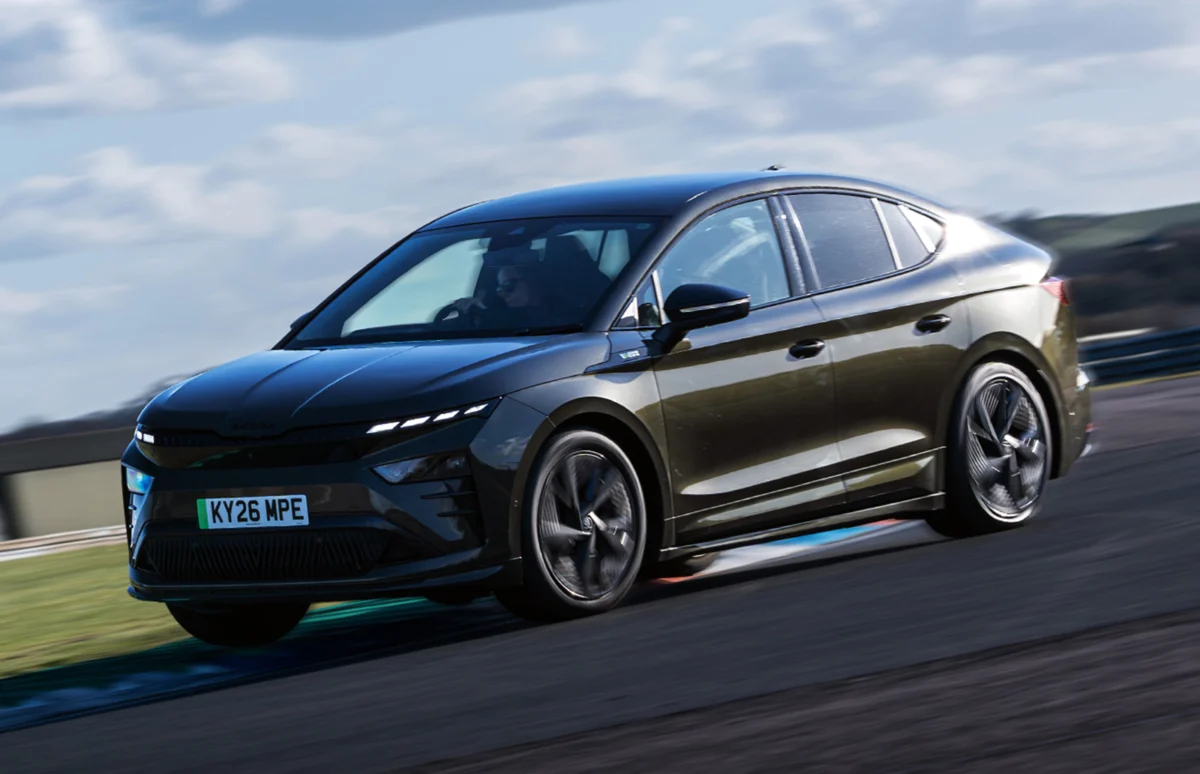
The concept of the perfect two-car garage has long served as a cornerstone of automotive discourse, representing a balance between pragmatic daily utility and the visceral thrill of weekend performance. Historically, enthusiasts have sought to separate these roles, maintaining a sensible hatchback or SUV for the commute and school run, while reserving a dedicated sports car for spirited driving. However, shifting economic landscapes, rising insurance premiums, and the rapid evolution of electric vehicle (EV) technology are fundamentally altering this paradigm. As the cost of maintaining multiple vehicles becomes increasingly prohibitive for many households, the automotive industry is witnessing a surge in demand for a singular "all-in-one" solution. The Skoda Enyaq vRS emerges as a primary contender in this evolving market, aiming to bridge the gap between family-oriented practicality and enthusiast-grade performance within a zero-emission framework.
The Evolution of the vRS Badge and the MEB Platform
To understand the positioning of the Enyaq vRS, one must examine the heritage of the vRS (Victory Rally Sport) designation. Since its introduction to the United Kingdom market in 2001 with the first-generation Octavia vRS, the badge has represented a specific philosophy: accessible performance. Unlike more extreme performance divisions that prioritize track times at the expense of comfort, Skoda’s vRS sub-brand has traditionally focused on "real-world" speed—torque-rich engines, upgraded suspension, and subtle styling enhancements, all while retaining the class-leading boot space and clever ergonomics for which the Czech manufacturer is known.
The Enyaq vRS represents the most significant departure in this lineage, transitioning the performance formula from internal combustion engines (ICE) to the Volkswagen Group’s modular electric drive matrix (MEB) platform. This platform, which also underpins the Audi Q4 e-tron and the Volkswagen ID.4, allows for a low center of gravity due to the floor-mounted battery pack, providing a natural advantage for a performance-oriented SUV. The recent 2024 updates to the Enyaq vRS have seen a substantial increase in power, moving from the previous 295bhp to a more robust 335bhp (250kW), making it the most powerful production Skoda in history.
Technical Specifications and Performance Metrics
The Enyaq vRS utilizes a dual-motor, all-wheel-drive configuration. The system delivers a combined output of 335bhp and a peak torque of 697Nm. This torque figure is particularly noteworthy, as it is available almost instantaneously, a characteristic inherent to electric motors. In practical terms, this allows the Enyaq vRS to accelerate from 0 to 62 mph in 5.4 seconds, a 0.8-second improvement over its predecessor. This performance puts the Enyaq vRS in direct competition with established premium electric SUVs, yet it maintains a focus on composure rather than raw, jarring acceleration.
To manage this power, Skoda has equipped the vRS with Dynamic Chassis Control (DCC). This system employs electronically controlled dampers that monitor the road surface and driver inputs multiple times per second, adjusting the suspension stiffness accordingly. The vehicle also features a 15mm lower ride height at the front and 10mm at the rear compared to the standard Enyaq, alongside a revised steering calibration designed to offer more direct feedback. These mechanical adjustments are intended to provide the "B-road" engagement that enthusiasts seek, while allowing the car to settle into a refined, quiet cruiser on the motorway.
Efficiency, Range, and Charging Infrastructure
For a performance vehicle to serve as a viable sole family car, its utility must not be compromised by the limitations of its powertrain. The Enyaq vRS is equipped with an 82kWh (84kWh gross) lithium-ion battery pack. Under the Worldwide Harmonized Light Vehicles Test Procedure (WLTP), the vehicle offers a maximum range of up to 344 miles on a single charge. While real-world range varies based on driving style, ambient temperature, and terrain, the 344-mile figure places the Enyaq vRS toward the top of its segment for efficiency.
The 2024 model year also brought significant improvements to charging speeds. The Enyaq vRS now supports DC rapid charging at rates of up to 185kW. Under optimal conditions, this allows the battery to be replenished from 10% to 80% in approximately 26 minutes. For home charging, the standard 11kW onboard charger allows for a full overnight charge via a dedicated wallbox. These technical advancements address the "range anxiety" that has historically deterred some buyers from transitioning to high-performance electric vehicles.
Interior Ergonomics and Technological Integration
The cabin of the Enyaq vRS is designed to reflect its dual-purpose nature. The interior features vRS-specific sports seats with integrated headrests, upholstered in a combination of leather and microsuede with contrast stitching. This aesthetic is mirrored on the dashboard and door panels, creating a cockpit that feels distinct from the standard Enyaq without sacrificing the brand’s minimalist design language.
Technological integration is centered around a 13-inch infotainment touchscreen, which has recently been updated with the latest software (Version 4.0). This update introduces a more intuitive user interface, faster processing speeds, and improved voice control functionality. Standard equipment for the vRS trim is extensive, including:
- An augmented reality (AR) head-up display that projects navigation cues onto the windscreen.
- A 12-speaker CANTON sound system.
- Heated front and rear seats, alongside a heated steering wheel.
- Matrix LED headlights with an animated "Coming/Leaving Home" function.
Despite these premium additions, the Enyaq vRS retains Skoda’s "Simply Clever" features. These include the signature umbrella stowed within the driver’s door, an ice scraper located in the tailgate, and various storage solutions throughout the cabin. The boot offers 585 litres of capacity, which can be expanded to 1,710 litres with the rear seats folded, ensuring the vehicle remains capable of handling bulky family cargo.
Economic Context and Market Positioning
The automotive market is currently navigating a period of significant volatility. In the United Kingdom and Europe, the cost of living crisis and high interest rates have made the "two-car garage" a luxury that many are reconsidering. According to industry data, the average cost of running a second car—including insurance, VED (Vehicle Excise Duty), maintenance, and depreciation—can exceed several thousand pounds annually. Consequently, there is a clear trend toward "downsizing" the number of vehicles per household while "upsizing" the capability of the primary vehicle.
The Enyaq vRS is positioned to capitalize on this trend. While its list price places it in the premium bracket of the volume market, its proponents argue that the total cost of ownership (TCO) is lower than maintaining both a budget commuter car and a secondary performance car. Furthermore, for corporate users, the Enyaq vRS benefits from low Benefit-in-Kind (BiK) tax rates, which remain a significant driver for EV adoption in the UK.
Competitive Landscape and Industry Implications
The Enyaq vRS does not exist in a vacuum. It faces stiff competition from within its own parent company and from external rivals. Key competitors include:
- Tesla Model Y Performance: Offers superior straight-line speed and access to the Supercharger network but is often criticized for its ride quality and minimalist interior.
- Kia EV6 GT-Line: Known for its striking design and 800V charging architecture, though it offers slightly less cargo space than the Skoda.
- Ford Mustang Mach-E: Provides a more traditional "muscle car" branding and engaging handling dynamics.
Skoda’s strategy with the vRS is to focus on "balanced performance." Industry analysts suggest that by prioritizing comfort and practicality alongside speed, Skoda is targeting a more mature demographic of enthusiasts—those who require a vehicle that can transport a family in silence and comfort during the week but provides enough mechanical depth to be enjoyed on a weekend.
Chronology of the Enyaq’s Development
The journey of the Enyaq vRS reflects Skoda’s broader transition toward electrification:
- September 2020: The standard Skoda Enyaq iV makes its global debut in Prague, marking Skoda’s first purpose-built EV.
- January 2022: Skoda reveals the Enyaq Coupé vRS, the first electric model to wear the vRS badge.
- Late 2022: The SUV variant of the Enyaq vRS is introduced, offering more headroom and a larger boot than the Coupé.
- October 2023: Skoda announces a major technical update for the 2024 model year, including the 335bhp power hike and faster charging capabilities.
- 2024: Deliveries of the enhanced Enyaq vRS begin, solidifying its place as the flagship of the Skoda range.
Conclusion and Future Outlook
The Skoda Enyaq vRS represents a significant milestone in the evolution of the performance SUV. By successfully integrating 335bhp and advanced chassis technology into a package that remains fundamentally practical and easy to live with, Skoda has created a vehicle that directly addresses the modern driver’s need for versatility.
As the 2035 ban on the sale of new petrol and diesel cars in the UK approaches, the "all-in-one" electric performance car is likely to become the new standard for motoring enthusiasts. The Enyaq vRS proves that the transition to electric power does not necessitate the end of the performance-oriented "driver’s car," but rather its adaptation into a more efficient, technologically advanced, and multi-functional form. While the sparks may still fly in debates over the perfect two-car garage, for many, the reality of the modern economy suggests that the perfect garage may now only need to hold one car—provided that car is as capable as the Enyaq vRS.