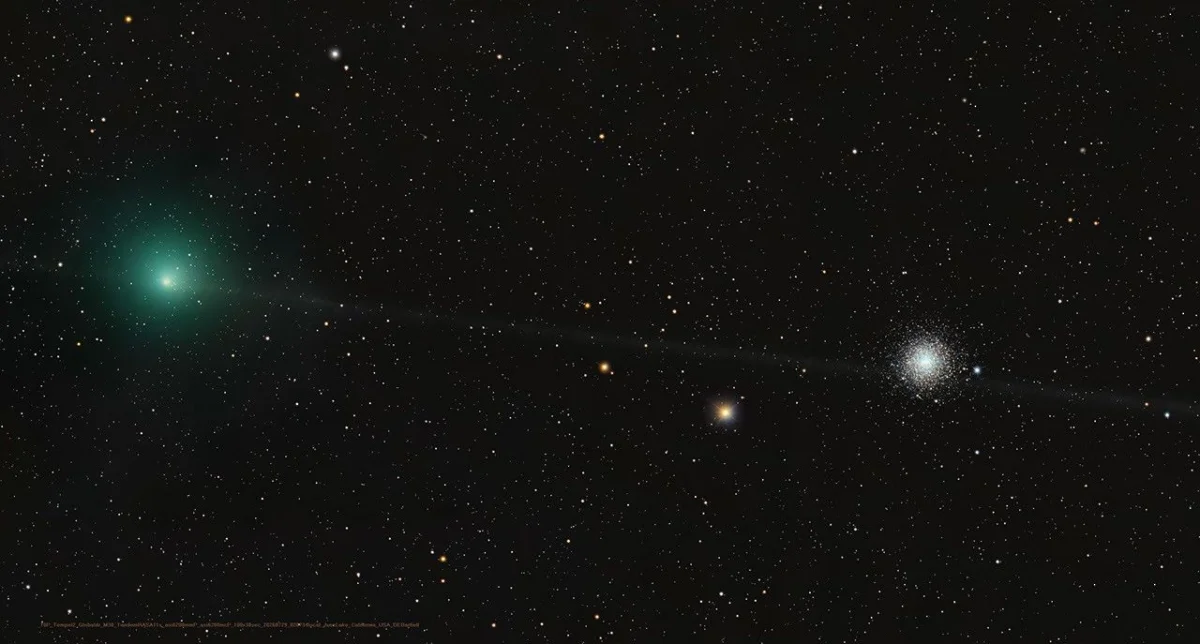
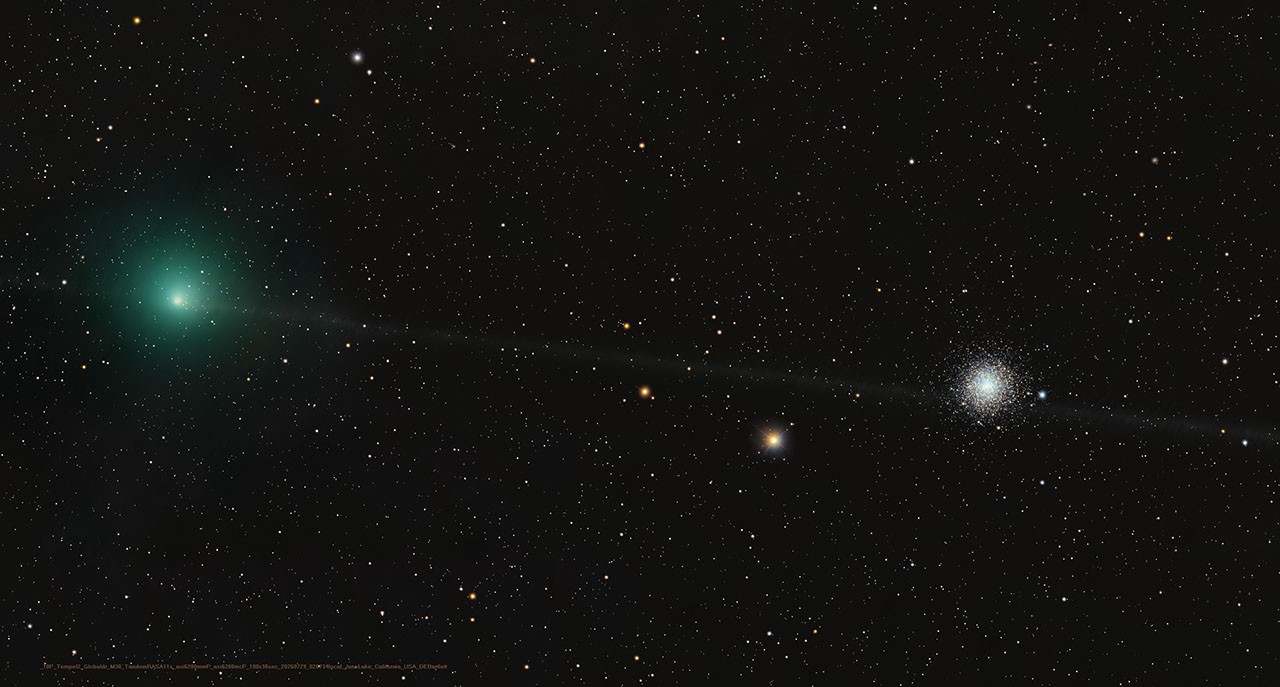
The cosmos recently offered a breathtaking spectacle as Comet 10P/Tempel 2 appeared to make a fleeting pass directly in front of the ancient globular star cluster Messier 30 (M30) from an Earth-bound perspective. This stunning visual conjunction, captured by modern telescopes on July 29, 2026, and subsequently featured as NASA’s Astronomy Picture of the Day (APOD), highlighted the vast, often deceptive, distances in our universe, illustrating how objects physically separated by billions of kilometers can align perfectly in our field of view. The greenish coma of the periodic comet, a faint and diffuse halo of gas and dust, created a striking visual against the densely packed stars of M30, prompting observers to ponder the sheer scale and dynamic nature of the celestial tapestry.
The Dance of Celestial Objects: A Rare Alignment
The celestial encounter between Comet 10P/Tempel 2 and Messier 30 was a testament to the intricate ballet performed by objects within and beyond our solar system. The image, recorded on July 29, 2026, showcased the ephemeral beauty of such alignments. From our vantage point on Earth, the comet’s faint, narrow, orbital dust trail appeared to momentarily "pierce" the distant globular cluster, creating a profound sense of depth and cosmic perspective. This optical illusion underscored the concept of line-of-sight astronomy, where objects at vastly different distances can appear adjacent or even overlapping on the celestial sphere. While the visual impact was one of close proximity, the physical reality was quite different: Comet Tempel 2 was merely 3.5 light-minutes away from Earth at the time of the observation, a relatively close neighbor in astronomical terms, whereas Messier 30 resides a staggering 28,000 light-years distant. This immense disparity in distance—where one object’s light takes minutes to reach us and the other’s takes millennia—serves as a powerful reminder of the profound emptiness of space and the rarity of such perfect visual overlaps.
Comet 10P/Tempel 2: A Periodic Visitor
Comet 10P/Tempel 2 is a periodic comet, a member of the Jupiter-family comets, characterized by its relatively short orbital period and its repeated visits to the inner solar system. Discovered by German astronomer Ernst Wilhelm Leberecht Tempel in 1873, the comet has an orbital period of approximately 5.3 years. Its nucleus, estimated to be around 10-14 kilometers in diameter, is a primordial remnant composed of ice, dust, and frozen gases. As it approaches the Sun, the solar radiation causes these volatile materials to sublimate, forming a vast, diffuse atmosphere known as the coma, and often two tails—a dust tail and an ion tail.
The greenish hue observed in the coma of 10P/Tempel 2 is a common characteristic for many comets and is primarily attributed to the presence of diatomic carbon (C2) molecules. When sunlight excites these molecules, they emit light at specific wavelengths, predominantly in the green part of the spectrum. Observing comets like Tempel 2 provides invaluable insights into the early conditions of our solar system. These icy wanderers are often described as "dirty snowballs" or "cosmic time capsules," preserving material from the solar nebula that formed the planets billions of years ago. Scientists meticulously study their composition, orbital mechanics, and outgassing processes to unlock secrets about the origins of water and organic molecules on Earth, and potentially the building blocks of life itself. The consistent monitoring of periodic comets also aids in refining our understanding of orbital dynamics and predicting future close approaches or potential impacts, though Tempel 2 poses no threat to Earth.
Messier 30: An Ancient Stellar Metropolis
In stark contrast to the transient nature of Comet Tempel 2, Messier 30 (M30), also known as NGC 7099, is an enduring monument of the cosmos. It is a globular star cluster, one of approximately 150 known globular clusters orbiting the Milky Way galaxy. These spherical collections of hundreds of thousands to millions of stars are among the oldest objects in the galaxy, with M30 itself estimated to be around 13 billion years old, nearly as old as the universe itself.
Discovered by French astronomer Charles Messier in 1764, M30 is located in the constellation Capricornus. Globular clusters are gravitationally bound systems, meaning their stars are densely packed and orbit a common center of mass. The stars within M30 are predominantly old, low-mass stars, including numerous red giants and blue stragglers, which are enigmatic stars that appear younger than their counterparts. Studying these clusters provides astronomers with natural laboratories to investigate stellar evolution, the dynamics of dense stellar systems, and the early history of galaxies. M30, like other globular clusters, is a relic from the early universe, offering clues about the conditions under which the first stars and galaxies formed. Its immense distance of 28,000 light-years means that the light we observe today left the cluster long before humans walked the Earth, providing a glimpse into the cosmic past.
Historical Context: Charles Messier and the Quest for Comets
The inclusion of Messier 30 in the famed Messier Catalog carries a rich historical narrative, illustrating the challenges faced by astronomers in the 18th century. Charles Messier, a dedicated and prolific comet hunter, compiled his catalog of "nebulae and star clusters" not out of a primary interest in these objects themselves, but rather to differentiate them from the comets he so eagerly sought. In an era when telescopic optics were rudimentary compared to today’s instruments, comets, nebulae, and star clusters often appeared as similarly faint, fuzzy patches of light in the eyepiece. This created a significant "comet hunter’s dilemma": how to distinguish a new, transient comet moving against the background stars from a fixed, permanent celestial object.
Messier’s ingenious solution was to meticulously catalog these stationary, fuzzy objects. Beginning in 1758 with the Crab Nebula (M1), his list grew to include 110 entries, ranging from star clusters and nebulae to galaxies. Each entry, like M30, was an object he had observed and confirmed was not a comet. His catalog, initially a practical tool for his own research, quickly became an indispensable resource for other astronomers, both professional and amateur, and remains widely used today. It stands as a testament to scientific rigor and the systematic approach to observation, laying groundwork for future astronomical discoveries. The irony, as highlighted by the recent alignment, is that Messier himself, peering through his less powerful telescope, would have seen both 10P/Tempel 2 and M30 as similar-looking faint and fuzzy objects, only distinguishing the comet by its motion over successive nights.
The Illusion of Proximity: Light-Minutes vs. Light-Years
The visual phenomenon of Comet Tempel 2 appearing to traverse M30 is a powerful illustration of the vastness of space and the concept of "line-of-sight" alignments. The critical distinction lies in the units of distance: light-minutes versus light-years. A light-minute is the distance light travels in one minute, approximately 18 million kilometers (11 million miles). Thus, 3.5 light-minutes means the comet was about 63 million kilometers away. In contrast, a light-year is the distance light travels in one Earth year, roughly 9.46 trillion kilometers (5.88 trillion miles). Therefore, M30 at 28,000 light-years is an almost incomprehensibly distant object, lying approximately 265 quadrillion kilometers away.
This immense difference underscores that the "piercing" of the globular cluster by the comet’s dust trail was purely a matter of perspective. The comet was located within our own solar system, while the globular cluster was a distant island of stars far beyond our galaxy’s immediate neighborhood. Such alignments, while spectacular, carry no physical interaction or connection between the objects involved. They are transient optical phenomena that highlight the three-dimensional nature of the universe when viewed from a two-dimensional projection on the celestial sphere. Astronomers frequently encounter such alignments, and distinguishing between apparent proximity and true physical closeness is a fundamental aspect of celestial mechanics and observational astronomy.
The Role of Astronomy Picture of the Day (APOD)
The feature of this extraordinary image on NASA’s Astronomy Picture of the Day (APOD) underscores its significance not just as a scientific observation, but also as a powerful tool for public engagement and education. APOD, a collaborative effort between NASA and Michigan Technological University, fulfills its mission to "Discover the cosmos!" by presenting a different image or photograph of our fascinating universe each day, accompanied by a brief, accessible explanation written by a professional astronomer. Since its inception in 1995, APOD has become a cornerstone of astronomical outreach, making complex celestial phenomena understandable and captivating for a global audience.
This particular image, showcasing the juxtaposition of a nearby comet and a distant star cluster, perfectly exemplifies APOD’s educational value. It allows viewers to visualize abstract astronomical concepts like distance, scale, and orbital mechanics in a tangible way. By presenting such visually stunning events, APOD inspires curiosity, fosters scientific literacy, and encourages countless individuals to look up at the night sky with a renewed sense of wonder. The platform serves as a vital bridge between cutting-edge astronomical research and the general public, demonstrating the beauty and relevance of scientific discovery.
Observational Techniques and Future Prospects
Capturing an image like the one featuring Comet Tempel 2 and M30 requires sophisticated modern telescopic technology and advanced astrophotography techniques. Unlike Charles Messier’s 18th-century instruments, which offered limited light-gathering power and resolution, today’s telescopes, equipped with highly sensitive digital cameras, can resolve faint objects and capture intricate details. Astrophotographers must precisely track celestial targets, often compensating for Earth’s rotation, and employ long exposure times to gather sufficient light from dim objects. The processing of these images also involves complex software to enhance details, reduce noise, and accurately render colors, revealing the subtle greenish coma of the comet and the myriad stars within the globular cluster.
Such observations are not merely visually appealing; they contribute to ongoing scientific endeavors. Tracking comets like Tempel 2 provides updated ephemerides, allowing for more accurate predictions of their future trajectories and physical behavior. For globular clusters, continued imaging helps in identifying variable stars, studying stellar populations, and understanding their dynamic evolution over billions of years. The increasing accessibility of advanced amateur astronomical equipment also means that citizen scientists play an ever-growing role in discovering and documenting such celestial events, often collaborating with professional astronomers. As technology advances, we can anticipate even more detailed and immersive views of our universe, continuing to reveal its hidden wonders.
Scientific Significance and Broader Implications
While the alignment of Comet 10P/Tempel 2 and M30 was an optical coincidence, its scientific significance lies in the individual properties of the objects involved and the educational opportunity it presents. The periodic nature of Comet Tempel 2 makes it a valuable target for studying the evolution of cometary nuclei over multiple solar passages. Each perihelion (closest approach to the Sun) causes sublimation and changes in its surface, offering clues about its internal structure and the physical processes that govern its activity. Understanding comets is crucial for theories regarding the delivery of water and organic molecules to early Earth, potentially kickstarting life.
Messier 30, as a prime example of an ancient globular cluster, provides a rich environment for studying stellar dynamics in crowded conditions. The high density of stars in its core can lead to stellar collisions and the formation of exotic objects like blue stragglers or even intermediate-mass black holes, though none have been definitively confirmed in M30. Analyzing the metallicity (the abundance of elements heavier than hydrogen and helium) of its stars helps astronomers reconstruct the chemical evolution of the Milky Way galaxy.
Beyond the specific scientific data gleaned, events like this serve a broader cultural purpose. They ignite public interest in astronomy and science, fostering a sense of shared humanity under a vast and mysterious sky. The juxtaposition of a relatively nearby, active comet and a profoundly distant, ancient stellar city offers a powerful lesson in cosmic scale and perspective, reminding us of our place within an unimaginably grand universe. As astronomers continue to probe the depths of space with increasingly sophisticated instruments, such serendipitous alignments will continue to offer moments of both scientific insight and profound wonder.