



As the Bureau of Labor Statistics (BLS) prepares to unveil the eagerly awaited employment figures for July on Friday, economists, according to Dow Jones consensus estimates, are forecasting a modest gain of 85,000 jobs for the month. This projection arrives amidst a complex economic landscape characterized by fluctuating labor force participation rates and persistent inflationary pressures, setting the stage for a critical assessment of the nation’s economic health. However, a notable divergence has emerged from prediction market platforms, with traders on Kalshi suggesting that the official figures might fall short of these consensus expectations, introducing an element of uncertainty into the pre-release analysis.
The anticipated 85,000 job gain, if realized, would signify a continued, albeit tempered, expansion of the U.S. labor market. This figure stands as a crucial benchmark for policymakers, financial markets, and businesses alike, offering insights into the pace of economic recovery and the effectiveness of current monetary policies. Analysts across Wall Street will be dissecting every data point, from the headline payroll number to the unemployment rate, wage growth, and labor force participation, to discern underlying trends and potential shifts in the economic trajectory. The context of mid-2026 sees the economy navigating the lingering effects of earlier global supply chain disruptions, evolving consumer spending patterns, and the Federal Reserve’s ongoing efforts to manage inflation without triggering a significant downturn.
Kalshi’s Contrarian Market Signals
In contrast to the relatively stable consensus from traditional economic forecasts, the prediction market platform Kalshi presents a more cautious outlook for the July jobs report. Speculators on Kalshi assign just a 47% probability that employers added more than 80,000 jobs in July, a figure that already sits below the Dow Jones consensus. While they give a 60% chance that additions will exceed 70,000 jobs, this still implies a significant possibility of underperforming the broader market’s expectations. These contracts on Kalshi are structured to ask traders to predict whether the official BLS figure will surpass a series of predefined thresholds, with outcomes resolved directly by the government’s official data.
Interestingly, while the platform signals a potential downside miss, it also acknowledges the possibility of an upside surprise, albeit with lower probabilities. Traders place a 41% chance that employers added 90,000 jobs in July, and just over a one-in-three chance (approximately 33-34%) that the number will reach six figures, exceeding 100,000. This indicates a degree of uncertainty and a spread of potential outcomes in the market’s collective wisdom. Conversely, Kalshi traders also suggest a one-in-three chance that the number could fall below 60,000, underscoring the platform’s capacity to reflect a wide range of possibilities, including a significantly weaker report than generally anticipated. The dynamic nature of these prediction markets, where participants literally "bet" on economic outcomes, provides an alternative barometer of sentiment, often reflecting a more immediate and unfiltered aggregation of individual expectations compared to traditional expert surveys.
A Look Back: Kalshi’s June 2026 Forecast and the Reality Check
The credibility and analytical value of prediction markets like Kalshi often come under scrutiny, especially when their forecasts diverge significantly from official data. A pertinent example lies in their performance leading up to the June 2026 jobs report. Last month, Kalshi traders had placed a 63% chance that employers would add more than 125,000 jobs in June. This forecast was notably optimistic, surpassing the consensus estimates from economists, which hovered around 115,000 jobs.
However, the official figure released by the Bureau of Labor Statistics ultimately presented a starkly different picture. The U.S. economy added a mere 57,000 jobs in June, significantly underperforming both the consensus expectations and Kalshi’s more bullish prediction. This substantial discrepancy between the prediction market’s high confidence and the actual outcome raises important questions about the reliability of such platforms as precise forecasting tools for every economic indicator. While prediction markets are often lauded for their ability to aggregate diverse information and reduce biases inherent in traditional polling, their performance can vary. The June experience serves as a crucial reminder that while they offer valuable insights into market sentiment and perceived probabilities, they are not infallible and can sometimes be swayed by collective optimism or misinterpretation of nascent economic signals. This prior miss will undoubtedly be a factor as analysts and investors evaluate Kalshi’s July predictions, adding a layer of skepticism or at least caution to their interpretation.
The Broader Economic Landscape in Mid-2026
The impending July jobs report does not exist in a vacuum; it is deeply embedded within a complex and evolving economic narrative. A significant backdrop for the current labor market is the persistently low labor force participation rate, which, outside of the immediate COVID-19 pandemic era, has reportedly fallen to its lowest point in 50 years. This long-term trend signifies a shrinking proportion of the working-age population actively engaged in or seeking employment, posing structural challenges to sustained economic growth and productivity. Factors contributing to this decline are multifaceted, including demographic shifts (an aging population retiring), lingering effects of long-term illness, changes in childcare availability, and potentially evolving worker preferences for non-participation or part-time roles.
Amidst these structural shifts, the U.S. economy in mid-2026 continues to grapple with the Federal Reserve’s restrictive monetary policy. The central bank has been on an aggressive campaign of interest rate hikes aimed at cooling inflation, which peaked in preceding years. Higher interest rates typically translate to increased borrowing costs for businesses and consumers, which can dampen investment, consumer spending, and ultimately, job creation. The Fed’s dual mandate of maximum employment and price stability means that each jobs report is scrutinized for signs of either overheating or over-cooling in the labor market. A very strong jobs report could signal persistent inflationary pressures, potentially prompting further rate hikes, while a weak report might suggest that the economy is slowing too rapidly, raising concerns about a recession.
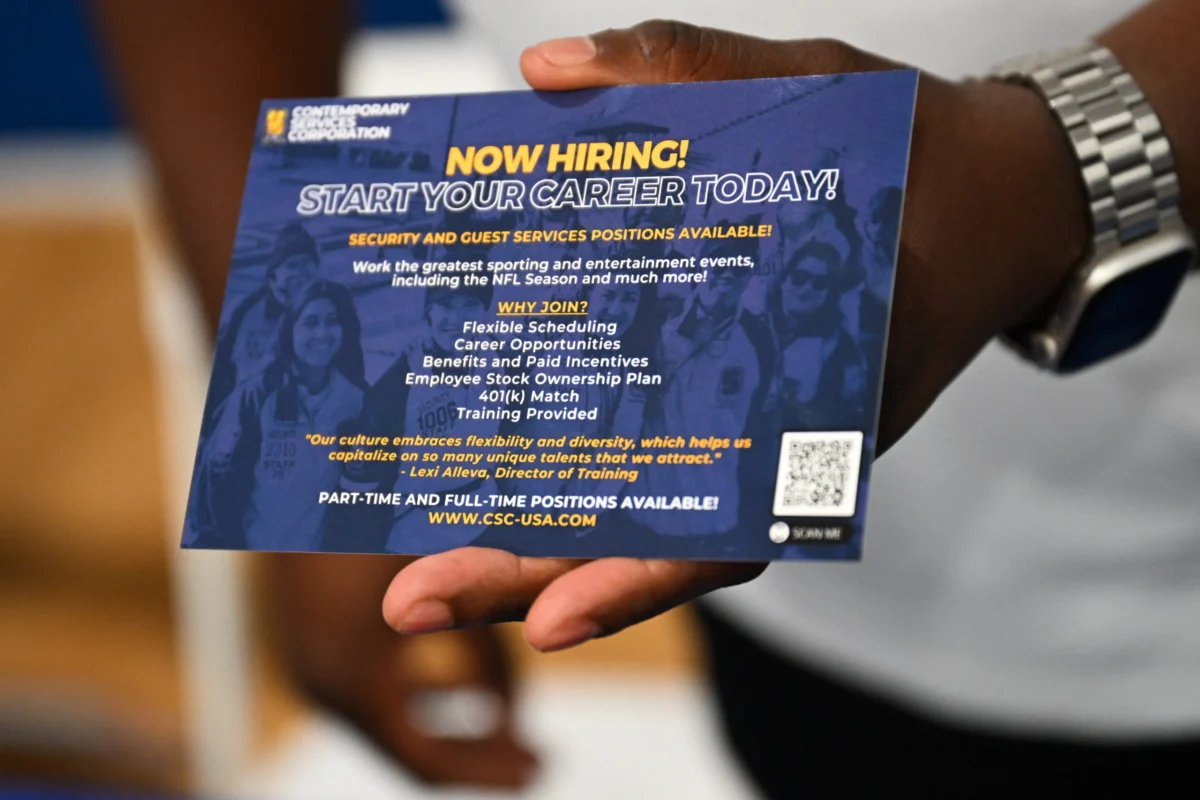
Sector-specific trends also paint a varied picture. The image accompanying the original article, depicting a Contemporary Services Corporation (CSC) "now hiring" flyer for event security guards at an "Inspire Together" job and resource fair in Los Angeles in July 2026, highlights the ongoing demand in certain service sectors. Event security, hospitality, and leisure industries, which were significantly impacted by the pandemic, have seen a resurgence in hiring as social activities and large gatherings return to pre-pandemic levels. However, other sectors, particularly technology and interest-rate sensitive areas like real estate and construction, have experienced slowdowns, layoffs, or hiring freezes as companies adjust to higher capital costs and shifting demand. The "Inspire Together" fair itself underscores community efforts to bridge skill gaps and connect job seekers with available opportunities, a vital component in addressing localized labor market imbalances.
The Mechanics of Employment Data: Understanding the BLS
The Bureau of Labor Statistics (BLS) is the principal fact-finding agency for the U.S. government in the broad field of labor economics and statistics. Its monthly employment situation report, commonly known as the jobs report, is one of the most closely watched economic indicators globally. The report is primarily derived from two comprehensive surveys:
- The Establishment Survey (Current Employment Statistics – CES): This survey collects data from approximately 119,000 businesses and government agencies, representing about 629,000 individual worksites. It provides detailed industry data on nonfarm employment, hours, and earnings of workers on payrolls. The headline "nonfarm payrolls" number, which is the focus of the consensus estimates and Kalshi’s predictions, comes from this survey. It’s a measure of jobs added, not necessarily people hired, as one person can hold multiple jobs.
- The Household Survey (Current Population Survey – CPS): This survey is conducted monthly by the Census Bureau for the BLS and involves approximately 60,000 households. It provides data on the labor force, employment, unemployment, and earnings by demographic characteristics. The unemployment rate, labor force participation rate, and employment-to-population ratio are derived from this survey.
The BLS’s rigorous methodology, which includes seasonal adjustments and benchmark revisions, aims to provide the most accurate and comprehensive picture of the U.S. labor market. However, the sheer scale and complexity of data collection mean that initial figures are often subject to revisions in subsequent months. These revisions can sometimes be significant, further adding to the challenge of real-time economic forecasting. For instance, a strong initial report might be revised down later, or vice versa, influencing market sentiment and policy decisions with a lag. The BLS data is considered sacrosanct by the Federal Reserve and other government agencies for informing monetary policy, fiscal policy, and various social programs.
Economists vs. Algorithms: The Art and Science of Forecasting
The divergence between traditional economic consensus and prediction market signals for the July jobs report highlights an ongoing debate about the most effective methods for economic forecasting. Economists typically rely on a combination of econometric models, surveys of businesses and consumers, leading and lagging economic indicators, and qualitative analysis of market trends and geopolitical events. Their forecasts are often informed by deep institutional knowledge and a careful weighing of various factors, attempting to synthesize complex data into a coherent outlook. While robust, these methods can sometimes be influenced by groupthink or inherent biases, and can struggle to capture sudden shifts in sentiment or unforeseen external shocks.
Prediction markets, on the other hand, operate on a different principle: the "wisdom of crowds." By allowing individuals to trade contracts on future events, these platforms aggregate decentralized information and beliefs, with the price of a contract reflecting the crowd’s perceived probability of an outcome. The financial incentives (or disincentives) for accurate predictions are theoretically supposed to lead to more efficient and unbiased forecasts. However, as seen with Kalshi’s June miss, prediction markets are not immune to collective errors. They can be susceptible to herd mentality, irrational exuberance, or a lack of deep, fundamental analysis that economists bring to the table. They also rely on a sufficiently liquid market and diverse participation to function optimally.
The interplay between these two forecasting approaches offers a richer, albeit more nuanced, understanding of potential economic outcomes. While economists provide structured, model-driven analysis, prediction markets offer a real-time, sentiment-driven reflection of collective confidence. The significant difference in their outlook for July underscores the current uncertainty in the economic environment and the challenges in accurately predicting the notoriously volatile monthly jobs data.
Potential Implications for Monetary Policy and Markets
The outcome of the July jobs report will have profound implications across the financial landscape and for the future direction of monetary policy. For the Federal Reserve, a jobs report significantly above the 85,000 consensus could signal that the labor market remains robust, potentially fueling wage inflation and underscoring the need for continued vigilance against price pressures. This might prompt the Fed to maintain its hawkish stance, potentially signaling further interest rate hikes or a prolonged period of higher rates to bring inflation sustainably back to its target. Conversely, a report significantly below consensus, particularly if it dips below the 60,000 mark suggested by Kalshi’s lower bound, could indicate a more rapid cooling of the economy than anticipated. Such a slowdown could provide the Fed with room to pause its rate hikes or even consider future rate cuts if recessionary concerns mount, although their primary focus would remain on inflation.
Financial markets are highly sensitive to jobs data. A stronger-than-expected report typically leads to higher bond yields (as investors anticipate higher rates), a stronger U.S. dollar, and potentially a sell-off in growth stocks (due to higher discount rates and recession fears), while value stocks might fare better. Conversely, a weaker report could see bond yields fall (as rate hike expectations diminish), the dollar weaken, and a potential rally in equities as investors price in a less aggressive Fed. The volatility around these releases is often significant, as traders adjust their positions rapidly based on the new information.
Beyond immediate market reactions, the jobs report also influences consumer confidence and spending patterns. A healthy labor market generally supports consumer purchasing power, which accounts for a substantial portion of economic activity. Any signs of weakness, such as rising unemployment or slowing wage growth, could dampen consumer sentiment, leading to reduced spending and a broader economic deceleration. Businesses also closely monitor these figures to inform their hiring, investment, and production decisions. A tightening labor market, for example, might encourage businesses to invest in automation, while a loosening market could reduce wage pressures.
The Human Element: Job Seekers and Employers
At the heart of every jobs report are individuals seeking employment and businesses striving to fill open positions. The image of the CSC "now hiring" flyer at the "Inspire Together" job fair in Los Angeles vividly illustrates this human dimension. For job seekers, a tight labor market can mean more opportunities and potentially higher wages, while a cooling market can translate into increased competition and longer job searches. Programs like "Inspire Together" play a vital role in connecting talent with demand, especially in specific sectors like event security, which often requires a rapid ramp-up of staff for large-scale gatherings and entertainment venues.
Employers, meanwhile, face the challenge of attracting and retaining talent in a dynamic environment. Depending on the industry and skill requirements, businesses might be contending with labor shortages, wage demands, or the need to invest in training and upskilling their workforce. The ongoing debate around labor force participation and its structural causes directly impacts businesses’ ability to find the human capital necessary for growth and innovation.
Looking Ahead: The Road to Economic Stability
As the July jobs report draws near, it represents more than just a monthly data point; it’s a critical barometer of the U.S. economy’s resilience and trajectory. The interplay between traditional economic forecasts and the intriguing signals from prediction markets underscores the current climate of uncertainty. Whether the BLS report aligns with economists’ cautious optimism or leans towards Kalshi’s more conservative outlook, its release will undoubtedly trigger significant market movements and provide crucial guidance for the Federal Reserve’s path forward.
The long-term health of the labor market will continue to be shaped by demographic shifts, technological advancements, and evolving global economic conditions. Policymakers and businesses alike will need to adapt to these changes, focusing on strategies that promote sustainable job growth, enhance labor force participation, and equip workers with the skills needed for the jobs of tomorrow. The July 2026 employment picture will be another vital piece in this ongoing puzzle, offering insights into how the nation is progressing on its road to economic stability and prosperity.
Disclosure: CNBC and Kalshi have a commercial relationship that includes customer acquisition and a minority investment.