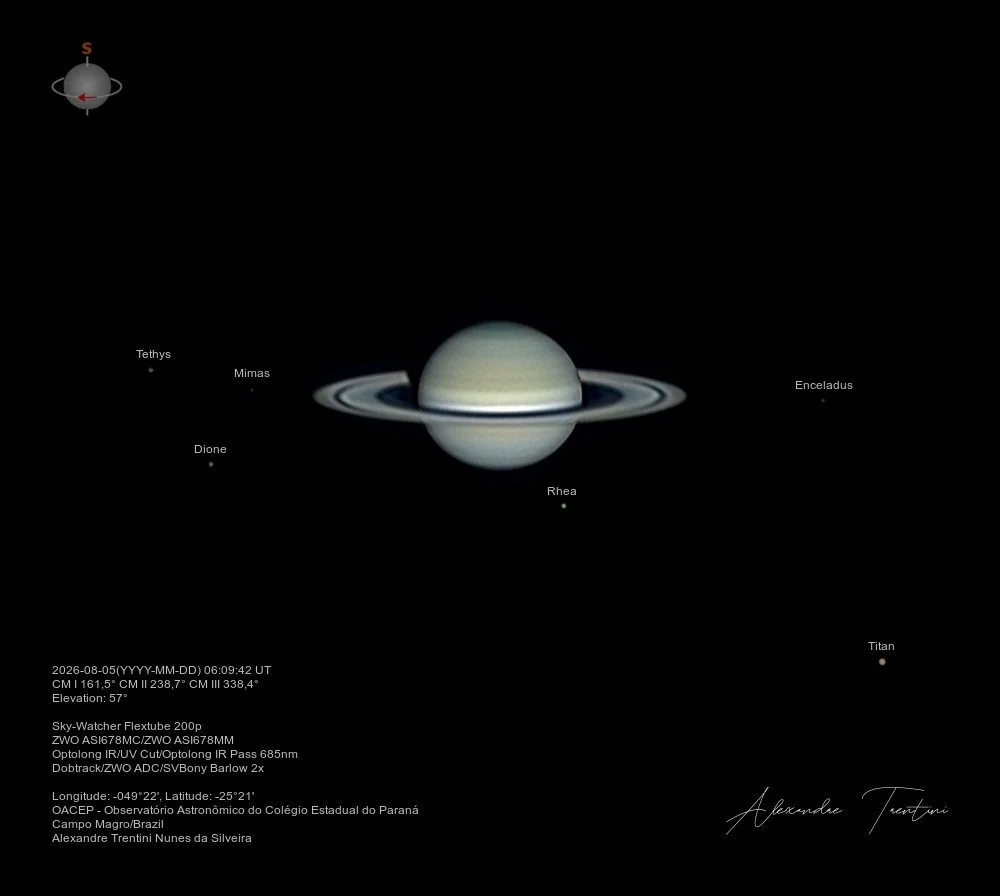
A captivating image of Saturn, its iconic rings, and six of its largest moons recently featured as the Astronomy Picture of the Day (APOD) on August 5, 2026, has once again drawn the public’s attention to the gas giant’s astounding number of natural satellites. As of June 2026, Saturn holds the undisputed record for the most confirmed moons in our solar system, boasting an astonishing 293 celestial bodies in orbit around it. This number significantly eclipses that of its gas giant counterpart, Jupiter, which currently holds 115 confirmed moons, firmly establishing Saturn as the supreme lunar overlord of our cosmic neighborhood.
The Astronomy Picture of the Day: A Window to the Cosmos
The Astronomy Picture of the Day (APOD), a daily feature curated by NASA and Michigan Technological University, serves as a vital conduit for public engagement with astronomical science. Each day, APOD presents a different image or photograph of our universe, accompanied by a concise yet informative explanation penned by a professional astronomer. Since its inception in 1995, APOD has become an indispensable resource for enthusiasts, educators, and the general public seeking to "Discover the cosmos!" The August 5, 2026, entry, showcasing a sharp telescopic portrait of Saturn and its prominent moons, exemplifies APOD’s mission to highlight significant astronomical observations and discoveries, providing context for the ever-evolving understanding of our universe. The featured image, a composite of high-resolution telescopic data, not only offers a visually stunning perspective of the ringed planet but also underscores the sheer complexity and richness of its satellite system.
A Lunar Empire: Unpacking Saturn’s 293 Moons
The sheer volume of Saturn’s moons is a testament to the dynamic and often chaotic processes that shaped the early solar system, as well as the ongoing gravitational dance within the gas giant’s sphere of influence. While the number 293 is monumental, it is crucial to understand that the vast majority of these moons are not colossal, Earth-like worlds. Instead, they predominantly fall into the category of small, irregular satellites. Many of these newly confirmed moons are mere kilometers, or even fractions of a kilometer, in diameter. These diminutive bodies are often characterized by their highly tilted and eccentric outer orbits, suggesting they are likely captured asteroids or fragments resulting from ancient collisions within the Saturnian system. Their irregular shapes and diverse orbital paths provide invaluable clues about the chaotic early history of the outer solar system and the processes of planetary accretion and gravitational capture.
The Illustrious "Big Six": Major Moons in Focus
Despite the numerical dominance of its smaller, irregular satellites, Saturn is also home to several truly remarkable major moons, six of which are prominently visible in the August 5 APOD image. These are not merely icy rocks but worlds with distinct geological features, atmospheres, and even potential for subsurface oceans.
-
Titan: Positioned at the lower right of the image, Titan stands out not just for its size but for its unique characteristics. With a diameter of 5,150 kilometers, it is not only larger than Earth’s Moon but also slightly larger than the inner planet Mercury. Titan is the only moon in our solar system known to possess a dense, nitrogen-rich atmosphere, even thicker than Earth’s. This hazy veil shrouds a landscape featuring liquid methane and ethane lakes, rivers, and seas, forming a hydrological cycle akin to Earth’s water cycle, albeit with different chemistry. Discovered in 1655 by Dutch astronomer Christiaan Huygens, Titan has been a primary target for scientific investigation, most notably by the Cassini-Huygens mission, which deployed the Huygens probe to its surface in 2005. Future missions, such as NASA’s Dragonfly rotorcraft, are planned to further explore Titan’s prebiotic chemistry and astrobiological potential.
-
Enceladus: Though smaller than Titan, Enceladus is arguably one of the most exciting moons in the solar system from an astrobiological perspective. This icy world exhibits active cryovolcanism, spewing plumes of water vapor, ice particles, and organic molecules from its south polar region. These plumes are direct evidence of a subsurface saltwater ocean beneath its icy crust, heated by tidal forces from Saturn. The presence of liquid water, along with heat and organic compounds, makes Enceladus a prime candidate in the search for extraterrestrial life.
-
Mimas: Often dubbed the "Death Star moon" due to its enormous Herschel crater, which spans 130 kilometers (one-third of the moon’s diameter), Mimas is another icy moon. Its heavily cratered surface suggests a long history of impacts. Its close proximity to Saturn and its relatively small size make it subject to intense tidal forces.
-
Tethys: A medium-sized icy moon, Tethys is notable for its immense Odysseus crater, measuring about 400 kilometers across, and a vast canyon system known as Ithaca Chasma, which stretches for over 2,000 kilometers. These features hint at past geological activity, possibly linked to internal stresses or impacts.
-
Dione: This moon displays a mix of heavily cratered terrain and smooth plains, along with bright, wispy streaks that are believed to be cliffs of ice. Dione also has a tenuous exosphere and evidence of past cryovolcanic activity, suggesting a more dynamic history than some of its counterparts.
-
Rhea: The second-largest of Saturn’s moons, Rhea is heavily cratered and has a low density, indicating a composition primarily of ice with a small rocky core. It also boasts a faint, tenuous exosphere of oxygen and carbon dioxide, and is believed to have a subtle ring system of its own, although this remains a subject of ongoing research.
A Chronology of Discovery: From Telescopes to Spacecraft
The story of Saturn’s moons is a testament to humanity’s persistent curiosity and technological advancement.
-
The Dawn of Telescopic Astronomy (17th Century): The journey began in 1655 when Christiaan Huygens, using a powerful telescope of his own design, became the first to identify a moon orbiting Saturn – Titan. His observations also helped to correctly interpret Saturn’s rings as distinct, separate structures. Decades later, between 1671 and 1684, Giovanni Cassini, another pioneering astronomer, discovered four more of Saturn’s major moons: Iapetus, Rhea, Tethys, and Dione. These early discoveries were monumental, demonstrating the complexity of other planetary systems.
-
Further Telescopic Revelations (18th-20th Centuries): William Herschel, famed for discovering Uranus, added Mimas and Enceladus to Saturn’s known moons in 1789. The late 19th and early 20th centuries saw the discovery of Phoebe (1899 by William Henry Pickering), Saturn’s first known irregular moon, orbiting in a retrograde direction, and then Japet and Hyperion. These discoveries hinted at the existence of a more diverse population of satellites than previously imagined.
-
The Space Age Revolution (1970s-2010s): The true explosion in the number of known Saturnian moons began with the advent of robotic spacecraft missions.
- Pioneer 11 (1979): Provided the first close-up images of Saturn and its rings, offering tantalizing glimpses of its moons.
- Voyager 1 (1980) and Voyager 2 (1981): These flyby missions revolutionized our understanding of the outer solar system. They confirmed the existence of several previously suspected moons, discovered new small inner moons (like Atlas, Prometheus, and Pandora), and provided detailed images of the major satellites, revealing their unique geologies. The Voyager missions also provided the first direct evidence of the complex interactions between Saturn’s rings and its "shepherd moons."
- Cassini-Huygens (2004-2017): This joint NASA-ESA mission was the undisputed game-changer. Orbiting Saturn for 13 years, Cassini conducted an unprecedented detailed study of the planet, its rings, and its vast moon system. The mission was responsible for the discovery and confirmation of dozens of new moons, many of them small, irregular bodies found within the rings or in distant, highly inclined orbits. Cassini’s observations transformed our understanding of Titan, Enceladus, and many other moons, revealing subsurface oceans, active plumes, and complex geological processes. The mission’s data continues to be analyzed, yielding new insights and leading to the confirmation of additional moons even years after its dramatic end in Saturn’s atmosphere in 2017.
-
Modern Ground-Based and Orbital Surveys (2020s onwards): Even after Cassini, the hunt for new moons continues. Advanced ground-based telescopes, combined with sophisticated image processing techniques, have proven incredibly effective. Recent surveys, such as those conducted by teams from Carnegie Science and the University of British Columbia, have systematically scanned archival and new images of Saturn, identifying faint, previously undetected objects. These efforts, often involving years of meticulous observation and orbital confirmation, are primarily responsible for the rapid increase in Saturn’s moon count in the 2020s, pushing the total to 293 as of June 2026. This ongoing discovery process underscores the fact that our solar system, even after centuries of study, still holds many secrets.
The Science Behind the Numbers: Formation and Dynamics
The extraordinary number and diversity of Saturn’s moons offer a rich laboratory for planetary scientists studying everything from celestial mechanics to the origins of life. The irregular moons, in particular, are thought to be remnants of captured asteroids or comets, or fragments from larger bodies that broke apart due to collisions or tidal forces. Their highly eccentric and inclined orbits are hallmarks of such capture events, contrasting sharply with the more regular, prograde, and equatorial orbits of the larger inner moons, which likely formed alongside Saturn from the same protoplanetary disk.
The gravitational interactions within the Saturnian system are incredibly complex. Moons can exert gravitational forces on each other and on the ring particles, leading to orbital resonances, shepherd effects that sculpt the rings, and even internal heating in moons like Enceladus. Understanding these dynamics provides crucial insights into the evolution of planetary systems, the distribution of mass, and the long-term stability of celestial bodies.
Official Perspectives and Future Endeavors
Scientists at NASA, the European Space Agency (ESA), and research institutions worldwide consistently emphasize the profound scientific value of these ongoing discoveries. Dr. Amy Simon, a planetary scientist at NASA, might note, "Every new moon we confirm around Saturn adds another piece to the grand puzzle of planetary formation and evolution. These tiny, distant worlds hold clues to the conditions in the early solar system and the dynamic processes that shaped the giants we see today." Similarly, researchers involved in the recent moon discoveries, like those at the University of British Columbia, would likely highlight the blend of advanced observational techniques and computational analysis required to push the boundaries of detection. The continued surveillance of Saturn’s environment, potentially with next-generation telescopes like the James Webb Space Telescope (JWST) for atmospheric and compositional studies, promises further revelations. Future missions, whether flybys or dedicated orbiters, will undoubtedly be planned to explore the most intriguing of these newfound worlds.
Broader Impact and Public Engagement
The APOD feature, along with the announcement of Saturn’s record-breaking moon count, serves as an excellent example of how complex scientific discoveries are translated for public consumption, inspiring wonder and fostering a deeper appreciation for the universe. Such revelations ignite public interest in space exploration and scientific research, encouraging new generations to pursue careers in STEM fields. The August 5 APOD also subtly points to another upcoming celestial spectacle: the Total Solar Eclipse on August 12, 2026, which NASA is actively promoting through live streams and educational initiatives. This dual focus on deep space wonders and accessible terrestrial astronomical events demonstrates NASA’s commitment to broad public engagement in the marvels of the cosmos.
In conclusion, Saturn’s astounding 293 confirmed moons represent not just a statistical record but a vibrant, dynamic system ripe with scientific mysteries and potential for future breakthroughs. From the atmospheric enigma of Titan to the cryovolcanic wonders of Enceladus, and the countless small, irregular bodies still yielding their secrets, the Saturnian system continues to be a frontier of discovery. As technology advances and our understanding deepens, the precise number of Saturn’s moons may yet continue to climb, solidifying its status as one of the most compelling and scientifically significant destinations in our solar system.