



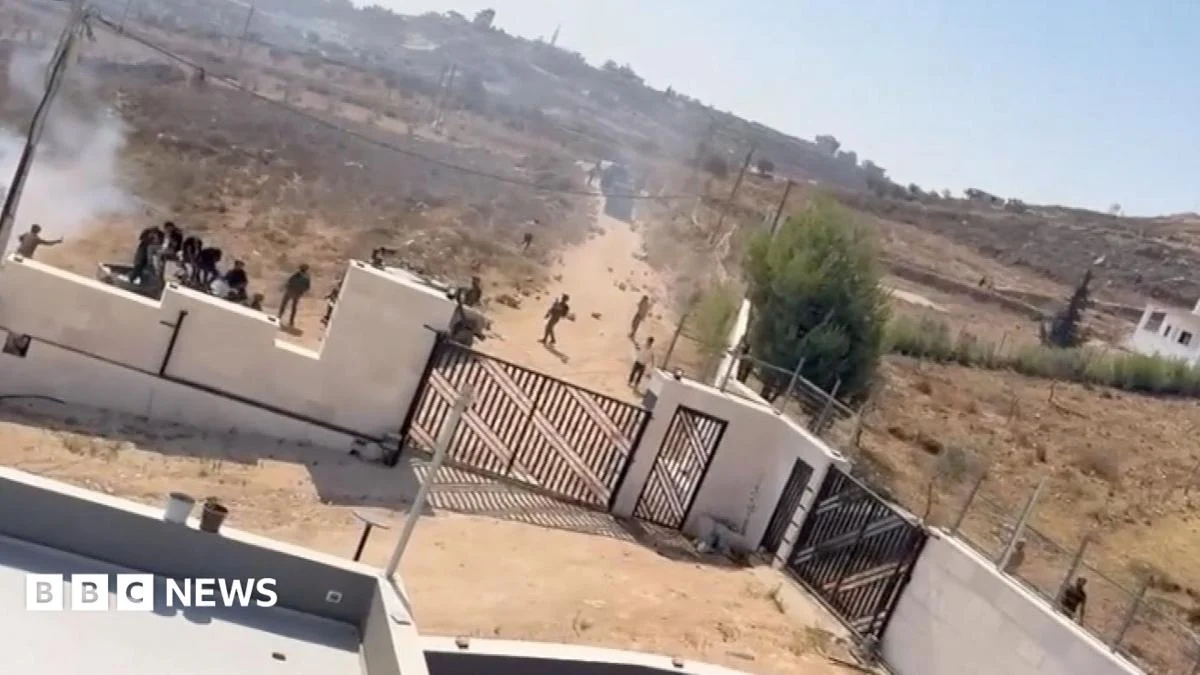
For several days, two Palestinian families in the occupied West Bank have endured a harrowing siege by Israeli settlers, trapped in their homes in the village of Qusra near Nablus. The families, identified as the Abu Ridi and Hassan households, reported dwindling supplies of food, water, and electricity, prompting urgent appeals for help and drawing sharp condemnation from human rights organizations and international bodies. The incident underscores a perilous escalation of settler violence in the West Bank, a region already teetering on the brink of widespread instability, as highlighted by a top UN official.
The crisis began on Sunday, October 22, when a group of Israeli settlers established a new outpost in the vicinity of Qusra. Palestinian security camera footage from Sunday evening depicted settlers dismantling a wall outside the Abu Ridi family’s home, subsequently using the stones to barricade the road leading to the property. This act of obstruction effectively cut off seven individuals, including two young girls, from the outside world, preventing them from leaving their homes and denying access to other Palestinians attempting to reach them. The families reside in Area B of the West Bank, a designation under the Oslo Accords where the Palestinian Authority holds administrative control, but Israel retains overarching security control – a distinction that often complicates security responses to settler-related incidents.
Chronology of a Siege: Days of Isolation and Intervention
Sunday, October 22: The Initial Blockade
The siege commenced with the physical blockade of the Abu Ridi and Hassan homes. The destruction of property and the creation of a physical barrier immediately plunged the families into isolation. Following the initial report to the Israeli army, a disturbing scene unfolded: the first Israeli soldiers dispatched to the location were filmed engaged in prayer with the very settlers accused of perpetrating the blockade. This footage quickly circulated, drawing widespread criticism and raising serious questions about the impartiality and conduct of Israeli security forces in protecting Palestinian civilians.
Monday, October 23: Escalation and Obstructed Reporting
As the families’ plight worsened, their pleas for help intensified. Qusay Abu Ridi, a member of one of the besieged families, took to Facebook, describing their critical situation: "We are living in our own home, on our own land, and we are asking for nothing more than the right to live safely and with dignity." He emphasized their complete isolation, highlighting the growing humanitarian concerns. On the same day, Israeli journalists from the left-leaning Haaretz newspaper attempted to reach the Palestinian properties but were aggressively blocked by Israeli settlers. Despite the presence of Israeli soldiers, the reporters stated that no assistance was provided, and they were informed the area was a closed military zone – an order that was conspicuously not enforced against the settlers who continued their activities unimpeded for two hours. This selective enforcement further fueled accusations of complicity or inaction on the part of the Israeli military.
Tuesday, October 24: Urgent Appeals and First Aid
With food stocks critically low and water and power supplies severed, the humanitarian situation became dire. The Israeli human rights group Yesh Din issued an urgent appeal to the head of the Israeli military’s Central Command. Their demand was unequivocal: the army must protect the besieged residents, dismantle the settler outpost, and hold the responsible settlers accountable for their actions. Late on Tuesday, a critical breakthrough occurred when a Palestinian ambulance was finally granted access to the families. The ambulance delivered much-needed food supplies and transported one child, suffering from a medical condition exacerbated by the ordeal, to receive urgent medical treatment. This intervention provided temporary relief but did not resolve the underlying siege.
Around the same time, the Israel Defense Forces (IDF) released a statement, seemingly in response to the mounting pressure and public outcry. The IDF condemned the establishment of the new outpost, unequivocally describing the act of entering and seizing Palestinian homes as "illegal, reprehensible, and unacceptable activity." This official condemnation marked a shift in rhetoric, acknowledging the severity of the settlers’ actions.
Wednesday, October 25: Security Forces’ Intervention and Disciplinary Action
The situation took a significant turn early on Wednesday. Major General Avi Bluth, head of the IDF’s Central Command, along with other senior officers, arrived at the scene. They reportedly met with residents and expressed their "grave concern" over the developments. Following these discussions, Palestinian security camera footage shared with the BBC captured confrontations between Israeli soldiers and border police and a substantial crowd of settlers. The security forces deployed tear gas and stun grenades to disperse the settlers, signaling a more assertive intervention. Further footage showed Israeli forces confiscating a canopy used by the settlers for shelter, though other equipment remained untouched.
The IDF subsequently issued a statement confirming that Border Police forces had evacuated the tent and were working to remove the remaining civilians. Crucially, the IDF also announced that "disciplinary action would be taken against the security personnel involved, who were documented at the site several days ago." This acknowledgment of misconduct among its ranks, likely referring to the soldiers filmed praying with settlers, suggested an internal recognition of the need to address the perception of bias and ensure proper protocol. However, about a dozen settlers were reported to still remain at the site, indicating the ongoing challenge of completely dislodging them.
The Humanitarian Toll and Legal Framework
The siege on the Abu Ridi and Hassan families is not an isolated incident but a symptom of a much broader and deeply concerning trend of escalating settler violence and displacement in the West Bank. Under international law, all Israeli settlements in the occupied Palestinian territories, including East Jerusalem, are deemed illegal. This position has been consistently affirmed by numerous United Nations Security Council resolutions and the International Court of Justice. Outposts, such as the one established near Qusra, are particularly egregious as they are constructed even without official Israeli government authorization, often by extremist settler groups aiming to unilaterally expand Israeli presence and assert control over Palestinian land.
The humanitarian impact of such actions is profound. Families are forcibly displaced, livelihoods are destroyed, and access to basic necessities is routinely denied. The cutting off of water, electricity, and food supplies constitutes a severe violation of humanitarian principles and international human rights law, which mandates the protection of civilians in occupied territories. The psychological trauma inflicted on besieged families, particularly children, is immeasurable, contributing to a cycle of fear and instability.
A West Bank "At Breaking Point"
The events in Qusra unfolded against a backdrop of increasing alarm from the international community. On Tuesday, Ramiz Alakbarov, the UN’s Deputy Special Coordinator for the Middle East Peace Process, delivered a stark warning to the Security Council in New York, stating unequivocally that "the West Bank is at breaking point." He presented a "sobering human toll," specifically noting the devastating impact on the Nablus Governorate, where Qusra is located, which has been particularly hard-hit by recent violence.
UN figures paint a grim picture of the escalating conflict in 2023. As of the time of Alakbarov’s briefing, 76 Palestinians, including 18 children, had been killed in the West Bank by either Israeli forces or settlers. In the same period, three Israelis, including one civilian, lost their lives in confrontations with Palestinians and an alleged ramming attack.
The issue of displacement is equally severe. Since January 2023, the UN has documented that 127 Palestinian communities in the West Bank have experienced full or partial displacement, affecting more than 6,390 Palestinians. Alarmingly, 47 of these communities have been entirely displaced, meaning their residents have been forced to abandon their homes and land permanently. The statistics for 2022 were similarly troubling, with approximately 3,800 Palestinians, nearly half of them children, displaced due to settler violence, demolitions, and evictions, underscoring a consistent and destructive pattern.
Broader Patterns of Violence and Impunity
The Qusra incident is not an isolated event but rather part of "a clear and sustained pattern of targeting Qusra," according to Abdel Azim Wadi, the Palestinian village mayor. Only last month, a newly completed mosque in Qusra was set on fire, with Hebrew graffiti sprayed nearby – a clear act of hate crime attributed to extremist settlers.
This settler attack was one of many that followed a significant escalation triggered by an incident in the Palestinian village of Tal. After Israeli settlers attacked Tal, the subsequent confrontations led to the deaths of six people: four Palestinians and two Israeli soldiers. One of the deceased soldiers notably served as a security coordinator for a nearby Israeli settlement, further highlighting the complex and often intertwined roles of settlers and security forces.
Another illustrative case occurred in July, when settlers surrounded a Palestinian home in the village of Jalud, also near Qusra, for more than two weeks. The sustained pressure eventually forced the owners to flee, and settlers subsequently took over the property, where they have remained since. These incidents collectively demonstrate a strategy of intimidation, harassment, and land seizure aimed at expanding settler control and diminishing Palestinian presence in the West Bank.
Official Reactions and Divergent Narratives
The international community’s condemnation of settlements and settler violence stands in stark contrast to the official stance of the Israeli government. Speaking at the UN meeting, Israel’s Ambassador to the UN, Danny Danon, adamantly dismissed the notion that settlements constituted an obstacle to peace. He asserted that settlements would "remain and continue to grow," citing what he described as Israel’s "biblical, historic, and legal rights to the land." Ambassador Danon’s resolute declaration, "The Security Council must understand a simple truth: we are not going anywhere," encapsulates the Israeli government’s unwavering commitment to its settlement enterprise, irrespective of international legal frameworks or Palestinian aspirations.
This divergence in narratives underscores the intractable nature of the Israeli-Palestinian conflict. While the international community, through organizations like the UN and human rights groups, calls for adherence to international law and the protection of Palestinian civilians, the Israeli government often frames its actions and the presence of settlers through historical and security lenses, rejecting external pressures.
Implications for Peace and Stability
The ongoing siege in Qusra and the broader surge in settler violence carry grave implications for regional peace and stability. The systematic targeting of Palestinian communities, coupled with perceived impunity for perpetrators and inconsistent protection from security forces, erodes trust, fuels resentment, and exacerbates an already volatile environment. The UN’s warning that the West Bank is at a "breaking point" is not merely rhetorical; it reflects a genuine concern that continued escalations could lead to widespread unrest, potentially drawing in other regional actors and further complicating efforts towards a lasting peace.
The incident also raises critical questions about the rule of law and accountability. The initial complicity of some Israeli soldiers, followed by the IDF’s condemnation and promise of disciplinary action, highlights an internal struggle within the Israeli security establishment regarding its mandate in the West Bank. For many Palestinians and international observers, such actions perpetuate a sense of injustice and reinforce the belief that settlers operate with a degree of immunity. Without consistent and effective enforcement of law against all perpetrators of violence, regardless of their background, the cycle of conflict is likely to persist.
Ultimately, the siege in Qusra serves as a microcosm of the larger struggle for land, dignity, and self-determination in the West Bank. It underscores the urgent need for robust international intervention, a renewed commitment to international law, and a tangible effort to protect vulnerable populations from violence and displacement, if any semblance of a peaceful future is to be salvaged in this deeply contested land.