


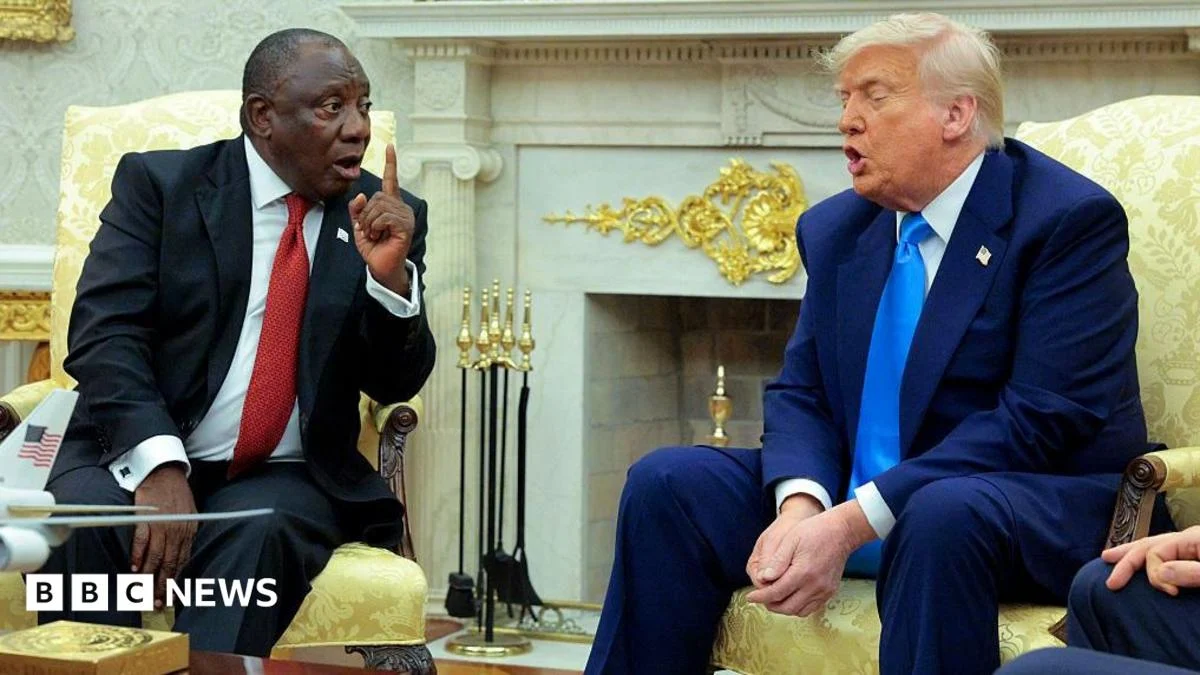
Washington, D.C. — United States President Donald Trump has formally notified Congress of his administration’s intention to terminate the eligibility of South Africa and Rwanda for benefits under the African Growth and Opportunity Act (Agoa), effective January 1, 2027. This decision marks a significant development in US-Africa trade relations, signaling a hardening stance on compliance with the program’s eligibility criteria and reflecting broader geopolitical tensions.
The African Growth and Opportunity Act, initially enacted in 2000 during the Clinton administration, serves as the cornerstone of US trade policy with sub-Saharan Africa. Designed to foster economic development and reform, Agoa grants eligible African countries duty-free access to the US market for thousands of products, ranging from textiles and apparel to agricultural goods and manufactured items. Its primary objectives include promoting market-oriented economies, strengthening the rule of law, protecting human rights, and encouraging the elimination of barriers to US trade and investment. The program has been periodically renewed, with its current authorization extending until 2025, offering a stable framework for African exporters.
According to a statement released by US Trade Representative Jamieson Greer, an annual review conducted by the Trump administration concluded that both South Africa and Rwanda are currently engaging in practices deemed inconsistent with Agoa’s stringent eligibility requirements. Greer elaborated that the decision had also been directly communicated to the governments of the two affected nations.
Reasons for Termination: A Closer Look
For South Africa, the US administration cited multiple concerns. A primary accusation pointed to pervasive corruption within the country, an issue that has frequently drawn international scrutiny and has been a central focus of domestic reform efforts, such as the Zondo Commission of Inquiry into state capture. More specifically, President Trump, in a letter addressed to South African President Cyril Ramaphosa, highlighted Pretoria’s actions regarding international security and its perceived deepening relations and cooperation with governments considered "of concern" to Washington. This broadly refers to South Africa’s non-aligned foreign policy stance, which has increasingly diverged from Western positions on various global issues. Examples include South Africa’s refusal to condemn Russia’s invasion of Ukraine, its participation in joint military exercises with Russia and China, and its vocal advocacy for an expanded BRICS bloc, often viewed as a counterweight to Western geopolitical influence. The US asserts that these actions risk undermining American national security and foreign policy interests in the region.
Furthermore, the Trump administration accused South Africa of maintaining significant barriers to American trade and investment. These alleged barriers encompass restrictions affecting agricultural market access, complex regulatory requirements, inadequate investment protections, and challenges related to intellectual property rights. Such issues, the US argues, hinder the ability of American businesses to compete fairly and invest effectively within the South African economy.
Regarding Rwanda, the US raised concerns centered on human rights, political pluralism, the rule of law, and workers’ rights. These issues have been long-standing points of contention between Kigali and various international bodies and human rights organizations. The timing of this announcement for Rwanda is particularly salient, coming barely a week after the US Treasury Department imposed sanctions on Rwanda’s Ministry of Defence for its alleged role in supporting the M23 armed rebellion in eastern Democratic Republic of Congo (DRC). The US Treasury’s detailed assessment claimed that Rwanda’s defence ministry directed thousands of troops to fight alongside M23 rebels, providing crucial weapons, equipment, logistics, and training. Despite what the US describes as "overwhelming evidence," Rwanda has consistently denied any involvement in backing the M23, maintaining that its presence in the DRC is solely to protect its borders from security threats. The M23 rebellion has caused widespread displacement and a severe humanitarian crisis in eastern DRC, further straining regional stability.
US Trade Representative Jamieson Greer emphasized that the Trump administration remains committed to ensuring that African partners take the necessary steps to meet Agoa’s eligibility criteria, implying that the door for reinstatement remains open should conditions change.
South Africa’s Response and Economic Context
South Africa’s Trade Minister Parks Tau described the US decision as "unfortunate." He expressed surprise that Washington was introducing new issues into the discussion that had not been prominent in the bilateral trade negotiations between the two countries, which reportedly commenced in 2025. Tau reiterated South Africa’s commitment to mitigating the potential impact of this decision, stating, "We will continue to accelerate the diversification of South Africa’s export markets to protect jobs." This strategy involves strengthening trade ties with other major global economies, particularly within the BRICS framework and with countries in Europe and Asia.
Pretoria has also sought to contextualize the potential impact of losing Agoa benefits, arguing that the country’s broader trade relationship with the US extends far beyond the specific provisions of the program. Government figures from 2025 indicate that approximately 89% of South African exports to the US already entered under ordinary World Trade Organization (WTO) most-favoured-nation (MFN) terms, meaning they would not be immediately affected by Agoa’s termination. Only around 10% of South African exports to the US benefited from Agoa preferences in 2025, a significant decrease from 28% in 2024. This reduction in Agoa utilization suggests a shift in export composition or a strategic realignment by South African exporters even before the termination announcement.
Minister Tau highlighted the declining value of South African exports under the program, which fell to about $1.7 billion (£1.3 billion) in 2025, a stark drop from $4 billion in the preceding year. This decline may be attributed to various factors, including changes in global demand, shifts in South Africa’s export basket, or increased competitiveness challenges. Despite this, bilateral trade between the two countries remains substantial, reaching $28.8 billion in 2025. The economic ties are further underscored by the presence of over 600 American companies operating in South Africa, collectively supporting an estimated 134,600 jobs.
South Africa also emphasized the complementary nature of the two economies. Pretoria supplies 12 of the 50 minerals considered critical by the US, which are essential for various high-tech industries and national defense. Furthermore, South Africa provides 70% of American isotopes used in critical applications, including cancer treatment, highlighting its strategic importance in specific sectors. South African manufacturers also incorporate American inputs into products subsequently exported to the US under Agoa, particularly in sectors like vehicles and boats, creating a complex interdependent supply chain that could be disrupted.
Implications for South Africa’s Economy
Jee-A van der Linde, a senior economist at Oxford Economics, warned that Washington’s move would likely exert further pressure on South Africa’s already struggling manufacturing sector. He cautioned that affected exports, particularly those reliant on Agoa’s duty-free access, might be difficult to redirect to other markets due to established supply chains, specific product standards, and existing tariff structures elsewhere. "This decision comes as global trade flows remained disrupted and South Africa faces growing competition from cheap Chinese imports, particularly in the automotive industry," van der Linde noted. The automotive sector, a significant beneficiary of Agoa, could face higher tariffs, making South African-made vehicles less competitive in the US market. However, he also pointed out that South Africa has previously demonstrated an ability to redirect some tariff-affected exports to markets including Europe and China, suggesting a degree of resilience and adaptability.
The US Ambassador to South Africa, Leo Brent Bozell III, expressed regret over the situation, asserting that South African policies had regrettably led to its termination from Agoa. In a post on X, he characterized the outcome as "predictable and preventable," stemming from the South African government’s "rejection of real concerns raised by the US."
Rwanda’s Trade and Geopolitical Context
For Rwanda, the direct economic impact of Agoa termination is expected to be less severe compared to South Africa, primarily due to its smaller overall trade volume with the US and its lower reliance on the program. According to US import data, Rwanda’s exports to the US rose to $43.3 million in 2025, an increase from $13.1 million in 2024, indicating growing trade ties. However, Alexander Venter, an Oxford Economics economist, noted that Washington accounted for only about 2% of Rwanda’s merchandise exports in 2025, with a mere 4% of its exports to the US benefiting from Agoa preferences. Neighboring African countries and Asian markets continue to dominate Rwanda’s trade landscape, diminishing the relative importance of the US market for Kigali. Nonetheless, the loss of Agoa benefits could still hinder Rwanda’s efforts to diversify its export base and develop nascent industries that rely on preferential market access.
The announcement regarding both countries comes amid broadly strained relations between Washington and Kigali, especially concerning human rights and regional stability. Beyond the M23 controversy, the US has frequently raised concerns about democratic space, political opposition, and media freedom within Rwanda, issues that align with Agoa’s governance criteria.
Broader Implications and Timeline
The proposed termination of Agoa benefits for South Africa and Rwanda on January 1, 2027, marks a significant shift in the US approach to its preferential trade agreements in Africa. While the effective date is over two years away, providing a window for potential diplomatic engagement or policy adjustments, the notification itself sends a strong signal to other Agoa beneficiaries about the stringent enforcement of eligibility criteria under the Trump administration.
This move follows a pattern of heightened scrutiny and conditional engagement under President Trump’s "America First" trade agenda, which prioritizes US economic interests and national security. The decision could set a precedent for future reviews, potentially impacting other African nations whose policies might be perceived as diverging from US interests or failing to meet governance benchmarks.
Last year, President Trump had notably accused South Africa of persecuting its white minority, launching a program to offer asylum to white Afrikaners in the US. These claims, which included widely discredited assertions of a "white genocide" in South Africa, have significantly contributed to the deterioration of diplomatic relations and underscore the deep ideological chasms between the two nations. Such rhetoric, combined with the official reasons for Agoa termination, paints a picture of a US administration willing to use trade policy as leverage for a broader range of political and strategic objectives.
The Agoa program has historically been a tool for both economic development and the promotion of democratic values and good governance in Africa. Its future under successive US administrations will likely continue to be shaped by evolving geopolitical dynamics, regional stability, and the compliance records of its beneficiary nations. For South Africa and Rwanda, the coming years will be critical in navigating these challenges, potentially re-evaluating their foreign policy alignments, and seeking alternative trade partnerships to cushion the impact of this significant US policy shift. The long-term effects on regional trade, investment, and US-Africa relations will be closely watched by policymakers and economists worldwide.