


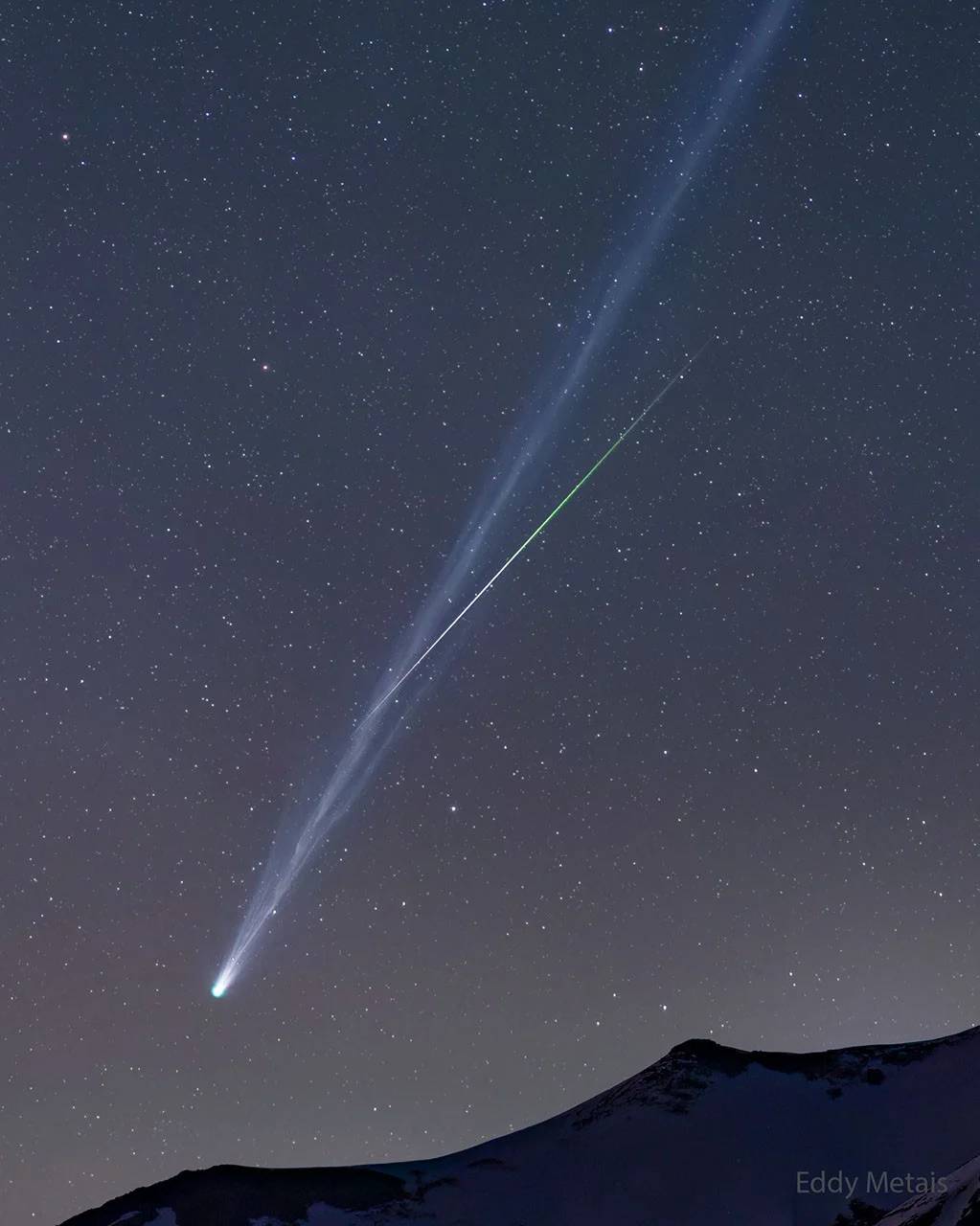
The cosmos presented a captivating dual spectacle on November 3, 2026, as the Astronomy Picture of the Day (APOD) featured a striking image by astrophotographer Eddy Metais, capturing Comet C/2025 R3 (PanSTARRS) alongside a vibrant, streaking meteor. This arresting photograph immediately prompts a fundamental astronomical question: did the meteor originate from the comet it appears to pass? While many meteors do indeed trace their lineage back to cometary debris, the expert analysis accompanying the image clarifies that, in this specific instance, the two phenomena are likely unrelated, with the comet situated far beyond the foreground meteor. This distinction, though subtle to the casual observer, underscores the intricate dynamics of our solar system and sets the stage for a series of notable meteor showers poised to grace Earth’s skies throughout November.
The Enigmatic Image: PanSTARRS and the Transient Streak
The photograph, taken from Hautacam, France, in April, showcases Comet C/2025 R3 (PanSTARRS) in impressive detail. Often referred to by astronomers as "giant space icebergs," comets like PanSTARRS are transient visitors to the inner solar system, originating from the frigid, distant reaches of the Oort Cloud or Kuiper Belt. As they approach the Sun, their icy nuclei sublimate, releasing gas and dust that form their iconic tails. In Metais’s image, C/2025 R3 (PanSTARRS) exhibits both a distinct blue ion tail, composed of ionized gases pushed directly away from the Sun by the solar wind, and a broader, more diffuse dust tail, typically curved and trailing the comet’s orbit. These features provide crucial data points for astronomers studying cometary composition and the solar environment.
In stark contrast to the distant, ethereal comet, a brightly colored meteor slices across the foreground. Meteors, commonly known as "shooting stars," are the visible streaks of light produced when small particles of cosmic debris, ranging from dust grains to pebble-sized rocks, enter Earth’s atmosphere at high speeds and burn up due to atmospheric friction. The vibrant, multi-hued streak observed in the APOD image suggests a complex chemical composition for the meteoroid, as different elements ionize and glow at distinct wavelengths upon atmospheric entry. For instance, magnesium often produces a greenish glow, sodium a yellow, and calcium or nitrogen can yield blue or violet hues. This rich coloration provides forensic evidence of the meteoroid’s origins, offering clues about the parent body from which it detached.
Despite their apparent proximity in the two-dimensional capture, the comet and the meteor are separated by immense cosmic distances. Comet C/2025 R3 (PanSTARRS) was millions of kilometers away from Earth when photographed, following its own distinct trajectory through the solar system. The meteor, conversely, was incinerating within Earth’s upper atmosphere, typically at altitudes between 80 and 120 kilometers. This vast spatial separation is the primary reason why their co-occurrence in a single frame is a matter of chance alignment for the observer on Earth, rather than a direct causal relationship.
Differentiating Celestial Phenomena: Comets vs. Meteors
To fully appreciate the celestial dynamics at play, it is essential to understand the fundamental differences and connections between comets and meteors.
Comets: These are icy, small solar system bodies that, when passing close to the Sun, warm up and begin to outgas, displaying a visible atmosphere or coma, and sometimes a tail. Comets are essentially primordial remnants from the formation of our solar system some 4.6 billion years ago, preserving pristine material from that epoch. Their nuclei are composed of ice (water, methane, ammonia, carbon dioxide), mixed with dust and rocky particles. As a comet orbits the Sun, it sheds a continuous stream of dust and gas, creating a diffuse trail of debris along its orbital path. This debris stream is the ultimate source for many of Earth’s meteor showers. The orbital periods of comets vary widely, from a few years for short-period comets (like 2P/Encke) to hundreds of thousands or even millions of years for long-period comets (like many PanSTARRS comets, though C/2025 R3’s full orbital parameters would determine its specific classification).
Meteors: The visible phenomenon of a meteor is fleeting, typically lasting only a few seconds. The actual object causing this light is called a meteoroid – a piece of rock or dust in space. When a meteoroid survives its fiery atmospheric plunge and lands on Earth’s surface, it is then termed a meteorite. Meteoroids originate from various sources: fragments of asteroids colliding in the main asteroid belt, lunar or Martian ejecta from impacts, or, most commonly for meteor showers, dust and debris shed by comets. When Earth’s orbit intersects with the debris trail of a comet, numerous meteoroids enter the atmosphere simultaneously, resulting in a meteor shower. The speed at which these particles enter the atmosphere, typically tens of kilometers per second, generates intense heat and light through friction and ionization, creating the characteristic glowing streak.
While the majority of meteor showers are unequivocally linked to specific comets, the vastness of space and the sheer number of cometary visitors to the inner solar system make it challenging to attribute every sporadic meteor to a known cometary parent. There are thousands of known comets, both periodic and non-periodic, and their debris streams can be diffuse and widespread. Therefore, a lone meteor, especially one appearing in the same frame as a comet, is more often a coincidence than a direct progeny of that particular comet, unless their orbital paths are known to converge. The professional astronomers at APOD, Robert Nemiroff, Jerry Bonnell, Cecilia Chirenti, and Keighley Rockcliffe, emphasize this distinction to prevent misinterpretation of such visually compelling but scientifically disparate events.
November’s Sky Show: A Trio of Meteor Showers
Beyond the singular encounter depicted in the APOD image, November 2026 promises a celestial feast for skygazers with three notable meteor showers reaching their peaks. This concentration of activity makes November a prime month for meteor observation, offering multiple opportunities to witness the cosmic ballet of cometary debris meeting Earth’s atmosphere.
The Taurids: A Pair from Comet 2P/Encke
The Taurid meteor shower is unique in that it comprises two distinct branches: the Southern Taurids and the Northern Taurids. Both branches originate from the same parent body, Comet 2P/Encke. This short-period comet, discovered by Pierre Méchain in 1786 and later recognized by Johann Franz Encke, boasts one of the shortest orbital periods of any known comet, completing an orbit around the Sun in approximately 3.3 years. Its frequent passages through the inner solar system have left a substantial and widely dispersed debris stream.
The Southern Taurids are currently reaching their apex over the next few days. Following approximately a week later, the Northern Taurids will achieve their peak. While the Taurids are not typically known for producing high rates of meteors per hour, they are renowned for their slow-moving, often bright fireballs. These "Halloween fireballs" are a result of larger-than-average particles within Encke’s debris stream. The slow speed of Taurid meteors (around 27 km/s) makes them particularly mesmerizing, allowing observers more time to track their luminous paths across the night sky. Astronomers occasionally refer to the "Taurid swarm," a denser region within Encke’s debris trail that, when encountered by Earth, can lead to enhanced activity and an increased number of bright fireballs, though 2026 is not predicted to be a year for such an exceptional encounter.
The Leonids: Fast and Furious from Comet 55P/Tempel-Tuttle
Perhaps the most famous of November’s meteor showers are the Leonids, which are set to reach their crescendo in about two weeks. The Leonids originate from Comet 55P/Tempel-Tuttle, a medium-period comet discovered independently by Ernst Tempel and Horace Tuttle in 1865. This comet has an orbital period of approximately 33 years and is notorious for producing some of the most spectacular meteor storms in recorded history.
Leonid meteors are known for their exceptional speed, entering Earth’s atmosphere at approximately 71 km/s, making them among the fastest meteors observed. This high velocity leads to intensely bright, often bluish-white streaks, frequently leaving persistent trains of ionized gas that can linger for several seconds after the meteor has vanished. While typical Leonid displays offer modest rates, the shower can periodically erupt into a meteor storm, with thousands of meteors per hour, particularly when Earth passes through a dense filament of fresh debris recently shed by Comet Tempel-Tuttle after its perihelion passage. Such storms, documented vividly in historical accounts from 1833, 1966, and 1999, underscore the dynamic and sometimes unpredictable nature of cometary debris trails. Although a full-blown storm is not anticipated for 2026, the Leonids remain a highly anticipated event for their potential for bright, fast meteors.
The Science Behind the Streaks: Unpacking Meteor Composition and Dynamics
The study of meteors, meteoroids, and meteorites provides invaluable insights into the composition and evolution of our solar system. The colorful streak of the meteor in Eddy Metais’s photograph, for instance, is not merely a visual treat but a spectroscopic fingerprint. As the meteoroid plows through the atmosphere, the intense heat and pressure ablate its surface, releasing atoms that then collide with atmospheric gases. These collisions excite the atoms, causing them to emit light at specific wavelengths, much like the process in a neon sign.
The color of a meteor can thus indicate the dominant elements within the meteoroid itself, or the atmospheric gases it is interacting with. For example:
- Green/Yellow: Often indicative of nickel and magnesium, common constituents of stony and iron meteorites.
- Orange/Red: Can be attributed to sodium, also present in many meteoroids.
- Blue/Violet: Suggests the presence of calcium in the meteoroid or strong interaction with atmospheric nitrogen and oxygen.
Furthermore, the speed and angle of atmospheric entry dictate the meteor’s luminosity and trajectory. Faster meteors generate more heat and appear brighter. The density and composition of Earth’s atmosphere also play a critical role, causing the meteoroid to slow down and disintegrate. The study of these atmospheric interactions helps scientists understand not only the characteristics of the meteoroids but also the properties of the upper atmosphere itself. Networks of cameras and radar systems worldwide continuously monitor meteor activity, providing data on trajectories, speeds, and brightness, which in turn helps to refine our understanding of meteoroid populations and their origins.
The Astronomy Picture of the Day (APOD) Legacy
The Astronomy Picture of the Day (APOD) program, a collaborative effort by NASA’s Goddard Space Flight Center (GSFC) Astrophysics Science Division (ASD), NASA Science Activation, and Michigan Technological University, stands as a testament to the power of public science communication. Since its inception in 1995, APOD has curated and presented a daily image of the universe, accompanied by a concise explanation written by professional astronomers. Its mission is to make complex astronomical concepts accessible and engaging to a global audience, fostering curiosity and scientific literacy.
The image by Eddy Metais, credited for its capture of Comet C/2025 R3 (PanSTARRS) and the meteor, exemplifies APOD’s commitment to showcasing both cutting-edge scientific imagery and the breathtaking artistry of astrophotography. Such contributions from talented individuals like Metais, whose Instagram page is cited as the source, highlight the symbiotic relationship between amateur enthusiasts and professional astronomy. Their dedication to documenting celestial phenomena enriches the collective understanding and appreciation of the universe. The consistent work of the APOD authors and editors—Robert Nemiroff, Jerry Bonnell, Cecilia Chirenti, and Keighley Rockcliffe—ensures that each daily feature is not only visually stunning but also scientifically accurate and informative, serving as a vital resource for educators, students, and the general public alike.
Broader Implications for Space Science and Public Engagement
The observation and study of comets and meteors, as highlighted by the APOD feature and the upcoming meteor showers, carry significant implications for our understanding of the solar system and beyond.
Understanding Solar System Evolution: Comets are often referred to as "fossils of the solar system" because their icy, dusty compositions are thought to represent the pristine material from which the planets formed. By studying their composition, orbital dynamics, and the debris they shed, scientists gain crucial insights into the conditions of the protoplanetary disk and the early processes that shaped our cosmic neighborhood. Meteoroids, especially those that survive as meteorites, provide tangible samples of this primordial material for laboratory analysis, offering direct evidence of the solar system’s birth.
Planetary Defense and Near-Earth Objects (NEOs): While the meteor in the APOD image was a harmless, sand-sized particle, the broader context of meteoroids and cometary fragments touches upon the critical field of planetary defense. Larger meteoroids and asteroid fragments are classified as Near-Earth Objects (NEOs), and their trajectories are meticulously tracked by organizations like NASA’s Planetary Defense Coordination Office. Understanding the populations, origins, and orbital characteristics of comets and asteroids is vital for assessing potential impact risks to Earth. Meteor showers, while generally benign, serve as a constant reminder of the dynamic environment of space and the ongoing interaction between Earth and the myriad of cosmic debris.
Citizen Science and Astrophotography: The image by Eddy Metais underscores the invaluable contribution of citizen scientists and astrophotographers. Their passion, skill, and dedication often result in observations and images that complement professional astronomical research. High-quality astrophotography not only captures scientific data but also inspires a sense of wonder and curiosity, drawing more people into the scientific endeavor. Platforms like APOD amplify these contributions, demonstrating how accessible astronomy can be and encouraging further engagement from the public.
Inspiring Future Generations: Ultimately, the regular unveiling of breathtaking celestial images and the anticipation of annual meteor showers serve a profound educational purpose. They bring the wonders of the universe directly into homes and classrooms, sparking interest in science, technology, engineering, and mathematics (STEM) fields. By making astronomy relatable and visually compelling, initiatives like APOD play a crucial role in nurturing the next generation of scientists, engineers, and informed citizens.
As November 2026 unfolds, skygazers are encouraged to turn their eyes skyward. While the distant Comet C/2025 R3 (PanSTARRS) may require specialized equipment to observe, the upcoming Southern and Northern Taurids, followed by the faster, brighter Leonids, offer accessible opportunities for anyone to connect with the ongoing cosmic drama. Each meteor streak is a fleeting testament to the dynamic processes that continually shape our solar system, reminding us of the ancient, icy wanderers that gift us these spectacular celestial displays.
Tomorrow’s picture: a hidden gem.