

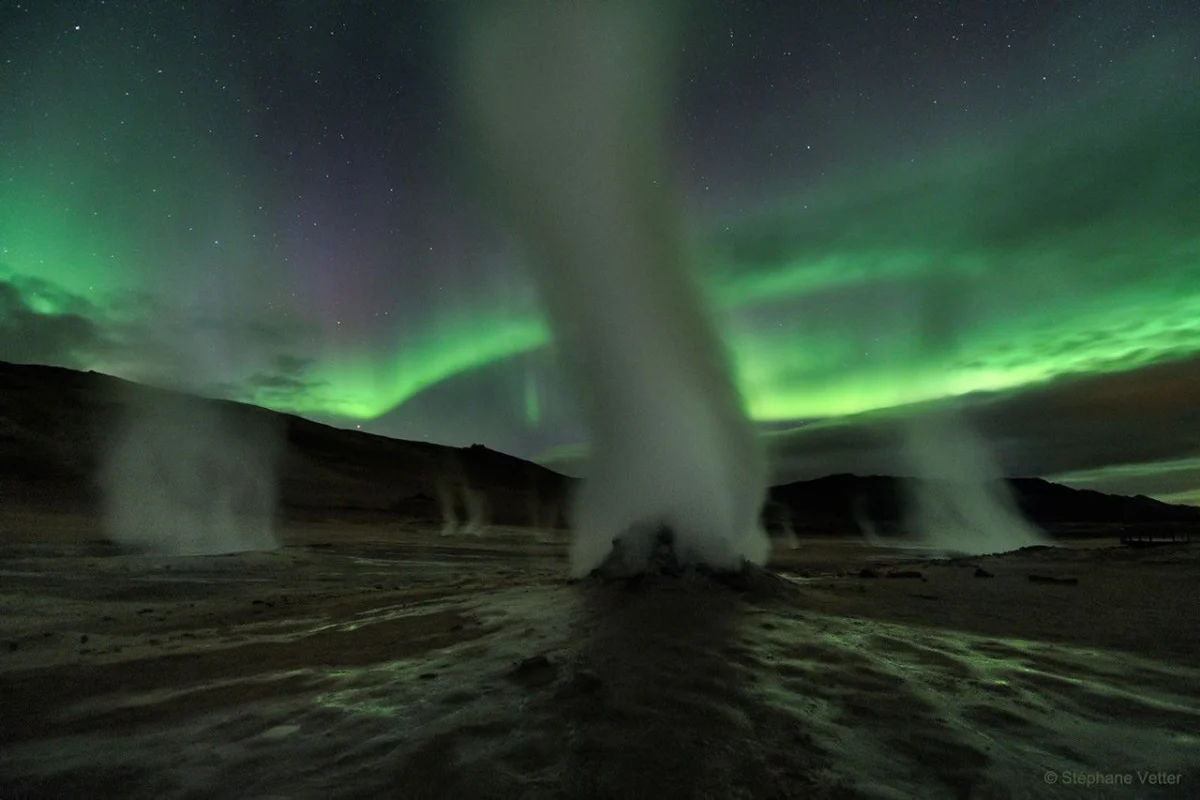
On October 31, 2026, NASA’s renowned Astronomy Picture of the Day (APOD) showcased a breathtaking and eerily beautiful fusion of terrestrial and celestial phenomena, featuring Iceland’s Hverir geothermal area bathed in the ethereal glow of the aurora borealis. The image, captured by photographer Stéphane Vetter of Nuits sacrées, presented a vivid tableau of steam venting from volcanic fumaroles against a backdrop of vibrant greenish aurorae, prompting the APOD’s evocative description of "Planet Earth on a dark and stormy night" as a "spooky planet" befitting the Halloween date. This captivating photograph serves as a powerful reminder of Earth’s dynamic geological activity and its intricate connection to the Sun’s powerful influence.
The featured image offers a rare glimpse into the dramatic interplay between our planet’s internal heat and the energetic particles streaming from space. The scene, located in the geothermally active region of Hverir, near Lake Mývatn in northeastern Iceland, depicts towering plumes of superheated steam and gases escaping from the Earth’s crust. These ghostly apparitions, formed by the interaction of groundwater with magma chambers beneath the surface, create an almost otherworldly landscape. Against this terrestrial spectacle, the sky above ignites with the iridescent dance of the Northern Lights, a celestial ballet triggered by intense solar activity, painting the night with an unsettling yet magnificent green hue.
The Phenomenon Unveiled: A Celestial and Terrestrial Spectacle
The APOD feature meticulously combines scientific explanation with visual storytelling, making complex astrophysical and geological processes accessible to a global audience. The photograph itself is a testament to the unique environmental conditions prevalent in high-latitude regions like Iceland, where volcanic dynamism meets atmospheric luminescence.
Iceland’s Volcanic Heartbeat: The Hverir Geothermal Area
Hverir, situated at the foothills of Mt. Námafjall, is a prime example of Iceland’s extraordinary geothermal landscape. This area is part of the Krafla volcanic system, one of the most active in Iceland, which lies directly on the Mid-Atlantic Ridge. Here, the North American and Eurasian tectonic plates diverge, allowing magma from the Earth’s mantle to rise close to the surface. This geological setting fuels intense geothermal activity, manifesting as fumaroles, solfataras, and mud pots.
Fumaroles, specifically, are openings in the Earth’s crust that emit steam and gases, such as carbon dioxide, sulfur dioxide, and hydrogen sulfide, originating from cooling magma deep below. The steam observed in the APOD image is a direct result of groundwater percolating through the superheated rock, flashing into steam as it reaches the surface. The distinct smell of sulfur, often likened to rotten eggs, is characteristic of such areas, adding to the primal, untamed atmosphere. Iceland’s reliance on geothermal energy for heating and electricity underscores the practical significance of these geological wonders, transforming the planet’s internal heat into a sustainable resource for its inhabitants. The Krafla system, with its history of significant eruptions, particularly the "Krafla Fires" period between 1975 and 1984, remains a focal point for geological study, offering insights into plate tectonics and volcanic processes.
The Aurora Borealis: Earth’s Magnetic Light Show
Complementing the terrestrial spectacle, the aurora borealis, or Northern Lights, captivated viewers in the APOD image. This natural light display is a direct consequence of the interaction between the solar wind and Earth’s magnetosphere. The Sun continuously emits a stream of charged particles, primarily electrons and protons, known as the solar wind. During periods of heightened solar activity, such as solar flares and coronal mass ejections (CMEs), these emissions become more intense, leading to geomagnetic storms.
When these energetic particles encounter Earth’s magnetic field, they are largely deflected. However, some particles are trapped and funneled along the magnetic field lines towards the polar regions. As these particles descend into the upper atmosphere, typically at altitudes of 80 to 500 kilometers, they collide with atmospheric gases—primarily oxygen and nitrogen atoms and molecules. These collisions excite the gas atoms, causing them to emit photons of light. The characteristic green glow seen in the Hverir image is predominantly produced by excited oxygen atoms, typically at lower altitudes (around 100-300 km). Higher altitude oxygen can emit red light, while nitrogen often contributes blue or purple hues. The intensity, color, and dynamic movement of the aurora are dictated by the energy of the incoming particles, the type of atmospheric gases they interact with, and the altitude of these interactions. The phenomenon is not only a visual marvel but also a crucial indicator of space weather conditions.
The Solar Engine: Powering Earth’s Light Displays
The explanation accompanying the APOD image explicitly links the aurora display to ongoing solar activity, highlighting that "auroral activity on planet Earth remains in a high state as the Sun is only in early phases of decline from the peak of its solar activity cycle." This statement provides critical context for the frequency and intensity of such celestial events.
Understanding the Solar Cycle
The Sun undergoes an approximately 11-year cycle of activity, characterized by fluctuations in the number of sunspots, solar flares, and coronal mass ejections. This cycle is driven by the Sun’s internal magnetic dynamo. The peak of this cycle is known as Solar Maximum, a period marked by the highest frequency of solar storms and, consequently, the greatest potential for intense auroral displays on Earth. Following the Solar Maximum, the Sun enters a period of decline, gradually moving towards Solar Minimum, when solar activity is at its lowest.
The APOD’s observation that the Sun is in "early phases of decline" suggests that Earth has recently experienced or is still experiencing the effects of a robust Solar Maximum. During this peak, the Sun’s magnetic field becomes highly complex, leading to a greater occurrence of disturbances like CMEs. These colossal expulsions of plasma and magnetic field from the Sun’s corona travel through space, and if directed towards Earth, can trigger significant geomagnetic storms. Such storms are the primary drivers of widespread and vivid aurorae, extending to lower latitudes than typically observed during quieter solar periods.
Geomagnetic Storms and Their Terrestrial Impact
Geomagnetic storms, caused by the interaction of CMEs with Earth’s magnetosphere, are not merely responsible for beautiful aurorae. They also have practical implications for modern technology. Strong geomagnetic storms can induce currents in long conductors, potentially disrupting power grids, as famously occurred in Quebec in 1989. They can also interfere with satellite operations, including GPS and communication satellites, and pose radiation hazards to astronauts in space. Therefore, understanding and predicting solar activity is crucial for safeguarding critical infrastructure and ensuring the safety of space missions.

Scientific organizations like NASA, NOAA, and various international bodies continuously monitor the Sun’s activity using a suite of ground-based and space-based observatories. Instruments like the Solar Dynamics Observatory (SDO) and the Solar and Heliospheric Observatory (SOHO) provide real-time data on solar flares, CMEs, and the solar wind, enabling scientists to forecast space weather events and issue warnings when necessary. The auroral display over Hverir on October 31, 2026, served as a stunning visual confirmation of these powerful solar-terrestrial connections.
The Astronomy Picture of the Day Initiative
The APOD program, a collaborative effort involving multiple institutions and dedicated individuals, has been a cornerstone of public astronomy outreach for decades, making complex cosmic phenomena accessible to millions worldwide.
A Daily Glimpse into the Cosmos
Since its inception in 1995, the Astronomy Picture of the Day has offered a daily dose of cosmic wonder, featuring a different image or photograph of our fascinating universe along with a brief, yet insightful, explanation written by a professional astronomer. The initiative’s mission is to "Discover the cosmos!" by presenting high-quality astronomical imagery and accompanying scientific context in an engaging format. APOD’s archives, accessible through its website, represent a vast repository of astronomical knowledge and stunning visuals, covering everything from planetary close-ups and nebulae to galaxies and cosmological simulations. The consistent delivery of fresh, expertly curated content has cemented APOD’s status as a beloved resource for amateur astronomers, educators, students, and the general public, significantly contributing to global science literacy and appreciation for the universe.
The Creators Behind the Image and Explanation
The success of APOD relies on the contributions of many. The captivating image of Hverir was captured by Stéphane Vetter, a renowned astrophotographer affiliated with "Nuits sacrées" (Sacred Nights), a collective dedicated to capturing and sharing the beauty of the night sky, particularly auroral phenomena. Vetter’s work often highlights the interplay between terrestrial landscapes and celestial events, demonstrating a keen artistic eye coupled with a profound understanding of natural phenomena.
The accompanying scientific explanation for the October 31, 2026, APOD was crafted by a team of distinguished astronomers and editors: Jerry Bonnell, Cecilia Chirenti, Robert Nemiroff, and Keighley Rockcliffe. Jerry Bonnell and Robert Nemiroff are long-standing co-creators and editors of the APOD program, guiding its scientific content and narrative for decades. Their expertise ensures the accuracy and clarity of the explanations, making complex astrophysical concepts understandable to a broad audience. The program itself is a service of the Astrophysics Science Division (ASD) at NASA’s Goddard Space Flight Center (GSFC), supported by NASA Science Activation and Michigan Technological University. This institutional backing underscores the commitment to scientific dissemination and public engagement at the highest levels of space exploration and research.
A Timely Feature: Halloween’s Cosmic Connection
The choice of October 31, 2026, for featuring this particular image was undeniably serendipitous, aligning perfectly with the cultural connotations of Halloween. The APOD team skillfully leveraged this timing to enhance the narrative, describing Earth as a "spooky planet" and hinting at "other ghostly apparitions" dancing in neighborhoods.
"Spooky Planet" Theme
The image itself lends itself well to the Halloween theme. The steam vents, with their wispy, ghost-like forms, rising from a seemingly desolate, sulfur-tinged landscape, evoke an eerie, supernatural atmosphere. When combined with the ethereal, dancing green lights of the aurora, the scene transforms into something both beautiful and mysteriously unsettling. This natural juxtaposition of Earth’s powerful geological forces and the distant, cosmic influence of the Sun creates a profound sense of wonder and perhaps a touch of primal fear, resonating with the spirit of Halloween. The "spooky planet" description, while playful, also subtly encourages contemplation of the raw, untamed aspects of our world and its cosmic environment, elements often overlooked in daily life. It’s a clever way to engage a broader audience, drawing them in with a familiar cultural reference before immersing them in scientific discovery.
Broader Implications and Future Outlook
Beyond its immediate aesthetic appeal and timely cultural reference, the Hverir aurora image and its APOD feature carry broader implications for scientific understanding and public engagement.
Advancing Space Weather Science
The continuous observation and documentation of events like the Hverir aurora are vital for advancing space weather science. By analyzing the characteristics of auroral displays—their intensity, duration, and geographic extent—scientists can infer properties of the solar wind and the strength of geomagnetic storms. This data contributes to predictive models that help mitigate the risks posed by extreme space weather to our technological infrastructure. Furthermore, citizen science initiatives, where aurora chasers submit observations and photographs, complement professional efforts, providing a vast dataset that helps researchers understand the global distribution and dynamics of auroral events. The photograph by Stéphane Vetter, a professional in the field, contributes to this ongoing scientific dialogue, offering precise visual data of a specific event.
Inspiring the Next Generation
The APOD program, through images like this, plays a crucial role in inspiring future generations of scientists, engineers, and explorers. Presenting such breathtaking natural phenomena, accompanied by clear, concise scientific explanations, can ignite curiosity and foster a deeper appreciation for astronomy, geology, and Earth sciences. It highlights the interconnectedness of our solar system, demonstrating that events on the Sun directly influence our planet’s atmosphere and environment. For a young mind, the idea of "ghostly towers of steam" dancing with "eerie, greenish northern lights" can be the spark that leads to a lifelong passion for scientific inquiry and a desire to "discover the cosmos" for themselves.
Tomorrow’s Picture: Many Moons
As the October 31, 2026, APOD concluded, it left readers with a tantalizing hint for the following day: "Tomorrow’s picture: many moons." This customary APOD teaser ensures continued engagement, promising another captivating journey into the vast and varied tapestry of our universe, maintaining the program’s tradition of daily scientific discovery and visual splendor. The Hverir aurora, however, stands as a particularly memorable entry, weaving together Earth’s fiery heart with the Sun’s distant embrace in a truly spectacular, and fittingly "spooky," Halloween display.