

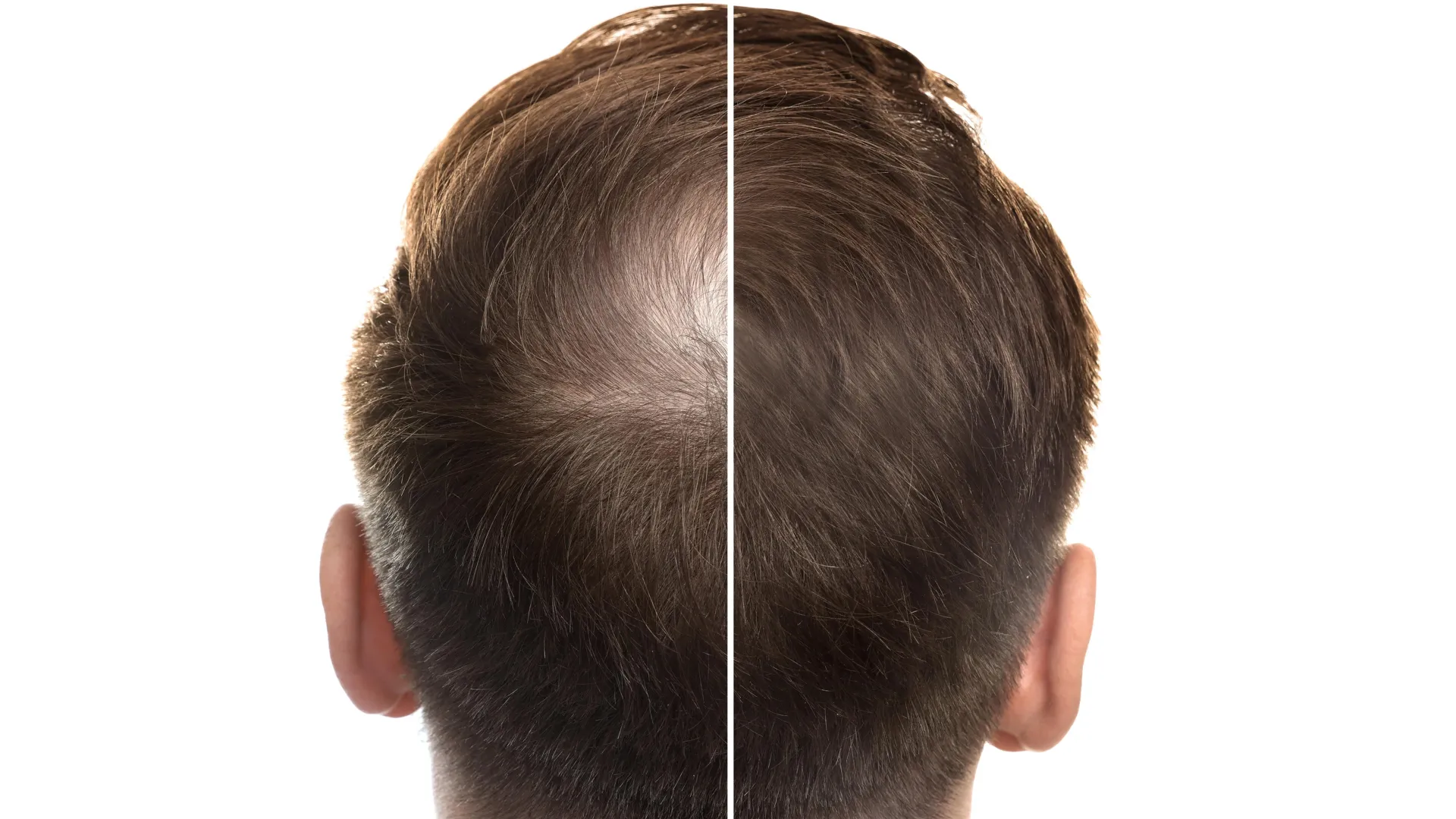
Androgenetic alopecia (AGA), commonly known as male or female pattern hair loss, stands as the most prevalent form of hair loss globally, impacting millions of individuals. This progressive condition is characterized by the gradual shrinking of hair follicles over time, leading to the production of progressively thinner, shorter hairs. Eventually, hair growth may slow dramatically or cease altogether as follicles become miniaturized. Current therapeutic interventions, such as finasteride and minoxidil, offer some efficacy but are not universally suitable for all patients. Finasteride operates by modulating hormones implicated in follicle shrinkage, while minoxidil is a topical solution applied to the scalp to stimulate hair growth. However, concerns persist among patients regarding potential adverse effects, including the sexual side effects associated with finasteride and scalp irritation linked to minoxidil. These limitations fuel a continuous search for safer, more natural, or more comprehensive treatment alternatives.
The Revival of a Traditional Remedy
A recent scientific review has brought renewed attention to Polygonum multiflorum, a root deeply embedded in the annals of traditional Chinese medicine (TCM). This herb, with a history of use spanning over a millennium, has traditionally been lauded for its purported ability to "blacken hair and nourish essence." What distinguishes this review is its exploration of Polygonum multiflorum‘s multifaceted biological activity, suggesting it may not operate through a single mechanism but rather influences multiple pathways simultaneously involved in hair loss and regrowth.
The intricate biology of androgenetic alopecia involves key hormonal players, most notably dihydrotestosterone (DHT). DHT plays a pivotal role in the miniaturization of hair follicles, thereby compromising their ability to sustain robust hair production. The review indicates that Polygonum multiflorum may exert a protective effect by mitigating the impact of DHT, thus shielding follicles from one of the primary drivers of pattern hair loss. This potential dual action sets it apart from many conventional treatments that typically target a single pathway.
A Multifaceted Approach to Hair Regeneration
Beyond its potential impact on hormonal pathways, Polygonum multiflorum exhibits a range of other promising effects, as detailed in the review. Researchers have identified its capacity to prevent premature cell death within hair follicles. This is a critical factor, as the health and longevity of follicle cells are fundamental to maintaining the hair growth cycle. Furthermore, the herb appears to activate key biological signaling pathways crucial for regeneration, including the Wnt and Shh (Sonic hedgehog) pathways.
These signaling pathways are indispensable in regulating cellular growth, communication, and tissue repair. Within the context of hair follicles, they are intimately linked to the transition from dormant phases to active growth. Enhanced signaling through these pathways could potentially prime follicles for re-entry into a growth state, offering a significant advantage in combating hair loss.
An additional benefit highlighted is the herb’s potential to improve blood circulation to the scalp. Enhanced blood flow ensures a more robust supply of oxygen and essential nutrients to the hair follicles, creating an optimal environment for healthier hair growth. This comprehensive action, addressing hormonal influences, cell viability, regenerative signaling, and vascular support, positions Polygonum multiflorum as a potentially broader therapeutic agent compared to conventional treatments with a singular focus.
Dr. Han Bixian, the lead author of the review published in the Journal of Holistic Integrative Pharmacy, articulated the significance of this research. "Our analysis bridges ancient wisdom and modern science," stated Dr. Han. "What surprised us was how consistently historical texts—from the Tang Dynasty onward—described effects that align perfectly with today’s understanding of hair biology. Modern studies now confirm that this isn’t folklore; it’s pharmacology." This sentiment underscores the compelling synergy between traditional knowledge and contemporary scientific validation.
Bridging Historical Records and Laboratory Findings
The review synthesizes diverse forms of evidence, encompassing laboratory-based research, clinical observations, and historical herbal records. Crucially, the older records are not presented as definitive proof but rather as a historical foundation upon which modern scientific investigation can build. Researchers have meticulously compared traditional claims with contemporary biological findings to identify areas of congruence.
This convergence of historical usage and modern scientific understanding is a primary driver of the renewed interest in Polygonum multiflorum. The review suggests that the herb’s potential extends beyond merely slowing hair loss; by influencing growth factors and signaling pathways, it may actively foster an environment conducive to regeneration. This distinction is significant. While many existing hair loss treatments are designed primarily to preserve existing hair or decelerate thinning, a therapy that actively supports regrowth through multiple mechanisms could offer a novel therapeutic paradigm, particularly for individuals who have not responded favorably to current options.
The Criticality of Preparation: Safety and Efficacy
A pivotal aspect addressed by the review is the importance of proper preparation of Polygonum multiflorum. In traditional Chinese medicine, the herb undergoes specific processing before administration. This step is considered paramount as it significantly influences both the herb’s safety profile and its biological activity.
"When properly processed—a key step in traditional preparation—the herb shows a favorable safety profile, making it more acceptable to patients wary of side effects like sexual dysfunction or scalp irritation linked to current medications," the article emphasizes. This point is particularly salient, as natural products are not inherently risk-free. Herbs can contain potent bioactive compounds, and their effects can vary considerably depending on the processing methods, dosage, and overall product quality. The review posits that processed Polygonum multiflorum presents a more acceptable alternative for certain patients but strongly cautions against self-treatment without professional guidance.
The historical context of Polygonum multiflorum‘s use is extensive. Its application dates back to ancient China, with mentions in texts such as the Shennong Ben Cao Jing (The Divine Farmer’s Materia Medica), compiled around the Han Dynasty (206 BCE – 220 CE). Later pharmacopeias, including the Ben Cao Gang Mu (Compendium of Materia Medica) by Li Shizhen in the Ming Dynasty (1368–1644), further documented its use for hair-related ailments and general vitality. This long-standing historical application provides a rich dataset for modern scientific inquiry.
The Path Forward: Clinical Validation and Future Implications
Despite the compelling preliminary findings, the researchers underscore the imperative for more robust clinical evidence. A substantial portion of the current support for Polygonum multiflorum‘s efficacy stems from laboratory studies, historical accounts, and limited clinical observations. Large-scale, rigorously designed human trials are essential to definitively ascertain its effectiveness for androgenetic alopecia and to establish its safety across diverse patient populations.
Nevertheless, the review highlights a broader trend of increasing scientific importance: the exploration of traditional remedies for their potential to yield novel therapeutic agents. The biologically active compounds found in these time-tested remedies can serve as inspiration for new treatments when subjected to modern scientific scrutiny. In the case of Polygonum multiflorum, centuries of traditional application are now being re-examined through the sophisticated lenses of hormone biology, cellular mechanisms, growth signaling pathways, and scalp microcirculation.
For individuals grappling with hair loss, this research offers a message of measured optimism. While a root utilized for over a millennium may not yet supplant established treatments, its study holds the potential to inform and guide the development of the next generation of hair regrowth therapies. The convergence of ancient wisdom and cutting-edge scientific inquiry into Polygonum multiflorum represents a significant step in the ongoing quest for more effective and well-tolerated solutions for androgenetic alopecia. The implications extend beyond just hair loss treatments, suggesting a promising avenue for validating and integrating other traditional medicinal practices into modern healthcare through rigorous scientific investigation. The economic implications are also noteworthy, as a successful, naturally derived treatment could offer a more accessible and potentially less expensive alternative for a significant global market. Furthermore, the research could spur further investigation into other botanical compounds with similar multifaceted therapeutic potential.