


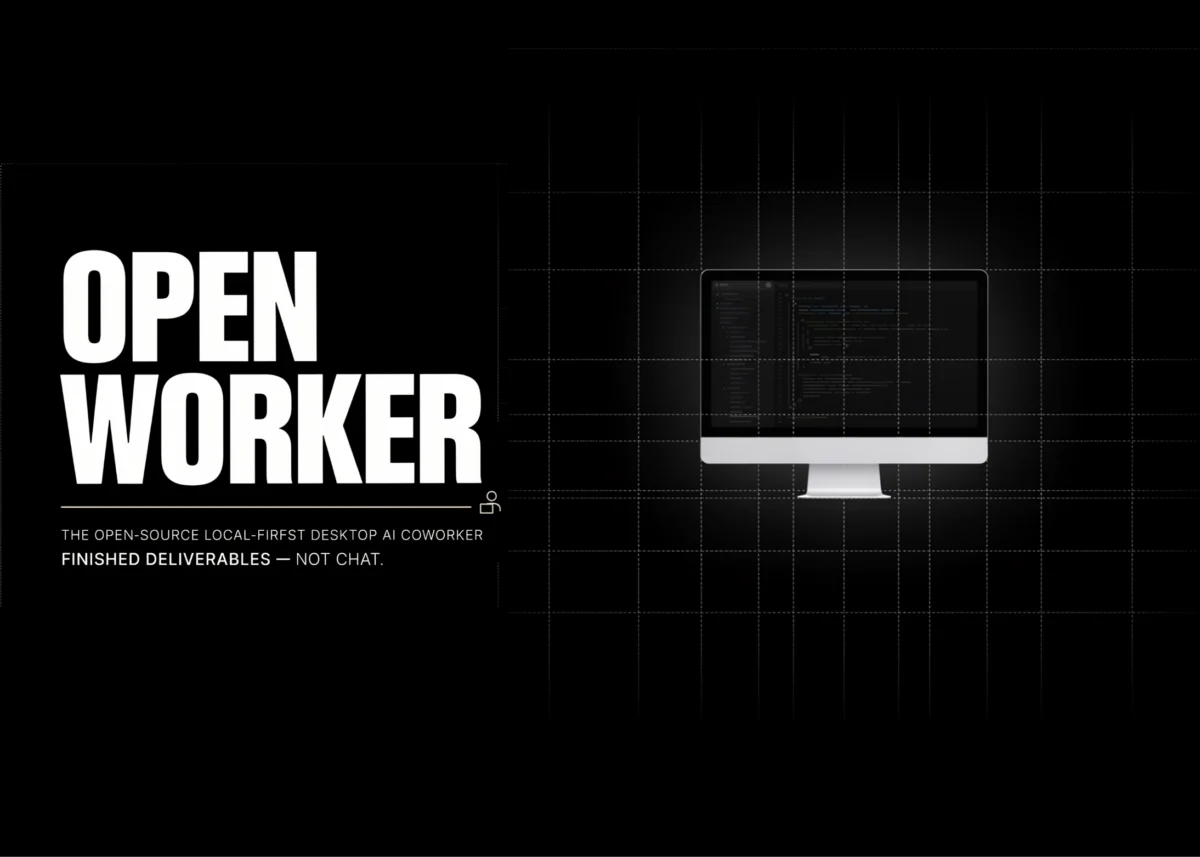
Andrew Ng, the globally recognized AI pioneer and founder of DeepLearning.AI and Coursera, has officially announced the release of OpenWorker, a groundbreaking open-source desktop agent designed to shift the artificial intelligence paradigm from simple conversation to the delivery of finished professional work. Unlike traditional large language model (LLM) interfaces that prioritize chat-based interaction, OpenWorker is engineered to produce specific, tangible outcomes based on user requirements. The system is designed to function as a digital coworker capable of executing complex tasks across local files and connected applications, marking a significant milestone in the evolution of agentic workflows.
The core philosophy behind OpenWorker is the transition from "prompts" to "outcomes." Instead of engaging in a back-and-forth dialogue to refine an idea, users provide OpenWorker with a defined end goal—such as a polished document, a Slack reply populated with verified internal data, an updated corporate calendar, or a triaged email inbox. Upon receiving a directive, the agent autonomously decomposes the objective into a series of logical steps, executes those steps using a suite of integrated tools, and maintains a "human-in-the-loop" protocol by checking in with the user before performing any consequential or external actions.
The Architectural Foundation of OpenWorker
The technical framework of OpenWorker is built on a robust four-layer architecture designed for local execution. This local-first approach ensures that the primary logic and data processing occur on the user’s hardware rather than on a centralized cloud server. The repository is substantial, comprising 119 Python files totaling approximately 32,400 lines of code within the core engine, complemented by 149 TypeScript and TSX files that manage the graphical user interface (GUI). Additionally, the system includes 78 backend test modules, ensuring a high degree of stability and reliability for enterprise-grade tasks.
At the heart of the engine is "aisuite," an open-source, provider-agnostic library also developed by Andrew Ng. This library allows OpenWorker to interact seamlessly with various LLM providers without requiring significant code changes. By utilizing aisuite, the project maintains a modular design that can adapt to the rapidly changing landscape of AI models. The four layers of the architecture work in concert to manage the user interface, task planning, tool execution, and the underlying model inference, creating a cohesive ecosystem that bridges the gap between the desktop environment and advanced machine learning models.
A Curated Model Matrix for Specialized Performance
OpenWorker does not provide its own inference service; instead, it adopts a "bring your own model" (BYOM) strategy. Users are required to input their own API keys or connect the application to a local runtime. This approach provides maximum flexibility while ensuring that the project remains lightweight and focused on the agentic logic rather than hosting massive model weights.
The platform supports a deliberately curated matrix of 30 high-performance models. This list includes industry-leading proprietary models and emerging open-weight alternatives. The native providers supported include:
- OpenAI: Support for the GPT-5.5 and GPT-5.6 series (including the Sol, Terra, and Luna variants).
- Anthropic: Integration with Claude Fable 5, Opus 4.8, Sonnet 4.6, and Haiku 4.5.
- Google: Compatibility with Gemini 3.1 Pro, 3.6 Flash, 2.5 Pro, and 2.5 Flash.
Furthermore, the system is compatible with OpenAI-compliant vendors, allowing users to utilize models such as GLM-5.2, DeepSeek V4, Kimi K2.6, MiniMax M2.5, Qwen3 Max, Grok 4.3, and Mistral Large. For users prioritizing privacy or operating in offline environments, OpenWorker supports open-weight models through Together AI and Fireworks, as well as fully local execution via Ollama, which requires no API key or external internet connection.
Advanced Permission Engineering and Risk Mitigation
One of the most significant engineering achievements of OpenWorker is its sophisticated permission engine. While many desktop agents treat user approvals as a secondary user interface concern, OpenWorker integrates permissions as a foundational, typed layer of the software. This ensures that every action taken by the agent is scrutinized based on its potential impact on the system.
The engine classifies every tool call into one of four distinct risk classes:
- Read: Operations that involve viewing data but have no side effects (e.g., reading a file or checking a calendar).
- Write_Local: Actions that mutate the local workspace but are restricted to specific, path-scoped directories.
- Exec: The execution of system commands, which carries a higher risk profile.
- External: Actions that have side effects outside the local machine, such as sending an email or posting to a messaging platform.
To manage these risks, OpenWorker offers five permission modes. The "Discuss" and "Plan" modes are strictly read-only, allowing the agent to strategize without making changes. The "Interactive" mode, which serves as the default setting, prompts the user for explicit approval before any write, command, or external action is taken. The "Auto" mode permits the agent to work autonomously within path-scoped boundaries, while the "Custom" mode allows users to pre-approve a specific set of trusted tools.
Two design decisions within this engine are particularly noteworthy. First, the permission layer is enforced at the code level, meaning it is not merely a suggestion to the AI but a hard constraint that the model cannot bypass. Second, the system includes a built-in "Ops Persona" that instructs the model to treat all content from tools, logs, the web, and incoming messages as "untrusted data." This proactive stance against prompt injection attacks is a critical security feature, preventing external data from hijacking the agent’s instructions.
Privacy and Data Sovereignty in the Agentic Era
In an era of increasing concerns over data privacy, OpenWorker distinguishes itself through a local-first design. All model calls are routed directly from the user’s machine to the chosen provider. Sensitive information, including conversation histories, connector tokens, and API keys, remains stored locally. The secret store is architected to ensure that credentials never enter the model’s context, prompts, or traces, significantly reducing the risk of accidental data leaks.
The only cloud-based component is an optional broker used to handle OAuth handshakes for one-click integrations with third-party apps like Slack or Google Calendar. This broker uses the Auth0 Authorization Code flow with PKCE (Proof Key for Code Exchange) to ensure security. Once the handshake is complete, the connector tokens are passed directly to the user’s machine and are never stored on the cloud broker. For those who prefer a completely air-gapped or manual setup, the application remains fully functional when signed out, allowing users to manually paste credentials for each service.
Timeline of Development and the Rise of Agents
The release of OpenWorker comes at a pivotal moment in the AI industry. Throughout late 2023 and 2024, the focus of AI development shifted from "Chatbots" to "Agents." Andrew Ng has been a vocal proponent of this shift, frequently arguing in his newsletters and public speaking engagements that "Agentic Workflows"—where an AI iterates, self-corrects, and uses tools—often yield better results than simply using a more powerful model in a single-shot prompt.
The development of OpenWorker follows a series of incremental releases by Ng’s team, including the aisuite library earlier this year. The project reflects a broader industry trend where developers are seeking to move AI beyond the browser and into the operating system. While competitors like Microsoft and Apple are integrating agents directly into Windows and macOS, OpenWorker provides an open-source, cross-platform alternative that prioritizes user control and model flexibility.
Implications for the Future of Work and Software Development
The introduction of OpenWorker has profound implications for professional productivity. By automating the "busy work" of triaging communications and preparing documents, the agent allows human workers to focus on high-level strategy and creative decision-making. For developers, the open-source nature of the project provides a blueprint for building secure, tool-enabled AI applications that respect user privacy.
Analysts suggest that OpenWorker could become a foundational tool for the "AI-native" enterprise. Its ability to work across local files means it can handle sensitive corporate data that companies are often hesitant to upload to centralized AI platforms. Furthermore, the inclusion of robust security measures against prompt injection addresses one of the primary hurdles for the enterprise adoption of autonomous agents.
Conclusion and Project Availability
OpenWorker represents a sophisticated synthesis of Andrew Ng’s vision for agentic AI and practical, security-conscious engineering. By focusing on outcomes rather than conversation, providing a wide array of model support, and implementing a rigorous permission system, the project sets a new standard for open-source desktop agents.
The project is now available to the public via its official GitHub repository. The developers have encouraged the community to contribute to the codebase, particularly in expanding the library of tools and refining the agent’s planning capabilities. As AI continues to evolve from a novelty into a functional tool for daily labor, OpenWorker stands as a significant step toward a future where digital agents are as common and capable as the software applications they manage.
The full codebase, documentation, and installation guides can be accessed through the project’s website and repository. With the backing of one of AI’s most respected figures, OpenWorker is poised to influence the next generation of productivity software, emphasizing that the future of AI is not just about what the machine can say, but what it can do.