


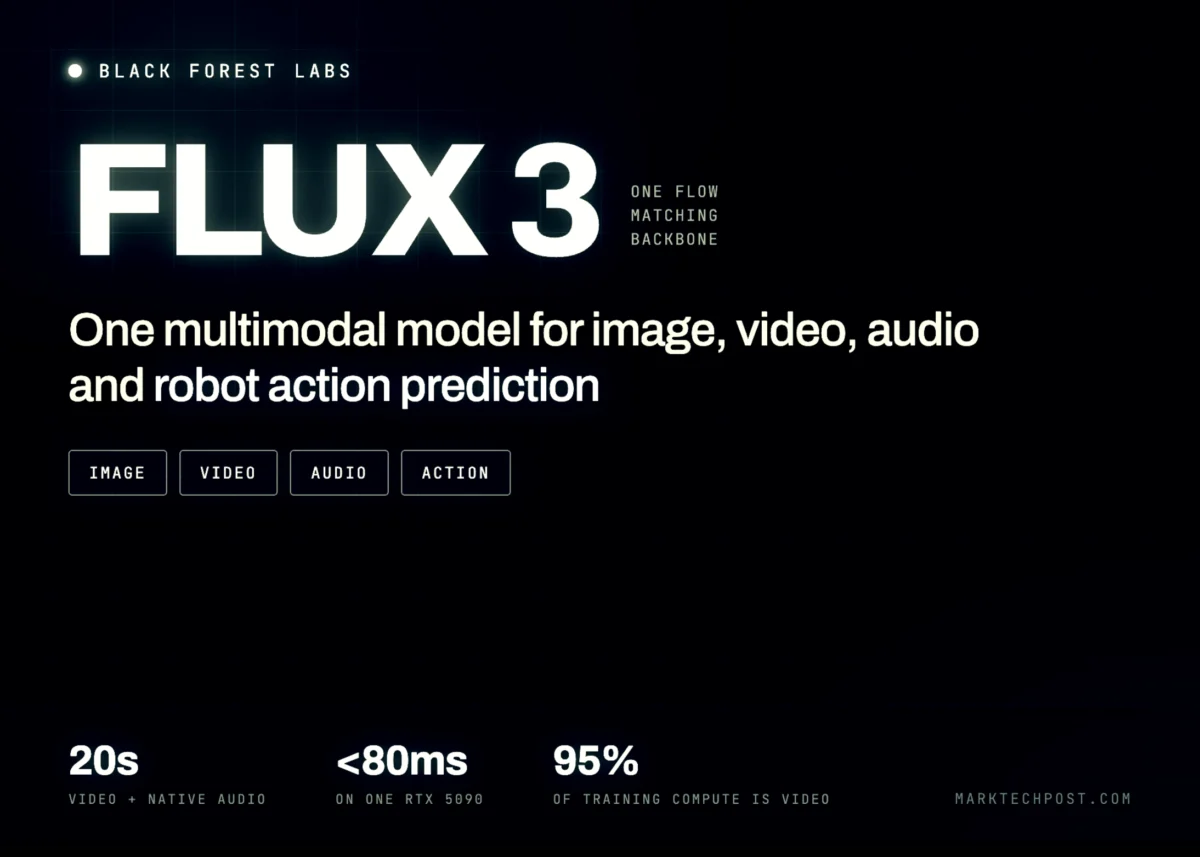
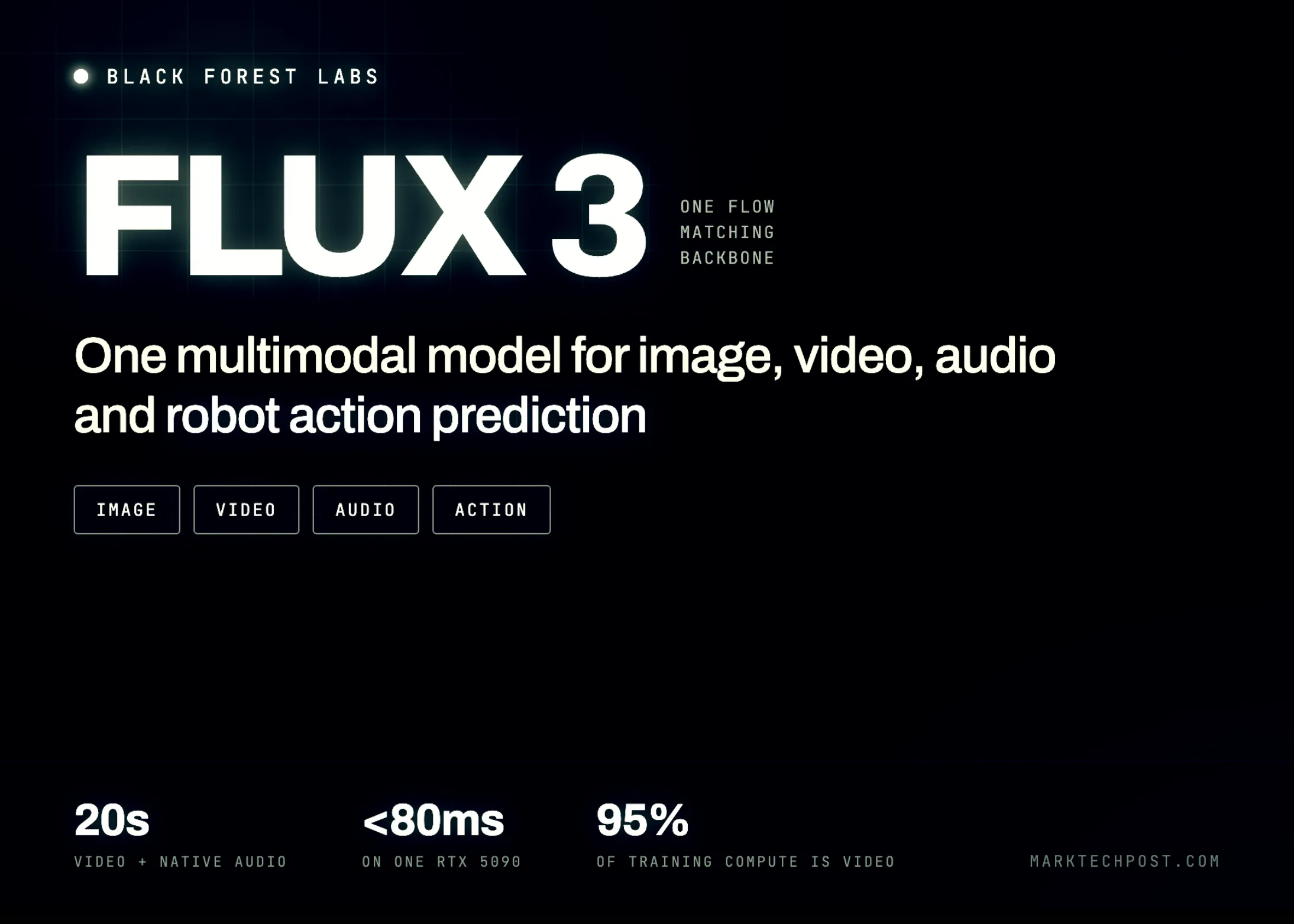
The artificial intelligence sector has reached a significant milestone with the release of FLUX 3 by Black Forest Labs (BFL), a foundation model that represents a departure from traditional modular AI architectures. Unlike previous iterations or competing systems that often utilize separate models for different media types, FLUX 3 is a singular, multimodal architecture designed to learn from images, videos, and audio simultaneously. This release marks the first time a FLUX model has successfully integrated video, audio, and action prediction within a single set of weights, effectively creating a "world model" that understands the interconnected nature of physical reality across different sensory dimensions.
The research philosophy driving Black Forest Labs is rooted in the belief that isolated modalities—such as static images or silent video—provide an incomplete and often contradictory description of the world. By treating image, video, and audio as "lossy projections" of a singular underlying reality, the BFL team has developed a system where each modality serves as a constraint upon the others. In this framework, the sound generated by the model must align with the visual impact of an object, and the motion of a digital entity must adhere to the simulated mass and physical dynamics inferred from the training data. This holistic approach ensures a level of temporal and physical consistency that has historically eluded generative AI models.
The Evolution of the FLUX Ecosystem
The trajectory of Black Forest Labs has been marked by rapid innovation since the team, composed of original creators of Stable Diffusion, emerged from stealth in August 2024. The initial release of FLUX.1 established the company as a leader in high-fidelity image generation, particularly praised for its ability to render complex human anatomy and legible text. However, the roadmap always pointed toward a more comprehensive understanding of temporal and auditory data.
In March 2026, the team published the "Self-Flow" research paper, which laid the theoretical groundwork for what would eventually become FLUX 3. This methodology focused on aligning multimodal generation and understanding within a unified architecture. While the FLUX.1 series focused on the spatial excellence of images, the development of the Self-Flow mechanism allowed BFL to scale its compute and data resources significantly, moving from research-grade ImageNet models to the production-ready FLUX 3. This timeline highlights a strategic shift from specialized generative tools to generalized foundation models capable of simulating complex environments.
Technical Foundations: The Self-Flow Architecture
At the heart of FLUX 3 lies the Self-Flow method, a technique that harmonizes the flow matching objective with a self-supervised feature reconstruction objective. Flow matching has become an industry standard for diffusion-based models, providing a more efficient path for transforming noise into structured data. However, BFL’s innovation involves combining this with a per-token timestep conditioning system, implemented in a SiT-XL/2 architecture.
The technical specifications released by BFL indicate that the model was trained using a 25% per-token mask ratio. This masking strategy forces the model to predict missing information across modalities, effectively teaching it the relationship between a frame of video and its corresponding audio track or the subsequent movement in a sequence. Furthermore, the model employs a self-distillation process, where an Exponential Moving Average (EMA) teacher at layer 20 guides a student at layer 8. This distillation not only optimizes the model’s performance but also allows for high-quality outputs even as the computational footprint is managed.
While BFL has provided a reference implementation of Self-Flow on GitHub under the Apache-2.0 license, the company clarified that the public repository contains a research model trained on 256×256 ImageNet data. FLUX 3 itself is the result of scaling this approach by orders of magnitude, incorporating massive datasets of high-resolution video and synchronized audio to achieve its "world model" status.
Capabilities and Features of FLUX 3 Video
FLUX 3 Video represents a leap forward in the duration and complexity of AI-generated content. The model is capable of producing clips up to 20 seconds in length in a single generation pass, a substantial increase over the 5-to-10-second industry average. Crucially, these clips feature native audio that is generated in lockstep with the visuals, ensuring that environmental sounds, footsteps, and dialogue are perfectly synchronized with the on-screen action.
The model supports a wide array of operational modes:
- Text-to-Video (T2V): Generating complex scenes from natural language descriptions.
- Image-to-Video (I2V): Animating static images with realistic physical motion.
- Video-to-Video (V2V): Re-styling or modifying existing clips based on new prompts.
- Keyframe-to-Video: Allowing creators to specify start and end points for controlled transitions.
- Multimodal Continuation: Extending existing video and audio sequences while maintaining narrative and physical continuity.
BFL has also emphasized the model’s "agentic chaining" capabilities. This allows users to link multiple generated clips into cohesive, multi-shot sequences, effectively acting as an automated film editor that understands the continuity of characters and environments. Furthermore, FLUX 3 maintains the brand’s reputation for strong typography, enabling the generation of animated designs where text interacts naturally with the 3D environment.
Benchmarking Performance and Human Preference
To validate the efficacy of FLUX 3, Black Forest Labs conducted extensive human preference testing. The evaluation focused on 10-second text-to-video clips rendered at 720p resolution with accompanying audio. The results suggest that FLUX 3 has established a new performance ceiling in the generative video space.
When compared against Luma Ray 3.2, FLUX 3 was preferred in 93% of instances, a near-total dominance that highlights the gap in multimodal synchronization. Against Runway Gen-4.5, a major industry incumbent, FLUX 3 maintained a 77% preference rate. The model also outperformed Grok Imagine Video (69%), Kling v3 Pro (60%), and the Happy Horse series (v1.1 at 57%).
The most competitive matchups occurred against Seedance 2.0 and Gemini Omni Flash, where FLUX 3 secured a 52% preference rate. This statistical "coin flip" indicates that while FLUX 3 is a leader, the industry is seeing a convergence of high-end models that are beginning to master the basics of video generation, shifting the competition toward more niche features like action prediction and audio fidelity.
Implications for Robotics and Action Prediction
One of the most intriguing aspects of the FLUX 3 release is its collaboration with "mimic robotics." By including action prediction within its set of weights, FLUX 3 moves beyond being a mere media creation tool and enters the realm of physical world simulation. Action prediction allows the model to anticipate the movements of objects and agents within a scene, a capability that is directly transferable to the training of robotic systems in synthetic environments.
Industry analysts suggest that by training a model to understand how a human hand moves to pick up a glass (and the sound that glass makes when it touches a table), BFL is providing a blueprint for the next generation of general-purpose robots. The integration of "Self-Flow" suggests that the model isn’t just "dreaming" pixels; it is calculating the vectors of motion required to achieve a specific physical outcome. This could significantly reduce the "sim-to-real" gap that currently plagues the robotics industry.
Industry Reaction and Future Outlook
The release of FLUX 3 has prompted a flurry of reactions from the tech community. Early adopters have noted the model’s particular strength in rendering human facial expressions, which often suffer from "uncanny valley" effects in other video models. By utilizing the synchronized audio data, FLUX 3 appears to better understand the muscle movements associated with speech and emotion.
The creative industry, ranging from Hollywood visual effects houses to independent content creators, is viewing the 20-second native audio generation as a potential paradigm shift. The ability to generate a sequence that already includes its own foley and sound design could drastically shorten production timelines for storyboarding and conceptualization.
However, the scale of FLUX 3 also raises questions about the computational resources required to run such models. While the research version is available for study, the full-scale FLUX 3 requires significant hardware, prompting BFL to offer early access through specialized API partners and their own "Interactive Explorer" terminal.
As Black Forest Labs continues to iterate on the Self-Flow architecture, the focus is expected to shift toward even longer durations and higher resolutions. With FLUX 3, the company has successfully argued that the future of AI does not lie in specialized silos, but in a unified understanding of the world’s many dimensions. The transition from FLUX.1’s static beauty to FLUX 3’s dynamic, audible reality marks a definitive step toward the creation of truly comprehensive artificial intelligence.