The landscape of generative artificial intelligence is undergoing a significant shift from text-centric models toward multimodal systems capable of interpreting complex visual and structured data. At the forefront of this transition is NVIDIA NeMo Retriever, a sophisticated framework designed to bridge the gap between static document repositories and actionable enterprise intelligence. By integrating advanced layout detection, optical character recognition (OCR), and vision-language reranking, NeMo Retriever allows developers to build Retrieval-Augmented Generation (RAG) pipelines that can "see" and "understand" tables, charts, and infographics within PDF documents. This evolution addresses a critical bottleneck in enterprise AI: the "dark data" trapped within complex document formats that traditional text-only embedding models often fail to capture accurately.
The Technical Foundation of Multimodal Document Processing
The implementation of an advanced multimodal RAG pipeline begins with a precise environmental configuration. Utilizing Python 3.12, the workflow leverages the latest optimizations in the NVIDIA NeMo Retriever library. The initial phase of the pipeline focuses on local, offline text extraction. Using tools such as PDFium, the system can perform preliminary text ingestion without the need for a GPU or external API calls. This "in-process" mode ensures that basic textual content is captured quickly, providing a baseline for more complex operations.
However, the true power of the NVIDIA ecosystem is realized through the transition to hosted NVIDIA Inference Microservices (NIM). These endpoints provide specialized models for layout analysis and element extraction. In a standard advanced deployment, the pipeline utilizes several distinct NIM URLs:
- Nemotron-Page-Elements-v3: Identifies the structural layout of a page, distinguishing between headers, footers, paragraphs, and visual assets.
- Nemotron-OCR-v1: Converts visual representations of text into machine-readable strings with high spatial accuracy.
- Nemotron-Table-Structure-v1: Deconstructs complex tables into structured Markdown or HTML formats, preserving the relationship between rows and columns.
- Nemotron-Graphic-Elements-v1: Analyzes charts and infographics to extract the underlying data trends and labels.
By delegating these computationally intensive tasks to hosted NIMs, developers can maintain a lightweight local runtime, such as a Google Colab environment, while leveraging the massive throughput of NVIDIA’s optimized inference infrastructure.
Chronology of a Multimodal RAG Workflow
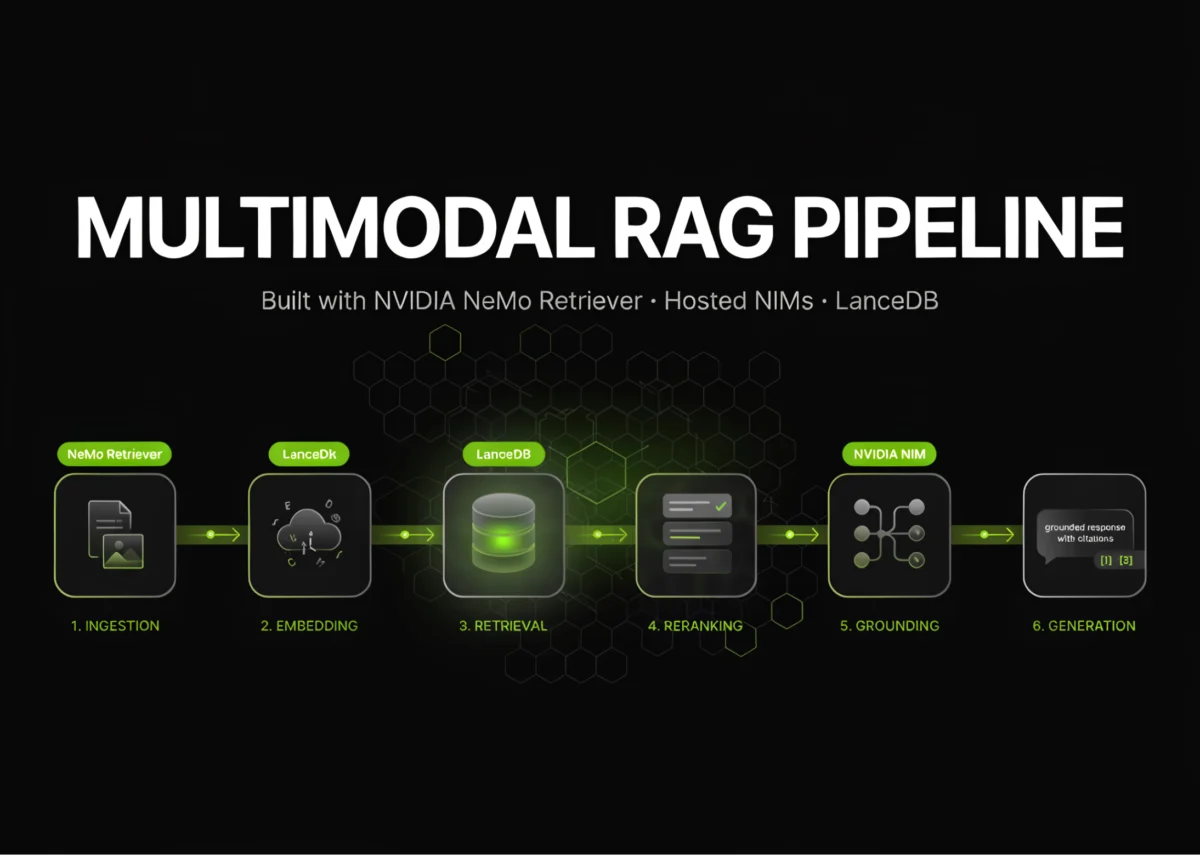
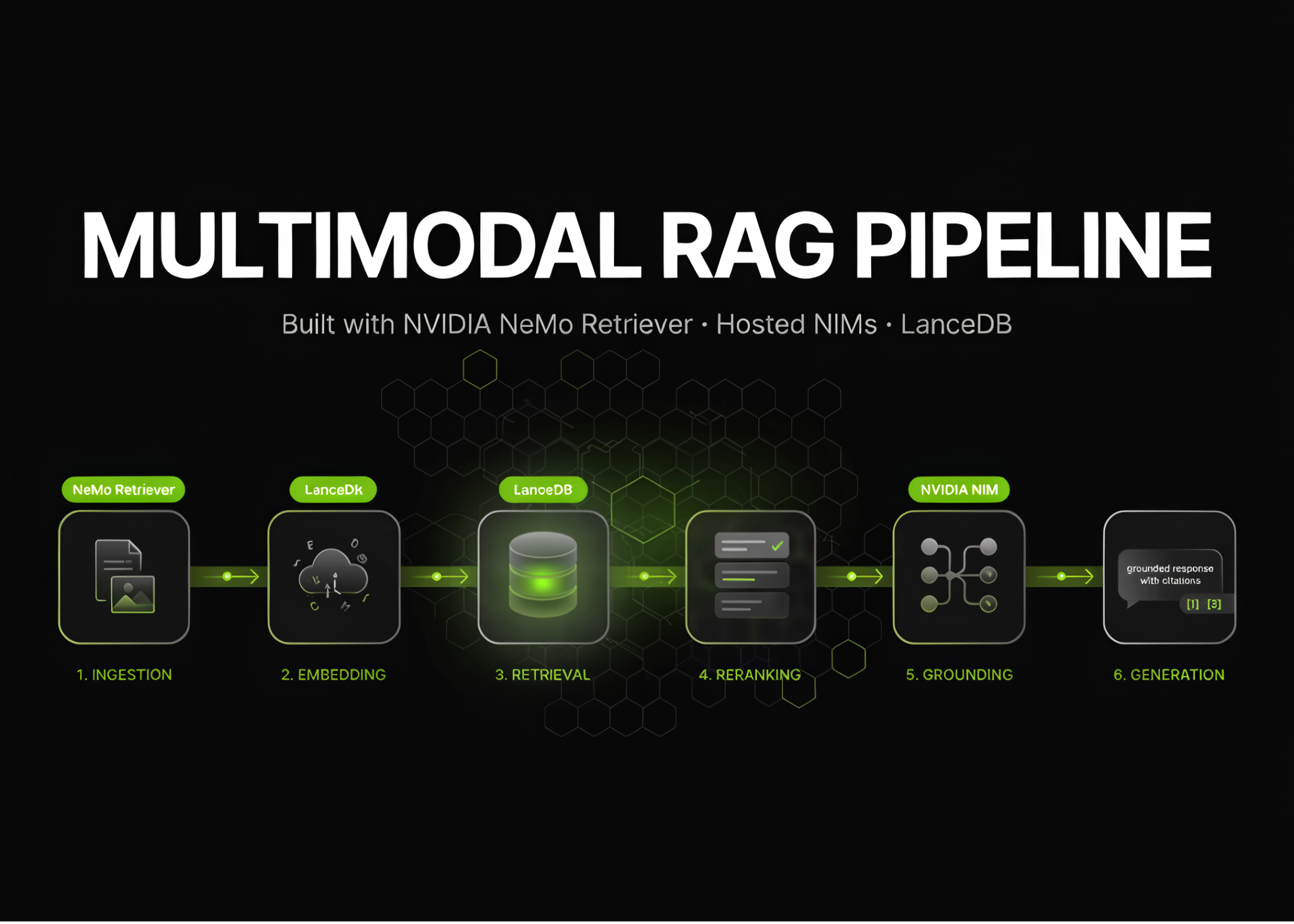
The construction of a production-grade RAG system follows a rigorous sequence of data engineering and model orchestration. This chronology ensures that data remains consistent and searchable across various modalities.
1. Environment Initialization and Offline Baseline:
The process begins by validating the Python environment and installing the nemo-retriever package. An initial "dry run" of text extraction is performed on a sample multimodal PDF. This step is crucial for verifying that the document is readable and that the basic ingestion logic is sound before committing to API-based processing.
2. Multimodal Ingestion and Enrichment:
Once the API connectivity is established via an NVIDIA API key, the pipeline moves into the enrichment phase. The ingestor is configured to extract not just text, but tables, charts, and infographics. During this stage, the system applies "token-aware chunking"—typically setting a maximum of 512 tokens with a 64-token overlap. This ensures that the context remains intact when the document is broken down into smaller segments for the vector database.
3. Content Deduplication and Metadata Tagging:
To prevent the retrieval of redundant information, the pipeline employs deduplication based on content hashes and Bounding Box (BBox) Intersection over Union (IoU) thresholds. If two extracted elements overlap significantly on a page, the system filters out the redundant data. Each chunk is then tagged with metadata, including page numbers and element types (e.g., "table" or "chart").
4. Vector Embedding and LanceDB Integration:
The processed content is transformed into dense vector embeddings using models such as nvidia/llama-nemotron-embed-1b-v2. These embeddings are stored in LanceDB, an open-source vector database designed for high-performance AI applications. LanceDB’s ability to handle both vector data and structured metadata makes it ideal for RAG pipelines that require filtered searches, such as looking for information exclusively within tables.
5. Dense Retrieval and Vision-Language Reranking:
When a user submits a query, the retriever identifies the top-k most relevant chunks using a similarity search. To further refine these results, a vision-language (VL) reranker, such as nvidia/llama-nemotron-rerank-vl-1b-v2, evaluates the candidate set. The reranker considers the semantic alignment between the query and the visual context of the document, reordering the results to ensure the most contextually accurate information is at the top.
Data-Driven Analysis of Retrieval Efficacy
The success of a RAG pipeline is measured by its ability to provide grounded, accurate answers. In the NVIDIA NeMo Retriever workflow, this is validated through a "Recall@k" evaluation. This metric measures the percentage of times the correct answer is found within the top ‘k’ retrieved documents.
Supporting data suggests that multimodal extraction significantly outperforms text-only methods when dealing with financial reports or technical manuals. For instance, in a document where key data is presented only in a bar chart, a traditional RAG system would return a "null" or hallucinated response. By contrast, the multimodal pipeline extracts the chart’s data into a textual description or markdown table, allowing the embedding model to index the information.
During testing, the implementation of a reranking step often increases the precision of the retrieval. While dense retrieval might identify five relevant-looking chunks, the vision-language reranker can distinguish which of those chunks actually contains the specific data point requested, such as a specific "cost" or "date" hidden within a complex layout.
Official Positioning and Industry Implications
While NVIDIA has not released a singular formal statement on every individual tutorial, the company’s strategic direction with the NeMo framework is clear. NVIDIA’s leadership has consistently emphasized that "Retrieval is the new frontier of AI." By providing the tools to convert unstructured PDF data into structured, searchable knowledge, NVIDIA is positioning itself as the primary infrastructure provider for "Agentic RAG"—systems where AI agents can autonomously browse and reason over massive document corpora.
Industry analysts suggest that this technology has profound implications for several sectors:
- Legal and Compliance: Automating the review of contracts where formatting and signatures are as important as the text itself.
- Financial Services: Extracting real-time data from quarterly earnings reports that are heavily reliant on complex tables and year-over-year growth charts.
- Manufacturing: Allowing engineers to query technical blueprints and maintenance manuals that contain intricate diagrams and callouts.
The integration of inline citations and grounded response generation addresses the "hallucination" problem that has plagued LLM adoption in the enterprise. By forcing the model to cite specific page numbers and document chunks, organizations can verify the AI’s output against the original source of truth.
Broader Impact on Document Intelligence
The transition toward multimodal RAG represents a maturation of the AI industry. We are moving away from simple chatbots that summarize text and toward "Document Intelligence" systems that act as expert researchers. The use of NVIDIA NeMo Retriever demonstrates that building such a system no longer requires a massive team of data scientists to build custom OCR and layout models from scratch. Instead, through the use of NIMs, advanced capabilities are democratized, allowing developers to assemble high-performance pipelines using standardized components.
The final artifacts of this process—a searchable LanceDB vector table and a full Markdown representation of the document—serve as a reusable foundation for future AI applications. As models continue to evolve, the ability to maintain a clean, structured, and multimodal index of organizational knowledge will become a primary competitive advantage.
In conclusion, the workflow established by NVIDIA NeMo Retriever provides a blueprint for the next generation of RAG. By combining the efficiency of local processing with the power of cloud-based inference, and by treating visual data with the same importance as text, this pipeline ensures that no piece of information is left behind. The result is a system that not only answers questions but does so with a level of accuracy and traceability that meets the rigorous standards of modern enterprise operations.