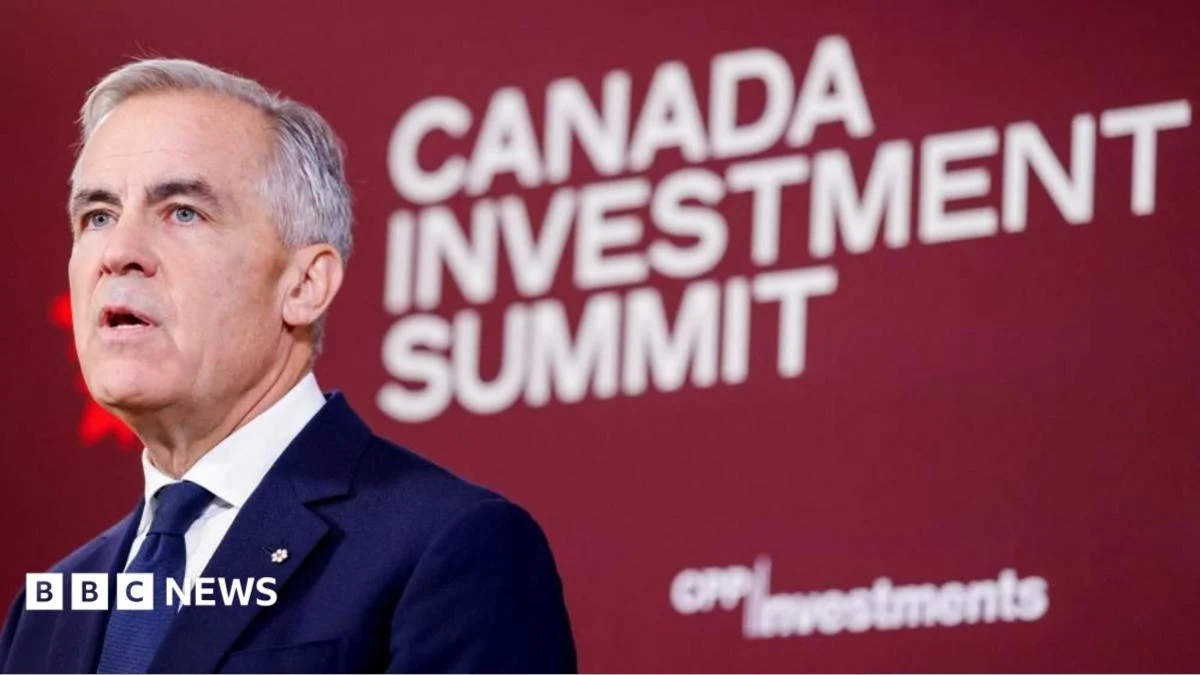
Prime Minister Mark Carney is spearheading an ambitious campaign to position Canada as a beacon of stability and opportunity, a "safe harbour" for the world’s most influential investors grappling with an era of unprecedented geopolitical and economic uncertainty. Addressing a powerful cohort of over 100 major global investors, who collectively manage assets exceeding C$120 trillion ($86 trillion; £64 trillion), in Ottawa on Tuesday, Carney articulated a vision of Canada "perfectly situated to build in the new global economic order." This high-stakes summit marks a pivotal moment for the Carney administration, which has pledged to attract a monumental C$1 trillion in investments over the next five years, a strategic imperative aimed at significantly reducing Canada’s historical economic reliance on the United States and bolstering its overall economic resilience.
The investment drive comes at a critical juncture for Canada, as it navigates escalating trade tensions with its southern neighbour, marked by a recent collapse in bilateral trade talks and the implementation of tit-for-tat tariffs. Against this backdrop, Ottawa is aggressively pursuing deeper economic partnerships with diversified markets across Europe, Asia, and the Middle East, a strategy central to Carney’s broader efforts to elevate Canada’s global economic profile. The Prime Minister, a former Governor of the Bank of England and Bank of Canada, whose career trajectory includes top tiers of global finance before his pivot to politics, personally extended invitations to many of the business luminaries attending the Toronto event, underscoring the personal commitment behind this national economic pivot. "Our goal is simple: to make Canada the most attractive place in the G7 to invest," Carney declared, setting a clear benchmark for his administration’s economic ambitions.
A Bold Vision for Economic Diversification and Resilience
Carney’s pitch to the global investment community is multifaceted, strategically targeting sectors deemed crucial for Canada’s future prosperity and global competitiveness. These include defence, energy, mining, artificial intelligence (AI), and critical infrastructure. The summit has unveiled an extensive portfolio of more than 160 projects, ranging from vital resource extraction initiatives like new mines to cutting-edge data centres and strategic energy pipelines, all designed to appeal to a broad spectrum of capital. This comprehensive offering is a direct response to the volatile global landscape, where supply chain disruptions, energy security concerns, and the accelerating pace of technological innovation are reshaping investment priorities worldwide.
The emphasis on defence investments, for instance, reflects a growing global recognition of national security priorities in an increasingly unstable world, alongside Canada’s commitments as a NATO member. In energy, the focus is dual: leveraging Canada’s vast traditional energy reserves to meet global demand for energy security, while simultaneously investing in renewable energy and clean technology to position the country as a leader in the global energy transition. Mining, particularly critical minerals essential for electric vehicles and advanced electronics, presents another significant opportunity, aligning with global decarbonization efforts. Canada’s robust research ecosystem and highly skilled workforce in AI and technology make it a natural hub for digital innovation, while ambitious infrastructure projects are vital to support economic growth, improve connectivity, and enhance logistical capabilities across the country.
Strategic Privatisation: The Airport Initiative
A cornerstone of Carney’s reform agenda, and a significant announcement made during the summit, is the plan to privatise operations for four of Canada’s largest airports. This move, according to Carney, is projected to generate billions of dollars, which would then be strategically reinvested into modernizing the nation’s broader transport infrastructure. While many developed countries have long embraced varying degrees of private sector involvement in airport management and development, Canada has historically lagged, with its airports traditionally operating under a not-for-profit governance model, often managed by local airport authorities.
Under the proposed model, the federal government would maintain ownership of the underlying land and core assets, but private entities would be invited to invest in and manage airport operations. This distinction is crucial; it seeks to balance the infusion of private capital and expertise with the preservation of public ownership over critical national assets. The rationale behind this policy shift is rooted in the belief that private investment can unlock efficiencies, accelerate modernization, and provide access to capital that might otherwise be constrained by public funding cycles. Proponents argue that such a model could lead to improved passenger experiences, enhanced cargo capabilities, and greater connectivity, ultimately boosting Canada’s attractiveness as a business and tourism destination.
However, the proposal has not been without its detractors. Labour unions have swiftly voiced strong criticism, expressing concerns that the privatisation could negatively impact both workers and passengers. Union representatives argue that private operators, driven by profit motives, might cut corners on staffing, reduce benefits, or increase service charges, leading to diminished working conditions and higher costs for travellers. Organizations like the Public Service Alliance of Canada (PSAC) and Unifor have historically opposed the sale or outsourcing of public assets, citing potential job losses, erosion of public services, and a shift of public wealth into private hands. They often advocate for public control to ensure accountability, accessibility, and fair treatment for employees and the public alike.
The Shadow of Tariffs: US-Canada Trade Tensions
The backdrop to this ambitious investment summit is a deepening rift in trade relations between Canada and the United States, casting a significant shadow over Ottawa’s economic diversification efforts. Trade talks between the two historically close allies collapsed last month, leading to a series of escalating tit-for-tat tariffs. On the very day of the summit, new US tariffs came into effect on a range of Canadian goods, while some previously imposed tariffs were lifted, reflecting a complex and often unpredictable trade environment. Further bans on Canadian goods, including alcohol and motorcycles, are reportedly slated to come into force next week, signaling a continued escalation.
This tariff war, initiated by the US, has encompassed key Canadian exports, including steel, aluminum, and certain agricultural products, causing significant disruption to cross-border supply chains and raising anxieties within Canadian industries. For Canada, these trade disputes with its largest trading partner underscore the urgency of its strategic pivot towards new markets and diverse investment sources. The economic rationale for attracting C$1 trillion in global investment and forging deeper ties with Europe, Asia, and the Middle East becomes even more compelling when faced with the unpredictability of its traditional economic anchor.
Addressing the American executives present in Toronto directly, Prime Minister Carney adopted a carefully calibrated diplomatic tone. "To our American friends, let me say this. We will always be neighbours, and Canada will continue to be the US’s most important partner in many key areas," he stated, attempting to reassure while acknowledging the current friction. He further added, "After all, even at times of disagreement during our long history, we have always maintained deep ties." This statement reflects the delicate balance Canada must strike: asserting its economic independence and pursuing diversification, while simultaneously safeguarding its fundamental relationship with the United States.
Protests and Public Scrutiny: The "Great Canadian Sell-Off"
While official proceedings unfolded within the high-security confines of the summit, outside, the Carney government faced vocal opposition from protestors who accused it of orchestrating a "great Canadian sell-off" of public resources and infrastructure to corporate interests. Hundreds of demonstrators gathered outside the opening night gala at a downtown museum, decrying the perceived erosion of public assets and national sovereignty.
Kai Nagata, a spokesperson for the advocacy group Dogwood, articulated the protestors’ core concern, highlighting the significant American presence among the invited investors. "Half the buyers that he has invited here to Toronto are American," Nagata stated on Monday. He warned, "Let’s be clear, every piece of our country that we sell off to American billionaires brings us closer to becoming the 51st state." This sentiment reflects a deep-seated public anxiety about foreign ownership, particularly from the US, and the long-term implications of privatising assets that many Canadians consider to be public patrimony. Critics argue that such moves could lead to a loss of control over strategic national assets, potential profit repatriation that benefits foreign shareholders over Canadian citizens, and a diminished capacity for the government to regulate essential services in the public interest.
This public backlash underscores a significant political challenge for the Carney administration. While the economic imperative to attract foreign capital is clear, particularly in an era of constrained public finances and fierce global competition for investment, the government must navigate strong domestic sentiments regarding national ownership and the role of the state in providing essential services. The debate pits economic efficiency and global competitiveness against concerns about social equity, national identity, and democratic accountability.
Chronology of Key Events and Economic Context
The current investment summit and the associated policy announcements are the culmination of a series of events and long-term economic trends. For decades, Canada’s economy has been deeply intertwined with that of the United States, benefiting from proximity, shared language, and integrated supply chains under agreements like NAFTA (now USMCA). However, this reliance has also exposed Canada to the vulnerabilities of US economic cycles and protectionist shifts in US trade policy.
- Late 20th Century – Early 21st Century: Canada experiences periods of robust Foreign Direct Investment (FDI), often driven by resource extraction and automotive sectors, with the US remaining the primary source of FDI.
- Mid-2010s: Global economic shifts, rising geopolitical tensions (e.g., US-China trade disputes), and growing calls for supply chain resilience begin to highlight the need for Canada to diversify its economic partnerships.
- 2020-2022: The COVID-19 pandemic exposes significant vulnerabilities in global supply chains and underscores the importance of domestic resilience and diversified trade routes. Canada, like many nations, grapples with economic recovery, inflation, and labour market challenges.
- Early 2023: Trade talks between Ottawa and Washington reach an impasse, leading to renewed trade disputes and the imposition of tariffs. This further intensifies Canada’s resolve to seek new economic anchors.
- This Week (Summit Dates): Prime Minister Carney hosts the major investment summit in Toronto, formally launching the C$1 trillion investment drive and announcing the airport privatisation plan. New US tariffs come into effect, adding urgency to the diversification efforts.
- Upcoming Weeks: Further US trade bans on Canadian goods are anticipated, maintaining pressure on the bilateral relationship. The details of the airport privatisation are expected to be elaborated, likely sparking further public and political debate.
Broader Implications and Future Outlook
The success of Prime Minister Carney’s ambitious C$1 trillion investment target will have profound implications for Canada’s economic trajectory and its standing on the global stage. If successful, the influx of capital could stimulate significant job creation, foster innovation, and diversify the national economy away from its traditional reliance on resources and US trade. It could also elevate Canada’s profile as a stable, predictable, and attractive destination for long-term capital, particularly for investors seeking refuge from more volatile regions.
However, the path to achieving this goal is fraught with challenges. The geopolitical landscape remains fluid, and global competition for investment is intense. While Canada boasts political stability, a strong rule of law, and a highly educated workforce, it must contend with its relatively smaller domestic market size compared to larger economies. The ongoing trade disputes with the US, while serving as a catalyst for diversification, also pose an immediate economic headwind that could deter some investors.
Domestically, the government faces the delicate task of balancing economic growth with public concerns about asset ownership and the distribution of wealth. The protests against the "sell-off" of public resources highlight a significant political risk. The administration will need to articulate clearly how these investments, particularly in privatised assets like airports, will benefit ordinary Canadians, ensuring transparency and accountability to mitigate public skepticism.
Ultimately, the investment summit represents a bold gamble by the Carney government – a strategic repositioning of Canada in a rapidly evolving world order. The coming years will reveal whether this vision of Canada as a "safe harbour" translates into the tangible economic resilience and diversified prosperity that the Prime Minister has so confidently pitched to the world’s most powerful investors. The outcome will not only shape Canada’s economic future but also define its role in the shifting dynamics of global power and commerce.