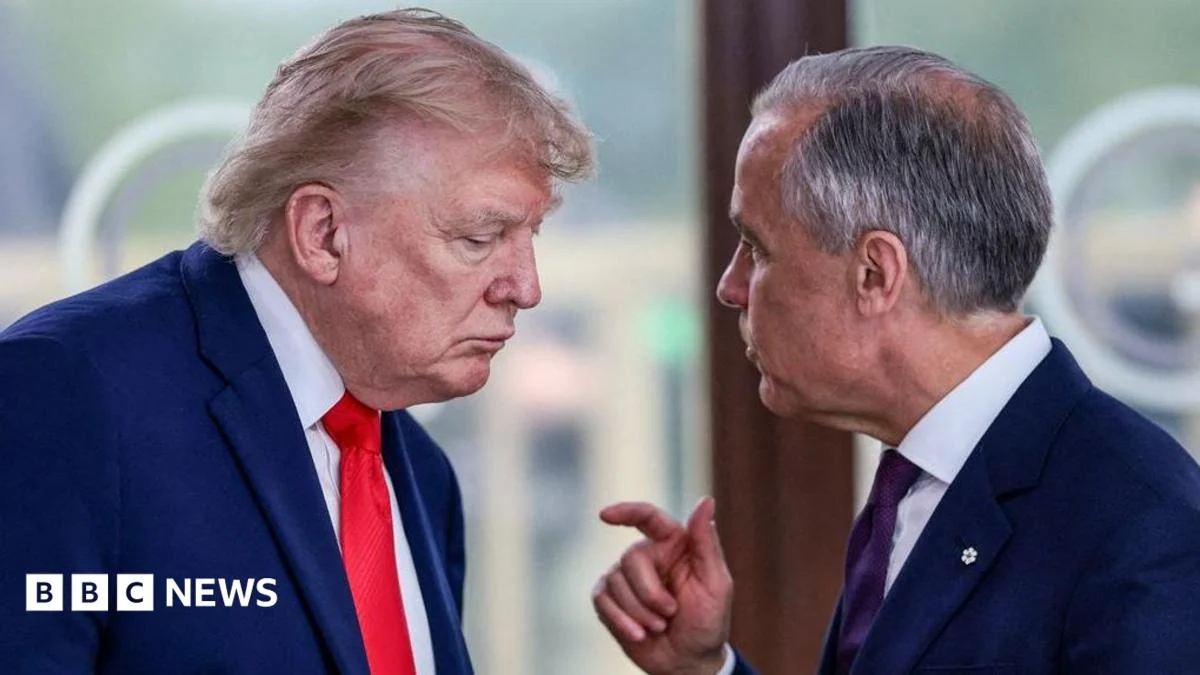
The once-unthinkable scenario, where two of the world’s closest allies and largest trading partners find themselves at loggerheads over tariffs, became stark reality following the dramatic collapse of last-ditch negotiations between Washington and Ottawa. For Prime Minister Mark Carney, the late-night decision to suspend talks with President Donald Trump and to retaliate against perceived US aggression, rather than acquiesce to a seemingly within-reach deal, marks a profound political and economic test. Carney stands out as one of the first world leaders to unequivocally walk away from the negotiating table with the White House on such contentious terms, and the ramifications of his stance are now under intense global scrutiny.
A Partnership Under Strain: The Historical Context
For over a century, the United States and Canada have cultivated one of the most robust and integrated economic relationships globally. Sharing the world’s longest undefended border, their economies are deeply intertwined, facilitated by agreements such as the North American Free Trade Agreement (NAFTA), which came into effect in 1994. NAFTA, a cornerstone of North American economic policy for nearly three decades, fostered an intricate web of supply chains, particularly in the automotive and manufacturing sectors, and eliminated most tariffs on goods traded between Canada, the U.S., and Mexico. Bilateral trade between the U.S. and Canada alone routinely exceeds $700 billion annually, making Canada the largest trading partner for numerous U.S. states and the U.S. the destination for approximately 70% of Canadian exports. This historical backdrop of mutual benefit and free trade makes the current escalation all the more jarring.
However, the election of President Donald Trump in 2016 ushered in a new era of "America First" protectionism. Trump’s administration swiftly signaled its intent to renegotiate or abandon existing trade deals, viewing them as detrimental to American workers and industries. NAFTA quickly became a primary target, with the President frequently labeling it "the worst trade deal ever made." While negotiations for a successor agreement, the United States-Mexico-Canada Agreement (USMCA), eventually concluded with Mexico, Canada found itself under increasing pressure, facing threats of tariffs on steel, aluminum, and even automobiles. This aggressive posture laid the groundwork for the current impasse, fundamentally challenging the long-standing assumption of seamless economic cooperation.
The Breakdown: A Chronology of Failed Talks
The recent escalation culminated after a week of intense, high-stakes negotiations that, for a time, appeared to be inching towards a resolution. Reports from both Washington and Ottawa indicated that an interim trade agreement was tantalizingly close, aiming to de-escalate the burgeoning tariff war. However, the final hours proved to be a crucible, exposing deep divisions and a fundamental lack of trust.
- Early Week Optimism: Throughout the preceding week, Canadian and U.S. trade representatives, along with diplomatic envoys, engaged in marathon sessions. Leaks to the media suggested progress, particularly on contentious issues surrounding dairy access and dispute resolution mechanisms, fostering a cautious optimism that a deal could be struck before a looming deadline.
- Friday’s Eleventh-Hour Demands: According to Prime Minister Carney, the talks abruptly collapsed late Friday night after the U.S. introduced a series of "eleventh-hour changes" to the proposed terms. Carney characterized these demands as "unfair, uneconomic, and called into question the reliability of any deal." Specifically, he cited "unacceptable" restrictions on Canada’s ability to forge trade agreements with other countries and onerous demands concerning the automobile sector, a critical industry for both nations. In a particularly pointed remark, Carney suggested that the Trump administration’s "signature is written in pencil," implying a lack of commitment to agreed-upon terms.
- U.S. Counter-Narrative: The U.S. trade representative, Jamieson Greer, offered a different account, attributing the breakdown to "new demands and walk backs of other commitments by Canada." The Distilled Spirits Council of the United States also weighed in, suggesting that "Canadian provinces’ continued refusal to return US spirits products to store shelves has led to this outcome," highlighting a specific point of contention. Furthermore, Canadian media reported that US Commerce Secretary Howard Lutnick, a key figure in the administration’s trade policy, expressed dissatisfaction with the proposed deal, potentially contributing to its derailment.
- Carney’s Saturday Address: On Saturday, Prime Minister Carney addressed the nation, confirming the suspension of talks and announcing Canada’s decision to retaliate against the latest U.S. duties. He asserted, "we take this step confident this is in the best interest of Canada" and condemned the U.S. actions as a "power play." When directly asked by a reporter if the two countries were in a trade war, Carney’s defiant response encapsulated the gravity of the situation: "You’re at war when you’re attacked – we got attacked." Switching to French, he reiterated that the spiraling dispute "wasn’t our choice," adding a powerful declaration of national resolve: "Canada is strong, Canada is ready, Canada is united."
The Political Crucible for Prime Minister Carney
Carney’s decision to walk away from the table represents a significant political gamble. He came to power advocating an "elbows up" approach, an ice-hockey term signifying an aggressive and assertive stance in defending Canadian interests against the "America First" agenda. Now, he must convince Canadians that the economic pain resulting from this trade dispute is a worthwhile cost for standing firm against the Trump administration in pursuit of a more equitable long-term agreement.
This resolve appears to align with a prevailing sentiment among the Canadian populace. Recent polling data underscores a growing appetite for a tougher stance against U.S. trade pressure. A survey by Abacus Data indicated that approximately 36% of Canadians would support direct retaliation to U.S. tariffs, while a Leger poll suggested a more significant 56% want the federal government to adopt a hard line and cease making further concessions. These figures suggest a public willingness to endure economic discomfort for the sake of national sovereignty and a better deal.
A crucial aspect of Carney’s strategy is maintaining a united front with Canada’s provincial premiers, some of whom have been disproportionately affected by the U.S. tariffs. While initial concerns were raised by some provincial leaders, industry groups, and political opponents about the tentative deal potentially being too soft, they have since coalesced behind Carney’s decision to reject the final U.S. terms. On Saturday, after briefing the premiers on the state of affairs, a strong message of unity emerged. British Columbia Premier David Eby affirmed his commitment to the "national project we are on," while Ontario Premier Doug Ford, whose province hosts a vast manufacturing and vehicle sector and has been among the hardest hit, declared, "we didn’t start this fight but I can assure you, we’re going to win this fight." This provincial solidarity is vital for Carney to project a unified national resolve both domestically and internationally.
Economic Fallout and Sectoral Impact
The trade dispute is already inflicting tangible economic pain on both sides of the border, and the recent escalation promises to deepen these wounds. Canadian businesses face increased pressure from U.S. duties on key exports, while U.S. industries are now contending with Canadian counter-tariffs.
- Canada’s Export Dependence: Given that Canada sends roughly 70% of its exports to the U.S., the economic vulnerability of Canadian industries is substantial. Sectors such as steel, aluminum, lumber, and particularly the automotive industry, which relies heavily on integrated cross-border supply chains, are directly impacted by U.S. tariffs. For instance, potential U.S. tariffs on Canadian auto parts and finished vehicles could disrupt a supply chain that sees components cross the border multiple times before final assembly, threatening thousands of jobs in both countries.
- U.S. States and Industries Under Pressure: The ripple effect extends deep into the American heartland. Canada is the top trading partner for a significant number of U.S. states, with Michigan, Kentucky, Indiana, and Ohio identified as among the most exposed. These states have robust manufacturing bases, especially in automotive, and their economies are intrinsically linked to Canadian demand and supply. For example, Michigan’s automotive sector relies heavily on Canadian customers and suppliers, making it highly susceptible to any trade disruptions.
- The Impact of Canadian Retaliation: Canada’s retaliatory measures have already proven effective in certain sectors, creating considerable frustration within the U.S.
- Travel Boycott: A notable shift in Canadian consumer behavior has been the conscious choice by many to avoid travel to the U.S. This "boycott" resulted in an estimated loss of C$3.3 billion (approximately $2.35 billion USD; £1.75 billion) in travel revenue for the U.S. last year, impacting tourism-dependent businesses in border states and popular vacation destinations.
- Alcohol Sector: Provincial governments across Canada, which control alcohol distribution, made a coordinated decision to remove U.S. alcohol products from store shelves. This measure has severely hammered the American alcohol industry. Based on U.S. government trade data, U.S. wine exports to Canada plummeted by 78% year over year, representing a staggering $357 million loss in export value. The U.S. Distillers Association reported similar devastation, indicating that provincial bans caused exports of American spirits to drop by more than 70%. This targeted action quickly became a significant point of frustration for the Trump administration, directly impacting a visible and politically sensitive industry.
Broader Implications and the Path Forward
The collapse of these trade talks casts a long shadow over the future of North American trade relations, particularly the ongoing review of the USMCA pact. The immediate consequence is a deepening of uncertainty for businesses and investors across the continent, who crave stability and predictability. Without a clear framework, investment decisions may be delayed, supply chains reconsidered, and prices for consumers potentially increased.
Beyond the bilateral economic impact, this standoff holds significant geopolitical weight. Other world leaders, many of whom have faced similar aggressive trade tactics from the Trump administration, will be closely watching the outcome. Carney’s willingness to stand firm could serve as a precedent, either emboldening others to resist or demonstrating the high cost of such defiance.
The confrontation also underscores the fragility of the global trading system in an era of resurgent protectionism. The principle of free and fair trade, once a given among Western allies, is now under considerable strain. The breakdown between the U.S. and Canada, two nations with historically strong ties and shared values, sends a concerning message about the state of international cooperation.
For now, the ball is firmly in Washington’s court. Prime Minister Carney has made his position clear, backed by a seemingly united Canada. The world now waits to see how President Trump, known for his unpredictable and often escalating responses, will react to this unprecedented challenge from America’s closest neighbor. The path ahead is indeed uncharted, fraught with economic risks and diplomatic unknowns, with the potential to fundamentally redefine one of the world’s most enduring alliances.