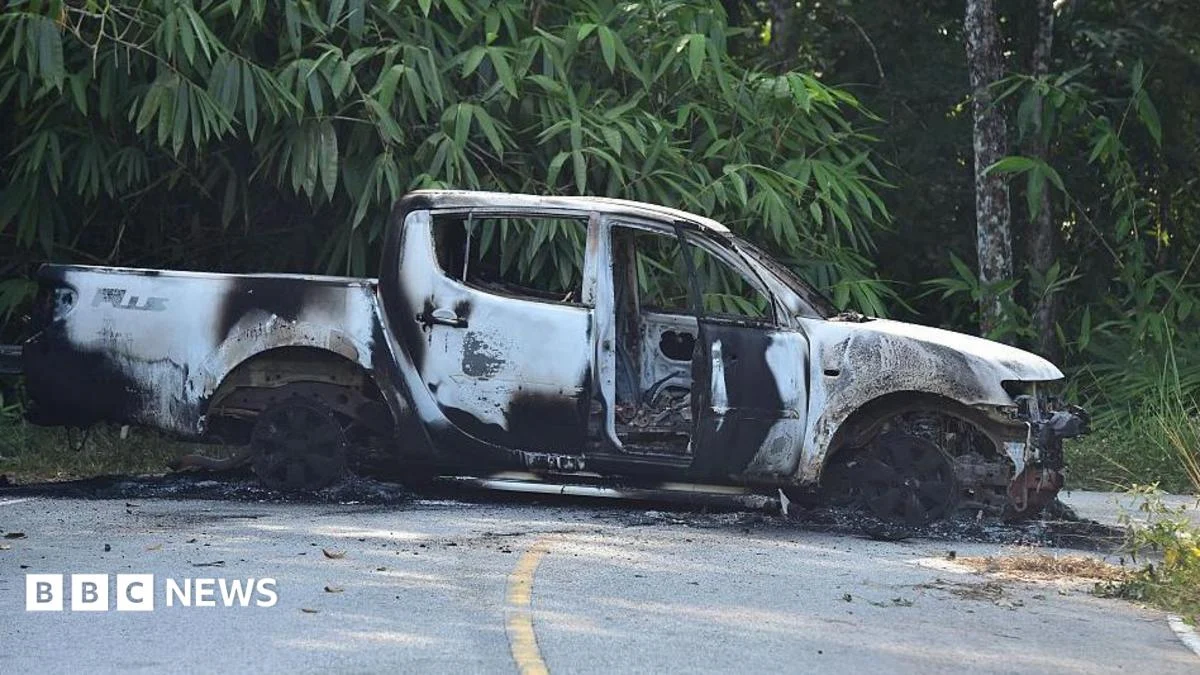
More than 50 meticulously co-ordinated arson and incendiary attacks, explicitly described by the Thai military as "aimed at creating unrest," swept across Thailand’s insurgency-hit southern border provinces on Saturday night. The wave of destructive acts resulted in at least two reported injuries and caused significant damage to various targets, including a local government office building, multiple convenience stores, and several vehicles, one of which was stolen and subsequently torched. These widespread incidents unfolded across Narathiwat, Yala, and Pattani provinces, regions long plagued by a simmering separatist insurgency, between approximately 8:00 PM local time (13:00 GMT) and midnight. The Internal Security Operations Command (ISOC), the Thai military’s primary command responsible for national security affairs, particularly in the Deep South, issued a statement confirming the scale and synchronized nature of the attacks.
Widespread Attacks and Immediate Aftermath
The initial reports indicated that the majority of the incidents were concentrated in Narathiwat province, though neighbouring Yala and Pattani also experienced significant disruption. The targeted locations were diverse, suggesting a deliberate strategy to maximize chaos and demonstrate reach. Beyond the aforementioned government office and convenience stores, several telecommunication towers were also set ablaze, an act that could disrupt communication networks and hinder emergency response efforts. The Bangkok Post, a prominent English-language newspaper in Thailand, reported that two women sustained injuries when an explosive device detonated in the Muang district of Narathiwat province, adding a layer of concern regarding the potential for further violence beyond mere arson.
In response to the escalating situation, local authorities in Narathiwat province swiftly imposed an overnight curfew. The measure, aimed at restoring order and preventing further incidents, was subsequently lifted on Sunday morning after a tense night. Fortunately, no additional attacks were reported throughout Sunday, offering a brief respite and allowing security forces to assess the damage and commence investigations. Security officials concurrently issued urgent warnings to residents across the affected provinces, advising extreme caution and urging them not to touch any suspicious objects, a standard protocol in regions prone to improvised explosive devices (IEDs) and booby traps. The coordinated nature and timing of the attacks underscore a sophisticated level of planning and execution, pointing towards organized insurgent groups seeking to destabilize the region and challenge state authority.
A Coordinated Campaign of Incendiarism
The simultaneous nature of over 50 incidents across multiple provinces within a four-hour window strongly suggests a well-organized and centrally directed operation. Such a scale of coordination demands significant logistical planning, communication, and resource allocation from the perpetrators. Targets were not random; they included symbols of state presence, such as the government office, and commercial establishments, like convenience stores, which represent everyday life and economic activity. The burning of convenience stores, particularly those belonging to major national chains, often serves a dual purpose: disrupting commerce and instilling fear among the general populace, while also sending a message of defiance against national integration. The destruction of telecommunication towers, critical infrastructure, could impede emergency services, spread panic, and potentially allow for further unhindered operations by the perpetrators in areas where communication is compromised.
The use of stolen vehicles in some of the attacks, later found torched, is a tactic sometimes employed to create diversions, transport incendiary devices, or mask the identities of the perpetrators. This method adds complexity to the investigative process, as forensic evidence from the vehicles themselves may be compromised. The explicit statement from the ISOC, attributing the attacks to a motive of "creating unrest," frames the incidents within the broader context of the long-running separatist conflict. This implies that the objective was not merely destruction, but a psychological operation designed to undermine public confidence in security forces, exacerbate ethnic and religious tensions, and demonstrate the continued capability of insurgent groups to inflict widespread disruption despite ongoing government efforts to restore peace.
The Deep South Insurgency: A Historical Context
The violence in Thailand’s southern border provinces, often referred to as the "Deep South," is rooted in a complex history of cultural, religious, and political grievances. The region, comprising Narathiwat, Yala, Pattani, and parts of Songkhla, was historically an independent Malay sultanate known as Patani. It was annexed by Siam (now Thailand) in the early 20th century. The predominantly Malay-Muslim population in these provinces has long felt marginalized by the central Buddhist Thai government, leading to persistent demands for greater autonomy or, for some, outright independence. The distinct identity of the Malay-Muslim community, characterized by their unique language (Yawi/Patani Malay), Islamic faith, and cultural practices, contrasts sharply with the dominant Thai Buddhist culture, contributing to a sense of alienation.
While sporadic violence and separatist movements have existed for decades, the current phase of the insurgency dramatically escalated in January 2004 with a raid on an army camp in Narathiwat, where a large cache of weapons was stolen. This event marked a significant resurgence of organized violence, characterized by bombings, assassinations, arson attacks, and ambushes targeting both security forces and civilians, including teachers, monks, and government officials. Various insurgent groups are believed to be active, with the Barisan Revolusi Nasional (BRN) generally considered the most influential and well-organized. These groups operate clandestinely, often employing hit-and-run tactics and relying on local networks for support and intelligence.
Successive Thai governments have adopted a multi-pronged approach to address the conflict, combining robust security operations with socio-economic development initiatives and attempts at peace dialogue. However, progress has been slow and punctuated by cycles of violence. Trust deficits between the local population and state authorities remain a significant challenge, exacerbated by allegations of human rights abuses by security forces and the perception of heavy-handed tactics. The recent coordinated attacks highlight the persistent challenge to stability and the enduring capacity of insurgent elements to carry out sophisticated operations despite years of counter-insurgency efforts.
Statistical Snapshot of a Protracted Conflict
The Deep South insurgency is one of Southeast Asia’s longest-running and most deadly internal conflicts. Since its re-escalation in January 2004, the violence has claimed the lives of over 7,000 people and injured more than 13,000, according to data compiled by independent monitoring groups like Deep South Watch. The casualties include a mix of civilians, security personnel, and alleged insurgents. While the overall number of fatalities has seen some decline in recent years compared to the peak periods, the conflict continues to simmer, manifesting in intermittent but often severe outbreaks of violence, such as the recent coordinated arson attacks.
The nature of the violence is diverse. Improvised Explosive Devices (IEDs) remain a prevalent tactic, targeting military convoys, police patrols, and public spaces. Assassinations, often carried out by gunmen on motorcycles, frequently target individuals perceived to be collaborators with the state or those from the Buddhist minority. Arson attacks, as witnessed on Saturday, are a recurring feature, typically aimed at government property, schools, and commercial establishments, serving to disrupt daily life and assert control or influence. The recent 50+ incidents represent a significant spike in arson activity, demonstrating a renewed intent to cause widespread disruption rather than targeted assassinations or bombings. This shift in tactic, focusing on property destruction and creating widespread "unrest," suggests a strategic move to project power and psychological impact across a broader geographical area simultaneously.
Official Response and Heightened Security Measures
In the immediate aftermath of the attacks, the Thai military’s Internal Security Operations Command (ISOC) took the lead in coordinating the response. Their statement was crucial in framing the events as a deliberate act aimed at creating instability, rather than isolated incidents. This official attribution sets the tone for subsequent security operations and government rhetoric. Security forces across Narathiwat, Yala, and Pattani were placed on high alert, with increased patrols and checkpoints implemented throughout the affected areas. Local police and military units initiated comprehensive investigations, gathering forensic evidence from the numerous crime scenes to identify perpetrators and their networks.
While no specific insurgent group immediately claimed responsibility, ISOC’s swift designation of the acts as designed to "create unrest" implicitly points towards well-established separatist factions. The government, through spokespersons, condemned the attacks as cowardly acts of terrorism that undermine peace and development efforts in the region. Calls for calm and unity were issued, reassuring the public that authorities are in full control and committed to bringing the perpetrators to justice. The implementation of the overnight curfew in Narathiwat highlights the seriousness with which authorities viewed the situation, prioritizing public safety and security over normal routines. Such measures, while disruptive, are often deemed necessary to prevent further attacks and allow security forces to conduct their operations unhindered. Looking ahead, an increased security presence and intelligence-gathering efforts are expected to intensify in the coming days and weeks to prevent potential follow-up attacks and dismantle the cells responsible for the coordinated operation.
Implications for Peace and Stability
The coordinated arson and incendiary attacks carry significant implications for the already fragile peace and stability in Thailand’s Deep South. Firstly, they undermine ongoing efforts towards peace dialogue. While formal peace talks between the Thai government and the BRN have seen intermittent progress, such large-scale acts of violence can derail trust-building initiatives and make it more challenging for negotiators to demonstrate a genuine commitment to de-escalation. The attacks send a strong message that not all factions may be willing to engage constructively in dialogue or that the groups possess the capability to disrupt any perceived progress.
Secondly, the incidents exacerbate fear and insecurity among the civilian population. The targeting of everyday places like convenience stores, alongside government offices, blurs the lines between state and civilian targets, creating a pervasive sense of vulnerability. This heightened fear can lead to further displacement, economic disruption, and a deepening of social divisions within the affected communities. Businesses, already struggling in a conflict-prone region, face additional risks and potential losses, impacting local livelihoods and discouraging investment.
Thirdly, the attacks challenge the authority and effectiveness of state security forces. While the military swiftly responded, the sheer number and coordination of the incidents raise questions about intelligence gathering and preventive measures. This can lead to increased pressure on the government to adopt even tougher security postures, potentially risking a cycle of retaliatory violence and further alienating segments of the local population. The ISOC’s immediate attribution to a motive of "creating unrest" also serves as a rallying call for increased vigilance and potentially more aggressive counter-insurgency operations.
Finally, the long-term impact on regional development and social cohesion remains a concern. The Deep South has immense potential for economic growth, but persistent instability deters both domestic and international investment. The repeated cycles of violence also hinder efforts to foster inter-communal harmony between the Malay-Muslim majority and the Buddhist Thai minority, perpetuating a climate of suspicion and distrust. The recent coordinated attacks serve as a stark reminder that despite years of efforts, the conflict in Thailand’s southern border provinces remains a potent and volatile challenge, requiring sustained political will, comprehensive security strategies, and genuine reconciliation efforts to achieve lasting peace.