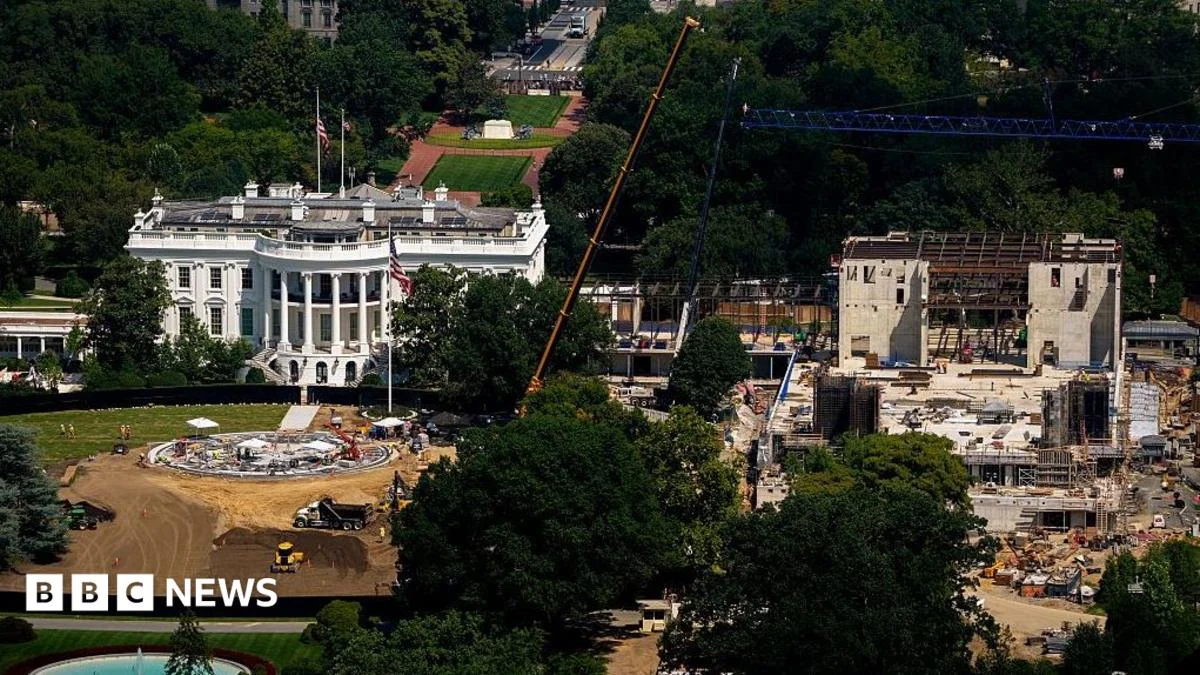
A recent judicial ruling has cleared the path for the controversial construction of a new ballroom at the White House, a decision that has been met with both presidential triumph and profound disappointment from historic preservation advocates. The ruling effectively dismissed a lawsuit brought by the National Trust for Historic Preservation, which had sought to halt the project on grounds of irreversible damage to a national landmark. President Donald Trump swiftly celebrated the outcome, declaring his satisfaction that the "baseless" legal challenge had failed to impede his vision for an expanded White House events space. "We are living in the Golden Age of America, and this Building will be one of the Greatest ever constructed in Washington, DC," Trump posted, underscoring his ambition to leave a significant architectural legacy on the nation’s capital.
The President’s Vision: Security, Scale, and Legacy
The proposed White House ballroom project has been a long-standing point of contention, embodying President Trump’s broader efforts to reshape the Washington D.C. cityscape and modernize the executive residence. Trump has consistently articulated two primary justifications for the ballroom’s construction: the need for a larger, more functional events space capable of accommodating significant gatherings, and, more recently, enhanced security.
The argument for increased capacity stems from the historical limitations of the White House’s existing state rooms. While the East Room and State Dining Room have traditionally hosted various official functions, state dinners, and press conferences, their combined capacity and layout often present logistical challenges for events involving hundreds of guests, particularly those requiring elaborate staging or specific security protocols. Presidents throughout history have grappled with these spatial constraints, often resorting to temporary structures or off-site venues for larger assemblies. Trump’s proposal aimed to provide a permanent, purpose-built solution to these challenges, envisioning a grand ballroom that would solidify the White House’s capacity to host world leaders and domestic dignitaries with unparalleled grandeur and efficiency.
The security aspect gained particular prominence following an alleged assassination attempt at the White House Correspondents’ Association dinner in April. While details of the incident remain largely under wraps, the event evidently reinforced the President’s conviction that the White House’s current infrastructure was inadequate for managing both large crowds and potential threats. A new, secure ballroom, designed with modern protective measures and controlled access points, was presented as a critical component of a comprehensive security upgrade for the executive mansion. Proponents argued that such a facility would allow for more secure ingress and egress, better crowd control, and the integration of advanced surveillance and defensive technologies, thereby reducing vulnerabilities inherent in the existing, historically preserved structures.
The proposed ballroom is reportedly envisioned as a substantial addition, potentially encompassing several thousand square feet and featuring high ceilings and state-of-the-art amenities. While specific architectural plans have not been publicly detailed, preliminary concepts suggested a structure that would significantly alter the existing footprint of the White House complex, likely impacting surrounding gardens or ancillary buildings. Estimates for such a project, even without public disclosure of a budget, would undoubtedly run into tens of millions of dollars, funded through federal appropriations or, potentially, private donations, a common practice for White House improvement projects.
The Preservationists’ Stand: Protecting a National Landmark
In direct opposition to the President’s ambitions, the National Trust for Historic Preservation launched its legal challenge, asserting that the ballroom project constituted an act of "irreversible damage" to a cherished national landmark. The organization, a privately funded non-profit chartered by Congress in 1949, plays a pivotal role in advocating for the preservation of America’s historic places. Its mission is to save America’s historic places, ensuring that future generations have access to the nation’s rich past.
The National Trust’s position was rooted in the expert testimony and declaration of Alison Hoagland, a prominent preservationist residing in Washington D.C. and serving on the Trust’s board of trustees. Hoagland, who attests to regularly visiting the White House neighborhood, articulated her deep concern that the construction of a ballroom "of the proposed form and scale" would inflict both "professional and personal injuries." These injuries, she specified, included harm to her "aesthetic, cultural and historical interests." Her declaration formed the cornerstone of the Trust’s legal argument, particularly regarding the crucial legal concept of "standing."
For a lawsuit to proceed in federal court, the plaintiff must demonstrate "standing," meaning they must prove they have suffered a direct and concrete injury that can be redressed by the court. The preservationists argued that Hoagland’s direct engagement with the historical and aesthetic environment of the White House, coupled with her professional expertise in historic preservation, constituted a sufficiently concrete injury to allow the lawsuit to move forward. They contended that altering the White House, a site of unparalleled national and international significance, would diminish its integrity and the public’s ability to experience its historical context, thereby harming individuals like Hoagland who derive professional and personal value from its preservation.
The White House, originally designed by James Hoban and constructed between 1792 and 1800, stands as an enduring symbol of American democracy and architectural heritage. It has undergone numerous renovations and expansions throughout its history, notably after being burned by British troops in 1814 and during the Truman reconstruction in the mid-20th century. However, these interventions have typically aimed to preserve its historical character while updating its functionality. The National Trust’s argument highlighted the unique status of the White House as a Grade I listed building (if it were in the UK context, a similar designation would apply in the US as a National Historic Landmark) and the potential precedent that unilateral presidential action to significantly alter its structure without broad congressional approval or rigorous historical review could set.
The Legal Battle and a Divisive Ruling
The legal challenge mounted by the National Trust for Historic Preservation progressed through various judicial levels, culminating in the recent decision that ultimately sided with the administration. The chronology of the lawsuit began shortly after the administration’s plans for the ballroom became more concrete, likely in late 2023 or early 2024, with the Trust filing an injunction to prevent construction. The case likely moved from a district court, which may have initially ruled on the merits or standing, to an appellate court, before reaching its final determination.
The majority opinion, though not fully detailed in the provided context, implicitly found that the National Trust and its representative, Alison Hoagland, lacked sufficient legal standing to challenge the construction. This often means that the court determined Hoagland’s claimed "aesthetic, cultural and historical injuries" were not direct, concrete, or particularized enough to meet the stringent requirements for standing in federal litigation. Such rulings often defer to executive authority in managing federal property, particularly when national security or functional efficiency is cited as a primary justification. The court may have also considered the project to be within the President’s purview as the "temporary steward" of the executive mansion, without explicitly stating a position on the project’s historical impact.
However, the ruling was not unanimous, featuring a "strong dissent" from Justice Roberts. This dissent is particularly noteworthy as it signals a significant division within the judiciary on issues of historic preservation and executive power. Justice Roberts explicitly stated that "the injuries claimed by Hoagland were sufficient to allow the lawsuit to go ahead." This indicates a fundamental disagreement with the majority’s interpretation of standing, suggesting that Roberts believed the aesthetic and cultural harm to a historic landmark, as articulated by an engaged preservationist, did indeed constitute a valid basis for a legal challenge. A Chief Justice’s strong dissent can often serve as a powerful signal for future litigation, highlighting areas where legal principles remain contested and potentially laying the groundwork for reevaluation in subsequent cases. It underscores the profound legal and philosophical tension between governmental operational needs and the imperative of protecting national heritage.
Broader Presidential Ambitions: Reshaping Washington’s Cityscape
The White House ballroom project is not an isolated endeavor but rather a key component of President Trump’s expansive vision to fundamentally transform the architectural and symbolic landscape of Washington D.C. His administration has pursued several other ambitious initiatives that collectively aim to leave an indelible mark on the capital.
One such project is the construction of a new helipad on the South Lawn of the White House. This initiative, driven by perceived security and logistical needs, aims to provide a more modern and secure landing zone for Marine One, the presidential helicopter. The current landing protocols often involve a more complex and visible operation, and a dedicated, upgraded helipad could streamline presidential travel and enhance operational security. However, this project also raises concerns among preservationists regarding the alteration of the historic South Lawn, an iconic green space integral to the White House’s visual integrity.
Beyond the immediate White House grounds, Trump’s plans extend to other monumental sites. Proposals have included the renovation of the Lincoln Memorial Reflecting Pool, a historically significant feature of the National Mall that serves as a backdrop for major national events and protests. While specific details of the proposed renovation were not fully public, any significant alteration to such an iconic and symbolically charged location would inevitably draw scrutiny from both historians and the public. The Reflecting Pool, famously the site of Martin Luther King Jr.’s "I Have a Dream" speech, holds immense cultural and historical weight, making any proposed changes subject to intense debate regarding their necessity and appropriateness.
Perhaps the most ambitious and symbolically charged of Trump’s broader urban plans is the conceptual "Arc de Trump." Envisioned as a monumental archway, grander in scale than Paris’s iconic Arc de Triomphe, this project speaks to a desire for a lasting architectural monument bearing the President’s name. While details regarding its proposed location, design, and funding remain speculative, the sheer ambition of such a project would undoubtedly spark a national conversation about presidential legacy, public space, and the aesthetic future of the capital. The Arc de Triomphe in Paris, commissioned by Napoleon, stands as a testament to military victories and national glory; an "Arc de Trump" would seek to embed a similar sense of triumph and national achievement within the fabric of Washington D.C., potentially serving as a new landmark at a prominent location, such as the entry to the National Mall or a major thoroughfare.
Reactions, Implications, and the Future of Preservation
President Trump’s immediate reaction to the court’s ruling — expressing pleasure and reaffirming his vision for a "Golden Age of America" — was characteristic. It underscored his determination to press forward with projects he believes are essential for national prestige, security, and the efficient functioning of the presidency. The ruling represents a significant victory for his administration, removing a key legal impediment to a high-profile construction project.
The National Trust for Historic Preservation, while expressing disappointment in the court’s overall decision, found solace in Justice Roberts’ "strong dissent." Their statement emphasized a core principle: "Each President is a temporary steward of the People’s House and does not have the unilateral authority to demolish and redesign it without the approval of Congress." This statement highlights the ongoing tension between executive prerogative and the constitutional checks and balances inherent in the governance of federal property, particularly those of profound historical significance. The dissent, in their view, validates their argument regarding the importance of standing for preservation groups and signals that the legal battle over such issues is far from over. It suggests that while this specific lawsuit was dismissed, the underlying legal principles remain contested, and future challenges to presidential development projects on federal lands might find stronger legal footing.
The implications of this ruling extend beyond the immediate construction of the White House ballroom. For executive power, the decision could be interpreted as bolstering a president’s authority to undertake significant modifications to federal property, particularly when national security is invoked. It might set a precedent where claims of operational necessity outweigh arguments based solely on aesthetic or cultural preservation, unless direct and tangible harm can be unequivocally proven.
For historic preservation, the ruling presents a mixed bag. While the National Trust’s specific challenge was dismissed, Roberts’ dissent provides a potential pathway for future lawsuits by clarifying what might constitute sufficient standing for preservation groups. It underscores the ongoing need for robust advocacy and potentially legislative action to safeguard national landmarks from unilateral executive action. Congressional oversight committees, such as the House Committee on Oversight and Reform or relevant Senate committees, might now intensify their scrutiny of federal construction projects, particularly those impacting historic sites, potentially demanding more transparent processes and greater accountability.
Architectural historians and urban planners across the country will be closely watching the execution of these projects. Concerns about the integrity of the White House’s original design, the contextual harmony of new structures within the historic fabric of D.C., and the long-term impact on the city’s unique blend of neoclassical grandeur and modern governance will persist. The "Arc de Trump" proposal, in particular, could ignite a fervent debate about the appropriate scale and symbolism of presidential monuments in a democratic republic.
Ultimately, the court’s decision on the White House ballroom construction marks a significant moment in the ongoing dialogue about executive authority, national security, and the stewardship of America’s cherished historic landmarks. It sets the stage for a period of profound transformation in Washington D.C.’s urban landscape, igniting both excitement for a new architectural era and deep concern for the preservation of its past. The "Golden Age of America" envisioned by President Trump will undoubtedly be defined not only by its political and economic achievements but also by the physical legacy he leaves on the nation’s capital.