

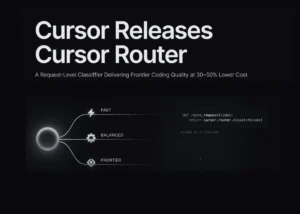
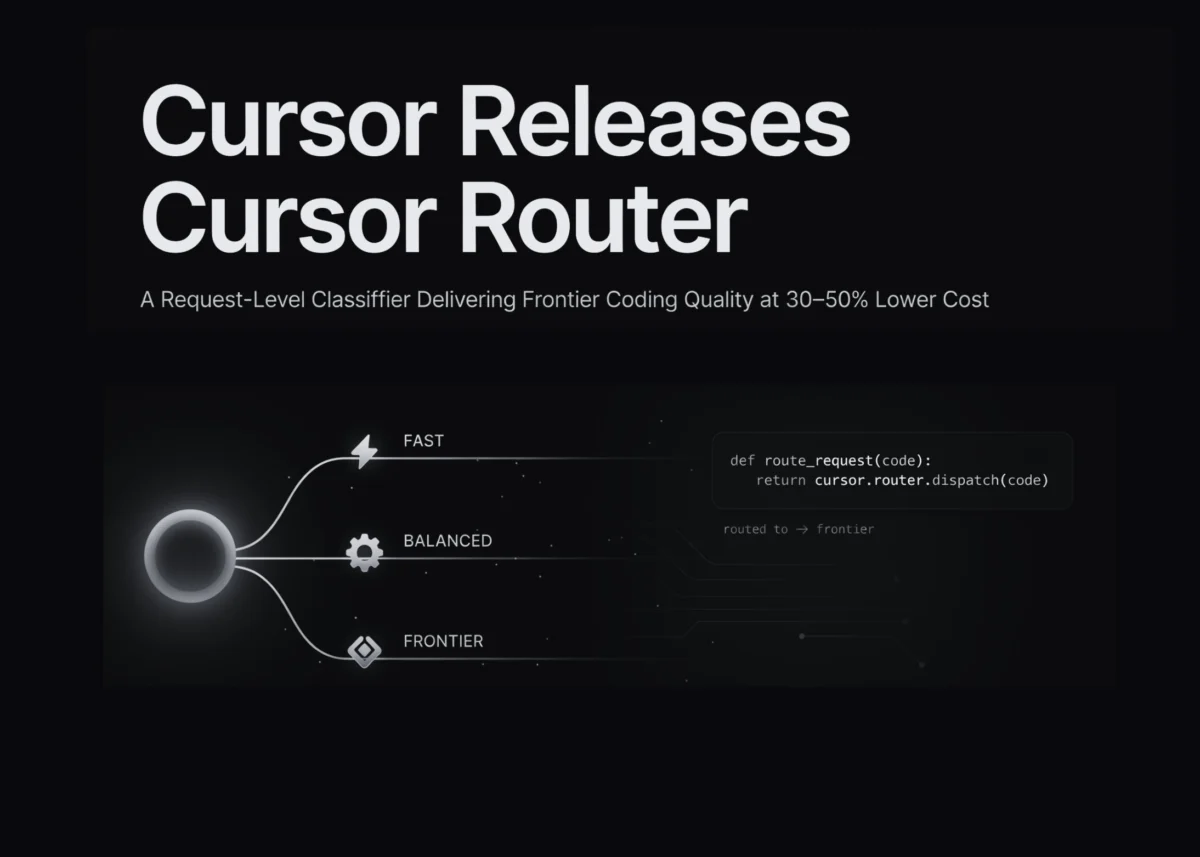
Cursor has officially announced the general availability of the Cursor Router for its Teams and Enterprise subscribers, marking a significant shift in how integrated development environments (IDEs) manage the distribution of artificial intelligence workloads. The new system functions as a sophisticated classifier that inspects each incoming request before a model execution occurs, subsequently dispatching the task to the large language model (LLM) best suited for that specific requirement. According to reports from the Cursor engineering team, the implementation of this routing logic has demonstrated frontier-quality performance while yielding a 60% reduction in costs during online A/B testing. Early-access enterprise accounts have reported similar success, with operational savings ranging between 30% and 50% compared to traditional single-model workflows.
The primary objective of the Cursor Router is to address a persistent "spend pattern" inefficiency rather than a lack of model capability. Internal data from the company indicates that approximately 60% of developers tend to select a single "frontier" model—such as GPT-4 or its successors—as their primary "daily driver" for all tasks. This behavioral trend results in routine, low-complexity coding tasks being processed at premium pricing, causing AI-related expenditures to scale much faster than the actual quality of the output. By introducing an automated routing layer, Cursor aims to bridge the mismatch between task complexity and model cost, ensuring that expensive compute resources are reserved for the most demanding engineering challenges.
The Technical Architecture of the Router Classifier
Unlike traditional fallback chains or simple retry mechanisms that only trigger upon a model failure, the Cursor Router is a proactive classification engine. The system was developed and refined using a dataset of over 600,000 live requests and has undergone rigorous evaluation through online A/B tests involving millions of real-world interactions. This methodology ensures that the router is optimized for user satisfaction, utilizing an "Agent Feedback Cycle" (AFC) as its primary reward signal during training.
For every request initiated within the IDE, the router performs a multi-dimensional analysis of four key inputs: the user’s query, the surrounding code context, the estimated task complexity, and the specific programming domain. This analysis is then cross-referenced with the system’s learned knowledge of various models’ behavioral strengths and weaknesses. The Cursor team has published three foundational routing rules that guide the classifier’s decision-making process:
- Simple Refactoring and Documentation: Routine tasks such as adding docstrings, basic refactoring, or standard unit test generation are routed to highly efficient, lower-cost models that maintain high speed without sacrificing accuracy for mundane logic.
- Complex Logic and Architectural Changes: Tasks involving deep structural changes to a codebase or the resolution of intricate bugs are dispatched to "frontier" models, ensuring that the highest level of reasoning is applied where it is most needed.
- Intermediate Coding Assistance: General code completion and mid-tier problem-solving are balanced between cost and intelligence, often utilizing models that offer the best "Pareto-optimal" performance.
This tiered approach ensures that the realized savings do not stem from a degradation of service quality for difficult problems. Instead, the economic benefits are derived from the elimination of "frontier pricing" for routine work, while the high-performance tier remains available for the 40% of tasks that truly require it.
Cache Awareness and Model Churn Resilience
A critical implementation detail that distinguishes the Cursor Router from other third-party routing solutions is its "cache-aware" design. In the context of LLM interactions, switching models mid-conversation often invalidates the prompt cache, leading to increased latency and additional costs that can negate the savings of using a cheaper model. The Cursor Router was trained on a dataset specifically designed to account for these cache misses.
The reported cost savings of 60% are inclusive of the expenses incurred by switching models. By incorporating cache-miss costs into both the training and evaluation phases, Cursor provides a more transparent and realistic economic outlook for enterprise users. Furthermore, the classifier is built to be resilient against "model churn." As the AI landscape evolves and newer models—such as the recently released Grok 4.5—enter the market, the router can be updated to integrate these new options without requiring a complete overhaul of the developer’s workflow.
Evaluating Success Through Online A/B Testing
Cursor has deliberately moved away from traditional offline evaluations as its primary metric for success. The company argues that offline benchmarks often suffer from small sample sizes and a lack of proximity to real-world developer behavior. Furthermore, offline rubrics struggle to capture the nuance of a multi-turn conversation where a developer might ask follow-up questions, encounter errors, and iterate on a solution over the course of several hours.
To measure the router’s efficacy, Cursor utilizes two primary quality metrics:

- User Satisfaction (AFC): This metric classifies agent success based on subsequent user responses. For instance, a user moving immediately to the next feature is viewed as a strong positive signal, whereas a user needing to manually correct the agent’s code is a strong negative signal.
- Keep Rate: This measures the longevity of agent-generated code. If code produced by the router remains in the codebase over time, it is considered a success. If it is quickly deleted or overwritten, it indicates a failure in model selection or output quality.
The Cursor team noted that these metrics have been used to evaluate every model launch and platform change for the last nine months, providing a robust historical baseline for the router’s current performance claims.
Performance Tiers and the Cost-per-Commit Analysis
With the general availability release, the Cursor Router introduces three optimization modes within its "Auto" setting, allowing users or administrators to position their teams along the cost-intelligence Pareto frontier:
- Auto Fast: Prioritizes low latency and maximum cost savings, ideal for rapid prototyping and routine tasks.
- Auto Balance: The default setting for most teams, providing a middle ground between high-level reasoning and economic efficiency.
- Auto Intelligence: Prioritizes the highest-quality model available for every task, regardless of cost, but still utilizes routing to prevent unnecessary waste on trivial queries.
To illustrate the impact of these modes, Cursor published a "cost-per-commit" comparison. In these tests, the "Auto Balance" mode resulted in an average cost of $4.63 per commit, while "Auto Intelligence" averaged $6.76. In contrast, using a high-end frontier model like Opus 4.8 exclusively resulted in a cost of $7.34 per commit, and Fable 5 reached as high as $12.69. Notably, the GPT-5.6 Sol model matched the cost of the Intelligence mode but resulted in lower overall user satisfaction, reinforcing the argument that model size alone does not dictate task success.
Enterprise Governance and Deployment Reality
The Cursor Router is now integrated across all Cursor platforms, including the desktop application, web interface, iOS app, command-line interface (CLI), and the Cursor SDK. For Teams plans, the feature is enabled by default to provide immediate cost relief. For Enterprise accounts, administrators are given granular control via a centralized dashboard.
The administrative interface allows for per-team or per-group enablement, the ability to restrict which optimization modes are available to specific members, and the configuration of default settings. Crucially, the router also supports model "allow and block lists," giving enterprises the ability to comply with internal data governance or preference policies. However, Cursor noted one specific constraint: Grok 4.5 is currently a required component for the router’s price-efficient tier. Released on July 8, Grok 4.5 is priced competitively at $2 per million input tokens and $6 per million output tokens, making it a cornerstone of the router’s ability to drive down costs for mid-tier tasks.
Another important procurement detail is that the "Balance" and "Intelligence" modes bill at the rate of the specific model selected by the router for each turn. This means that unit costs will vary based on the mix of tasks performed by the developer, rather than remaining at a flat, predictable rate. To maintain transparency, teams can opt to display which model is currently being routed, though this information is hidden by default to minimize distractions for the developer.
Broader Implications for the AI Development Market
The launch of the Cursor Router signals a maturing AI market where the focus is shifting from "raw intelligence at any cost" to "optimized intelligence for sustainable growth." As enterprise AI budgets come under increased scrutiny, tools that can demonstrate a clear return on investment (ROI) by reducing "compute waste" are likely to see rapid adoption.
Industry analysts suggest that model routing will soon become a standard feature across the entire AI stack, from IDEs to customer service chatbots. By decoupling the user experience from a specific underlying model, platforms like Cursor can offer a more stable and cost-effective product that is not beholden to the pricing whims or performance fluctuations of a single AI provider.
The success of the Cursor Router also highlights the growing importance of proprietary datasets in the AI era. By leveraging millions of live requests to train their classifier, Cursor has built a competitive advantage that is difficult for generic routing services to replicate. As the "frontier" of AI continues to move monthly, the ability to dynamically re-evaluate and re-route tasks will likely be the deciding factor in which AI-powered tools remain viable for large-scale enterprise deployment.
Chronology of Key Events
- October – June (Previous 9 Months): Cursor develops and tests quality metrics (AFC and Keep Rate) across all model launches.
- July 8, 2026: Grok 4.5 is released, providing a high-efficiency model option for the router’s lower tiers.
- July 15, 2026: Early access for Enterprise accounts begins, showing 30-50% savings.
- July 22, 2026: Cursor Router becomes generally available for all Teams and Enterprise plans.
- July 23, 2026: Detailed performance data and "cost-per-commit" figures are published, confirming the 60% savings in A/B testing environments.
In conclusion, the Cursor Router represents a sophisticated response to the rising costs of AI-assisted software engineering. By treating model selection as a dynamic, data-driven decision rather than a static user preference, Cursor has provided its enterprise clients with a powerful tool for scaling their AI capabilities without a linear increase in their monthly cloud expenditures.