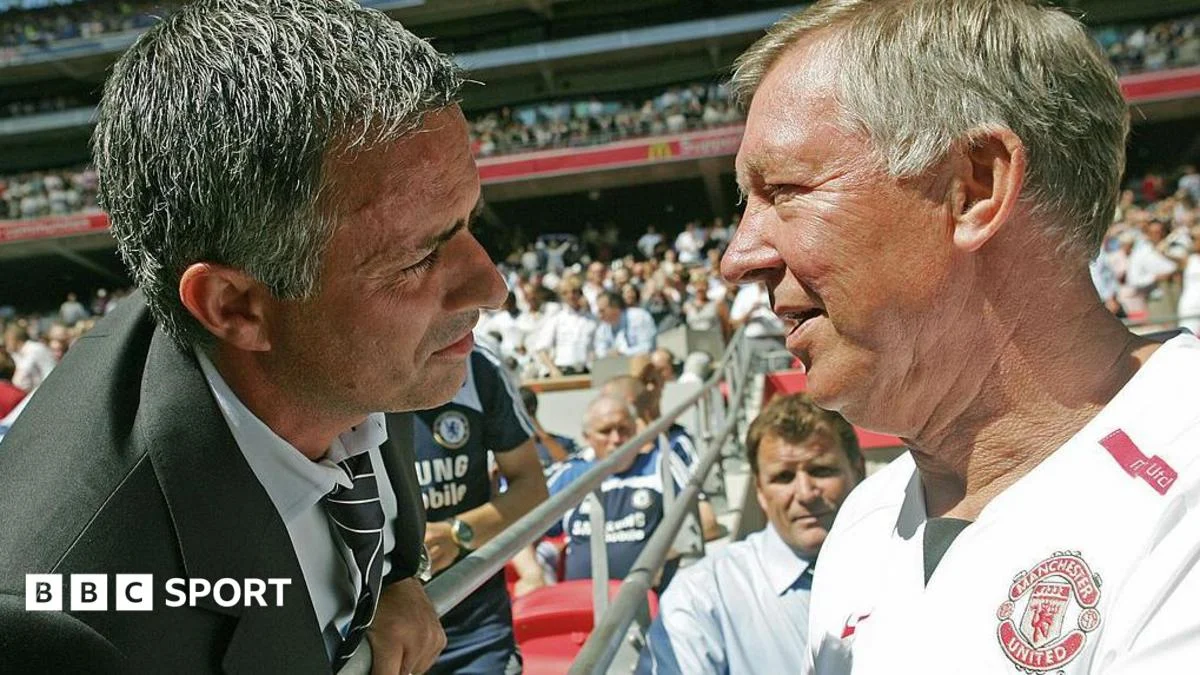
London, England – In a revelation that has sent ripples through the football world, Jose Mourinho has publicly confirmed that he had an agreement in place to succeed Sir Alex Ferguson as manager of Manchester United in 2013. The Portuguese tactician, speaking in a new Netflix documentary series detailing his illustrious career, stated that he ultimately changed his mind and accepted an offer to return to Chelsea, a decision that profoundly impacted the managerial landscape of English football.
The bombshell announcement, made by the 63-year-old coach who is currently embarking on his second spell at Real Madrid, sheds new light on one of the most pivotal moments in recent Premier League history. Mourinho’s account is corroborated by Sir Alex Ferguson himself, the legendary Scottish manager who retired from Old Trafford in 2013 after an unprecedented 26-year tenure, during which he secured 13 Premier League titles and numerous other accolades.
"When I left Real Madrid, I signed to go to Manchester United after Sir Alex," Mourinho stated in the documentary. This direct assertion from the manager, often referred to as "The Special One," leaves no room for ambiguity regarding his initial intentions.
Sir Alex Ferguson, a figure synonymous with Manchester United’s golden era, confirmed the veracity of Mourinho’s claims. "He was offered the job, yes," Ferguson stated, recalling the crucial period following his decision to step down. "I sat him down and explained the situation. As far as I was concerned, he was accepting. And then, within hours, it changed."
The seismic shift in Mourinho’s plans, as explained by the man himself, stemmed from an overwhelming pull to return to Chelsea. The West London club held a special place in his heart, having guided them to back-to-back Premier League titles in his first stint (2005 and 2006). This emotional connection proved to be the deciding factor in a decision that had far-reaching consequences for both Manchester United and Chelsea.
"One night, he phoned me and he was crying and he says, ‘Alex, I can’t take it. I’ve given my word to Chelsea and I’m not going to break my word’," Ferguson recounted, highlighting the emotional turmoil Mourinho experienced during this critical juncture. The former United manager expressed understanding for Mourinho’s reasoning, acknowledging the deep bond he shared with Chelsea, but admitted to a sense of disappointment.
Mourinho himself conveyed that he was "very flattered" by the offer to follow in the footsteps of Sir Alex Ferguson, recognizing the immense global appeal and prestige associated with the Manchester United hotseat. He elaborated on the complex motivations behind his eventual decision, stating, "But one thing is love for football, another thing is love for a certain club. I think this is more powerful than love for football and fundamentally, after Real Madrid, I needed to feel that I’m loved."
This desire for emotional validation, coupled with his deep-seated affection for Chelsea, ultimately led him to withdraw from the agreement with Manchester United. "For me to lose the chance to be the coach to succeed Sir Alex Ferguson was dramatic, but I don’t regret it because it was a decision that I made with my heart," Mourinho concluded, underscoring the personal nature of his choice.
The Ripple Effect: Managerial Changes and Title Pursuits
Mourinho’s decision to return to Chelsea in 2013 proved to be a successful one, at least in the short term. He guided the Blues to his third Premier League title and secured the League Cup in the 2014-15 season. However, his second spell at Stamford Bridge ended prematurely in December 2015, leading to another period of managerial uncertainty for the club.
Meanwhile, Manchester United, after a brief interim period, appointed Louis van Gaal as their new manager in the summer of 2014. The Dutch manager’s tenure was marked by a FA Cup victory in his final season but was ultimately deemed unsuccessful by the club’s hierarchy, leading to his dismissal in May 2016.
It was at this juncture that Jose Mourinho was presented with a second opportunity to manage Manchester United. He succeeded Louis van Gaal, embarking on a two-and-a-half-year spell at Old Trafford. During his time at the club, Mourinho secured both the League Cup and the Europa League, bringing European silverware back to the club. However, a significant dip in results during the 2018-19 season ultimately led to his sacking in December 2018.
Mourinho’s Complex Relationship with Real Madrid and Chelsea
The documentary also delves into Mourinho’s turbulent past at Real Madrid and his challenging relationship with former Chelsea owner Roman Abramovich. His first stint at the Bernabéu, from 2010 to 2013, saw him achieve significant success, most notably winning La Liga in the 2011-12 season with a record-breaking 100 points, a feat that ended Barcelona’s dominance under Pep Guardiola. However, the latter part of his tenure was marred by internal strife and a breakdown in relationships with key players, including club captain Iker Casillas.
The contentious split with Casillas, a revered figure at Real Madrid, significantly impacted the dressing room atmosphere. Former teammates, such as Sami Khedira, have spoken candidly about the detrimental effect Mourinho’s treatment of the goalkeeper had on team morale. Khedira described the situation as a "nightmare," noting that the rift extended to other influential players like Cristiano Ronaldo and Sergio Ramos.
Mourinho, however, defended his actions, attributing Casillas’s perceived entitlement and demands to a sense of being "spoilt" by the club’s established hierarchy. He cited instances where Casillas allegedly prioritized national team commitments and sought preferential treatment, which Mourinho found unacceptable. The manager’s uncompromising stance on player behaviour and loyalty was a recurring theme throughout his career, often leading to intense scrutiny.
Furthermore, the documentary revisits Mourinho’s dual tenures at Chelsea under Roman Abramovich, both of which ended in dismissal. Mourinho revealed that Abramovich, despite his passion for the club, often interfered in footballing decisions, citing the signing of Andriy Shevchenko as an example. Mourinho admitted that while he never actively wanted Shevchenko, he failed to assert his preference for a player like Samuel Eto’o, a decision he later regretted.
His sacking in 2007 and again in 2015 were emotional experiences, and Mourinho admitted to feeling a sense of "revenge" when his Inter Milan side defeated Chelsea in the Champions League in 2010, just months after his departure. He expressed a strong conviction that football should belong to those deeply involved – the players, coaches, and fans – rather than external influences he perceived as "intruders."
The Unwritten Chapter: What If?
The revelation that Jose Mourinho was on the cusp of becoming Manchester United manager in 2013 opens a fascinating "what if" scenario in football history. Had he taken the reins at Old Trafford, the managerial landscape of the Premier League and European football would undoubtedly have unfolded differently. Manchester United, under his leadership, might have pursued a different transfer strategy, potentially altering the careers of several players and the club’s trophy haul during the post-Ferguson era.
His decision to prioritize his emotional connection with Chelsea over the prestigious role at Manchester United highlights the complex interplay of personal ambition, professional opportunity, and emotional ties that shape the careers of football’s most prominent figures. While Sir Alex Ferguson ultimately found a successor in Louis van Gaal, and later Mourinho himself, the path not taken remains a significant footnote in the storied history of Manchester United and a compelling insight into the mind of one of football’s most enigmatic managers. The documentary promises to offer further insights into these pivotal moments, providing fans with a deeper understanding of the decisions that have defined Jose Mourinho’s remarkable and often controversial career.