

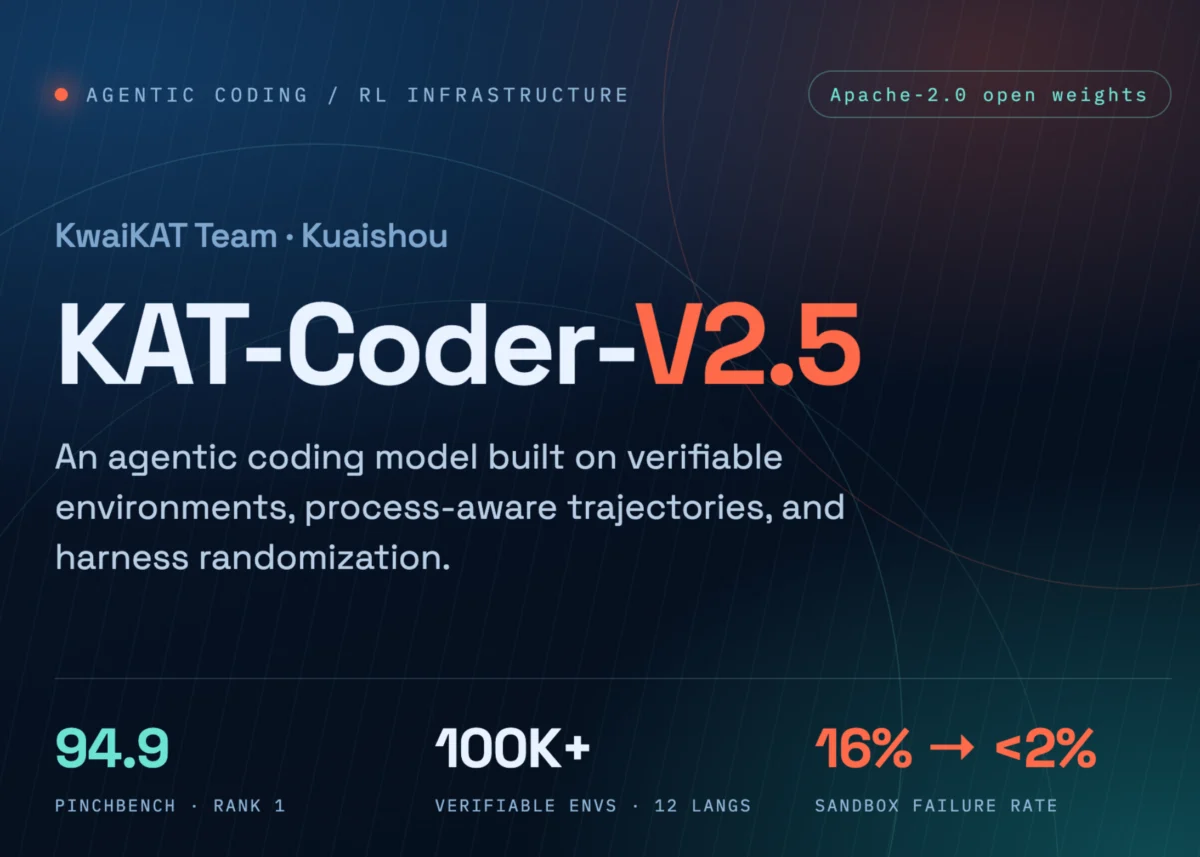
The KwaiKAT Team at Kuaishou, a leading global technology firm, has officially announced the release of KAT-Coder-V2.5, a sophisticated large language model (LLM) specifically engineered for complex, repository-level software development tasks. Moving beyond the limitations of traditional "single-turn" code generation—where models typically produce isolated snippets of code in response to a prompt—KAT-Coder-V2.5 is designed to operate within real, executable software environments. This release marks a significant milestone in the evolution of AI-driven software engineering, shifting the focus from simple code completion to autonomous problem-solving within the context of entire codebases.
The flagship model is currently being served through StreamLake, Kuaishou’s enterprise-grade video and AI solution platform. In a move toward fostering transparency and collaboration within the research community, the team also released KAT-Coder-V2.5-Dev, an open-weight variant available on Hugging Face under the permissive Apache-2.0 license. This dual-track release strategy highlights Kuaishou’s intent to both monetize high-end AI capabilities and contribute to the foundational growth of open-source coding agents.
The Paradigm Shift: From Snippets to Executable Repositories
For years, the industry benchmark for coding AI was the ability to solve competitive programming problems or write a single function. However, real-world software engineering is rarely about isolated functions. It involves navigating thousands of files, understanding complex dependencies, and ensuring that new patches do not break existing functionality. The KwaiKAT Team identified that the primary bottleneck in training effective coding agents was the lack of verifiable, high-quality data that mirrors this reality.
To address this, the research introduces a rigorous framework for defining "verifiable tasks." Each task is structured as a triplet: a precise task description, an executable repository environment, and a comprehensive set of validation tests. In this paradigm, a model-generated patch is deemed successful only if it passes every test within the sandbox environment. This approach aligns with the lineage of the SWE-bench benchmark but introduces several layers of refinement to ensure data integrity and model robustness.
AutoBuilder: Scaling the Construction of Verifiable Environments
The cornerstone of the KAT-Coder-V2.5 training pipeline is "AutoBuilder," a sophisticated system designed to automate the creation of isolated, executable software environments. Historically, building environments for diverse software projects has been a manual and error-prone process. The KwaiKAT Team observed that previous attempts to automate this resulted in low success rates, often due to missing dependencies or incompatible system configurations.
AutoBuilder utilizes a dual-agent architecture. First, a build agent analyzes the target repository to identify its structure, build systems (such as Maven, Pip, or NPM), and dependency requirements. It then generates a configuration script designed to install the necessary environment from a clean checkout. Second, a verification agent executes this script within an isolated sandbox, attempting to run the repository’s test suite.
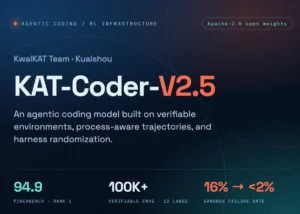
By integrating a library of distilled build recipes and utilizing build-system templates, the KwaiKAT Team successfully raised the environment construction success rate from a meager 16.5% to 57.2%. This technological leap enabled the creation of over 100,000 verifiable environments across 12 different programming languages. To prevent the model from "cheating" during training, the team implemented strict protocols to strip Git histories, commit metadata, and any other traces that might allow an agent to simply look up the reference solution within the repository.
The Data Scaling Flywheel: Prioritizing Process over Outcomes
A critical insight shared by the KwaiKAT researchers is that filtering training data solely based on the final success of a test run is insufficient. In many cases, a model might pass a test through "hard-coding" a solution to a specific test case or by bypassing safety mechanisms—behaviors that are counterproductive in a production setting. Conversely, many "failed" runs contain high-quality reasoning and localization steps that are valuable for learning.
To solve this, the team developed the "Data Scaling Flywheel," which focuses on filtering trajectories based on the quality of the problem-solving process. This involves two distinct strategies:
- Handling Near Misses: For tasks where the model fails but shows promise, the system provides targeted, process-level hints. These hints guide the model toward the correct verification path without revealing the final solution. This technique alone raised the pass rate of previously "zero-pass" tasks to approximately 20%. Once a verified patch is achieved via hints, a clean, hint-free trajectory is regenerated from the original context to ensure the training data remains authentic.
- Evaluating Successful Runs: For trajectories that pass verification, the team implemented rule-based gates to filter out unstable or exploitative behavior. A secondary scoring stage then evaluates the model’s performance across multiple dimensions, including specification fidelity, repository convention adherence, and patch minimality.
Furthermore, the team introduced "harness randomization" to prevent the model from overfitting to specific tool names or prompt formats. By injecting realistic perturbations—such as missing dependencies, noisy logs, or truncated outputs—the model learns to be resilient to the chaotic nature of real-world development environments.
Overcoming Infrastructure Bottlenecks in Reinforcement Learning
The transition from KAT-Coder-V2 to V2.5 was not merely an algorithmic upgrade but a lesson in infrastructure engineering. During the initial training phases of V2, the team noticed stagnating reward curves. While initial suspicions fell on the Reinforcement Learning (RL) algorithm itself, a comprehensive audit revealed that 16% of training trajectories were failing due to sandbox infrastructure issues.

Boundary misalignments within the sandbox were sometimes leading to "empty observations" for dozens of steps, effectively corrupting the rewards the model received. To stabilize training, the team implemented three major fixes:
- Image Eviction Policy: High disk usage was causing timeouts and invalid rollouts. By implementing an early-release image eviction policy, the team reduced disk usage from 95% to 60%, cutting timeout-related errors to under 1%.
- Environment Variable Standardization: Correcting the initialization of remote sandboxes prevented system-level overrides that were flipping reward signals on nearly 7% of samples.
- Direct Generation Calls: To combat "token drift"—where re-tokenization during long-turn chats (up to 200 turns) caused a 40% misalignment in rollout data—the team bypassed standard chat endpoints in favor of calling the
/generatefunction directly.
These refinements reduced the sandbox feedback error rate from 16% to below 2%, providing a stable foundation for the model to learn complex behaviors.
Algorithmic Innovation: Asymmetric PPO and Multi-Teacher Distillation
KAT-Coder-V2.5 utilizes Proximal Policy Optimization (PPO) with Generalized Advantage Estimation (GAE). The researchers opted for an "asymmetric actor-critic" model. In this setup, the "Critic"—the part of the model that evaluates the quality of actions—is given access to privileged information during training, including the ground-truth patches, full test coverage data, and future trajectory outcomes. The "Actor"—the model being trained for deployment—only sees the standard rollout state.
The reward system is structured into three tiers:
- Core Task Scores: High rewards for passing all required tests.
- Standard Behavior Constraints: Penalties for redundant tool calls, excessive debugging code, or violating repository conventions.
- Failed Trajectory Incentives: Partial credit for successful file retrieval and partial test passing, encouraging the model to "try its best" even on difficult tasks.
To further refine the model, the team employed "Multi-Teacher On-Policy Distillation." This involved fusing the knowledge of five different expert models using a technique known as Prune-OPD, which utilizes reverse Kullback-Leibler (KL) divergence and drift-aware truncation to ensure the student model captures the best traits of each teacher without suffering from performance degradation.
Benchmarking Performance: A Competitive Landscape
The results of KAT-Coder-V2.5 place it among the elite tier of coding AI. When evaluated under a unified Claude Code harness, the model achieved a score of 94.9 on PinchBench, surpassing Claude 3.5 Opus, which scored 93.5. On the rigorous SWE-Bench Pro, KAT-Coder-V2.5 secured a second-place finish with a score of 65.2, trailing slightly behind the leading model’s 69.2.
However, the benchmarks also highlighted areas for improvement. The model placed last on Terminal-Bench 2.1, a benchmark focused on command-line proficiency, scoring 60.7 compared to Opus 4.8’s 84.6. This suggests that while KAT-Coder-V2.5 is exceptionally strong at repository-level reasoning and patching, there is still room for growth in general-purpose terminal interaction.
The open-weight KAT-Coder-V2.5-Dev model, while separate from the flagship, also shows impressive metrics. As a Mixture-of-Experts (MoE) model with 35 billion total parameters (3 billion active per token), it was post-trained on Qwen3.6-35B-A3B using 127,000 Supervised Fine-Tuning (SFT) examples followed by RL.
Broader Implications and Future Outlook
The release of KAT-Coder-V2.5 signals a shift in how AI companies approach the "coding assistant" market. By focusing on the infrastructure of verification and the "flywheel" of data quality, Kuaishou has demonstrated that the path to more capable AI is paved with better engineering of the training environment, not just larger models.
For the software engineering industry, these advancements suggest a future where AI agents move beyond simple autocomplete. The ability to autonomously navigate a 100,000-file repository, identify a bug, write a patch, and verify it against a local test suite could significantly accelerate development cycles and reduce the burden of maintenance on human developers.
As the KwaiKAT Team continues to iterate, the focus will likely shift toward closing the gap in terminal-based interactions and expanding the model’s proficiency in rarer programming languages. For now, KAT-Coder-V2.5 stands as a powerful testament to the efficacy of verifiable, repository-level training in the quest for truly autonomous software engineering.