

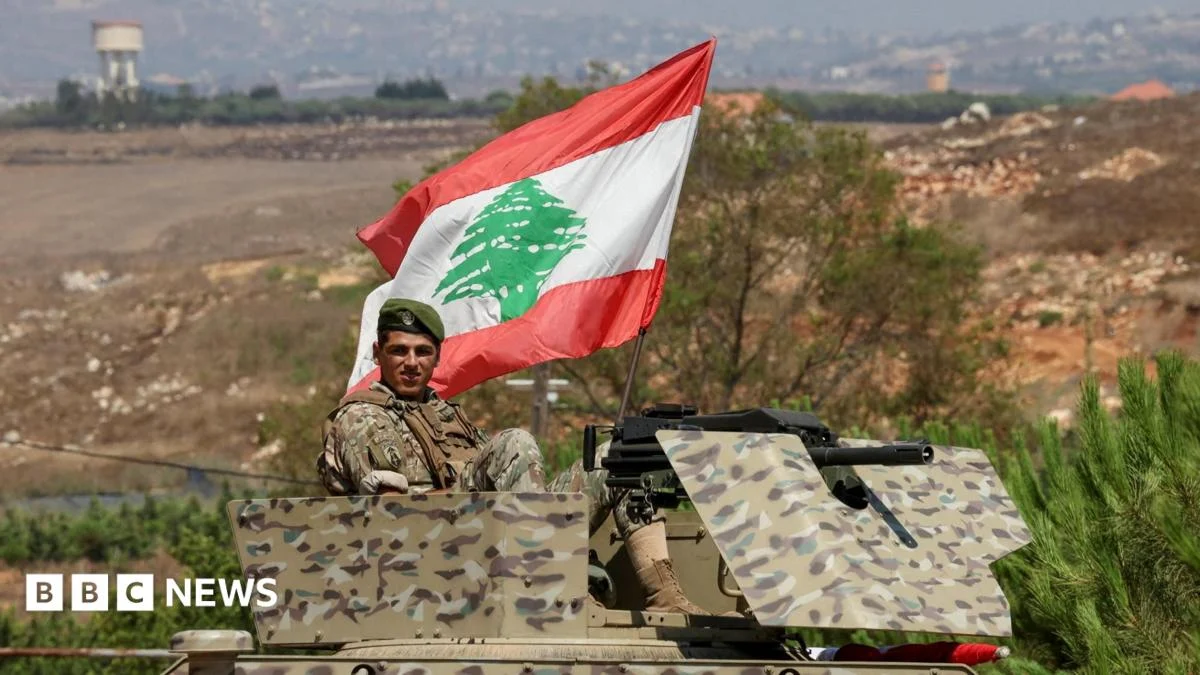
The Lebanese army has initiated a strategic deployment into a "pilot zone" in the south of the country, marking a critical phase in the implementation of a US-brokered agreement aimed at de-escalating tensions with Israel. This move follows the partial withdrawal of Israeli forces from designated areas, an accord reached last month that seeks to redefine the volatile border region. However, the delicate operation was immediately shadowed by an exchange of fire, highlighting the profound challenges inherent in disengaging two historically antagonistic forces.
Engineering units of the Lebanese Armed Forces (LAF) entered the village of Zawtar al-Gharbiyeh in the Nabatieh district on Tuesday morning, as announced by the army command. This initial deployment was part of a broader plan that also included operations in the villages of Froun and Srifa, as later confirmed by the US State Department. Yet, the tranquility of the deployment was shattered when Israeli forces reportedly opened fire in the vicinity of the Lebanese troops. Israel’s military countered, stating that warning shots had been fired after the Lebanese units inadvertently crossed into an Israeli-declared "security zone," a contested strip of land that has long been a flashpoint.
This intricate dance of military maneuvers and diplomatic overtures unfolds against a backdrop of recent, devastating conflict and a complex history of occupation and resistance in southern Lebanon. The "pilot zone" concept is designed to facilitate a phased Israeli withdrawal from a small segment of territory occupied during their recent conflict with the Iran-backed Lebanese group Hezbollah, concurrently with efforts to disarm the militant organization. The successful execution of this framework is seen as a crucial test for the stability of the Lebanese-Israeli border and the future of Lebanese sovereignty.
The Genesis of the Trilateral Framework
The deployment is a direct outcome of the "Trilateral Framework," an agreement forged at the end of June between Israel, Lebanon, and the United States. This diplomatic breakthrough followed intense discussions, including a pivotal meeting between Israeli and Lebanese representatives in Rome just a week prior to the deployment. The framework’s ambitious goals include not only a calibrated Israeli withdrawal but, critically, the disarmament of Hezbollah, a condition Israel has repeatedly stressed as non-negotiable for any full disengagement from Lebanese territory.
The historical context of Israeli military presence in southern Lebanon is essential to understanding the current complexities. Israel first invaded Lebanon in 1978 in Operation Litani, establishing a buffer zone. A more extensive invasion in 1982 led to a prolonged occupation, culminating in the creation of the "security zone" in 1985—a roughly 10-kilometer-deep strip of Lebanese territory along the border. This zone was ostensibly created to protect northern Israeli communities from cross-border attacks, but it became a symbol of occupation and a breeding ground for resistance, notably from Hezbollah, which emerged in the early 1980s. Israel’s unilateral withdrawal in 2000, largely under pressure from Hezbollah’s sustained guerrilla warfare, was celebrated in Lebanon but did not resolve underlying border disputes or the issue of Hezbollah’s armed status. The 2006 Lebanon War further underscored the fragility of the region, demonstrating the devastating potential for large-scale conflict.
Hezbollah, a powerful political party and military force in Lebanon, has consistently rejected any agreement linking Israeli withdrawal to its disarmament. The group views its arsenal as a legitimate means of defense against Israeli aggression and a cornerstone of Lebanon’s sovereignty, especially given the Lebanese state’s historically weak military capacity to defend its borders. For Hezbollah, the demand for disarmament crosses "all red lines," complicating any comprehensive resolution.
A Day of Deployment, Diplomacy, and Disagreement
The timeline of Tuesday’s events underscores the inherent volatility of the situation. The Lebanese army’s deployment began hours before a scheduled high-stakes meeting in Washington between US President Donald Trump and his Lebanese counterpart, Joseph Aoun. President Aoun’s agenda in Washington was clear: to leverage US influence to pressure Israel into a full withdrawal from the remaining occupied parts of southern Lebanon and to secure robust support for the Lebanese Armed Forces (LAF) in asserting full control over areas currently dominated by Hezbollah.
"I told him [Trump] I need two things from you: political support and supporting the LAF [Lebanese Armed Forces]," Aoun reportedly told reporters in the Oval Office. Speaking alongside Aoun, President Trump vowed substantial US assistance to Lebanon, acknowledging the country’s decades of hardship. "It’s been a very badly treated place and country, and we’re going to have it properly treated," he stated, promising the respect Lebanon deserves.
Meanwhile, the situation on the ground remained tense. The US State Department had announced on Monday afternoon that "pilot zone operations" had commenced in Zawtar al-Gharbiyeh, Froun, and Srifa, aligning with the Trilateral Framework. An Israeli military official later confirmed that the Israel Defense Forces (IDF) would "adjust its force posture in one of the pilot areas" to allow the Lebanese army to execute its mission, while simultaneously "safeguarding the security of IDF soldiers and preserving its right to self-defence and to remove threats." The official reiterated that the IDF’s primary objective remained "the disarmament of the Hezbollah terrorist organisation and the removal of its illegal weapons," emphasizing that Israeli forces would remain in the "security zone" – the 10km-deep strip of occupied Lebanese territory – for "as long as necessary" to defend northern Israeli communities.
The border incident occurred later on Tuesday. The Lebanese army command stated that Israeli forces had "opened fire in the vicinity of these units," warning that the "attack hinders the implementation of deployment steps in the pilot zones." The IDF, in its account, clarified that its soldiers fired "warning shots into the air" after Lebanese troops and an engineering vehicle reportedly "crossed approximately 150m (490ft) into the security zone and breached the barriers" in the neighboring area of Zawtar al-Sharqiyeh. The IDF confirmed that the Lebanese troops subsequently "withdrew from the area, and no injuries were reported." The Lebanese army also confirmed its troops were already undertaking missions in nearby Froun and Srifa following Monday’s US announcement, with an Israeli source telling Haaretz that no Israeli troops were present in those specific villages.
Further unsettling reports emerged from Lebanon’s state-run National News Agency (NNA) on Tuesday, which attributed two large explosions near the villages of Beit Yahoun and Kounine in Bint Jbeil district to Israeli forces. The NNA also reported blasts from Israeli-controlled demolitions in the town of Majdal Zoun in Tyre district, underscoring the ongoing and widespread destruction in areas still under Israeli occupation.
The Broader Conflict and its Devastating Toll
The current diplomatic and military maneuvers are a direct response to the recent, devastating conflict that engulfed Lebanon and Israel. Lebanon was drawn into the broader regional confrontation between Israel, the US, and Iran on March 2nd, when Hezbollah launched a barrage of rockets into Israel. This action was described as retaliation for an Israeli strike that reportedly killed Iran’s supreme leader, an event that significantly escalated regional tensions.
Israel responded with a comprehensive bombing campaign across Lebanon and an invasion of a significant portion of the country’s south. The human cost of this conflict has been catastrophic. According to the Lebanese health ministry, over 4,300 people have been killed in Lebanon, including an estimated 800 children, women, and medical personnel. The widespread destruction has been particularly severe in southern Lebanon, where many villages have been completely razed by Israeli strikes or demolitions. While the Israeli military asserts it has been targeting and destroying Hezbollah infrastructure, human rights organizations have voiced grave concerns, alleging that some of these actions amount to the deliberate destruction of civilian infrastructure, potentially constituting war crimes.
On the Israeli side, authorities have reported 37 Israeli soldiers and four civilians killed on both sides of the border during the conflict, highlighting the reciprocal nature of the violence, albeit with a stark asymmetry in overall casualties. The conflict also led to widespread displacement, with hundreds of thousands of Lebanese civilians forced to flee their homes, compounding an already dire humanitarian situation. The economic impact on Lebanon, a country already grappling with severe financial crises, has been profound, further stressing its infrastructure and social services.
Divergent Objectives and the Path Ahead
The differing objectives of the key players present significant hurdles to the successful implementation of the Trilateral Framework. For Israel, the "security zone" is a vital buffer, and the complete disarmament of Hezbollah is the ultimate guarantee of security for its northern communities. The IDF’s statement that it would remain in the zone "as long as necessary" to defend its citizens underscores this unwavering commitment.
Lebanon, while seeking to reassert its sovereignty and control over its entire territory, faces the complex internal dynamic of Hezbollah’s powerful presence. President Aoun’s appeal for US support for the LAF reflects the national army’s need to be sufficiently strengthened to eventually assume security responsibilities without relying on non-state actors. The Lebanese army’s call for citizens to avoid the pilot zone until the security situation stabilizes also highlights the precariousness of the ongoing operations.
President Trump, in his discussions with Aoun, reiterated the US commitment to helping Lebanon build its capacity to disarm Hezbollah, although he provided no specific details on these "concrete plans." He also expressed a surprising willingness to speak directly to representatives of Hezbollah if requested by Aoun, a significant diplomatic shift that could potentially open new channels for dialogue, though the practicality and implications of such a move remain highly speculative.
The pilot zone operation, therefore, represents a critical litmus test for the viability of the US-brokered agreement. Its success hinges not only on the precise execution of military withdrawals and deployments but also on a delicate balancing act of trust-building, verification, and sustained diplomatic engagement. The immediate border incident serves as a stark reminder of the ever-present risk of escalation and the profound historical mistrust that permeates the region.
The implications of this agreement, if successfully implemented, are far-reaching. For Lebanon, it offers a potential pathway towards greater national sovereignty and a reduction in the internal and external pressures stemming from Hezbollah’s armed status. For Israel, it could lead to enhanced border security and a reduction in the threat perception from its northern neighbor. For the wider region, it could signal a rare instance of de-escalation in a perennially volatile area, offering a glimmer of hope for future conflict resolution efforts. However, the deep-seated grievances, the enduring power dynamics, and the constant threat of renewed conflict mean that the path ahead for the Trilateral Framework and the stability of southern Lebanon remains fraught with immense challenges. The international community, including the United Nations Interim Force in Lebanon (UNIFIL), will likely play a crucial role in monitoring compliance, facilitating dialogue, and ensuring humanitarian assistance in the long and arduous process of peacebuilding and reconstruction.