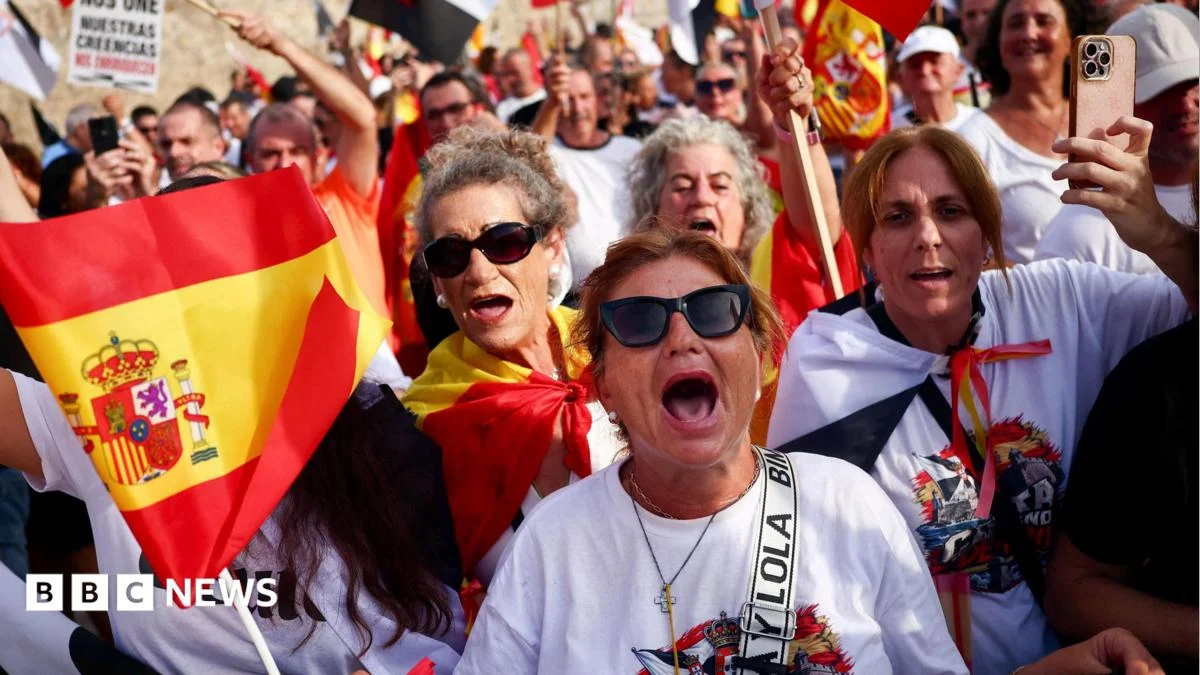
Thousands of people have taken to the streets in cities across Spain, voicing their profound discontent with the government’s response to a recent, unprecedented influx of migrants into Ceuta, a Spanish exclave situated on the north African coast. The demonstrations, organized primarily by opposition parties, underscore deep political divisions and escalating humanitarian concerns, casting a shadow over Prime Minister Pedro Sánchez’s administration.
The protests, which saw tens of thousands gather in Madrid alone, were a direct response to a recent mass crossing event where, according to reports cited by opposition figures, at least 72,000 migrants crossed from Morocco into Ceuta on July 30 and 31. While the majority of these individuals have reportedly returned to Morocco, an estimated 5,000 remain within the autonomous city, residing in makeshift camps, on beaches, or scattered across urban areas, thereby creating significant social and logistical challenges for local authorities and residents. This situation has fueled near-daily local protests within Ceuta itself, with demonstrators demanding the migrants’ repatriation or redistribution across mainland Spain.
The Genesis of the Crisis: A Border Under Pressure
Spain’s two North African enclaves, Ceuta and Melilla, represent the European Union’s only land borders with Africa. Historically, these cities have been flashpoints for irregular migration, attracting individuals from sub-Saharan Africa, North Africa, and increasingly, other regions, who seek to reach European soil. The formidable border fences, equipped with razor wire and surveillance technology, are frequently tested by groups attempting to breach them. However, the events of late July marked an escalation in scale that has rarely been witnessed, even surpassing the significant influx of May 2021, when approximately 10,000-12,000 people, including many unaccompanied minors, crossed into Ceuta within a 48-hour period. That earlier event was widely seen as a retaliatory move by Morocco following Spain’s decision to provide medical treatment to Brahim Ghali, the leader of the Polisario Front, a group fighting for the independence of Western Sahara.
The recent July influx has reignited and intensified the political and social tensions that have long simmered around these enclaves. A police report, released just days before the protests, controversially stated that Moroccan security forces showed "total permissiveness" during the unprecedented border crossings. This finding directly contradicts earlier assertions by Prime Minister Sánchez, who had initially insisted that Morocco bore no responsibility for the mass movement of people. Instead, Sánchez has largely attributed the crisis to the activities of human trafficking gangs and the pervasive influence of online misinformation, which he claims encourages individuals to attempt the perilous journey. Morocco, for its part, has consistently denied orchestrating or being involved in the mass crossing, maintaining its commitment to border control.
Chronology of Escalation and Political Fallout
- Pre-July 2021: Ongoing, albeit manageable, pressure on Ceuta and Melilla borders. Diplomatic tensions between Spain and Morocco, particularly exacerbated by the Western Sahara issue and the May 2021 migration crisis.
- July 30-31: An estimated 72,000 migrants cross from Morocco into Ceuta in an unprecedented mass movement. The sheer volume overwhelms local Spanish border defenses and humanitarian resources.
- Early August: Spanish authorities begin the arduous process of repatriating many of the new arrivals. However, a significant number, estimated around 5,000, remain in Ceuta, leading to immediate humanitarian challenges and social unrest among the local population. Makeshift camps emerge, and public services are strained.
- Mid-August (Date of Police Report): A police report emerges, reportedly concluding that Moroccan security forces exhibited "total permissiveness" during the July influx. This report ignites fresh controversy, challenging the Spanish government’s earlier narrative and directly implicating Morocco.
- Following Police Report: Prime Minister Pedro Sánchez reiterates his stance, blaming trafficking networks and misinformation, while refraining from directly accusing Morocco. The government simultaneously accuses right-wing opposition parties of "exploiting the crisis" for political gain.
- Late August (Date of Protests): Widespread protests are called by opposition parties and local councils across Spain, demanding accountability from the Sánchez government. Demonstrations occur in major cities, including a significant rally in Madrid.
Voices of Dissent: Opposition Accusations
The Wednesday rallies were orchestrated by city councils across Spain where opposition parties, notably the conservative Partido Popular (PP) and the far-right Vox party, either govern or wield substantial political influence. Demonstrators unfurled banners and chanted slogans calling for Sánchez’s resignation, reflecting a deepening chasm in Spanish politics over immigration policy and national sovereignty.
Alberto Núñez Feijóo, leader of the Partido Popular, addressed the rally in Madrid, where government figures estimated attendance at over 50,000 people. His words encapsulated the sentiment of many protestors: "A Spanish city has been invaded, occupied and, unfortunately, this happened with the knowledge of the Government of Spain." This strong rhetoric suggests an accusation of governmental negligence or even complicity, amplifying the sense of abandonment felt by residents of Ceuta and conservative voters across Spain.
Santiago Abascal, the leader of the ultranationalist Vox party, went further in his condemnation, accusing Prime Minister Sánchez of being "at the service, like a lackey, of the Moroccan regime." Abascal’s statement not only criticizes Sánchez’s handling of the crisis but also plays into long-standing nationalist narratives regarding Spain’s sovereignty and its relationship with Morocco, a country with whom Spain shares a complex and often fraught history. Vox has consistently advocated for stricter border controls, mass deportations, and a more assertive stance against what it perceives as threats to national identity and security.
Government’s Defense and International Dimensions
In response to the mounting criticism, the Socialist-led government has maintained that its priority is to manage the humanitarian situation in Ceuta while upholding Spain’s border integrity and international obligations. Officials have emphasized the logistical challenges of repatriating such a large number of people and the complexities involved in identifying unaccompanied minors, who are afforded special protections under international law. The government has also sought to contextualize the influx within the broader phenomenon of global migration, influenced by conflict, poverty, and climate change in sending countries.
Prime Minister Sánchez’s initial reluctance to directly blame Morocco reflects a delicate diplomatic balancing act. Spain relies on Morocco as a crucial partner in combating irregular migration and terrorism, and any direct accusation could destabilize this relationship. However, the police report’s findings regarding Moroccan "permissiveness" have undeniably put pressure on Madrid to address the apparent lack of cooperation from Rabat during the critical two days of the July influx. This situation hints at the use of migration as a diplomatic lever, a tactic Morocco has been accused of employing in the past to pressure Spain on issues such as the disputed territory of Western Sahara.
The European Union has also weighed in on similar past events, offering solidarity and financial assistance to Spain, recognizing its role as a frontline state in managing migration flows into the bloc. The EU’s external border agency, Frontex, often provides support for border surveillance and returns operations. However, the scale of the July influx highlights the persistent challenges of externalizing border control and relying on third countries to manage migration, particularly when bilateral relations become strained.
Humanitarian and Societal Impact in Ceuta
The immediate impact on Ceuta, a city of approximately 85,000 inhabitants, has been profound. The sudden arrival of thousands of individuals, even if temporary for many, has overwhelmed the city’s resources. Schools, sports facilities, and military barracks have been repurposed to house migrants. Food, water, and medical supplies have been stretched thin. Local residents have expressed fears for public safety, a strain on municipal services, and a sense of being abandoned by the central government.
The situation for the estimated 5,000 migrants who remain in Ceuta is precarious. Many live in rudimentary conditions, lacking adequate shelter, sanitation, and access to regular healthcare. Among them are a significant number of unaccompanied minors, who are particularly vulnerable to exploitation and require specialized care and protection. The Spanish government faces the complex legal and ethical challenge of either integrating these individuals into Spanish society, relocating them to other parts of the country, or repatriating them to their countries of origin, a process that is often fraught with legal hurdles and human rights concerns. Calls for greater solidarity and redistribution of these migrants across Spain’s autonomous communities have been made by humanitarian organizations and some regional governments.
Broader Implications for Spanish Politics and EU Migration Policy
The Ceuta crisis and the ensuing protests have significant ramifications for Spain’s domestic political landscape. The issue of immigration has become a highly polarizing topic, fueling the rise of the far-right Vox party, which has successfully tapped into public anxieties regarding national identity, security, and economic strain. The conservative PP, in turn, is attempting to reclaim ground by adopting a more robust stance on border control and national sovereignty, aiming to present a strong alternative to Sánchez’s government. This political polarization is likely to intensify as Spain approaches its next general election, with migration becoming a central battleground issue.
For the Sánchez government, the crisis represents a test of its ability to manage complex international relations while addressing domestic concerns. Navigating the delicate balance between maintaining a working relationship with Morocco and asserting Spain’s sovereign interests, while also upholding humanitarian principles, is a formidable challenge.
On an international level, the events in Ceuta underscore the vulnerabilities of the EU’s external borders and the ongoing debate surrounding a common European migration policy. The crisis highlights the need for robust mechanisms for burden-sharing among member states, effective cooperation with transit countries, and a comprehensive approach that addresses both security concerns and the humanitarian imperatives of migration. The lessons learned from Ceuta will undoubtedly inform future discussions within the EU regarding border management, asylum procedures, and the role of third countries in stemming irregular flows.
In conclusion, the mass influx into Ceuta in late July, followed by the widespread national protests, represents more than just a border incident; it is a multifaceted crisis exposing deep political divisions within Spain, testing its diplomatic ties with Morocco, and challenging the humanitarian framework of the European Union. The aftermath continues to unfold, promising further political debate and demanding sustained attention from Madrid and Brussels alike.