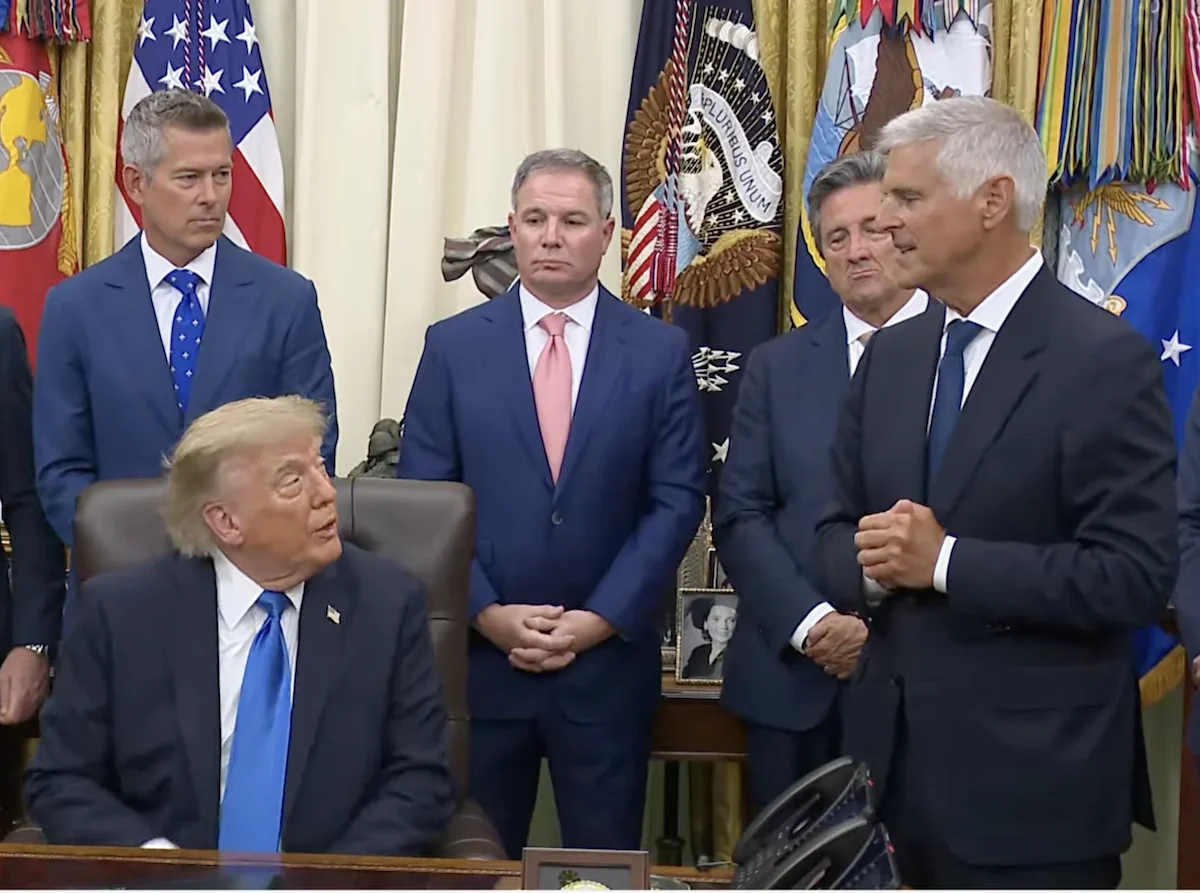
A coalition of the United States’ most prominent travel and hospitality executives has formally requested that the Trump administration commit to an ambitious national target of attracting 100 million international visitors annually by the year 2030. This strategic milestone, presented during a high-level briefing on Wednesday, is designed to propel the United States past France to become the most-visited country in the world. The proposal was discussed in detail during a meeting between President Donald Trump and a delegation of industry titans, including leadership from the U.S. Travel Association, Hilton, Marriott International, American Airlines, and Booking Holdings.
The 100 million visitor mark represents a significant escalation in the country’s tourism ambitions, requiring a 46% increase from projected 2025 levels. If achieved, this figure would sit approximately 25% higher than the United States’ previous pre-pandemic peak, signaling a transformative shift in how the nation markets itself and manages its borders. The industry’s push comes at a critical juncture as the U.S. prepares to host a series of "mega-events" that are expected to serve as the primary engines for this growth.
The Strategy for Global Dominance
For decades, France has consistently held the title of the world’s top tourist destination, largely due to its central location in Europe and the enduring appeal of Paris. However, U.S. travel leaders argue that the United States possesses an untapped potential to scale its inbound tourism sector far beyond current levels. The pitch to the Trump administration emphasizes that reaching the 100 million visitor threshold is not merely a matter of prestige, but a vital economic necessity.
To reach this goal, the industry is calling for a coordinated "whole-of-government" approach. This involves synchronizing the efforts of the Department of Commerce, the Department of State, and the Department of Homeland Security to ensure that the infrastructure of travel—from visa processing to airport security—can handle the influx. Executives at the meeting noted that while the U.S. currently leads the world in total international traveler spending, it lags behind in raw visitation numbers. By closing this gap, the industry believes it can add hundreds of billions of dollars to the U.S. GDP and create millions of domestic jobs that cannot be outsourced.
Leveraging the "Decade of Sport"
A central pillar of the industry’s proposal is the strategic utilization of upcoming international sporting events. The executives highlighted the 2026 FIFA World Cup as a blueprint for success. The tournament, which will be hosted across 11 U.S. cities alongside five additional markets in Canada and Mexico, is viewed as a unique opportunity to showcase American hospitality to a global audience of billions.
Despite the optimism surrounding these events, the industry remains wary of recent trends. Data shared during the meeting indicated that the country’s inbound tourism recovery has remained uneven. Visitation from overseas markets was reportedly down year-over-year during the critical summer months of June and July. Industry analysts suggest that a combination of a strong U.S. dollar, high inflation affecting travel costs, and lingering visa processing delays in key markets like Brazil, India, and China have contributed to this "inbound slump."
However, the Trump administration and industry leaders consider the preparations for the World Cup a successful proof-of-concept for streamlined entry procedures. The administration has expressed interest in expanding these efficiencies, potentially utilizing more advanced biometric technology and pre-clearance programs to reduce wait times at major gateways.
Historical Context and the Post-Pandemic Recovery
The U.S. travel industry has faced a tumultuous path over the last five years. In 2019, the U.S. welcomed approximately 79.4 million international visitors. The pandemic caused these numbers to plummet, and the recovery has been slower than many of its global competitors. While domestic travel rebounded quickly, international inbound travel—which typically involves longer stays and higher per-capita spending—has struggled to return to its 2019 baseline.
By 2023, the U.S. saw roughly 66.5 million international arrivals, still significantly below pre-pandemic levels. The 2030 goal of 100 million would require the U.S. to not only recover lost ground but to enter a period of unprecedented expansion. The timeline presented to the President suggests a phased approach:
- 2025–2026: Focus on the World Cup and stabilizing visa wait times.
- 2027–2028: Capitalize on the 2028 Summer Olympics in Los Angeles.
- 2029–2030: Consolidate gains through enhanced digital marketing and expanded flight routes from emerging markets.
Addressing Policy Bottlenecks: Visas and Border Security
The primary obstacle identified by the U.S. Travel Association and airline executives is the current state of the U.S. visa system. In some key growth markets, prospective travelers still face wait times exceeding 400 days for a first-time interview. Travel executives argued that these delays act as a "de facto ban" on tourism, driving high-spending travelers to alternative destinations like the United Kingdom, Australia, or the European Union.
During the Wednesday meeting, the delegation urged the administration to prioritize the "Visit America Act," which aims to formalize a high-level position within the Department of Commerce focused specifically on tourism strategy. They also advocated for increased funding for Customs and Border Protection (CBP) to staff entry points more effectively, ensuring that a 46% increase in arrivals does not result in multi-hour queues at airports like JFK, LAX, and Miami International.
The administration’s response focused on the intersection of security and efficiency. President Trump has historically emphasized border security, but travel leaders argued that "secure borders and welcoming gateways are not mutually exclusive." The proposal includes suggestions for expanding the Visa Waiver Program to more "low-risk" countries and investing in mobile passport control apps to speed up processing for returning citizens and vetted international visitors.
Economic Implications and Market Projections
The economic stakes of reaching the 100 million visitor mark are immense. International travel is currently the second-largest U.S. export service. According to data from the U.S. Travel Association, the average overseas visitor spends approximately $4,000 per trip. Scaling visitation to 100 million would equate to an estimated $400 billion in direct spending annually.
Furthermore, the impact extends beyond the "gateway" cities of New York, Las Vegas, and Orlando. The 11-city World Cup footprint, which includes cities like Kansas City, Dallas, and Seattle, is expected to distribute tourism wealth more broadly across the American heartland. Executives from Hilton and Marriott noted that hotel development pipelines are already shifting toward these secondary markets in anticipation of sustained international interest following the 2026 tournament.
Industry Reactions and Official Statements
Following the meeting, Geoff Freeman, President and CEO of the U.S. Travel Association, emphasized the need for a national mandate. "The United States is in a global war for travel dollars," Freeman stated in a follow-up briefing. "To win, we need a government that treats travel like the massive export industry it is. The 100 million visitor goal is ambitious, but with the right policy framework, it is entirely achievable."
Spokespeople for the airlines present, including American Airlines, highlighted the need for air traffic control modernization to support the increased flight volume. They noted that reaching 100 million visitors would require a significant expansion of transoceanic capacity, which is currently limited by both aircraft availability and infrastructure constraints.
From the administration’s side, the focus remained on the competitive aspect of the goal. Sources familiar with the discussion noted that the President was particularly receptive to the idea of "beating France" in the global rankings. The administration is expected to review the industry’s specific policy recommendations over the coming months, with a potential executive order or legislative package focused on tourism competitiveness rumored for early 2025.
Analysis: Can the U.S. Realistically Hit the Mark?
While the 100 million goal is a powerful rallying cry, independent analysts suggest several hurdles remain. The geopolitical climate, including trade tensions and regional conflicts, can shift travel patterns overnight. Additionally, the "brand" of the United States as a destination is often subject to fluctuations based on international perceptions of safety and political stability.
However, the "Decade of Sport" provides a unique tailwind. With the 2026 World Cup, the 2028 Olympics, and a potential bid for the 2031 Rugby World Cup, the U.S. will be in the global spotlight for the better part of the next six years. This provides a rare opportunity for "destination storytelling" that could overcome traditional barriers.
The success of this initiative will likely hinge on whether the government can successfully treat tourism as a strategic economic pillar rather than a secondary industry. If the Trump administration follows through on the industry’s requests for visa reform and infrastructure investment, the 2030 goal could mark the beginning of a new era for American tourism, redefining the country’s role in the global travel economy.
Conclusion and Future Outlook
The proposal for 100 million visitors marks a turning point in the relationship between the U.S. government and the travel sector. By framing tourism as a competitive "race to the top" against nations like France, industry leaders have aligned their economic goals with the administration’s focus on American leadership. As the 2026 World Cup approaches, the eyes of the world will be on the United States; the travel industry is betting that if they can get those visitors through the door once, they can keep them coming back until the 100 million dream becomes a reality.