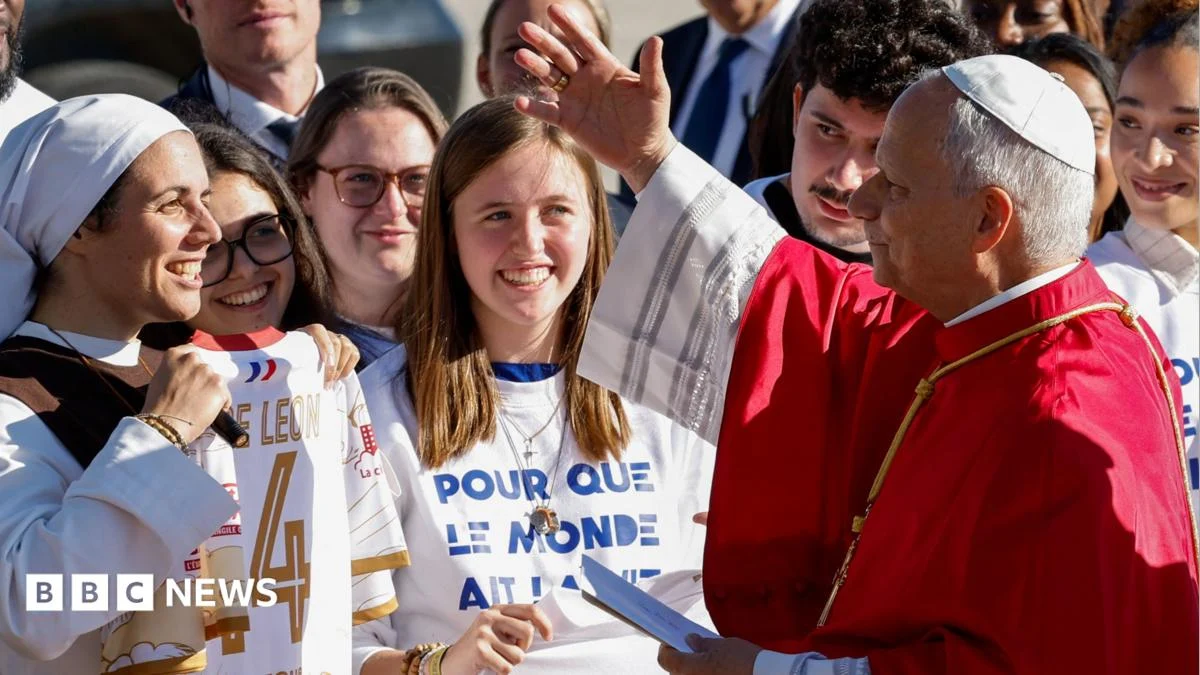
Pope Leo XIV has embarked on a highly anticipated four-day apostolic journey to France, a visit poised to blend profound spiritual outreach with high-stakes diplomatic engagement. The pontiff’s itinerary, commencing Friday, is highlighted by a colossal open-air Mass in central Paris, an event anticipated to draw more than half a million Catholic faithful from across France and beyond, marking a significant moment for the Church in a nation historically complex in its relationship with the Holy See. This pilgrimage is not merely a pastoral visit but a carefully orchestrated dialogue between faith and modernity, tradition and republicanism, in the heart of Europe.
A Pilgrimage of Grandeur and Diplomacy: The Itinerary
The meticulous planning for the Pope’s visit underscores its dual nature. From the grand liturgical celebrations to intimate meetings and high-level political discussions, every segment of the journey has been designed to convey specific messages and foster various forms of communion.
Friday: Arrival and Elysée Dialogue
The pontiff’s arrival on Friday morning at Orly airport was met by President Emmanuel Macron, initiating the diplomatic dimension of the visit. Following the airport reception, the two leaders proceeded to the Élysée Palace for a substantive discussion. Their agenda reportedly encompassed pressing geopolitical issues, reflecting the Holy See’s active role in international affairs, particularly in advocating for peace, human rights, and humanitarian concerns amidst global conflicts. Crucially, the talks also delved into the ethical implications of artificial intelligence (AI), a topic of increasing concern for the Vatican. Pope Leo XIV has, like his predecessors, emphasized the need for human-centric development of AI, urging international cooperation to ensure that technological advancements serve the common good and uphold human dignity, rather than exacerbating inequalities or undermining fundamental values. The Vatican has been at the forefront of advocating for an "ethics of AI," engaging with tech leaders and policymakers to shape responsible guidelines for its development and deployment. The Pope’s engagement with Macron on this frontier issue signals the Church’s commitment to remaining a relevant moral voice in an rapidly evolving technological landscape.
Saturday: The Parisian Grand Mass – A Sea of Faith
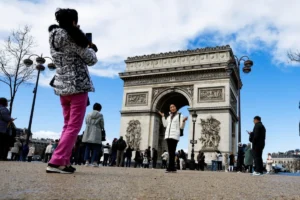
The spiritual zenith of the visit is undoubtedly Saturday afternoon’s grand Mass in Paris. For this momentous occasion, the iconic Place de la Concorde has been transformed, with a specially constructed altar serving as the focal point. A vast expanse encompassing the Champs-Élysées, stretching majestically up to the Arc de Triomphe and beyond, has been meticulously sealed off by police, creating an unprecedented sacred space in the heart of the French capital. Security measures are extensive, involving thousands of police officers, gendarmerie, and private security personnel, alongside a massive volunteer contingent, all working to ensure the safety and smooth flow of an estimated 600,000 attendees. Giant screens and powerful sound systems have been strategically placed along the avenue to ensure that every participant, regardless of their proximity to the altar, can witness and partake in the solemn liturgy.
The choice of the Place de la Concorde itself carries profound symbolism. Once the site of guillotines during the French Revolution, it now hosts a celebration of faith, embodying a reconciliation between historical turmoil and enduring spiritual aspiration. For many of the faithful, this Mass is a powerful reaffirmation of their Catholic identity, a communal expression of belief in a society where religious practice has increasingly become a private affair. The atmosphere is expected to be one of profound reverence mixed with jubilant celebration, reflecting the deep personal significance of seeing the Successor of Peter in person.
Notably, while President Macron greeted the Pope, he will not attend any of the pontiff’s Masses. This decision is a deliberate gesture to uphold France’s strict principle of laïcité, the separation of state and religion, a cornerstone of the French Republic. However, the President’s wife, Brigitte Macron, and Prime Minister Sébastien Lecornu are among the high-profile attendees, signaling respect for the institution and the significant portion of the French populace who are Catholic. The Mass will also attract a diverse array of political figures, including several prospective candidates for next year’s presidential election. Marine Le Pen of the nationalist right, centrists Édouard Philippe and Gabriel Attal, and conservative Bruno Retailleau are all expected, underscoring the political weight and cultural resonance of such a papal visit, even in a secular state. Their presence, while perhaps motivated by political considerations, also reflects an acknowledgment of the Catholic electorate’s continued importance.
Sunday: Compassion and Connection
While the original itinerary details are sparse for Sunday, it is understood that the Pope’s pastoral mission will continue with vital encounters. In Paris, he is scheduled to meet a group of migrants, offering a message of solidarity and compassion that aligns with the Vatican’s consistent advocacy for refugees and displaced persons. This meeting underscores the Church’s commitment to welcoming the stranger and addressing the humanitarian dimensions of global migration crises, a theme central to Pope Leo XIV’s pontificate.
Later in the visit, likely on Sunday, the Pope will travel to Lourdes, the renowned Marian shrine in the foothills of the Pyrenees. This pilgrimage site, famous for its miraculous healings, will be the setting for a deeply significant meeting with victims of sexual abuse by members of the Catholic clergy. This encounter is a crucial component of the Church’s ongoing efforts towards reconciliation, healing, and accountability in the face of the abuse crisis that has profoundly shaken its credibility worldwide. The Pope’s presence in Lourdes, a place of profound spiritual solace, offers a powerful symbol of repentance and a renewed commitment to safeguarding the vulnerable within the Church.
Monday: Metz – Honoring Europe’s Christian Roots
The final day of the Pope’s visit, Monday, will see him in Metz, a historic city in northeast France. Here, the pontiff will pay tribute to Robert Schuman (1886-1963), one of the revered founding fathers of the European Union. Schuman, a fervent Catholic, is today a candidate for beatification, his cause having advanced significantly. The Pope’s homage in Metz is not merely a recognition of Schuman’s deep faith but also an affirmation of the Christian values that underpinned the initial vision for European integration. Schuman, alongside figures like Jean Monnet and Konrad Adenauer, envisioned a united Europe built on principles of peace, solidarity, and human dignity, values deeply resonant with Catholic social teaching. This segment of the visit serves as a powerful reminder of the spiritual and moral foundations of the European project at a time when the continent grapples with questions of identity, unity, and its future direction.
In Metz, President Macron is also due to deliver a joint speech with the Pope, an event that will likely touch upon themes of European unity, shared values, and the role of faith in confronting contemporary challenges. This joint address will serve as a capstone to the diplomatic exchanges, reinforcing the idea of a constructive dialogue between religious authority and secular governance for the greater good of society.
Navigating Laïcité: France’s Unique Secular Fabric
The delicate balance between the spiritual and political dimensions of Pope Leo XIV’s visit is largely shaped by France’s unique understanding of laïcité, or secularism.
The 1905 Law and Its Legacy
The 1905 law separating Church and State is the bedrock of French secularism. It guarantees freedom of conscience and worship while ensuring the neutrality of the state regarding religious matters. This means the state neither recognizes, funds, nor subsidizes any religion. For over a century, this principle has profoundly influenced public life, prohibiting religious symbols in public schools and shaping the conduct of public officials. President Macron’s decision not to attend the papal Masses personally is a direct manifestation of this principle, aiming to avoid any perception of state endorsement of a particular religion. This strict adherence to laïcité is often a point of fascination and occasional tension for international observers, particularly those from nations with different models of church-state relations.
Balancing Act: State and Church Engagement
Despite the formal separation, the French state maintains a working relationship with religious organizations, particularly on matters of cultural heritage, social services, and dialogue on societal issues. The presence of Brigitte Macron and Prime Minister Lecornu at the Mass, alongside various political candidates, illustrates this nuanced approach. It allows for recognition of the Catholic community’s presence and contribution without formally breaching the separation. However, reports of "tensions" between Macron and the Vatican team regarding the ceremonial aspects of the visit suggest a delicate negotiation process. The president was reportedly keen on a more elaborate state ceremonial aspect, perhaps reflecting a desire to elevate France’s historical role and cultural prestige, while the Vatican team likely prioritized the pastoral and spiritual focus of the Pope’s visit, ensuring it wasn’t overshadowed by purely political pomp. This interplay highlights the ongoing negotiation of laïcité in practice, demonstrating that while the principle is firm, its application in high-profile events requires careful consideration and diplomatic maneuvering.
The Shifting Sands of French Catholicism
Pope Leo XIV’s visit comes at a pivotal time for Catholicism in France, a nation once proudly known as the "Eldest Daughter of the Church."
Declining Adherence and Growing ‘Spiritual Thirst’
France, along with much of Western Europe, has experienced profound secularization. While less than half of the population today identifies as Catholic, this figure masks deeper trends. The number of regular worshippers has plummeted from a robust 35% of the population in 1960 to less than 5% currently. This decline is mirrored in vocations, with the number of priests shrinking dramatically by two-thirds, from approximately 25,000 in 1990 to fewer than 9,000 today. Many churches struggle with dwindling congregations, and religious practice is increasingly concentrated among older generations.
However, beneath these statistics, there are intriguing counter-currents. The enthusiasm surrounding the Pope’s visit, with hundreds of thousands expected to attend, suggests that while institutional adherence may have waned, a "spiritual thirst" persists. This phenomenon, attributed by the Church to a broader search for meaning and values in an increasingly complex and often fragmented modern world, manifests in various ways, from New Age spirituality to a renewed interest in traditional religious practices.
A Glimmer of Renewal: The Rise in Adult Baptisms
One of the most striking signs of this underlying spiritual quest is the recent surge in adult baptisms. In a remarkable trend, the number of adults choosing to be baptized has more than doubled in just five years, reaching 10,000 in 2025. These new converts often represent a younger demographic, many of whom were raised without religious instruction, seeking community, structure, and moral guidance. This phenomenon, while still a small percentage of the overall population, offers a glimmer of hope for the Catholic Church in France, suggesting that despite widespread secularization, the message of faith continues to resonate with a segment of the population actively searching for spiritual anchors.
Cardinal François Bustillo, Bishop of Ajaccio, articulates this sentiment: "France has indeed secularised, but there is a void where God and values used to be." He posits that people are searching for meaning, whether in distant lands or in their own heritage. "Maybe they go to India or Tibet or the Amazon. And now the Pope comes here from Rome, bringing a reminder to people of their own roots." His hopeful declaration, "It was John-Paul II who awoke the East. Now Leo XIV will awake the West," encapsulates the profound aspirations accompanying this papal visit—a hope for a spiritual reawakening in a continent often perceived as post-Christian.
A Storied Past: France and the Holy See
The relationship between France and the Catholic Church is one of the oldest and most complex in European history, marked by periods of fervent devotion, geopolitical rivalry, and profound rupture.
The ‘Eldest Daughter’ Narrative
For centuries, France proudly bore the title "Eldest Daughter of the Church," a designation rooted in the conversion of Clovis, King of the Franks, to Catholicism around 496 AD. While historically inaccurate (Armenia, Georgia, and Ethiopia converted to Christianity as state religions earlier), this narrative solidified France’s self-perception as a foundational pillar of Catholicism in Western Europe and a primary defender of the faith. This historical narrative imbued France with a sense of special destiny and responsibility within Christendom.
Epochs of Conflict and Concord
The relationship was, however, far from uniformly harmonious. In the 14th century, the papacy itself moved into exile in Avignon in southern France, a period known as the Avignon Papacy, which profoundly influenced Church politics and eventually led to the Great Schism. Over subsequent centuries, French armies periodically intervened in Italian politics, often clashing with the temporal authority of the popes, who were not only heads of the Church but also secular rulers of the Papal States. Napoleon Bonaparte, in his complex dealings with the Church, famously held two popes captive, demonstrating the raw power dynamics that often characterized relations between the French state and the Holy See. These historical episodes underscore a pattern of deep connection often interspersed with periods of intense conflict, where the political interests of France frequently diverged from or outright challenged the authority of Rome.
Recent Papal Engagements
Despite these historical tensions, recent popes have consistently visited France, acknowledging its continued significance. Pope John Paul II, known for his charismatic outreach, made several impactful visits between 1980 and 2004, drawing immense crowds and leaving a lasting impression on French Catholics. Pope Francis, too, visited France three times, though notably he avoided Paris, opting instead for Strasbourg, Marseilles, and Corsica, perhaps strategically focusing on regions with particular socio-political or interfaith significance. Pope Leo XIV’s decision to make Paris the epicenter of his visit, particularly the grand Mass on the Champs-Élysées, marks a distinct approach, signaling a direct engagement with the heart of French republican identity and its diverse populace.
Pope Leo XIV: A Pontiff with French Roots and Global Vision
Pope Leo XIV, born Robert Prevost in Chicago in 1955, brings a unique personal connection to France. His birth name, Prevost, is French, a heritage tracing back to his paternal grandmother, who was born in Le Havre, Normandy, in 1894. When she married in the United States many years later, she and her Italian husband adopted Prevost, her mother’s maiden name, as their own. This ancestral tie to France adds an intimate layer to his visit, potentially fostering a deeper connection with the French people.
Throughout his pontificate, Pope Leo XIV has consistently emphasized dialogue, peace, and social justice. His engagement on issues like geopolitics and artificial intelligence during this visit is consistent with his broader vision of the Church as a moral compass in a rapidly changing world. He seeks to apply Catholic social teaching to contemporary challenges, advocating for ethical frameworks that prioritize human dignity and the common good. His call to "awake the West" can be interpreted as a summons for Europe to rediscover its spiritual and humanistic roots, to confront the challenges of secularization, materialism, and societal fragmentation with renewed faith and a commitment to shared values.
Implications and Future Horizons
Pope Leo XIV’s visit to France carries multifaceted implications, extending beyond the immediate duration of his stay.
For French Catholicism
The papal visit offers a significant moment of reaffirmation and potential revitalization for French Catholicism. The sheer scale of attendance expected at the Parisian Mass will provide a visible demonstration of the enduring presence of faith, potentially boosting the morale of the dwindling clergy and faithful. It could inspire renewed engagement among nominal Catholics and provide momentum for the nascent trend of adult baptisms. The Pope’s direct engagement with victims of abuse, migrants, and the legacy of figures like Schuman also underscores the Church’s commitment to addressing pressing social and ethical issues, thereby enhancing its moral authority and relevance in contemporary French society.
For European Unity and Values
The tribute to Robert Schuman in Metz is particularly poignant for the future of Europe. By honoring a founding father of the EU and a fervent Catholic, Pope Leo XIV implicitly calls for a re-engagement with the Christian roots and values that historically shaped the continent. In an era of increasing nationalism, political fragmentation, and questions about Europe’s identity, the Pope’s message is likely to be one of unity, solidarity, and a return to fundamental principles of human dignity and shared responsibility. This could serve as a powerful reminder for European leaders and citizens alike of the spiritual dimension inherent in the European project.
The Vatican’s Role in a Modern World
Finally, this visit solidifies the Vatican’s continued relevance as a global diplomatic and moral actor. By engaging directly with President Macron on cutting-edge issues like artificial intelligence and global geopolitics, Pope Leo XIV demonstrates the Church’s capacity to offer ethical guidance and foster dialogue on the most complex challenges facing humanity. The blend of spiritual celebration, compassionate outreach, and high-level diplomatic engagement positions the Holy See not merely as a religious institution, but as a significant voice contributing to global peace, justice, and human flourishing in the 21st century. The visit, therefore, is not just a journey to France; it is a profound statement about the enduring role of faith in shaping the future of Europe and the world.