


Scientists at Julius-Maximilians-Universität Würzburg (JMU) have achieved a significant breakthrough in nanotechnology, developing microscopic robots capable of direct interaction with the microbial world. These nanorobots, approximately 50 times smaller than the diameter of a human hair, represent a substantial leap towards the long-sought goal of manipulating individual cells, bacteria, and other microscopic entities with unprecedented precision. This advancement holds profound implications for fields ranging from biological research and medicine to environmental science.
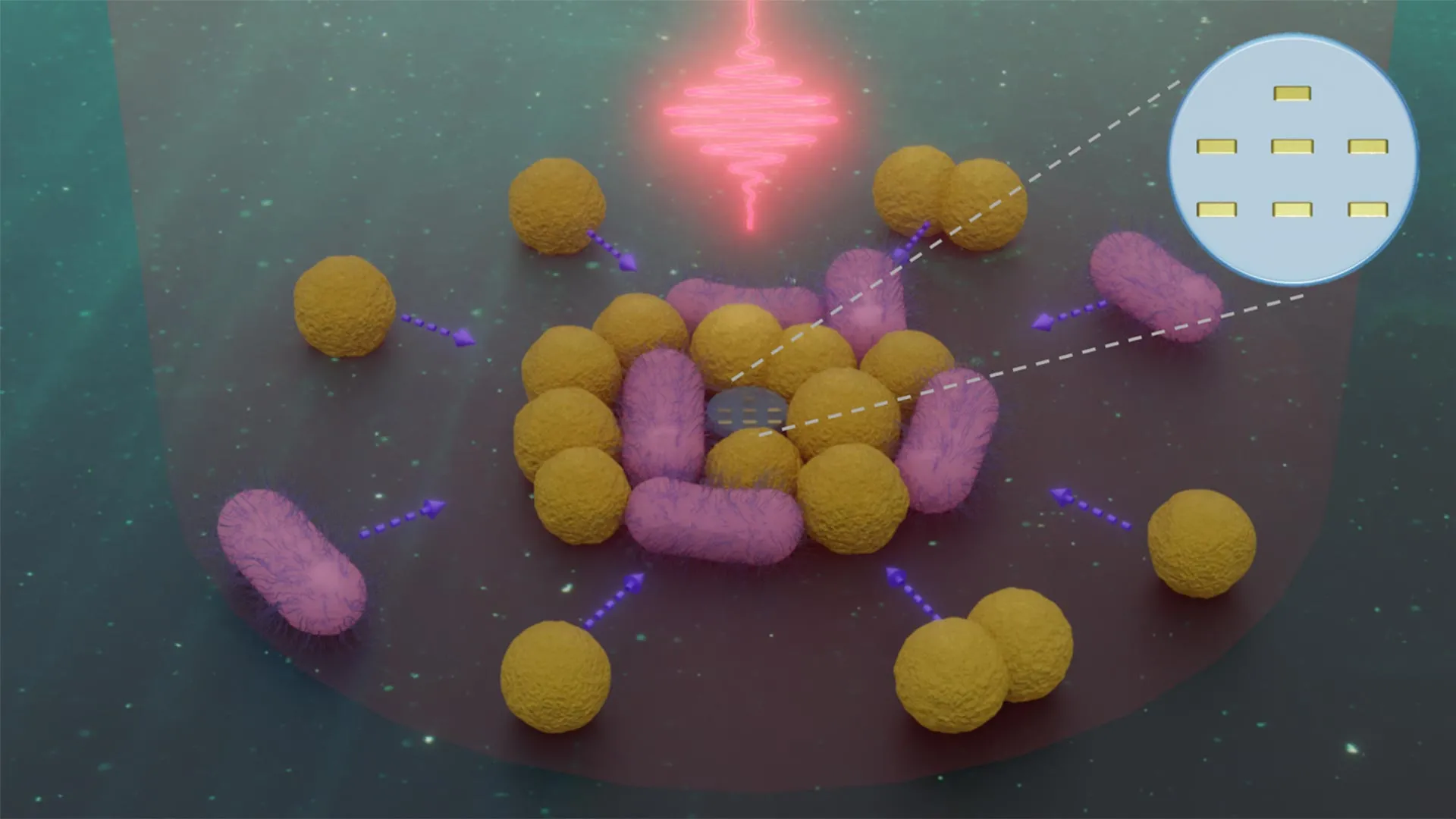
The core innovation lies in the development of light-driven nanorobots, dubbed "microdrones," that leverage the principles of photon recoil for propulsion and a novel optical steering mechanism. This allows researchers to not only move these minuscule machines but also to precisely control their actions, a capability that has long eluded the scientific community when dealing with objects at such infinitesimal scales. The research, spearheaded by Professor Bert Hecht and his team at JMU, has culminated in devices smaller than one micrometer, bringing them directly into the operational realm of bacteria and individual cells.
Genesis of the Microscopic Manipulators: A Journey Through Nanotechnology
The pursuit of microscopic robots has been a persistent endeavor within scientific circles for decades. Early concepts often envisioned complex mechanical systems, but the sheer scale of these envisioned machines presented insurmountable engineering challenges. The key hurdle has always been finding an effective and scalable method for both propelling and steering devices that are thousands of times smaller than the width of a human hair. Traditional motors and actuators are simply too large and energy-intensive to be viable at this scale.
Professor Hecht’s team at JMU has been at the forefront of exploring light-based propulsion systems for microscopic objects. Their earlier work focused on utilizing plasmonic nanoantennas, which are structures designed to interact with light at the nanoscale. These antennas can absorb specific wavelengths of light and, through a phenomenon known as plasmon resonance, re-emit that light in a controlled direction. The fundamental principle at play is Newton’s third law of motion: for every action, there is an equal and opposite reaction. When a photon is emitted in a specific direction by the nanoantenna, it imparts a tiny recoil force to the nanorobot. While minuscule on a macroscopic scale, this force, when applied to an object with extremely low mass, can generate substantial acceleration and velocity.
This foundational research laid the groundwork for the latest development. The team’s goal was to miniaturize these light-driven devices even further, pushing them into the sub-micrometer range, a critical threshold for interacting directly with microbial life. This required not only shrinking the physical dimensions of the nanorobots but also simplifying their control systems without compromising their propulsion capabilities. The success in creating devices smaller than one micrometer signifies a pivotal moment, moving from theoretical possibility to tangible application in the microbial realm.
The Ingenious Mechanism: Light-Powered Propulsion and Optical Steering
The operational principle of these new nanorobots is a testament to elegant engineering at the nanoscale. At their heart are plasmonic nanoantennas, meticulously designed structures that are capable of absorbing light of specific colors and helicity (a property related to the orientation of light waves). Upon absorption, these antennas efficiently re-emit the light in a precise direction. This directed emission of photons generates a recoil force, propelling the nanorobot forward. The analogy of a bullet firing from a gun, while a macroscopic example, effectively illustrates the underlying physics of recoil. Given the nanorobots’ incredibly small mass, even these minute forces translate into significant acceleration, enabling them to move with surprising speed and agility.
A significant advancement in this latest iteration is the development of a simplified yet highly effective steering mechanism. Instead of complex onboard actuators, the researchers have integrated nanoscale antenna wires into the nanorobot’s design. These wires possess a natural tendency to align themselves with the polarization direction of incoming light. Polarization refers to the orientation of the electric field of a light wave. By precisely controlling the polarization of the incident light, the researchers can dictate the orientation of these antenna wires, and consequently, the direction the nanorobot faces.
This optical steering method is ingeniously combined with the photon recoil propulsion. As the nanorobot is propelled forward by the recoil force, its orientation, controlled by the light’s polarization, determines its trajectory. This creates a steering system that is remarkably intuitive, functioning in a manner analogous to the directional control systems found in larger vehicles, but executed entirely through optical manipulation. The ability to control both forward motion and direction with light alone eliminates the need for bulky and complex internal mechanisms, crucial for achieving the sub-micrometer scale.
Applications Unveiled: From Microscopic Cleaners to Biomedical Frontiers
The implications of these light-driven nanorobots are far-reaching, particularly in the realm of biological and environmental sciences. Jin Qin, the lead experimental scientist on the study, aptly describes the nanorobots as "microscopic cleaning devices." Their ability to actively track down, collect, and transport bacteria opens up a new paradigm for manipulating microscopic environments.
The maneuverability of these nanorobots is a key factor in their utility. They are capable of executing remarkably sharp turns, including 90-degree maneuvers, which allows them to efficiently scan and cover broad areas of a sample. This systematic scanning capability is vital for tasks such as identifying and isolating specific types of bacteria or other microorganisms. Furthermore, their capacity to selectively capture and carry substantial numbers of bacteria, and then release them at designated locations, offers precise control over microbial populations.
Under controlled laboratory conditions, this functionality translates into the ability to "clean" microscopic environments. This could involve removing harmful bacteria from a culture, concentrating beneficial microbes for study, or even precisely depositing specific strains for experiments. The researchers have demonstrated that these nanorobots remain fully maneuverable even when laden with significant bacterial loads, though their speed experiences a marginal reduction. This resilience under load is a critical indicator of their potential for real-world applications.
The implications for microbiology and biomedical research are particularly profound. Imagine the possibility of precisely delivering therapeutic agents directly to individual cells, or isolating specific pathogens from a patient’s sample for rapid diagnosis. In environmental science, these nanorobots could be employed to remove pollutants from water sources at a microscopic level or to study the complex interactions within microbial ecosystems.
Supporting Data and Chronological Development
The research leading to these advanced nanorobots has been a gradual but consistent progression. The underlying principles of plasmonic nanoantennas and their interaction with light have been explored for over a decade. The JMU team’s specific focus on light-driven propulsion began to yield significant results approximately five years ago, with initial demonstrations of micro-scale devices.
Key milestones include:
- Early 2010s: Fundamental research into plasmonic nanoantennas and their optical properties.
- Mid-2010s: Development of proof-of-concept microdrones utilizing photon recoil for propulsion, operating at the micrometer scale. These earlier versions demonstrated basic movement but lacked sophisticated steering and miniaturization.
- 2018-2020: Focus on simplifying the design and control mechanisms to achieve sub-micrometer dimensions. This involved extensive computational modeling and experimental fabrication using advanced electron-beam lithography techniques.
- 2021-Present: Successful fabrication and testing of nanorobots smaller than one micrometer. These devices have demonstrated controlled movement, bacterial collection and transport, and precise release. The latest publications detail the integration of the optical polarization steering system.
Supporting data from laboratory experiments highlight the performance metrics of these nanorobots. For instance, under optimal light conditions, these devices have achieved speeds exceeding 10 micrometers per second, a remarkable feat for an object of their size. Their carrying capacity has been shown to be sufficient to transport hundreds of individual bacterial cells simultaneously. The accuracy of their directional control has been quantified, with steering precision within a few degrees of the target orientation. These figures, while subject to variation based on environmental conditions and specific nanorobot design, underscore the practical viability of the technology.
Reactions and Future Outlook: A New Era of Microscopic Intervention
While direct official statements from external bodies regarding this specific research are not yet widely available, the scientific community’s reaction to such advancements is typically one of enthusiastic anticipation and critical engagement. Leading figures in nanotechnology and microfluidics are likely to view this development as a significant validation of light-driven approaches to microscopic manipulation.
Professor Hecht’s statement, "The idea of tiny robotic cleaners may sound futuristic, but we are already demonstrating the physical principles that make it possible," encapsulates the forward-looking nature of this research. It suggests a clear pathway from fundamental scientific discovery to tangible technological application. The potential for these nanorobots to "actively shape" the microscopic world, as he also noted, signifies a shift from passive observation to active intervention.
The broader impact of this technology extends across multiple disciplines:
- Biomedical Research: Enhanced diagnostics, targeted drug delivery, and in-vitro manipulation of cells for disease modeling.
- Environmental Science: Microplastic removal, water purification, and studying microbial pollution.
- Materials Science: Precise assembly of nanoscale structures and manipulation of micro-scale components.
- Industrial Applications: Potential for microscopic manufacturing and targeted chemical synthesis.
The JMU team’s work represents a critical step in realizing the long-held dream of interacting with the microscopic world in a direct and controlled manner. As the technology matures, it promises to unlock new avenues of scientific inquiry and technological innovation, fundamentally changing our ability to understand and influence the smallest scales of existence. The development of these light-powered nanorobots is not merely an engineering feat; it is a profound enabler of future scientific discovery.