


West Hollywood found itself grappling with a significant infrastructure crisis early Thursday morning as a colossal water main break unleashed torrents of water onto major thoroughfares, inundating streets, damaging parked vehicles, and breaching the confines of residential and commercial properties. The incident, originating from a rupture in a massive 36-inch steel pipe beneath the intersection of Sunset Boulevard and Holloway Drive, triggered widespread flooding and necessitated extensive road closures, disrupting daily life in the affluent and bustling city.
The dramatic deluge began around 2:30 a.m. on Thursday, according to official reports from the Los Angeles Department of Water and Power (LADWP). The sheer volume of water gushing from the fractured pipe quickly overwhelmed drainage systems, transforming normally busy streets into fast-flowing rivers. By approximately 7:30 a.m. local time, after the gravity of the situation became apparent and the initial reports were filed, LADWP crews managed to shut off the flow of water to the affected area. The city of West Hollywood’s Department of Public Works swiftly mobilized personnel to the scene, initiating damage assessment and containment efforts in collaboration with LADWP and the Metropolitan Water District.
As of Thursday afternoon, no definitive timeline had been provided for the complex and extensive repairs required for the ruptured water main. The scale of the damage and the intricate nature of replacing such a critical piece of aging infrastructure suggest that residents and commuters should brace for prolonged disruptions.
The compromised water main is situated directly beneath Sunset Boulevard, a major artery that traces the northern edge of West Hollywood. This section of the boulevard is known for its dramatic topographical shifts, ascending steeply from the relatively level plains near Santa Monica Boulevard, through the iconic Sunset Strip, and ultimately towards the Hollywood Hills. The elevated terrain likely exacerbated the flow of water, channeling it with considerable force down adjacent streets and avenues.
Visual evidence captured by aerial news helicopters starkly illustrated the severity of the flooding. Footage from ABC7 revealed water cascading down Palm Avenue for several blocks, reaching as far south as Santa Monica Boulevard. Vehicles parked along Palm Avenue were submerged, with water lapping over their hoods, and residential properties experienced significant water intrusion, with torrents rushing into apartments and homes. The intersection of Sunset Boulevard, Holloway Drive, and Palm Avenue has been identified as the epicenter of the catastrophic break.
In response to the escalating crisis, Los Angeles Mayor Karen Bass made a personal visit to West Hollywood early Thursday morning to survey the damage and coordinate relief efforts. During a press conference held amidst the ongoing emergency response, officials conveyed that crews were working with extreme urgency to mitigate the flooding and assess the full extent of the damage. Mayor Bass emphasized the delicate nature of the repair work, noting that the highly pressurized state of the ancient pipes required a cautious and methodical approach to prevent further damage.
“I have to urge everyone to avoid this area,” Mayor Bass implored, highlighting the immediate need for public cooperation. “We will provide more information as progress is made. And let me also say that this is one of the challenges when our infrastructure is so old – it’s my understanding that these pipes are over 100 years old.” This statement underscored a critical underlying issue: the aging state of the city’s water infrastructure, a concern that has been a recurring theme in discussions about urban maintenance and resilience.
Fortunately, West Hollywood Mayor John Heilman reported that all residents in the affected areas were accounted for and safe, with no mandatory evacuations deemed necessary at this time. “The good news is that all of our residents, to our knowledge, are safe,” Mayor Heilman stated at the press conference. “There was some street flooding this morning, some sub-garages that were flooded, but that seems to be abating. Our city staff responded immediately. We have set up an evacuation zone, if that appears to be necessary. But at this time, it does not appear that any of our residents will have to evacuate.”
The public was strongly advised to steer clear of the affected neighborhoods to facilitate emergency operations and prevent further complications. The Los Angeles County Sheriff’s Department issued a Nixle advisory around 5 a.m. Thursday, detailing a comprehensive list of road closures designed to manage traffic and ensure the safety of emergency responders. The closures included:
- Eastbound Santa Monica Boulevard: Closed between San Vicente Boulevard and Hancock Avenue.
- Eastbound Holloway Drive: Closed between Sunset Boulevard and Westmount Drive.
- Eastbound Sunset Boulevard: Closed between Larrabee Street and Sherbourne Drive.
- Larrabee Street, Palm Avenue, and Hancock Avenue: Closed in both northbound and southbound directions between Sunset Boulevard and Santa Monica Boulevard.
The consequences of the massive water flow were not limited to flooding and property damage. A significant sinkhole reportedly opened up on a West Hollywood sidewalk near Sunset Boulevard, a stark visual testament to the subterranean forces at play. According to reports from KTLA, two individuals were reported to have fallen into this newly formed sinkhole. The incident occurred as neighborhood residents and commuters attempted to navigate the morning rush hour, with some vehicles observed driving past the hazardous cavity.
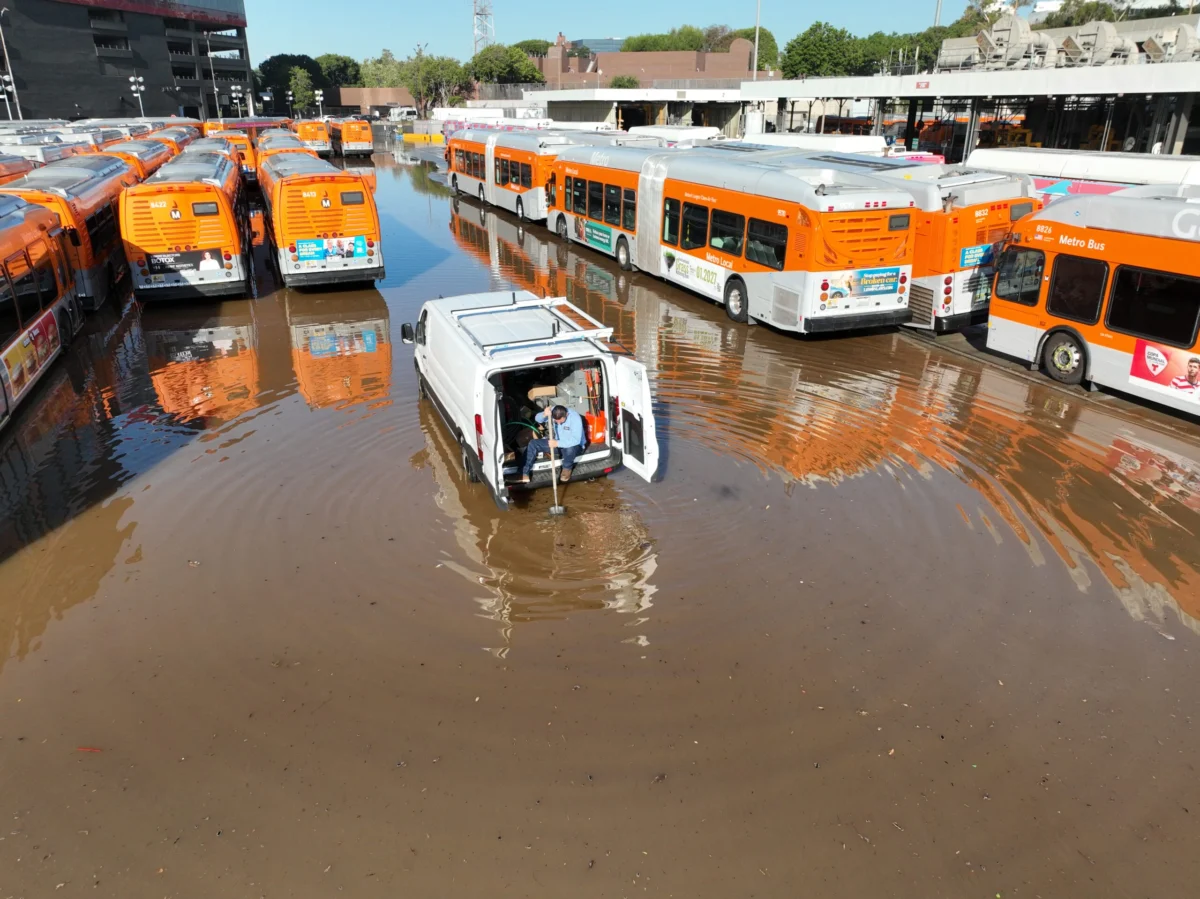
The widespread inundation also impacted public transportation. A West Hollywood bus yard located below Santa Monica Boulevard was inundated with water, leading to disruptions in service. Officials from Los Angeles Metro announced that bus lines 16 and 105 would experience modifications. Northbound and westbound buses on these lines were rerouted to lay over on San Vicente Boulevard in front of the Pacific Design Center, while eastbound and southbound buses were detoured via Robertson Boulevard between Santa Monica Boulevard and Melrose Avenue.
In a testament to the coordinated emergency response, Dave Hanson, Chief Operating Officer and Senior Assistant General Manager for the LADWP, confirmed that the department’s emergency command center had been activated. This activation facilitated seamless communication between LADWP’s emergency management team, the city of West Hollywood’s emergency management department, and other relevant agencies.
“We’d like to extend our apologies to the community for the impact that this has had on you,” Hanson stated. “Luckily, at this time, we don’t have services that are out, so everybody does have clean water that’s safe to drink.” This assurance regarding the continued availability of potable water, despite the scale of the infrastructure failure, provided a small measure of relief amidst the chaos.
The Underpinning Crisis: Aging Infrastructure and its Perils
The catastrophic failure of the 36-inch steel pipe beneath Sunset Boulevard is a stark reminder of the ongoing challenges posed by aging infrastructure in major metropolitan areas across the United States. The pipe, estimated to be over a century old, represents a segment of a water distribution system that has served Los Angeles and its surrounding communities for generations. While these systems have been instrumental in supporting the region’s growth and development, their age inevitably leads to increased vulnerability to leaks, breaks, and eventual failure.
The sheer size of the ruptured pipe – 36 inches in diameter – indicates the immense volume of water it was designed to carry, and consequently, the devastating potential of its failure. Such large-diameter pipes are critical components of the municipal water supply network, serving as primary conduits for delivering water to vast populations. Their failure not only disrupts service but can also lead to significant localized flooding, property damage, and the creation of hazardous conditions, as witnessed in West Hollywood.
Chronology of the Event
- Approximately 2:30 a.m. Thursday: A rupture occurs in a 36-inch steel water main at the intersection of Sunset Boulevard and Holloway Drive in West Hollywood.
- Shortly after the rupture: Major flooding begins to inundate streets, damage parked vehicles, and enter residential and commercial properties.
- Approximately 5:00 a.m. Thursday: The Los Angeles County Sheriff’s Department issues a Nixle advisory detailing extensive road closures in the affected area.
- Around 7:30 a.m. Thursday: The Los Angeles Department of Water and Power (LADWP) successfully shuts off the water supply to the ruptured main, halting the immediate flow of water.
- Throughout Thursday morning: City of West Hollywood’s Department of Public Works personnel, LADWP crews, and other emergency responders arrive on scene to assess damage, initiate cleanup, and begin planning for repairs.
- Thursday morning: Los Angeles Mayor Karen Bass visits the site to assess the situation and address the public.
- Thursday afternoon: Officials confirm that no residents require evacuation, though significant property damage has occurred, and road closures remain in effect. A timeline for repairs is not yet established.
Broader Implications and Future Considerations
The West Hollywood water main break serves as a potent case study for the broader challenges of maintaining and upgrading aging urban infrastructure. The economic impact of such events is multifaceted, encompassing the direct costs of emergency response, repairs, and property damage, as well as the indirect costs associated with business disruptions, traffic delays, and potential long-term impacts on property values.
For West Hollywood, a city renowned for its vibrant culture and dense urban environment, this incident highlights the critical need for proactive infrastructure investment. The reliance on pipes that are over a century old raises questions about the adequacy of past and present capital improvement plans. Experts in urban planning and civil engineering consistently emphasize the importance of regular inspections, systematic upgrades, and the replacement of aging components before catastrophic failures occur.
The incident also underscores the interconnectedness of municipal services. The disruption to bus services, for instance, illustrates how a failure in one critical system can have cascading effects on others. Effective coordination between different city departments, utility providers, and emergency management agencies is paramount in mitigating the impact of such crises.
Looking ahead, the focus will undoubtedly shift towards the extensive repair efforts and the long-term strategy for addressing the city’s aging water infrastructure. The LADWP and the city of West Hollywood face the daunting task of not only fixing the immediate problem but also ensuring that similar incidents are prevented in the future. This will likely involve a comprehensive review of the water system’s condition, a prioritization of repair and replacement projects, and potentially, an increase in funding allocated to infrastructure maintenance. The lessons learned from this event will undoubtedly inform future planning and investment in ensuring the resilience and reliability of essential public services for years to come.