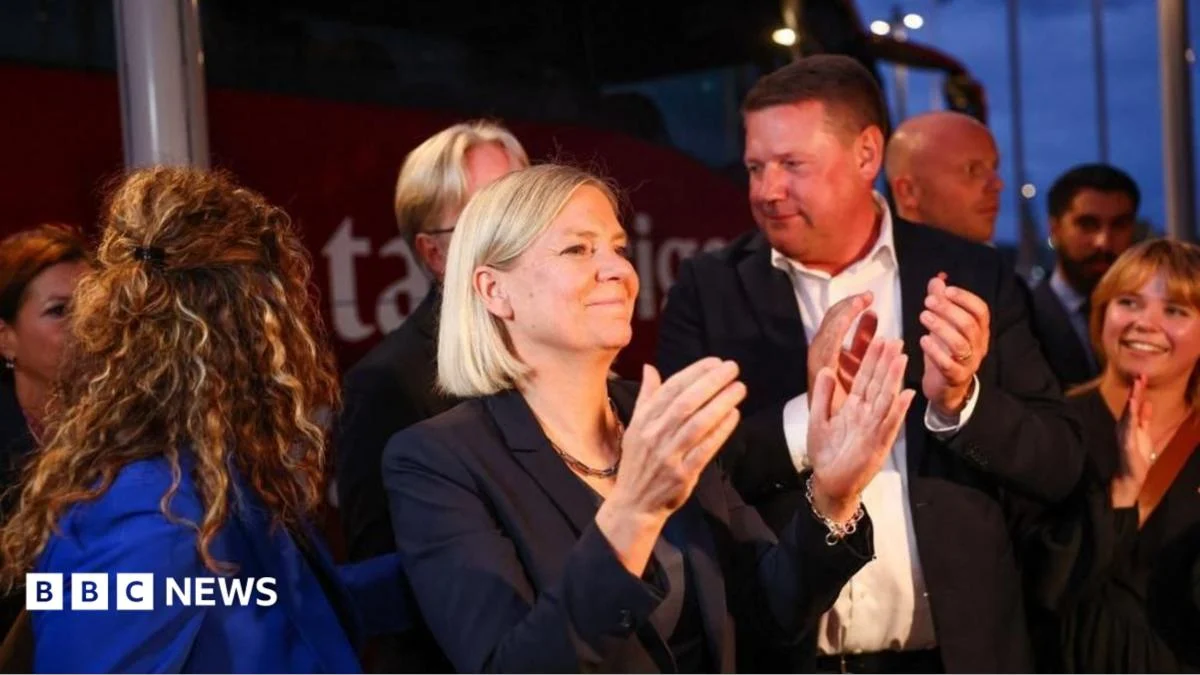
The recent general election in Sweden marked a profound shift in the country’s political landscape, challenging long-held norms and ushering in an era of complex governance. Historically characterized by stable, often coalition or minority governments formed within two major political blocs—one featuring four parties on the right and another four on the left—the nation found itself at a pivotal juncture. The vote on Sunday, September 11, 2022, was not merely an election but a referendum on the future direction of a country grappling with evolving societal challenges and the rise of a once-marginalized political force.
A Nation Divided: The Contested 2022 General Election
The 2022 general election concluded with an exceptionally tight race, ultimately leading to a change in government and signaling a significant realignment of political power. The stakes were high, with then-Prime Minister Magdalena Andersson, leader of the Social Democrats, articulating a stark choice for the Swedish electorate. After casting her ballot, Andersson emphasized the gravity of the decision: "Should we have a government entirely dominated by the Sweden Democrats, something that has never happened in Sweden before? Or should we have a government led by me, which will steer Sweden in a new spirit of co-operation?" Her statement underscored the unprecedented nature of the election, highlighting the potential for the far-right Sweden Democrats (SD) to wield significant influence, directly or indirectly, over the nation’s governance.
Conversely, Ulf Kristersson, leader of the Moderate Party and the de facto head of the right-wing bloc, expressed confidence in his alliance’s ability to continue its work. Speaking after casting his vote in his home municipality of Strängnäs, Kristersson stated, "I think there is a genuine enthusiasm for us being able to continue our important work." His remarks reflected the collective aspiration of the right-wing parties to secure a mandate for their policy agenda, which had been sharply contrasted with that of the incumbent Social Democrats. The election campaign itself was dominated by a triumvirate of critical issues: national security, escalating gang crime, and the future of welfare spending, each resonating deeply with different segments of the electorate.
The Shifting Sands of Swedish Democracy: A Historical Perspective
For decades, Swedish politics was synonymous with stability, consensus, and the robust development of a comprehensive welfare state. This "Swedish Model" became an international benchmark for social democracy, largely engineered and maintained by one dominant political force.
The Enduring Legacy of the Social Democrats
Andersson’s party, the Social Democrats (Socialdemokraterna), has been an unparalleled force in Swedish politics since the end of World War Two. Their ascendancy in the post-war era laid the foundation for modern Sweden, characterized by strong unions, universal social benefits, and a commitment to equality. From the 1930s to the 1990s, the Social Democrats governed for all but nine years, often with outright majorities or as the dominant partner in minority governments. Key figures like Tage Erlander and Olof Palme became symbols of this era, presiding over an economic boom and the expansion of the welfare state. This long period of dominance fostered a political culture where the Social Democrats were seen as the natural party of government, deeply embedded in the national consciousness. However, from the late 20th century onwards, their grip began to loosen as economic globalization, demographic shifts, and new political cleavages challenged their traditional base and policy frameworks.
The Traditional Blocs and the Rise of Fragmentation
Swedish politics traditionally organized itself around two main constellations: the centre-left "Red-Green" bloc (Social Democrats, Green Party, Left Party) and the centre-right "Alliance" (Moderates, Centre Party, Liberals, Christian Democrats). These blocs, while ideologically distinct, often found common ground on procedural matters and upheld a certain level of cross-party cooperation. However, the proportional representation system, while ensuring broad representation, often necessitates coalition or minority governments, making stable majorities a consistent challenge.
In recent decades, this traditional two-bloc system has faced increasing strain. The Centre Party, for instance, has at times refused to cooperate with the Moderates if it meant relying on the Sweden Democrats, thereby complicating the formation of a clear right-wing government. This increasing fragmentation, coupled with the rise of new political actors and issues, has made the process of government formation more arduous and less predictable, pushing Swedish democracy into uncharted territory where traditional alliances are no longer guaranteed.
The Unprecedented Ascent of the Sweden Democrats
Perhaps the most significant development in modern Swedish political history has been the meteoric rise of the Sweden Democrats (Sverigedemokraterna, SD). Their journey from a fringe, pariah party to a formidable political player has reshaped the national debate and forced a re-evaluation of political strategy across the spectrum.
From Fringe to Kingmakers: A Controversial Genesis
The SD was founded in 1988, emerging from a milieu with strong ties to extreme nationalism and white supremacism, including individuals who held sympathies for Nazism. For decades, the party was effectively shunned by all other established political parties, which maintained a "cordon sanitaire"—a policy of non-cooperation and exclusion. This strategy aimed to prevent the normalization of a party whose foundational ideology was seen as incompatible with Sweden’s liberal democratic values. During the 1990s and 2000s, the SD underwent a strategic "image clean-up," attempting to shed its extremist associations. This involved expelling members with overt racist or neo-Nazi views, moderating some of its rhetoric, and focusing its public messaging on more mainstream, albeit still controversial, issues. Despite these efforts, its origins remained a point of contention and a significant barrier to its acceptance in mainstream politics.
Capitalizing on Discontent: Immigration and Crime as Catalysts
The turning point for the SD came as Sweden experienced significant societal changes, particularly concerning immigration and its perceived consequences. Sweden, renowned for its generous asylum policies, saw a substantial influx of refugees, especially during the 2015 European migrant crisis. While many Swedes initially welcomed this humanitarian approach, concerns gradually mounted regarding integration challenges, strain on public services, and, crucially for the SD, a perceived link between immigration and rising crime rates.
The SD adeptly capitalized on these anxieties, crafting a campaign platform that relentlessly focused on violent crime and immigration. They argued for significantly stricter immigration policies, more effective deportation measures, and tougher penalties for criminals. Data from the Swedish National Council for Crime Prevention (Brå) showed a rise in certain types of violent crime, particularly gun violence and gang-related incidents, which became a dominant narrative in the public discourse. While experts debated the precise correlation with immigration, the public perception, fueled by media reports and the SD’s messaging, increasingly connected these issues. The party’s clear, uncompromising stance resonated with voters who felt ignored or dismissed by traditional parties on these issues.
By the 2022 election, the SD had successfully mainstreamed many of its concerns, becoming the country’s second-largest party, a dramatic ascent from their 2010 entry into parliament. Their electoral success reflected a broader shift in voter priorities and a growing disillusionment with the established political order, which many perceived as having failed to adequately address these pressing societal challenges. The cordon sanitaire had effectively crumbled, forcing other right-wing parties to engage with the SD, transforming them from pariahs into potential kingmakers.
Key Electoral Battlegrounds: Issues Defining the Swedish Mandate
The 2022 election was fought on a battleground of critical issues, each reflecting deep-seated concerns within the Swedish populace and demanding clear policy proposals from the competing parties.
National Security in a New Geopolitical Era
The issue of national security took on unprecedented urgency in the run-up to the 2022 election, primarily due to Russia’s full-scale invasion of Ukraine in February of that year. This geopolitical shockwave fundamentally altered Sweden’s long-standing policy of military non-alignment. Historically, Sweden had maintained neutrality, a doctrine that had served it well through two World Wars and the Cold War. However, the aggression in Ukraine prompted a rapid and historic reconsideration, leading Sweden, alongside Finland, to apply for membership in the North Atlantic Treaty Organization (NATO).
This shift became a central campaign theme. The Social Democrats, under Magdalena Andersson, were at the helm during the NATO application process, navigating complex international diplomacy. The right-wing bloc largely supported the NATO bid, but debates emerged regarding defense spending, military readiness, and the implications of closer integration with Western alliances. Voters were keenly aware that the election would determine the leadership guiding Sweden through this significant geopolitical transformation, impacting its role on the global stage and its fundamental security posture.
Confronting Gang Violence: A Growing Societal Challenge
Few issues gripped the Swedish public as intensely as the alarming rise in gang-related violence, particularly gun crime and bombings. Sweden, once known for its low crime rates, had witnessed a disturbing surge in fatal shootings and grenade attacks, primarily concentrated in vulnerable socio-economic areas of its major cities. Statistics from Brå indicated that Sweden had moved from having some of the lowest rates of fatal gun violence in Europe to being among the highest in certain categories.
This issue transcended traditional political divides, creating a broad consensus that urgent action was required. However, the proposed solutions differed sharply. The Social Democrats emphasized social prevention programs, increased police presence, and investment in vulnerable communities. The right-wing parties, spearheaded by the Moderates and strongly echoed by the Sweden Democrats, advocated for a much tougher, "law and order" approach: harsher sentences, increased surveillance, more effective policing, and a focus on deportation for foreign nationals involved in crime. The debate over gang violence highlighted a deep societal anxiety and became a proxy for broader discussions about integration, social cohesion, and the effectiveness of state institutions.
Safeguarding the Welfare State Amid Economic Headwinds
The core of the Swedish Model—its comprehensive welfare state—also faced scrutiny amidst global economic instability. The election occurred against a backdrop of rising inflation, increasing energy costs, and the lingering economic effects of the COVID-19 pandemic. Concerns about the cost of living, access to quality healthcare, educational standards, and the sustainability of pensions became central to the economic debate.
All parties pledged to protect and strengthen the welfare state, but their approaches varied significantly. The Social Democrats and their left-wing allies advocated for continued public investment, progressive taxation, and targeted support for vulnerable households. The right-wing bloc, while also promising to maintain essential services, often emphasized fiscal responsibility, tax cuts, and reforms aimed at improving efficiency and reducing bureaucracy. The debate over welfare spending encapsulated the perennial tension between social equity and economic growth, with voters seeking assurances that their standard of living and access to essential services would be protected in uncertain times.
The Post-Election Landscape: Navigating a Fractured Parliament
The immediate aftermath of the 2022 general election was characterized by uncertainty and intense negotiations, as no single bloc secured an outright majority, a common occurrence in Sweden’s multi-party system.
The Path to Government: Complex Negotiations and Alliances
Election night saw a razor-thin margin, with the right-wing bloc ultimately gaining a narrow lead of three seats in the 349-seat Riksdag (parliament). This result, however, was predicated on the inclusion of the Sweden Democrats, whose significant gains—making them the second-largest party with 73 seats—were pivotal. For the first time, a right-wing government could only be formed with their direct or indirect support.
This presented a significant challenge for Ulf Kristersson and the Moderate Party, as their traditional partners, the Christian Democrats and Liberals, had historically maintained a distance from the SD. The ensuing negotiations were protracted and complex, lasting over a month. They culminated in the "Tidö Agreement," a comprehensive 62-page policy platform that outlined the basis for a new government. Crucially, while the Moderates, Christian Democrats, and Liberals formed a minority coalition government, the Sweden Democrats were granted unprecedented influence, becoming an indispensable external support party. They secured key concessions on policy areas central to their agenda, particularly immigration and crime, and were given significant input into legislative priorities and committee appointments. This arrangement effectively ended the long-standing political isolation of the SD.
Leaders’ Calls: Co-operation vs. Continuity
Magdalena Andersson’s call for a "new spirit of co-operation" post-election hinted at a potential willingness to explore broader alliances, perhaps even across the traditional bloc lines, to prevent a government heavily influenced by the Sweden Democrats. Her statement reflected the deep concern within the Social Democrats and the wider centre-left about the implications of normalizing the SD. However, given the electoral outcome, her party ultimately moved into opposition.
Ulf Kristersson’s declaration of "genuine enthusiasm" reflected the right bloc’s determination to form a government after eight years in opposition. His confidence was based on the numerical reality that their path to power, however challenging, lay through cooperation with the SD. The immediate reactions from other parties varied: the Centre Party, which had traditionally been part of the Alliance, expressed profound regret and concern over the right-wing’s embrace of the SD, choosing instead to remain outside of government. The Green Party and the Left Party, while acknowledging the democratic outcome, also voiced strong criticism of the SD’s newfound influence and warned of potential negative consequences for Swedish society.
Implications for Sweden and Beyond
The 2022 Swedish general election is not just a chapter in the nation’s political history; it represents a fundamental recalibration with far-reaching implications for its governance, societal values, and international standing.
A New Political Era: The End of the Cordon Sanitaire
The most immediate and profound impact of the 2022 election is the definitive end of the "cordon sanitaire" that had isolated the Sweden Democrats for decades. Their integration, even as an external support party, into the governing framework marks a new political era. This normalization has several facets: it legitimizes the SD as a mainstream political actor, potentially paving the way for even closer cooperation or direct participation in future governments. It also forces other parties, particularly those on the right, to continuously engage with and respond to the SD’s policy positions, thereby shifting the overall political discourse. Critics fear this normalization could erode democratic norms and values by mainstreaming ideas rooted in extreme nationalism. Conversely, proponents argue it is a necessary adaptation to a changing electorate and an acknowledgement of the SD’s democratic mandate.
Policy Shifts and Governance Challenges
Under the new Kristersson government, supported by the Tidö Agreement, significant policy shifts are anticipated. The most pronounced changes are expected in immigration policy, with a likely move towards stricter controls, reduced asylum seeker numbers, and enhanced deportation measures. On crime, a tougher "law and order" approach is expected, including increased police powers, harsher penalties, and a focus on combating gang violence. While welfare spending and environmental policies were also part of the agreement, the SD’s influence on immigration and crime is particularly salient.
The nature of this minority government, reliant on a powerful external support party, presents inherent governance challenges. The SD, though not formally in cabinet, holds significant leverage, capable of destabilizing the government if their demands are not met. This dynamic could lead to a less predictable legislative process, requiring constant negotiation and compromise, potentially at the expense of government stability and long-term planning.
Sweden’s Image on the Global Stage
For decades, Sweden cultivated an international image as a beacon of progressive values, humanitarianism, and social liberalism. The rise of a far-right party with roots in extreme nationalism to a position of significant influence will inevitably alter this perception. While Sweden remains committed to its international obligations and its new NATO membership, observers globally will be watching closely for any shifts in its domestic policies, particularly concerning human rights, integration, and democratic principles. The election outcome could spark debates about the trajectory of liberal democracies in an era of rising populism and nationalism, prompting questions about the resilience of the "Swedish Model" in the face of evolving political realities. The 2022 election thus signifies not just a change in government, but a profound re-evaluation of Sweden’s identity both at home and abroad.