


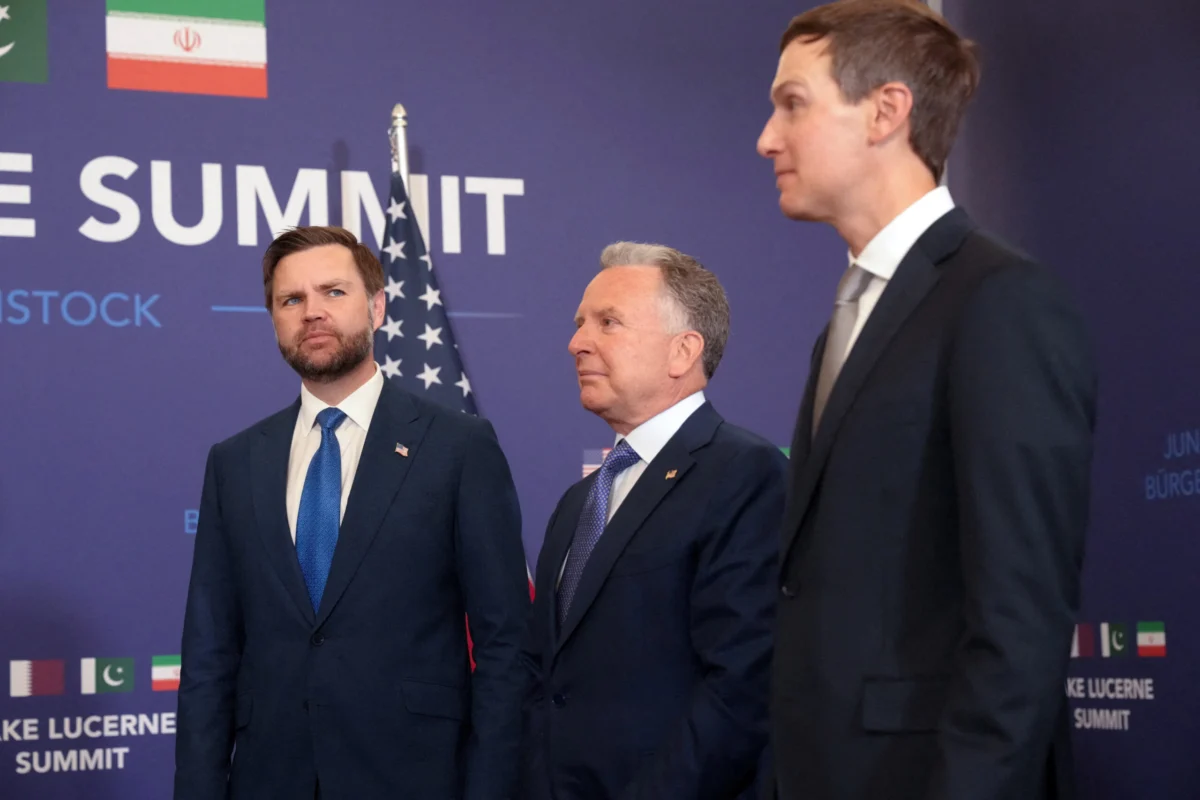
The picturesque Burgenstock luxury hotel complex, perched dramatically above Lake Lucerne in Switzerland, became the epicenter of high-stakes international diplomacy on Sunday, June 22, 2026. US Vice President JD Vance arrived to spearhead American negotiations with Iran, a crucial phase aimed at solidifying a comprehensive deal to end the protracted Middle East conflict. His arrival, however, was immediately overshadowed by a renewed declaration from Tehran that the strategically vital Strait of Hormuz had been closed, intensifying an already volatile geopolitical landscape just hours before the talks were set to commence.
This latest development follows an interim agreement struck just last week between US President Donald Trump and Iranian President Masoud Pezeshkian, an accord that brought a glimmer of hope after nearly four months of intense regional conflict. The interim deal had specifically called for an immediate cessation of military actions by Israel in Lebanon and the full, unimpeded reopening of the Strait of Hormuz, free of any tolls imposed by Iran, for at least 60 days. The current round of negotiations in Switzerland is tasked with fleshing out the technical details and converting this preliminary understanding into a durable, final agreement within a tight two-month deadline.
The Diplomatic Setting and Key Delegations
Switzerland’s Federal Department of Foreign Affairs confirmed the arrival of all principal parties at the Burgenstock. "The U.S. delegation, led by U.S. Vice President JD Vance, the Iranian delegation, led by the Speaker of the Iranian Parliament, Mohammad Bagher Ghalibaf, and the mediators, Pakistan and Qatar, have arrived at the Bürgenstock," read an official statement. Prime Minister Shehbaz Sharif of Pakistan, a key mediator alongside Qatar, was seen preparing to meet with the US delegation, which also included President Trump’s special envoy Steve Witkoff and Trump’s son-in-law Jared Kushner. These individuals are understood to be deeply involved in the intricate technical discussions required to bridge the remaining gaps between Washington and Tehran. The presence of such high-level envoys underscores the urgency and complexity of the current diplomatic push.
The choice of Switzerland, a nation renowned for its neutrality and long history of facilitating sensitive international negotiations, reflects the delicate nature of the discussions. The Burgenstock resort, with its secluded location and state-of-the-art facilities, provides a secure and discreet environment conducive to complex, potentially contentious, dialogue.
Escalating Tensions: Strait of Hormuz and Lebanon
The optimism generated by the interim agreement was severely tested by events unfolding just prior to the Swiss summit. On Saturday, Iran’s Tasnim news agency, citing sources close to its negotiating team, reported Tehran’s decision to close the Strait of Hormuz again. This critical maritime choke point, through which approximately one-fifth of the world’s total oil consumption transits daily, has been a recurring flashpoint in US-Iran relations for decades. The Iranian source explicitly linked the closure to two conditions: the non-respect of a ceasefire in Lebanon and the failure to issue waivers allowing the sale of Iranian oil, a clear reference to economic sanctions.
Iran’s joint military command further elaborated, stating that the closure was a direct response to "continued Israeli military operations in Lebanon" and what it termed "U.S. ‘bad faith’ and a failure to uphold commitments under the truce framework." Iranian state television also warned of "subsequent steps" if what it labeled "aggression" persisted. These statements signal a hardening of Iran’s stance, potentially aimed at increasing its leverage at the negotiating table.
These declarations from Tehran followed reports of significant violence in southern Lebanon. On Saturday, Israeli strikes in the region reportedly killed at least 16 people, including two children, according to Lebanese authorities cited by the Associated Press. Lebanon’s state-run National News Agency also reported that seven individuals remained trapped beneath rubble in Nabatiyeh and nearby villages following these attacks. The timing of these strikes and Iran’s subsequent response highlights the deeply interconnected and fragile nature of the broader regional conflict that the Swiss talks aim to address.
Conflicting Narratives and US Reassurance
In stark contrast to Iran’s claims, the United States firmly denied that the Strait of Hormuz had been closed. U.S. Central Command spokesperson Navy Captain Tim Hawkins explicitly stated, "Iran does not control the Strait of Hormuz. Traffic continues to flow, and U.S. forces are monitoring the situation to ensure this remains the case." He emphasized that US forces were actively observing the waterway to ensure its continued openness for international shipping.
President Donald Trump echoed this stance, indicating his administration considered the Strait open for traffic. However, he introduced a new element of potential future economic pressure. In a Truth Social post late Saturday, President Trump suggested that if the interim agreement failed to convert into a final deal within the 60-day timeframe, the U.S. could begin charging ships to transit the Strait. "There will be NO TOLLS in the Hormuz Strait for 60 days during the Cease Fire Period, and there will be NO TOLLS after the 60 day period has expired, unless they are imposed by and for the United States of America, should the deal not be completed," he wrote, claiming such a charge would be for "services rendered." This assertion introduces a novel, and potentially contentious, interpretation of international maritime law and could further complicate negotiations by adding another layer of economic threat.
Vice President Vance, despite the alarming headlines, maintained an optimistic outlook upon his arrival in Switzerland. He pointed to a significant rebound in tanker traffic following the initial ceasefire agreement as evidence that the Strait remained operational. "We actually got 16 million barrels of oil out of the Strait of Hormuz yesterday," Vance told reporters, highlighting that this was "a record going back to even before the conflict started." This data point served to counter the narrative of a closed Strait and underscored the economic benefits of the ceasefire, even if partial.
The Broader Agenda: Nuclear Ambitions and Regional Stability
Beyond the immediate crisis surrounding the Strait of Hormuz and the Lebanon ceasefire, Iran’s nuclear weapons program remains a paramount concern on the negotiating agenda. Vice President Vance articulated this priority before boarding his flight to Switzerland, expressing his hope to "make progress on the nuclear issue" alongside the "Lebanon ceasefire issue."
International Atomic Energy Agency (IAEA) Director General Rafael Grossi’s presence in Switzerland further highlighted the nuclear dimension of the talks. Grossi posted on X that he met with Swiss Foreign Minister Ignazio Cassis "to take stock of recent developments regarding Iran, the path ahead and the important role of the IAEA." He emphasized, "At this critical moment, it’s important to give diplomacy every opportunity to succeed." The IAEA plays a crucial role in monitoring Iran’s nuclear activities, and any comprehensive deal would likely involve enhanced inspections and verifiable commitments from Tehran regarding its nuclear program.
Vance specifically mentioned negotiators’ focus on "securing Iran’s enriched uranium stockpile to make it ‘effectively impossible’ for Tehran to rebuild its nuclear program." This objective implies a demand for significant reductions in Iran’s enriched uranium reserves and potentially limitations on its enrichment capabilities, echoing past international efforts to curb Iran’s nuclear ambitions. The US administration’s stance suggests a push for a robust, verifiable framework to prevent Iran from developing nuclear weapons.
The Role of Mediators and Economic Leverage
The involvement of Pakistan and Qatar as mediators is crucial. Their diplomatic channels and relationships with both the US and Iran allow for indirect communication and trust-building, which are often essential in such deeply entrenched conflicts. Pakistan’s Prime Minister Shehbaz Sharif’s direct engagement with the US delegation underscores the importance of this facilitative role.
Vance also reiterated the United States’ "significant economic leverage" should Iran fail to comply with the agreement. While not explicitly detailed, this leverage likely refers to the continuation or re-imposition of stringent economic sanctions, which have historically crippled Iran’s oil exports and financial system. The prospect of these sanctions being maintained or intensified provides a powerful incentive for Iran to adhere to any agreed-upon terms.
Historical Context and Implications
The current negotiations occur against a backdrop of decades of animosity and mistrust between the United States and Iran, exacerbated by the recent "four months of war" whose specific nature (e.g., proxy conflicts, direct military confrontations, cyber warfare) has not been fully detailed but clearly led to significant regional instability. The Strait of Hormuz has historically been a flashpoint, with past threats of closure or mining operations periodically disrupting global oil markets and leading to naval deployments. Its significance cannot be overstated for global energy security and international trade.
The conflict in Lebanon, involving Israel and various non-state actors, represents another persistent source of regional instability. A lasting ceasefire and de-escalation along the Israel-Lebanon border are critical for broader peace in the Middle East. The interconnectedness of these issues—the Strait, Lebanon, and Iran’s nuclear program—makes the Swiss talks exceptionally complex.
Challenges and Outlook for a Final Deal
The path to a final agreement within the 60-day timeframe is fraught with challenges. The immediate dissonance between Iranian and US statements regarding the Strait of Hormuz’s status underscores the deep mistrust and the differing interpretations of commitments. The ongoing violence in Lebanon further complicates efforts to build confidence.
Converting an interim agreement, which largely sets out principles, into a detailed, legally binding, and verifiable final deal requires immense diplomatic skill and political will from all sides. Technical details concerning nuclear safeguards, mechanisms for sanction relief, and concrete steps for regional de-escalation will need to be meticulously negotiated. The presence of Jared Kushner and Steve Witkoff, working on these technical details, suggests an acknowledgment of this complexity.
As the talks commence, the international community watches with bated breath. The outcome will not only determine the immediate future of US-Iran relations but also profoundly impact regional stability, global energy markets, and the trajectory of international efforts to prevent nuclear proliferation. The Burgenstock summit, therefore, represents a critical juncture where diplomacy attempts to navigate a perilous course amidst entrenched hostilities and escalating tensions.