


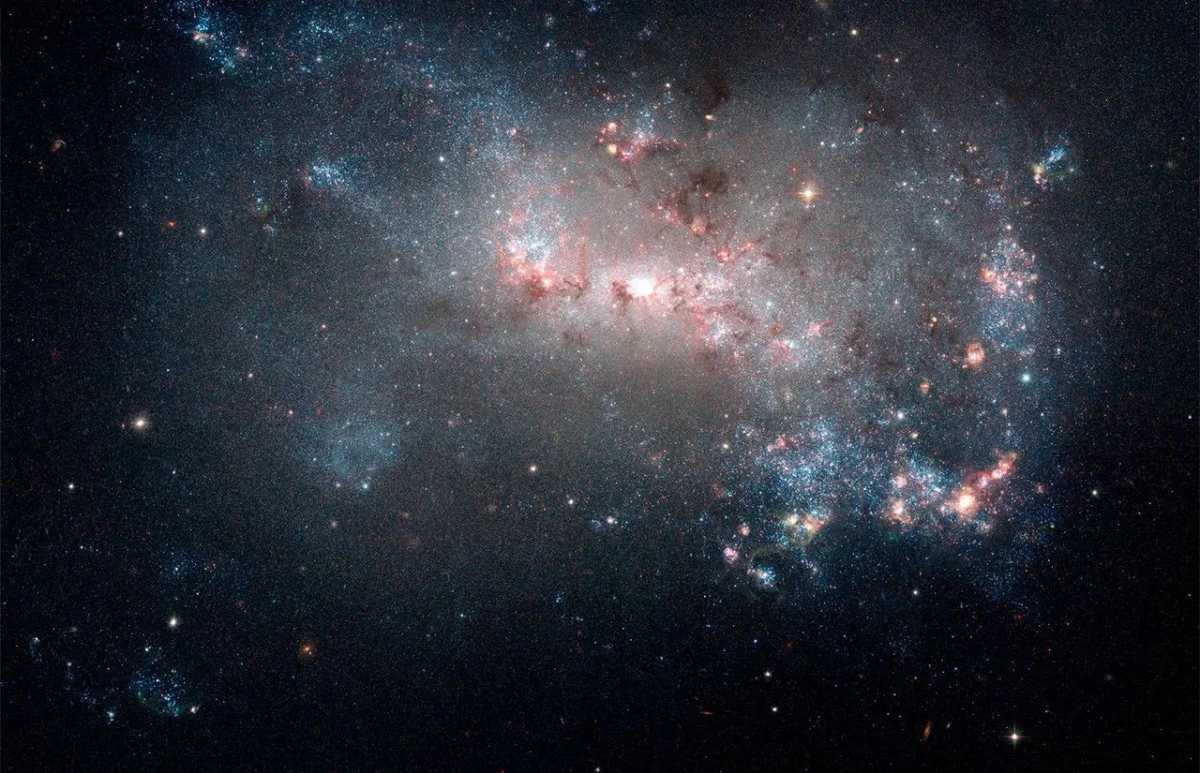
The vast cosmic tapestry, often dominated by the grandeur of colossal spiral and elliptical galaxies, holds a profound secret within its smallest members: dwarf galaxies. These diminutive stellar systems, though modest in size, are now understood to play a surprisingly significant role in the universe’s chemical evolution. Recent observations by the venerable Hubble Space Telescope, spotlighting the irregular dwarf galaxy NGC 4449, have provided crucial insights into how these compact stellar nurseries act as powerful engines for distributing vital heavy elements throughout the cosmos—elements fundamental to the formation of stars, planets, and ultimately, life itself.
The Enigma of Dwarf Galaxies: Small Size, Big Impact
Dwarf galaxies represent the most numerous type of galaxy in the universe, vastly outnumbering their larger, more famous counterparts. While our own Milky Way spans approximately 100,000 light-years and harbors hundreds of billions of stars, dwarf galaxies typically measure about one-tenth of that size, containing a mere few billion stars. Their prevalence, however, belies their previously underestimated influence on the intergalactic medium. These galaxies are considered cosmic relics, potentially representing the building blocks from which larger galaxies assembled over billions of years. Their irregular shapes and often vigorous star-forming regions make them laboratories for understanding early galaxy evolution.
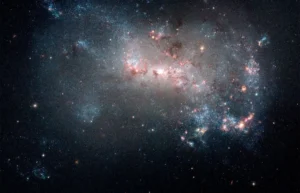
NGC 4449, located approximately 12.5 million light-years away in the constellation Canes Venatici, serves as an exemplary case study. Visually, it presents as a striking, elongated smear of stars, almost resembling a bow-tie across the celestial canvas. Its central region is ablaze with vibrant pink clumps of gas, indicative of active star formation, while its outer reaches are adorned with a mix of blue-white stars, intricate streaks of dark dust, and additional effervescent pink gaseous nebulae. This visual dynamism is a direct consequence of its intense star-forming activity, a characteristic feature of many irregular dwarf galaxies. Unlike the more orderly spirals or the quiescent ellipticals, NGC 4449’s chaotic structure speaks to a turbulent history and ongoing energetic processes.
The "Missing Oxygen" Paradox and Cosmic Chemical Enrichment
A central revelation from the Hubble observations of NGC 4449 concerns its peculiar elemental composition, specifically a significant depletion of oxygen. Models designed to predict the abundance of heavy elements in galaxies based on their star formation rates have consistently struggled to account for the lower-than-expected levels of oxygen observed in many dwarf galaxies, including NGC 4449. This discrepancy has puzzled astronomers, as oxygen, being the third most abundant element in the universe after hydrogen and helium, is a primary product of stellar nucleosynthesis within massive stars and a critical tracer of chemical evolution.
The explanation for this "missing oxygen" lies in the remarkable efficiency of stellar feedback mechanisms within these smaller galaxies. Stellar winds—powerful outflows of gas ejected from massive, hot stars—and supernovae—the catastrophic explosions marking the end of life for very massive stars—are surprisingly effective at expelling not only oxygen but also other heavy elements (collectively termed "metals" by astronomers) from dwarf galaxies. These processes generate immense energy, capable of driving galactic-scale outflows that can strip a dwarf galaxy of its chemically enriched gas.
In larger galaxies like the Milky Way, the gravitational pull is substantial enough to retain much of this expelled material, allowing it to be reincorporated into subsequent generations of stars. However, dwarf galaxies, with their shallower gravitational potential wells, are less capable of holding onto these energetic outflows. The gas, now enriched with elements forged in stellar interiors, is blown out into the vast, nearly empty expanse of the intergalactic medium. This process, far from being a mere loss for the dwarf galaxy, transforms them into crucial agents for seeding the wider universe with the building blocks of complexity.
Hubble’s Enduring Legacy in Deep Space Observations
The ability to resolve and analyze the detailed chemical composition and star-forming regions within galaxies like NGC 4449 is a testament to the unparalleled capabilities of the Hubble Space Telescope. Launched in 1990, Hubble has revolutionized our understanding of the universe, offering humanity an unprecedented view of cosmic phenomena across a broad spectrum of wavelengths, from ultraviolet to near-infrared. Its position above Earth’s obscuring atmosphere grants it exceptional clarity and sensitivity, allowing astronomers to discern individual stars, gas clouds, and the intricate structures within distant galaxies.
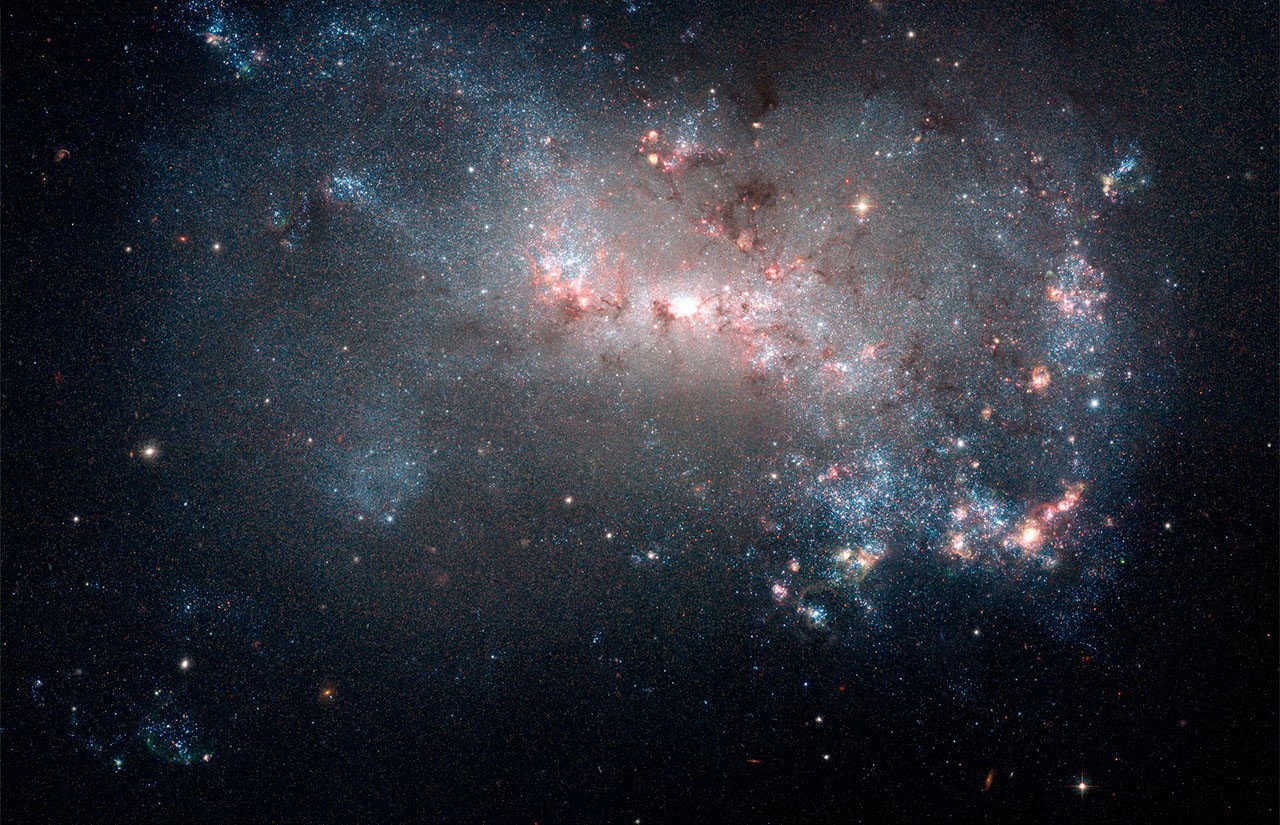
For observations of dwarf galaxies, Hubble’s high angular resolution is paramount. It allows researchers to distinguish between different star-forming regions, analyze the spectra of individual nebulae, and trace the distribution of various elements. The data from Hubble, meticulously collected and processed by teams of international scientists, has been instrumental in building detailed models of galaxy evolution, stellar populations, and the lifecycle of cosmic matter. The imagery of NGC 4449, captured by Hubble, not only provides aesthetic beauty but also a wealth of spectroscopic and photometric data that underpins these profound scientific conclusions.
A Chronology of Discovery and Evolving Understanding
The study of dwarf galaxies has evolved significantly over the past century. Initially viewed primarily as satellite galaxies or minor companions to larger systems, their independent cosmological significance began to emerge with improved observational techniques and theoretical models. Early 20th-century astronomical surveys cataloged numerous faint, diffuse nebulae, many of which were later identified as dwarf galaxies. The mid-to-late 20th century saw the development of more sophisticated models of galaxy formation, which posited that smaller structures formed first and then merged to build larger galaxies in a hierarchical manner.
The advent of space-based telescopes like Hubble in the late 20th century marked a new era. For the first time, astronomers could consistently obtain high-resolution images and spectroscopic data of dwarf galaxies far beyond the Local Group. This allowed for detailed studies of their star formation histories, internal dynamics, and chemical abundances. The "missing oxygen" problem began to solidify as a significant anomaly in the early 21st century, as more precise measurements became available. The observations of NGC 4449, culminating in the current understanding of its role in heavy element dispersal, represent a pivotal point in this ongoing chronological scientific journey, refining our models of how galaxies interact with their environments and enrich the cosmos. This research builds upon decades of foundational work in astrophysics, combining observational prowess with theoretical advancements.
Attribution and Collaborative Science
The findings regarding NGC 4449 are the result of extensive collaborative efforts, highlighting the international nature of modern astronomical research. The specific observations and analysis were credited to NASA, ESA (European Space Agency), A. Aloisi (Space Telescope Science Institute/ESA), and the Hubble Heritage (STScI/AURA)-ESA/Hubble Collaboration. The scientific team responsible for explaining and interpreting these complex observations includes authors and editors such as Keighley Rockcliffe, Robert Nemiroff, Jerry Bonnell, and Cecilia Chirenti. Such collaborations are essential for leveraging the global expertise and resources required to operate advanced observatories like Hubble and to process the immense volumes of data they generate.
These institutions and individuals represent a broad consortium of expertise: NASA and ESA provide the operational framework for Hubble, while STScI manages its scientific operations. Researchers like Dr. Aloisi contribute their specialized knowledge in galaxy evolution and star formation. The collective effort ensures rigorous analysis, peer review, and the dissemination of accurate scientific information to both the scientific community and the public. The Astronomy Picture of the Day (APOD) itself is a service provided by the Astrophysics Science Division (ASD) at NASA/GSFC, NASA Science Activation, and Michigan Tech. University, underscoring the commitment to public engagement and education in science.
Broader Implications for Cosmic Evolution and the Genesis of Life
The realization that dwarf galaxies are highly effective at blowing away oxygen and other heavy elements carries profound implications for our understanding of cosmic chemical evolution. These ejected elements—carbon, nitrogen, oxygen, silicon, iron, and many others—are not merely lost to the void. Instead, they become constituents of the intergalactic medium, available to be incorporated into new generations of stars and planetary systems that may form in other galaxies or in the diffuse gas clouds between them.
This process is critical because these heavy elements are the fundamental building blocks for everything beyond hydrogen and helium. Without them, rocky planets like Earth could not form, and the complex organic molecules necessary for life would not exist. Therefore, dwarf galaxies, by acting as cosmic "sprinklers" of these vital elements, play a much larger role in shaping the habitability of the universe than their size might suggest. They contribute significantly to the metallicity of the universe, ensuring that as time progresses, more regions of space become chemically enriched enough to support the formation of diverse celestial bodies and, potentially, life.
The study of dwarf galaxies like NGC 4449 thus directly informs our understanding of the conditions under which life might arise elsewhere in the universe. It suggests that the distribution of life-essential elements is not solely dependent on the activities within large, active galaxies, but is a complex, interconnected process involving the entire galactic population. Future telescopes, such as the James Webb Space Telescope, with its enhanced infrared capabilities, are expected to further unravel the mysteries of dwarf galaxies, peering through dust to observe their stellar populations in unprecedented detail and refining our understanding of their critical role in the grand cosmic narrative. This ongoing exploration promises to further illuminate the intricate dance of matter and energy that governs the universe’s evolution and the potential for life within it.