



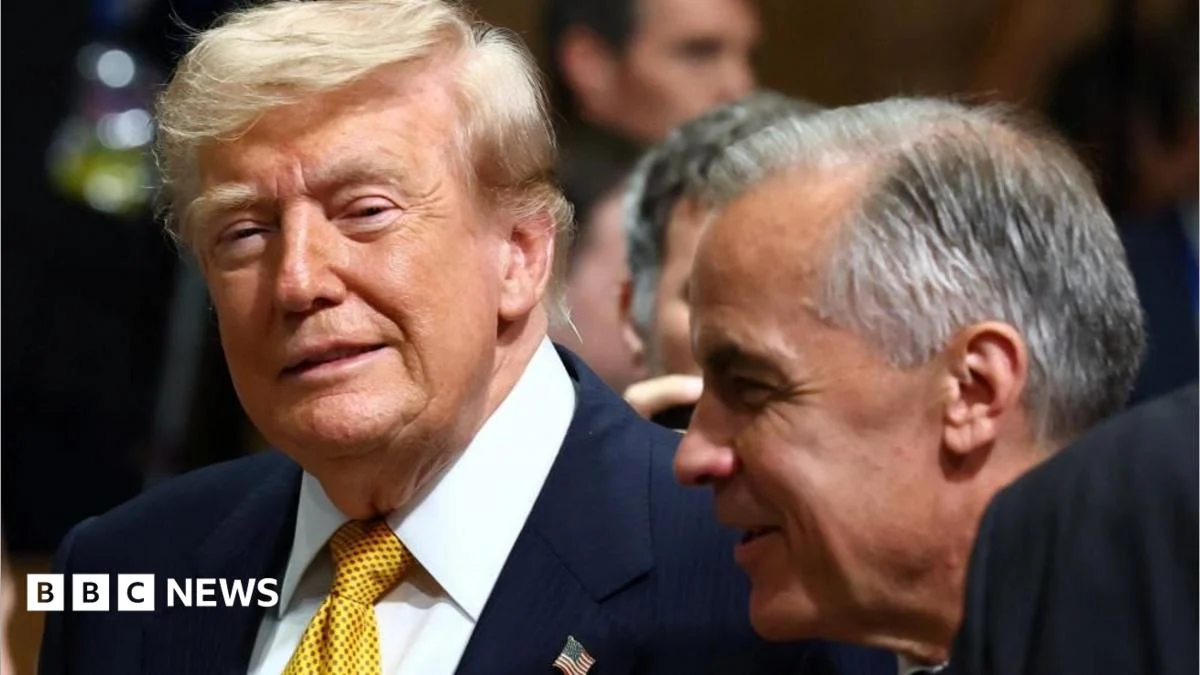
In a dramatic escalation of North American trade tensions, US President Donald Trump has announced the imposition of a 50% tariff on a wide array of goods imported from Canada, citing "unequal treatment" of American cars, dairy products, and alcohol. The move, set to take effect in 30 days, targets everyday consumer items such as wine and hockey sticks, alongside industrial staples like cement, marking a significant blow to the intricate economic relationship between the two long-standing allies. While several critical Canadian exports—including energy, potash, critical minerals, and fish—have been notably spared, the breadth of the targeted items underscores the severity of the new measures. Prime Minister Mark Carney of Canada swiftly responded, indicating that Ottawa remained prepared to "intensify" trade discussions with the United States in the coming weeks, signaling a diplomatic path amidst the economic confrontation.
A History of Simmering Tensions and Trump’s Renewed Trade Agenda
This latest development is not an isolated incident but rather the culmination of trade tensions that have been brewing since President Trump’s return to office in January 2025. Upon reassuming the presidency, Trump quickly unleashed a wide-ranging global program of tariffs, frequently employing these duties to pursue objectives extending beyond purely trade-related matters. Tariffs, essentially taxes on imported goods paid by companies bringing in foreign products, have become a cornerstone of his economic policy. The recent imposition on Canada represents a particularly sensitive flashpoint, given the deep integration and sheer volume of trade between the two nations, which collectively constitutes one of the world’s largest bilateral trading relationships, exceeding hundreds of billions of dollars annually.
Canada, as one of the US’s closest trading partners and a fellow signatory to the US-Mexico-Canada Agreement (USMCA), has historically been a significant but often contentious partner in trade disputes. The current friction builds upon a complex history, including previous spats over softwood lumber, steel, and aluminum. Last year, Canada was among the few countries to retaliate against earlier Trump tariffs, implementing its own 25% levy on approximately C$30 billion (£16 billion; $21.7 billion) worth of American goods. While Prime Minister Carney later scaled back some of those counter-tariffs, the precedent for tit-for-tat measures has been firmly established, raising concerns about a spiraling cycle of protectionism.
The Legal Underpinnings of the New Tariffs: An Untested Avenue
The legal framework underpinning these new tariffs is particularly noteworthy. Earlier this year, the US Supreme Court dealt a significant blow to President Trump’s previous tariff strategy, ruling that many of his globally imposed duties under emergency powers were illegally enacted. Specifically, the Court struck down sweeping international tariffs imposed through the International Emergency Economic Powers Act (IEEPA) of 1977. The justices concluded that the president had exceeded his authority by using a law reserved for national emergencies to justify duties on dozens of countries beyond America’s immediate neighbors.
Following this judicial setback, the White House vowed to seek alternative mechanisms for imposing import taxes. In recent weeks, the administration has utilized Section 301 of the Trade Act of 1974 to justify tariffs on various countries, including Brazil, where certain goods will face a 25% tax from Wednesday due to alleged harm to US trade from Brazilian policies. Like Canada and China, Brazil has also pledged retaliation.
However, the tariffs targeting Canada, announced on Monday, are being introduced under yet another distinct piece of legislation: Section 338 of the 1930 Tariff Act. This particular act covers trade discrimination rather than national emergencies, presenting a different legal pathway for the administration. Unlike IEEPA or even Section 301, Section 338 is considered an "obscure law" that is largely untested in modern court proceedings. This choice of legal basis indicates a deliberate attempt by the Trump administration to navigate around previous judicial constraints and pursue its trade agenda through novel, and potentially more durable, legal avenues. The reliance on such an untested statute introduces an element of legal uncertainty, potentially setting the stage for future challenges.
Specifics of the Tariffs: Targets, Exemptions, and Economic Context
The White House fact sheet accompanying Monday’s announcement clarified that the new 50% duties would apply regardless of whether the product was already covered under the existing USMCA free trade agreement. This direct circumvention of a major trade pact, which President Trump himself negotiated and signed in 2018, has been highlighted as a significant escalation.
Among the consumer items hit are Canadian wines, which have seen growing popularity in the US market, and hockey sticks, an iconic Canadian export. Industrial goods like cement, crucial for construction projects across North America, are also on the list. The value of these targeted goods runs into billions of dollars annually, and the 50% tariff will undoubtedly make them significantly more expensive for American consumers and businesses, potentially leading to reduced imports and market disruption.
Crucially, some of Canada’s most significant exports to the US have been exempted. These include energy products (primarily oil and natural gas, vital for US consumption), potash (a key fertilizer ingredient essential for American agriculture), critical minerals (increasingly important for high-tech industries), and fish. These exemptions suggest a strategic calculation by the US administration to avoid disrupting critical supply chains or inflicting harm on sectors deemed indispensable to the American economy, while still applying pressure on other sensitive areas of Canadian trade.
US Grievances: Cars, Dairy, and Alcohol
President Trump’s executive action announcing the new tariffs was accompanied by three proclamations detailing US complaints over trade issues that have long been points of contention with Canada. These issues – cars, dairy products, and alcohol – signal a significant breakdown in ongoing trade negotiations between the two neighbors.
-
Automotive Sector: On cars, Trump’s proclamation specifically targeted Canada’s tax on imports of US motor vehicles and parts not covered under the USMCA. He argues this tax is "unreasonable" and that Canada has unfairly discriminated against the US by not imposing similar taxes on other countries. The North American automotive manufacturing sector is highly integrated, with complex supply chains spanning Canada, the US, and Mexico. Parts and components frequently cross borders multiple times during the production process. A 50% tariff on certain Canadian automotive parts or vehicles could severely disrupt these established supply chains, raise production costs, and potentially impact the competitiveness of North American-made cars. The argument of "discrimination" implies that Canada’s policy disproportionately disadvantages US producers compared to those from other nations, even within the context of USMCA.
-
Dairy Products: Dairy has been a perennial source of friction between the US and Canada. At the heart of the dispute is Canada’s supply management system, which sets strict limits on foreign imports and imposes high tariffs—up to 300%—on products exceeding these limits. This system is designed to protect Canadian dairy farmers from foreign competition, ensuring stable prices and incomes. However, it has long been criticized by the US as a non-tariff barrier that effectively shuts out American dairy farmers from the Canadian market. The US has consistently pushed for greater access for its dairy products, viewing Canada’s system as protectionist and a violation of free trade principles. The 50% tariff on Canadian dairy products, therefore, is a direct response to this long-standing grievance, aiming to exert pressure on Canada to reform its supply management policies.
-
Alcoholic Beverages: The enduring boycott of US alcoholic drinks by most Canadian provinces has become a major sore point for the Americans since its imposition last year. This boycott, largely a retaliatory measure by Canadian provinces against previous US tariffs on key Canadian sectors like metals and automobiles, has significantly impacted American wine, beer, and spirits producers. Canadian premiers have repeatedly stated that the boycott would be lifted if the US removed its tariffs on these key Canadian sectors. The inclusion of alcohol in the new tariff list reflects the US administration’s frustration with this provincial-level protectionism and serves as a pressure tactic to compel Canada to end the boycott, thereby opening the Canadian market to American alcoholic beverages.
Reactions and Broader Implications
The announcement has elicited strong reactions and concerns from various stakeholders. Prime Minister Mark Carney’s statement, emphasizing Canada’s readiness to "intensify" trade talks, underscores the diplomatic urgency. Canadian trade negotiators have reportedly been working tirelessly to secure a deal that would at least reduce some of the existing US tariffs, making this latest escalation a significant setback for those efforts.
Michael Devereux, a professor of economics at the University of British Columbia, commented to BBC News that the move represented a "significant escalation because it directly targets goods that were previously exempt under the US, Canada, Mexico trade agreement that President Trump negotiated and signed himself in 2018." Devereux expressed doubt that this was merely a negotiating tactic, suggesting instead that it appeared to be "an impulsive move that came from kind of a grudge that the US government and President Trump has against Canada." This assessment highlights the perception that personal or political motivations might be driving these trade actions, rather than purely economic calculations.
Other analysts, however, expressed a cautious hope that the move might prompt new, more substantive negotiations. Candace Laing, head of the Canadian Chamber of Commerce, urged officials from both nations to make "meaningful progress" in talks before the new duties take effect in 30 days, emphasizing the need to avert further economic damage. Similarly, Chris Swonger, head of the Distilled Spirits Council of the United States, called for a bilateral solution, warning that the decision "raises the risk of further retaliation," which could harm businesses and consumers on both sides of the border.
The economic implications are considerable. For American consumers, tariffs on Canadian goods could lead to higher prices for everything from wine to construction materials. For US industries relying on Canadian inputs, increased costs could erode competitiveness. Conversely, Canadian industries targeted by the tariffs will face significant challenges in exporting to their largest market, potentially leading to job losses and reduced economic activity. The existing tariffs on Canadian steel, aluminum, copper (ranging from 15% to 50%), and softwood lumber (35%), alongside Canada’s own 25% counter-tariffs on selected American imports, already illustrate a fragmented trade landscape. The addition of a 50% tariff on a broader range of goods only exacerbates this fragmentation.
Moreover, the announcement comes in the wake of President Trump’s earlier threat to impose tariffs over Canadian wildfire smoke drifting into US cities. While this specific issue has not been officially cited as a justification for the current tariffs, its previous mention highlights a broader pattern of using trade measures to address a wide array of bilateral grievances, some of which fall outside traditional trade parameters. This approach risks politicizing trade relations to an unprecedented degree and could undermine the foundational principles of multilateral trade agreements.
The current trajectory points to a period of heightened uncertainty and potential economic disruption for both Canada and the United States. The 30-day window before the tariffs take effect offers a narrow window for diplomatic engagement, but the deep-seated grievances and the aggressive nature of the US measures suggest that a swift resolution will be challenging, potentially leaving the future of North American trade relations in a precarious state.