Wacom’s Enduring Legacy in Digital Creativity
Wacom’s journey began in an era predating widespread internet adoption, establishing itself as a pioneer in pen computing technology. Founded in Saitama, Japan, the company introduced its first commercial pen tablet in 1984, laying the groundwork for what would become an indispensable tool for countless creative professionals worldwide. For decades, Wacom tablets, particularly its Intuos and Cintiq lines, have been synonymous with digital art, graphic design, animation, and industrial design. Their proprietary electromagnetic resonance (EMR) technology, which allows styluses to operate without batteries while offering exceptional pressure sensitivity and tilt recognition, set an industry standard that many competitors have strived to emulate. This deep-rooted history provides crucial context for understanding the MovinkPad series, as it represents Wacom’s adaptation to the modern demands of mobile and versatile computing without compromising its core expertise in pen input. The company’s commitment to innovation has enabled digital artists to transition from traditional mediums to digital canvases with unprecedented fidelity and control, significantly shaping the trajectory of the creative industries.
The Evolution of Digital Art and Mobile Platforms
The landscape of digital art has undergone a profound transformation, moving from the pixelated graphics of early computing to sophisticated, high-resolution illustrations, animations, and 3D models. This evolution has been intrinsically linked to advancements in hardware and software. Early digital artists were often confined to desktop workstations, utilizing specialized software on powerful computers. However, the proliferation of portable devices, particularly tablets and smartphones, introduced a new paradigm: mobile creativity. Artists increasingly sought tools that offered both professional-grade performance and the flexibility to create anywhere, anytime.
This demand paved the way for devices like the MovinkPad. While Apple’s iPad, with its robust ecosystem of creative apps and the Apple Pencil, arguably popularized mobile digital art for a broader audience, Wacom’s entry into the Android tablet space with the MovinkPad series signifies a strategic move to cater to users who prefer the Android operating system or seek a device more singularly focused on drawing and illustration. The integration of Android allows the MovinkPad to leverage a vast app library while benefiting from Wacom’s specialized hardware and pen technology. This trend towards mobile-first or mobile-integrated creative workflows reflects a broader shift in how professionals and hobbyists approach their craft, valuing portability and immediacy as much as raw processing power.
Introducing the MovinkPad Series: The MovinkPad 11 as a Foundation
Wacom’s MovinkPad series represents a deliberate expansion of its product portfolio, aiming to capture the growing segment of artists seeking a dedicated, portable, and responsive Android-based drawing tablet. The MovinkPad 11, though not the latest iteration, serves as the inaugural device in this series, offering a compelling entry point into Wacom’s mobile creative ecosystem. Launched with a price tag of approximately $500, it positions itself as a mid-range option, appealing to aspiring digital artists, students, and hobbyists who are passionate about digital doodling but might find high-end professional equipment financially prohibitive.
The strategic intent behind the MovinkPad 11 was to provide a streamlined, user-friendly experience centered around Wacom’s acclaimed pen technology. By choosing Android, Wacom aimed for an open and flexible platform, allowing users access to a wide array of creative applications beyond its proprietary software. The MovinkPad 11’s design philosophy prioritizes portability and intuitive use, making digital art more accessible to a demographic that might be intimidated by complex professional setups. Its release laid the groundwork for subsequent, more powerful models, demonstrating Wacom’s commitment to iterating and improving its mobile offerings.
The Evolution: MovinkPad Pro 14
Following the MovinkPad 11, Wacom introduced the MovinkPad Pro 14, released approximately last fall. This newer model represents a significant upgrade, targeting a more professional segment of the mobile art market. Priced substantially higher at $899, the MovinkPad Pro 14 justifies its cost with a suite of impressive enhancements. Key among these is an OLED screen with 3K resolution, offering superior contrast, deeper blacks, and a broader color spectrum compared to the MovinkPad 11’s display. For digital artists, color accuracy and visual fidelity are paramount, making the OLED screen a crucial professional feature. The MovinkPad Pro 14 also typically includes more robust internal specifications, such as increased RAM and storage, to handle more demanding applications and larger project files. This chronological progression illustrates Wacom’s strategy: starting with an accessible, capable device and then building upon that foundation to offer a premium option for advanced users seeking top-tier performance in a mobile form factor.
MovinkPad 11: Specifications and User Experience
The MovinkPad 11 is an 11.45-inch device, a size that strikes a balance between portability and sufficient workspace for digital creation. It comes equipped with 8 gigabytes of memory (RAM) and 128 gigabytes of internal storage. While 8GB of RAM is generally sufficient for most Android applications and moderate creative tasks, users working with extremely large canvases or complex multi-layered projects might find it limiting compared to high-end professional workstations. The 128GB of storage provides ample space for numerous projects, applications, and reference materials, though artists with extensive libraries of brushes, fonts, and assets may eventually require cloud storage or external solutions.
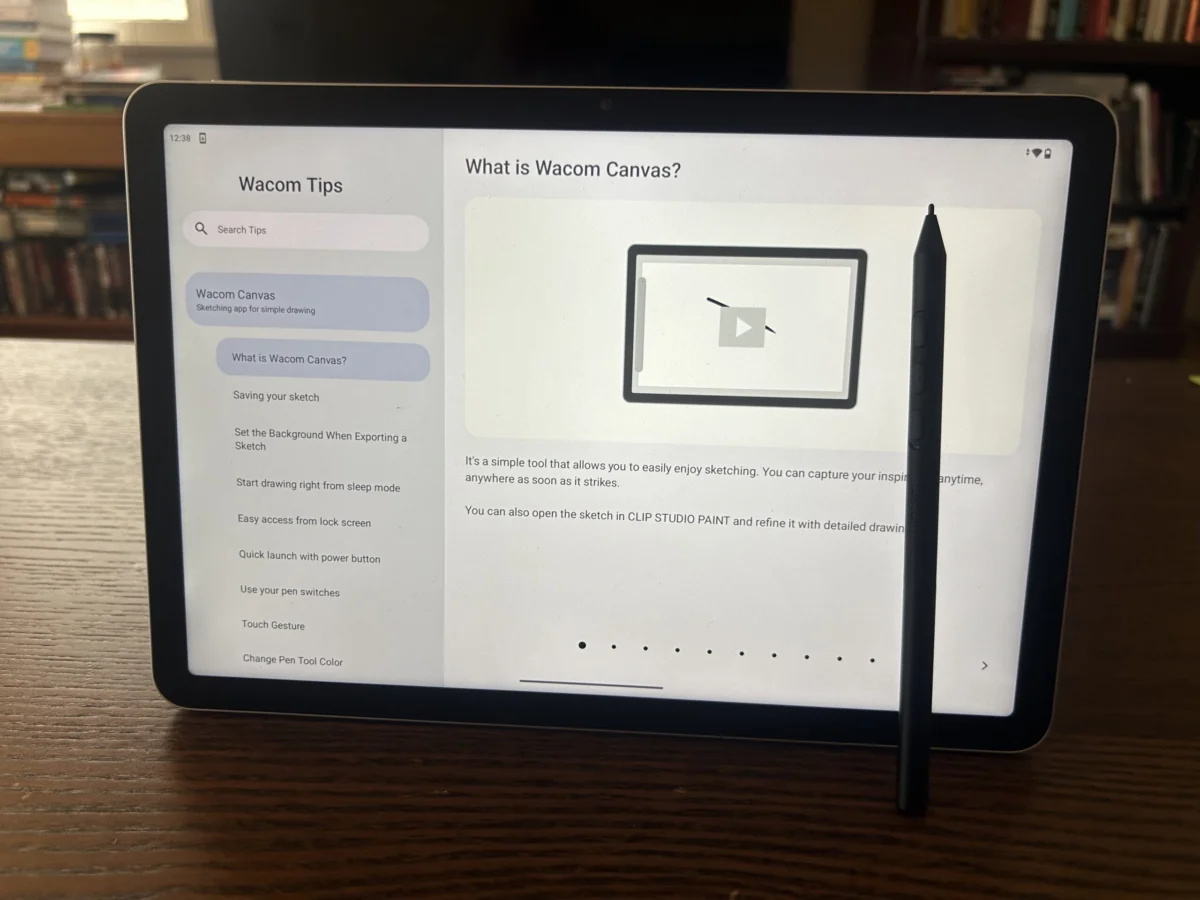
A defining characteristic of the MovinkPad 11, and indeed Wacom’s broader product range, is its battery-free Pro Pen 3 stylus. Measuring 6.3 inches, the stylus is engineered for comfort and precision, mimicking the natural feel of traditional drawing tools. It features three programmable side buttons, which can be customized by the user to execute frequently used commands, such as undo, redo, or switching tools, significantly enhancing workflow efficiency. Furthermore, the stylus nibs are interchangeable, with Wacom offering a variety of replacement packs of differing qualities and textures. This customization allows artists to tailor the stylus feel to their preference, emulating various traditional media like pencils, charcoal, or felt-tip pens. The EMR technology ensures a consistent and reliable drawing experience without the need for charging, a distinct advantage over battery-powered styluses. The stylus’s high pressure sensitivity (typically 8192 levels, a Wacom standard) and tilt recognition allow for nuanced line work, shading, and brushstrokes, faithfully translating subtle hand movements into digital output.
Setting up the MovinkPad 11 is designed to be straightforward. As an Android device, it integrates seamlessly with a user’s Google account, facilitating the synchronization of creative materials, app downloads from the Google Play Store, and access to cloud services. The device includes standard security features, such as a PIN number for login, which can be configured or disabled based on user preference through the device’s settings. This level of security, while perhaps seemingly robust for simple sketches, protects valuable creative assets and personal data stored on the device.

Software Ecosystem for Digital Art
The utility of any digital art hardware is intrinsically linked to the software it supports. The MovinkPad 11 comes pre-loaded with Wacom Canvas, a proprietary digital art application designed to provide basic tools for getting started with digital sketching. Wacom Canvas is suitable for beginners and casual users, offering fundamental drawing and painting functionalities. For those seeking a more comprehensive and professional-grade experience, the MovinkPad 11 is fully compatible with Clip Studio Paint.
Clip Studio Paint is a widely acclaimed and powerful drawing and painting application, particularly popular among manga artists, comic creators, and illustrators globally. It offers an extensive range of features, including advanced brush engines, customizable tools, 3D model import, animation capabilities, and robust layer management. Users can purchase a license for Clip Studio Paint, with varying versions offering different feature sets. Within Clip Studio Paint, the MovinkPad’s stylus capabilities are fully leveraged, allowing artists to select from a multitude of digital pens, paintbrushes, and sketching pencils, each with adjustable parameters such as size, opacity, texture, and blending modes. This deep integration between hardware and software is crucial for delivering a professional creative experience on a mobile platform. Beyond Wacom Canvas and Clip Studio Paint, the MovinkPad’s Android operating system opens the door to other popular creative applications available on the Google Play Store, such as Krita, Autodesk Sketchbook, or Ibis Paint X, offering artists a broad spectrum of choices to suit their specific workflow and artistic style.
Market Positioning and Competitive Analysis
The MovinkPad 11’s $500 price point places it squarely in the mid-range of the digital art device market, distinguishing it from both budget-friendly options and high-end professional equipment. This strategic positioning aims to make dedicated digital art accessible to a broader audience without compromising on core drawing capabilities.
In the competitive landscape, the MovinkPad 11 faces various rivals, each with its own value proposition:
- Budget Graphics Tablets: Devices like the Huion Inspiroy H640P, priced around $30, represent the entry-level. However, these are typically screenless pen tablets that connect to a computer, requiring users to look at a separate monitor while drawing on the tablet surface. While highly affordable, they offer a fundamentally different drawing experience compared to a display tablet like the MovinkPad 11.
- High-End Professional Displays: At the other end of the spectrum are devices like Wacom’s own Cintiq Pro 27, an interactive pen display costing a staggering $3,500. These are professional workstations designed for studios and top-tier artists, offering large 4K displays, advanced color accuracy, and robust connectivity, often replacing traditional monitors in a professional setup. The MovinkPad 11 is not intended to compete with these devices but rather to offer a portable, specialized alternative for mobile creation.
- General-Purpose Tablets (e.g., Apple iPad): The Apple iPad, particularly models like the iPad Air or iPad Pro (up to $1,100), presents a significant competitor. Paired with the Apple Pencil, iPads offer a powerful creative ecosystem with popular apps like Procreate and Affinity Designer. While iPads are versatile general-purpose tablets capable of creative work, the MovinkPad 11 offers a more focused solution. Wacom’s deep expertise in pen technology and its Android foundation provide a distinct alternative for users prioritizing a dedicated drawing experience or preferring the Android ecosystem. The MovinkPad’s direct-to-screen drawing experience, coupled with Wacom’s renowned pen performance, caters specifically to those for whom the primary function is digital art creation.
Wacom’s decision to offer the MovinkPad 11 at this price point demonstrates an understanding of the market’s need for a dedicated, portable, and capable digital art tablet that doesn’t demand the premium investment of its professional Cintiq line or the general-purpose utility of an iPad. It targets users who are serious about digital art but are operating within budget constraints or prioritize Wacom’s specialized pen input experience on a mobile platform.
Broader Impact and Implications
The introduction of devices like the MovinkPad 11 signifies several broader trends in the digital art and technology sectors. Firstly, it underscores the increasing demand for mobile creativity solutions. As remote work and flexible lifestyles become more prevalent, artists expect their tools to adapt, enabling them to create from coffee shops, during commutes, or while traveling. The MovinkPad 11 directly addresses this need, offering a lightweight (1.3 pounds) and portable device that doesn’t tether artists to a desk.
Secondly, it highlights the growing maturity and viability of Android as a platform for professional creative applications. While iOS has historically dominated the tablet creative space with apps like Procreate, Android’s open nature and increasing hardware capabilities are fostering a richer ecosystem of powerful art applications. Wacom’s endorsement of Android with a dedicated creative tablet lends significant credibility to the platform’s potential for serious artistic endeavors. This could lead to further investment from software developers in creating or optimizing professional art tools for Android, thereby diversifying the options available to artists.
Thirdly, for Wacom, the MovinkPad series represents a strategic move to diversify its product offerings and maintain market relevance against increasing competition. By extending its renowned pen technology to a standalone Android tablet, Wacom aims to capture new market segments and retain its leadership position in an evolving industry. It allows Wacom to cater to artists who may not require the full power of a desktop-connected Cintiq but still demand the precision and quality associated with the Wacom brand.
Finally, the MovinkPad 11 contributes to the democratization of digital art. Its mid-range price point makes dedicated digital art hardware more accessible to a wider audience, including students, hobbyists, and emerging artists who are developing their skills. By lowering the barrier to entry for quality tools, Wacom helps foster the next generation of digital creators, ensuring that passion and talent, rather than solely financial resources, dictate participation in the digital art community.
Conclusion
The Wacom MovinkPad 11, while not the most powerful or feature-rich tablet in Wacom’s extensive lineup, serves as a significant entry point into mobile digital art. It embodies Wacom’s legacy of superior pen technology within a portable, Android-based form factor. For aspiring artists, students, or those simply seeking a dedicated and enjoyable platform for digital doodling, the MovinkPad 11 offers a compelling balance of capability, portability, and value at its $500 price point. Its ease of setup, intuitive stylus, and access to a growing Android creative ecosystem make it a strong contender in the mid-range tablet market. By offering a focused and elegant solution derived from a company with deep roots in graphics tablet innovation, the MovinkPad 11 not only provides a fun and functional creative outlet but also reinforces Wacom’s ongoing commitment to empowering artists in an increasingly mobile and digital world. It is a testament to the fact that while top-tier specifications are impressive, accessibility and a tailored user experience remain paramount for fostering creativity across all skill levels.